
AOI original concept · Retrofuturist temporal collage
An AOI proposal for placing analog materials and speculative technologies in deliberate tension: one coherent setting, two time systems and a transformation that changes how an object works.
An A⊕I –[-.+] creαt¡ve c⊕ncept, n⊕t αn estαbl¡she∂ h¡st⊕r¡cαl m⊕vement.
A visual introduction
Select an image for a closer look. Use the thumbnails, arrow keys or a swipe to compare examples. Zoom in to inspect details, or share the image that inspires you.


Creative toolbox · take this style further
Choose an input and a destination. Search sends your words to the chosen site; Copy & open puts them on your clipboard to paste there.
Create with AI
Turn your chosen input into an image prompt or a new creative direction.
ChatGPT
Copy your input and paste it into a ChatGPT conversation or image request.
Copy & open ChatGPT (new tab)Claude · Anthropic
Develop an image prompt or explore the style in a new Claude conversation.
Copy & open Claude · Anthropic (new tab)Midjourney
Paste your input into the Imagine bar on the Create page.
Copy & open Midjourney (new tab)Adobe Firefly
Copy your input, open Firefly, and paste it into the prompt field.
Copy & open Adobe Firefly (new tab)Leonardo.Ai
Copy your input, open Leonardo, and paste it into the generation field.
Copy & open Leonardo.Ai (new tab)Image search
Find visual references. Short, concrete keywords usually work best.
Lexica
Search AI images and prompts using your selected input.
Search with this input Lexica (new tab)Pexels
Search the photo and video library. Short keywords often work best.
Search with this input Pexels (new tab)Pixabay
Search photos, illustrations and other images.
Search with this input Pixabay (new tab)Unsplash
Search photographs using the style name or your own keywords.
Search with this input Unsplash (new tab)Wikimedia Commons
Search photographs, artworks and historical images. Check each file for its source and reuse terms.
Search with this input Wikimedia Commons (new tab)Art & research
Explore artists, collections and the ideas behind a style.
Wikipedia
Search for background reading. A style may not have its own article.
Search with this input Wikipedia (new tab)WikiArt
Copy your input into WikiArt’s search to explore artists and artworks.
Copy & open WikiArt (new tab)Europeana
Paste your keywords into the search to explore European museum, library and archive collections.
Copy & open Europeana (new tab)Inspiration
Discover portfolios and visual ideas from creative communities.
Instagram hashtags
Search a hashtag made from your input: spaces and punctuation are removed. Instagram may require sign-in.
Search with this input Instagram hashtags (new tab)ArtStation
Paste your input into artwork search for concept art, environments, characters and visual development.
Copy & open ArtStation (new tab)Behance
Paste your input into project search for illustration, design and visual storytelling.
Copy & open Behance (new tab)A closer look
Tactile retro surfaces meet precise speculative light or geometry. Continuous perspective holds the image together while one object crosses between two material systems.
An AOI concept, with a clearer vocabulary
Futuristic Retro Schizophrenism is retained here as the name of an AOI creative proposal. It is not presented as a documented historical movement, a clinical category or a description of people with schizophrenia. The working visual idea is temporal counterpoint: objects from a chosen past meet a speculative technology within one deliberately composed scene. The alternate descriptive phrase, retrofuturist temporal collage, is useful when a neutral production brief is needed.
Earlier versions of this entry named fictional founders and artworks as if they were historical evidence. Those attributions are withdrawn. The concept does not have a verified founding date, membership or school. The images on this page are AOI interpretations, and the visual rules below are a proposal for making new work, not a claim that a new movement has been established.
Make two time systems share one room
Choose a specific material vocabulary first: curved cream enamel, walnut, analog dials and brushed aluminium, for example. Then introduce a contrasting future system such as a transparent navigation volume or a surface that changes state. Make the two systems interact. A reel can become an orbit; a physical dial can control a luminous spatial diagram. A random collection of cassettes, planets and neon signs does not establish that relationship.
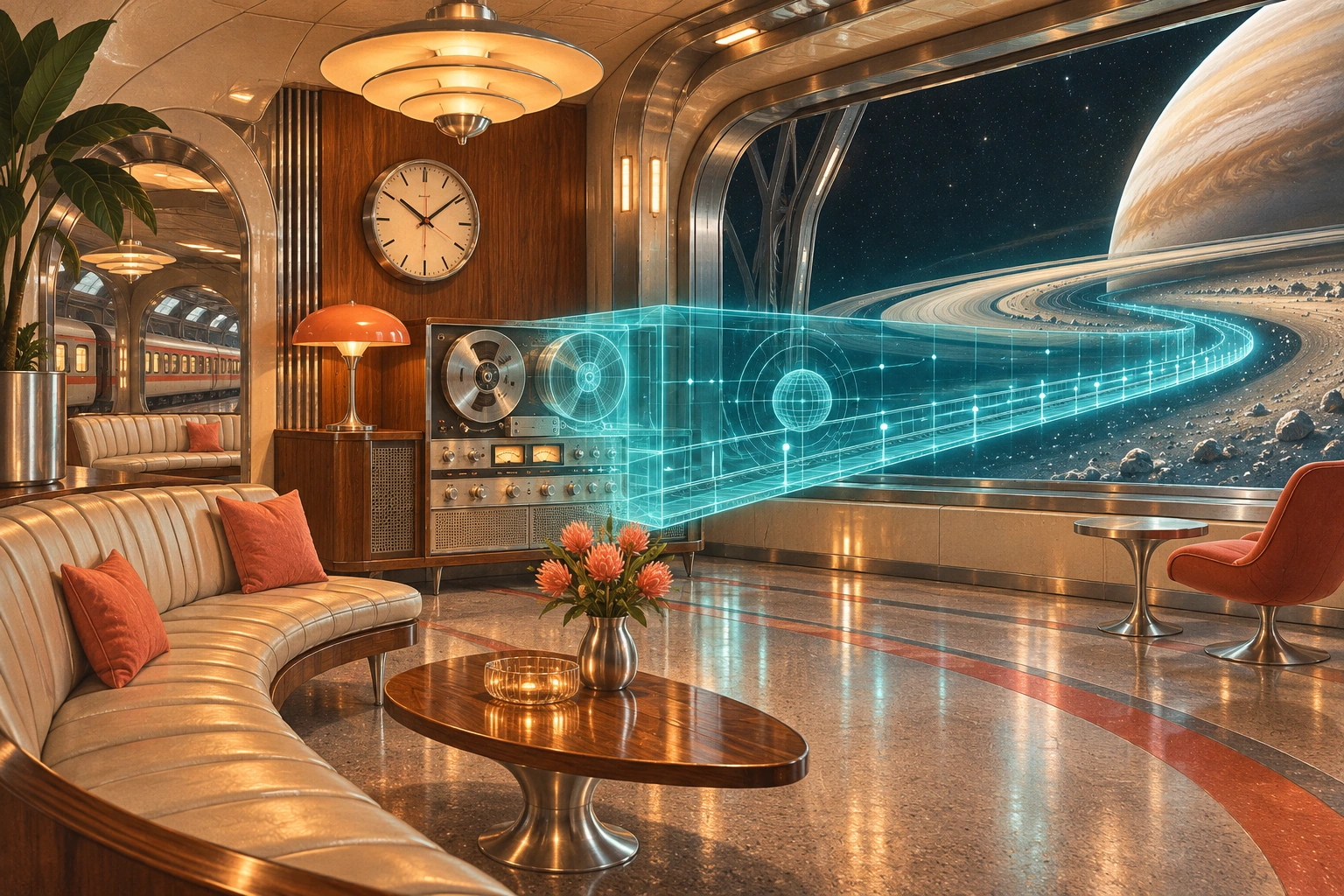
Preserve a continuous ground plane, believable overlaps and a stable viewing position. Let one object carry the impossible transformation while its surroundings remain readable. In the new banner, an analog reel console extends into a cyan navigation structure beside a ringed planet. Warm furnishings and cool projected geometry make the temporal contrast visible without breaking the room into unrelated fragments.
Colour, texture and the useful contradiction
Give the older material system tactile weight: worn edges, soft upholstery, shallow reflections and subtle print grain. Give the speculative system a different surface response: transparency, exact linework or a light source that reaches through a solid object. Warm amber against cool cyan is one effective pairing, but a monochrome version can use roughness against smoothness instead. Colour is a tool, not a required uniform.
The strongest contradiction also changes a function. A telephone that connects to a distant garden, or a jukebox that charts an orbital route, offers more to read than an old object with a glowing outline. Keep the transformation comprehensible at thumbnail scale. One strong silhouette and one unusual relationship usually work better than filling every surface with ornament.
Variations, uses and limits
Try the approach in an imagined transport interior, a product illustration or a narrative book cover. Keep one quiet area for a headline if the artwork will support typography. To test the concept, retain the room and camera while changing only the speculative intervention. Compare a translucent machine, a contradictory shadow and an impossible opening; the experiment should expose different relationships rather than produce three near-identical neon scenes.
Common failures include generic cyberpunk, inconsistent perspective, unreadable controls and retro objects used as decoration without any narrative role. Remove competing effects before adding detail. The archived collage remains a looser ornamental interpretation; the new banner demonstrates the more specific material and functional contrast described here. Neither visual disorder nor mental illness is a technique requirement.
A small poetic detour
Original words from the AOI studio.
Poetry
The clock keeps its small circle.
The window opens into rings.
A reel remembers the weight of tape;
light teaches it another way to turn.
The prompt workshop
Original creative exercises. These prompts create new illustrations, not documentary evidence.
An orbital waiting room
Original AOI temporal-counterpoint illustration: a cream-enamel and walnut orbital waiting room, analog reel console becoming a translucent cyan navigation volume, curved seats, one coherent floor and perspective, amber lamps and a ringed planet outside. One transformation, restrained detail, no text or logos.
The telephone garden
A carefully composed tabletop illustration: a rotary telephone in warm burgundy bakelite, its coiled cord becoming a precise transparent greenhouse containing a miniature silver garden. Tactile paper background, soft side light, one focal relationship, original speculative object, no lettering.
One object, two shadows
An analog desk clock on a plain pale surface casts two clearly separated shadows: one ordinary, one forming a clean orbital diagram. Restrained monochrome with one coral accent, believable single object and deliberate impossible shadow, broad quiet space, no labels or random glitch effects.
A smile from the studio
Jokes
The orbital lounge still accepts coins. Nobody has agreed which century should mint them.