
Original AOI concept · technology and AI-inspired art direction
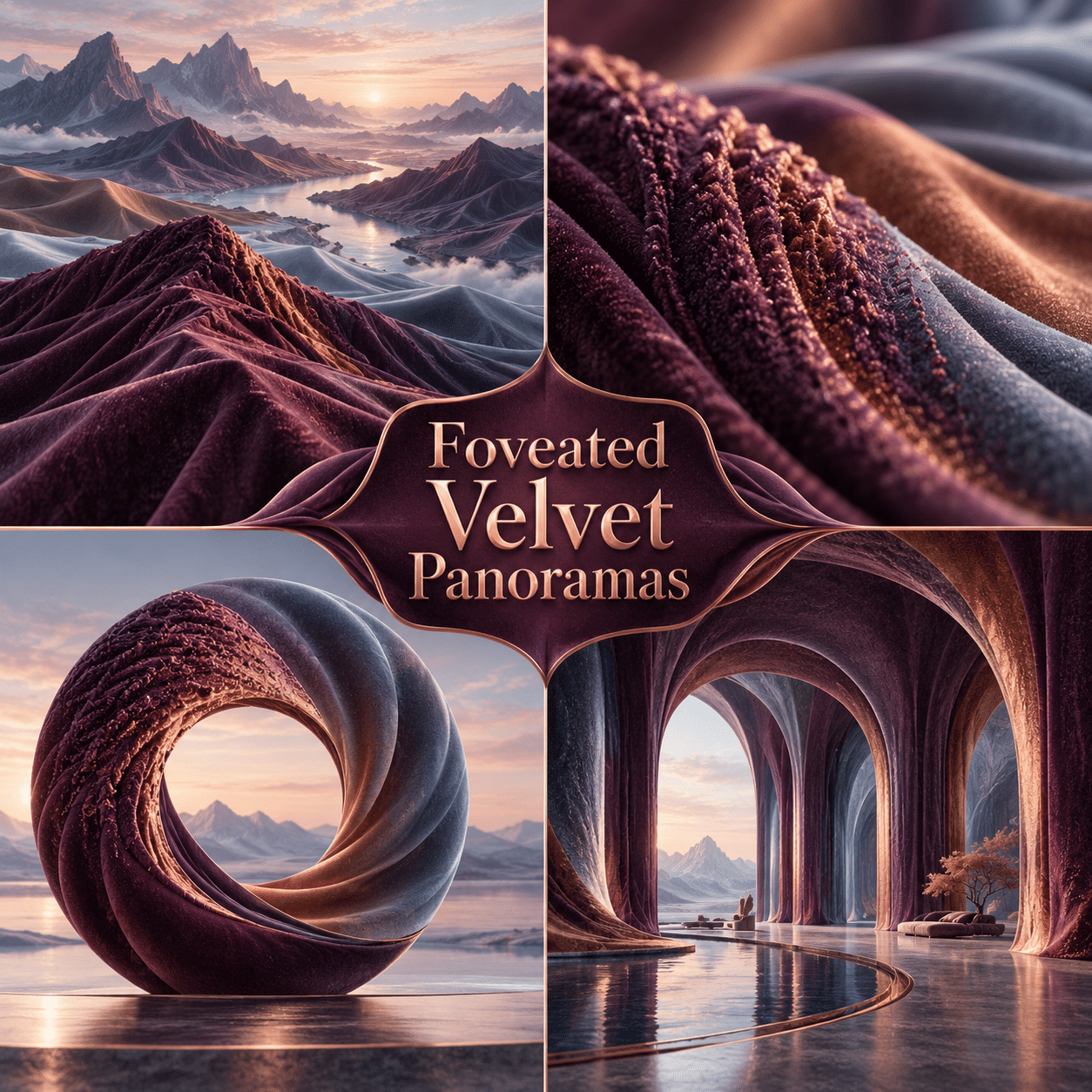
An original AOI concept in which a velvet panorama concentrates fine surface detail around one visual destination, while surrounding folds remain broad and quiet.
An A⊕I –[-.+] creαt¡ve c⊕ncept, n⊕t αn estαbl¡she∂ h¡st⊕r¡cαl m⊕vement.
A visual introduction
Select an image for a closer look. Use the thumbnails, arrow keys or a swipe to compare examples. Zoom in to inspect details, or share the image that inspires you.
Creative toolbox · take this style further
Choose an input and a destination. Search sends your words to the chosen site; Copy & open puts them on your clipboard to paste there.
Create with AI
Turn your chosen input into an image prompt or a new creative direction.
ChatGPT
Copy your input and paste it into a ChatGPT conversation or image request.
Copy & open ChatGPT (new tab)Claude · Anthropic
Develop an image prompt or explore the style in a new Claude conversation.
Copy & open Claude · Anthropic (new tab)Midjourney
Paste your input into the Imagine bar on the Create page.
Copy & open Midjourney (new tab)Adobe Firefly
Copy your input, open Firefly, and paste it into the prompt field.
Copy & open Adobe Firefly (new tab)Leonardo.Ai
Copy your input, open Leonardo, and paste it into the generation field.
Copy & open Leonardo.Ai (new tab)Image search
Find visual references. Short, concrete keywords usually work best.
Lexica
Search AI images and prompts using your selected input.
Search with this input Lexica (new tab)Pexels
Search the photo and video library. Short keywords often work best.
Search with this input Pexels (new tab)Pixabay
Search photos, illustrations and other images.
Search with this input Pixabay (new tab)Unsplash
Search photographs using the style name or your own keywords.
Search with this input Unsplash (new tab)Wikimedia Commons
Search photographs, artworks and historical images. Check each file for its source and reuse terms.
Search with this input Wikimedia Commons (new tab)Art & research
Explore artists, collections and the ideas behind a style.
Wikipedia
Search for background reading. A style may not have its own article.
Search with this input Wikipedia (new tab)WikiArt
Copy your input into WikiArt’s search to explore artists and artworks.
Copy & open WikiArt (new tab)Europeana
Paste your keywords into the search to explore European museum, library and archive collections.
Copy & open Europeana (new tab)Inspiration
Discover portfolios and visual ideas from creative communities.
Instagram hashtags
Search a hashtag made from your input: spaces and punctuation are removed. Instagram may require sign-in.
Search with this input Instagram hashtags (new tab)ArtStation
Paste your input into artwork search for concept art, environments, characters and visual development.
Copy & open ArtStation (new tab)Behance
Paste your input into project search for illustration, design and visual storytelling.
Copy & open Behance (new tab)A closer look
Build a continuous landscape of plum velvet folds, choose one finely textured ridge, and taper detail outward without dissolving the silhouettes. Copper light and pale blue distance separate the layers.
The proposal: give attention a landscape
Foveated Velvet Panoramas is an original AOI art-direction proposal, not a historical movement or a technical simulation. Its governing idea is selective elaboration: a broad textile landscape offers one region of unusually fine surface detail, surrounded by simpler folds. The picture gives the eye a destination without making the rest of the world disappear.
Here, “foveated” is a creative name for that unequal distribution of detail. It does not claim to reproduce human vision or an eye-tracked rendering system. “Velvet” supplies the imagined material, and “panorama” supplies the spatial problem: how can a wide scene remain coherent when only a small part asks for close inspection?
Compose the folds before adding texture
Begin with three overlapping bands: a broad foreground fold, a middle ridge that carries the focal region, and a quieter distant range. Give each band a distinct contour. A valley or diagonal fold can lead toward the focal ridge, but avoid making every seam converge like an arrow. The destination should feel discovered within the landscape.
Choose the detailed region by its role, not simply by its distance from the center. An off-center saddle, a crest above a still basin, or the inside edge of a large arch can work. Establish the image first as a few light and dark masses. If the focal region is invisible at thumbnail size, adjust its silhouette or value contrast before adding thousands of tiny marks.
Use a gradual sequence around the destination: small ridges and visible pile near the focus, larger surface undulations in the transition, then broad folds beyond it. Reduce the number of marks without erasing the shape beneath them. A blurred border around a sharp island tends to look like a lens effect; a change in the scale of the depicted surface makes the proposed construction more convincing.
Make the imagined velvet carry the light
For this visual language, favor soft highlights that travel along the folds, deep but readable troughs, and restrained fine texture. Let the direction of the surface marks turn with the cloth. A uniform grain pasted across every plane flattens the image; repeated parallel grooves can make it resemble corduroy. Hard mirror streaks push it toward polished metal.
The starting palette pairs plum fabric with copper-colored illumination and pale blue distance. Treat copper as a light color rather than an instruction to make the entire landscape metallic. Reserve the warmest edge for the chosen ridge, use subdued plum in adjacent folds, and allow cooler distant shapes to recede. These are proposed compositional choices, not compulsory colors or a claim about a physical textile experiment.
What the existing images demonstrate
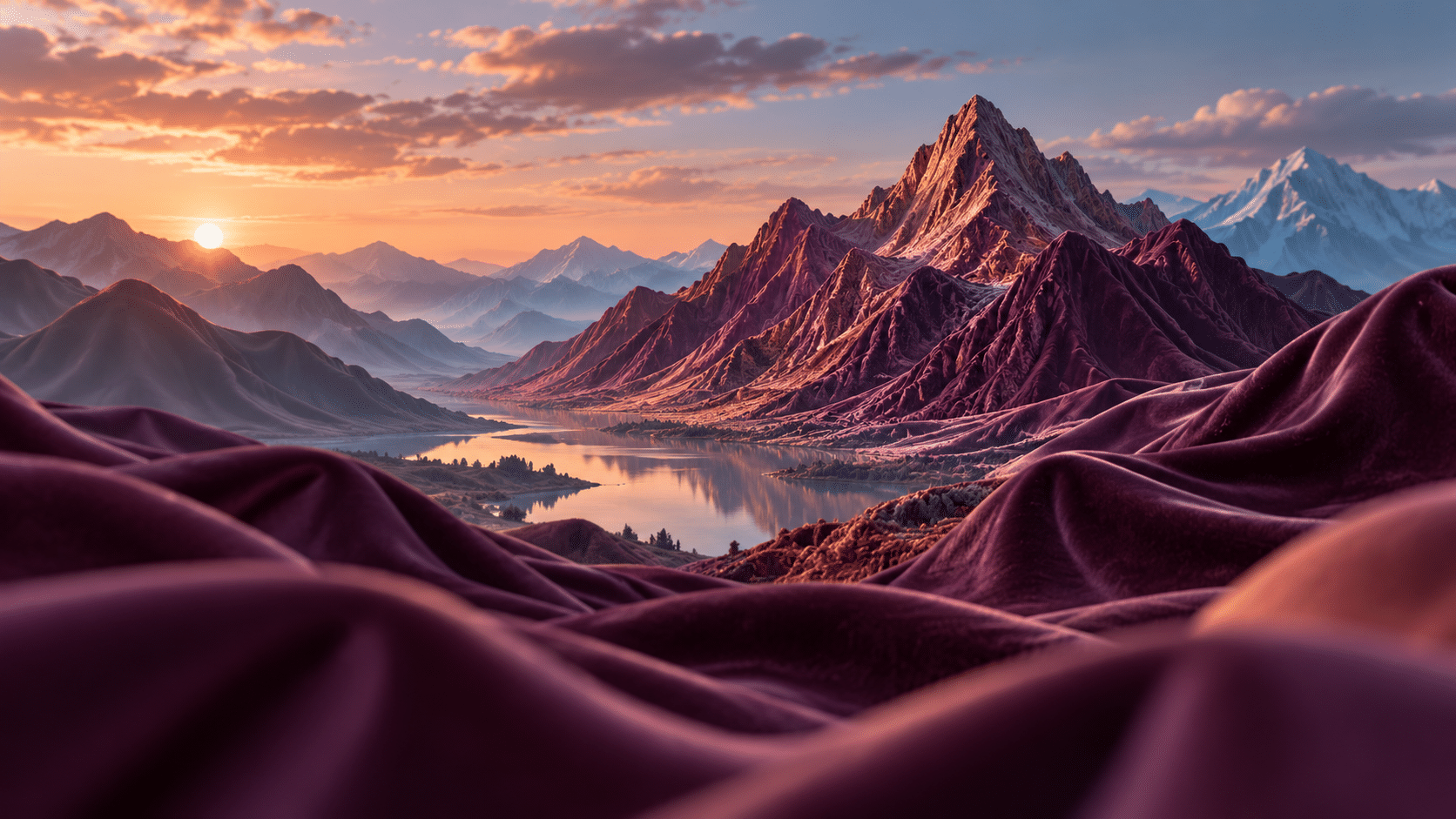
The featured interpretation places plum folds around a lake and a sharply articulated mountain range, with low warm sunlight at the left. It demonstrates the useful contrast between broad textile surfaces and intricate ridges. It also distributes detail across several peaks, so it is a looser interpretation of the single-focus rule rather than a perfect demonstration of it.
The centrally titled collage tests four settings: a mountain panorama, a close surface study, a loop-shaped sculpture and an architectural interior. Its complete title reads “Foveated Velvet Panoramas.” The sculpture offers a particularly clear exercise in moving from a textured portion to a smooth one around a continuous form. The interior translates the idea into scale and enclosure. These are generated creative studies, not photographed installations or historical examples.
Variations that test the idea
For a stricter panorama, move the most detailed patch onto a modest middle-distance ridge and simplify the peaks around it. The focal destination need not be the largest or tallest object. Keep enough edge information elsewhere to make the landscape readable; low detail should still look deliberately composed.
For an intimate study, bend one velvet strip into a continuous loop. Concentrate small folds on one inside arc, then widen them until the opposite side becomes almost smooth. For an architectural fantasy, carry the same progression along one archway. Do not describe the result as an executable building design: it is a study of visual rhythm and material suggestion.
Compare this proposal with the neighboring AOI concept Quantized Velvet Dunes. There, discrete terraces are the main construction; here, attention is organized through a gradual change in detail. A stepped mountain can be attractive without belonging to this particular idea. Preserve the distinction when combining concepts.
Where it works, and where it fails
The approach suits an atmospheric landscape, an editorial opening image, a speculative textile object or a quiet backdrop with a reserved reading area. It is less useful when every part of an image must communicate equally, or when exact construction details are the subject. Cropping a panorama for a square preview can also remove the transition that explains it; inspect the crop before choosing it as a thumbnail.
Typical failures are equally busy texture everywhere, a hard ring around the focal patch, velvet that reads as fur or stone, and several unrelated highlights competing for attention. Correct one cause at a time: remove small marks from secondary ridges, broaden the transition, simplify the material vocabulary, or lower competing highlights. Do not solve every problem by increasing sharpness.
Review the result at three scales. At thumbnail size, identify the intended destination. At ordinary reading size, follow the continuous folds into and away from it. At full size, inspect whether the detail changes with the form instead of becoming repetitive noise. A successful variation can change the scene or palette while preserving that journey.
Technique notes
Establish foreground, focal ridge and distance as distinct silhouettes before adding surface marks.
Taper mark density and fold size gradually; do not replace secondary forms with an indiscriminate blur.
Review the intended preview crop separately from the full panorama.
Treat the supplied prompts as new exercises. The preserved asset prompts record how the existing images were generated.
The prompt workshop
Original creative exercises. These prompts create new illustrations, not documentary evidence.
A single ridge to discover
Original AOI Foveated Velvet Panoramas study: a wide landscape built from plum velvet folds, one off-center middle-distance saddle with delicate pile and tiny ridges, progressively broader folds around it, readable silhouettes throughout. A quiet foreground fold leads toward the saddle; pale blue distant hills remain simple. Low copper-colored light, soft fabric highlights, no metallic surfaces, no sharp circular blur boundary, no text or logos.
Detail travels around a loop
Create an original sculptural fantasy of one continuous velvet loop on a plain pale blue ground. On one inner arc, fine plum folds gather closely; their spacing gradually widens around the loop until the opposite arc becomes smooth. Preserve a clear continuous silhouette and believable overlap. One warm side light, restrained shadow, no pedestal label, no letters. The subject is an imagined material study, not a documented object.
An archway with a quiet edge
Imagine a broad vaulted room formed from plum textile folds. Give one off-center arch a small finely textured zone where copper light grazes its inner edge; reduce detail gradually along the neighboring surfaces while keeping the room geometry readable. Pale blue light through a distant opening, generous quiet floor area, one consistent visual destination. Avoid repeated ornamental patterns and competing bright highlights. Original architectural fantasy, no text or logos.
Your next inspiration
Discover another art style
Follow a visual thread to the next subject.

Quantized Velvet Dunes
Soft dunes have terraced edges made from discrete velvet steps, while their shadows remain continuous gradients.
Normal Map Silk Armor
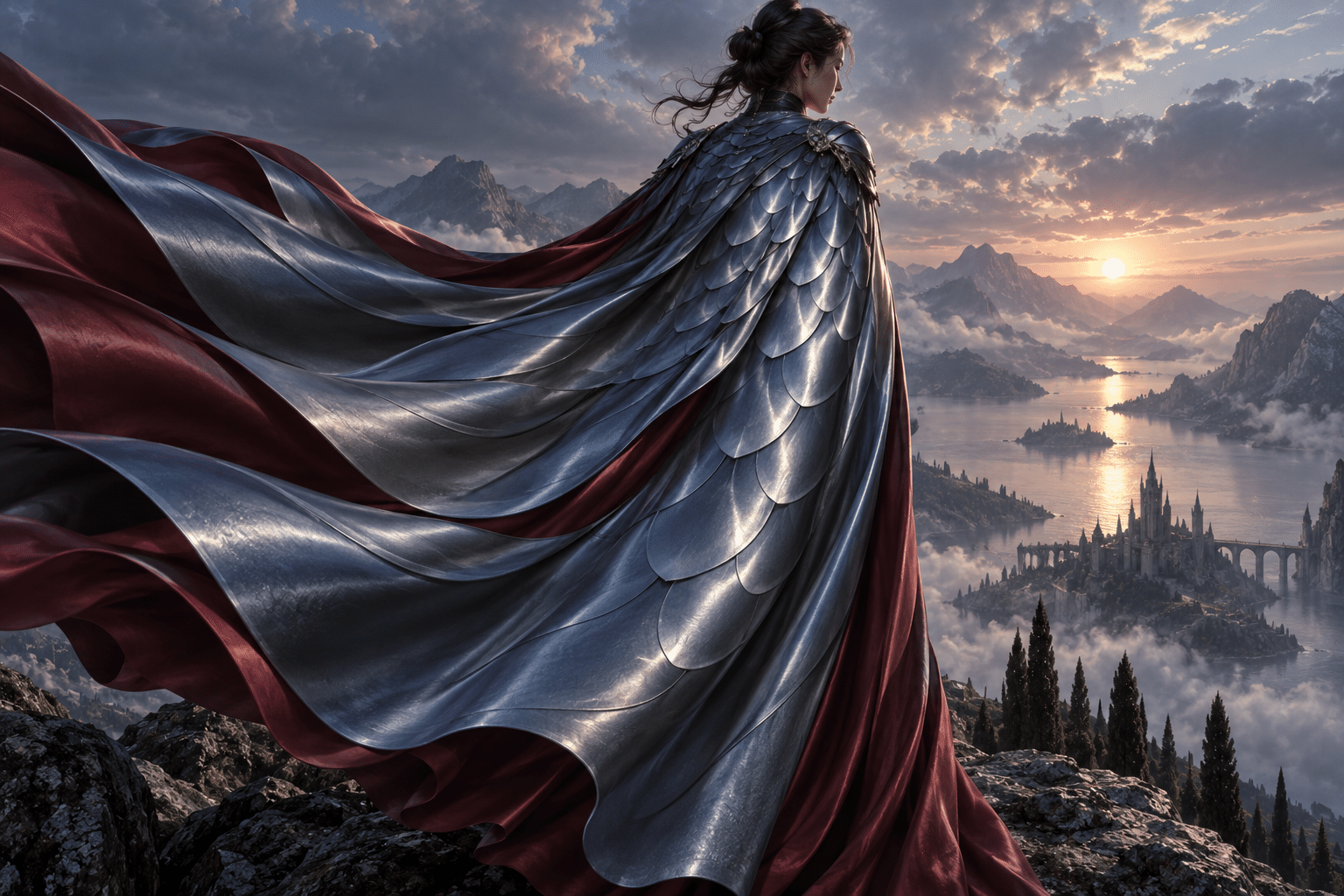
Smooth silk panels imply raised armor plates solely through sharply organized lighting gradients.
Adversarial Velvet Camouflage
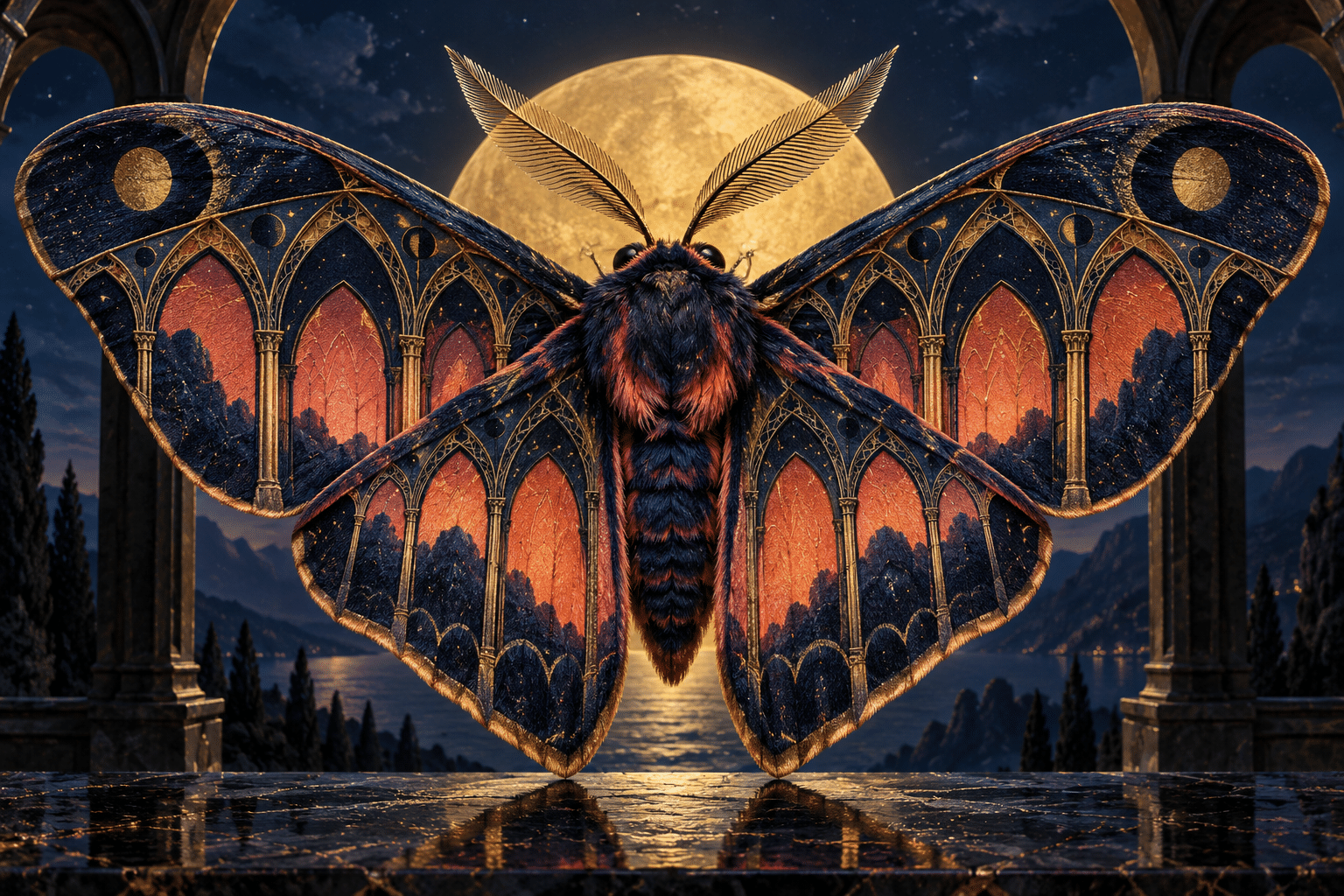
A clear sculptural silhouette contains internal patterns that suggest a different object when viewed closely.