
AOI floral creative brief · documented name usage distinguished
Explore an independent floral art approach built from petal structure, branching and change, with clear context for the Flowerism name and new original visual studies.
An A⊕I –[-.+] creαt¡ve c⊕ncept, n⊕t αn estαbl¡she∂ h¡st⊕r¡cαl m⊕vement.
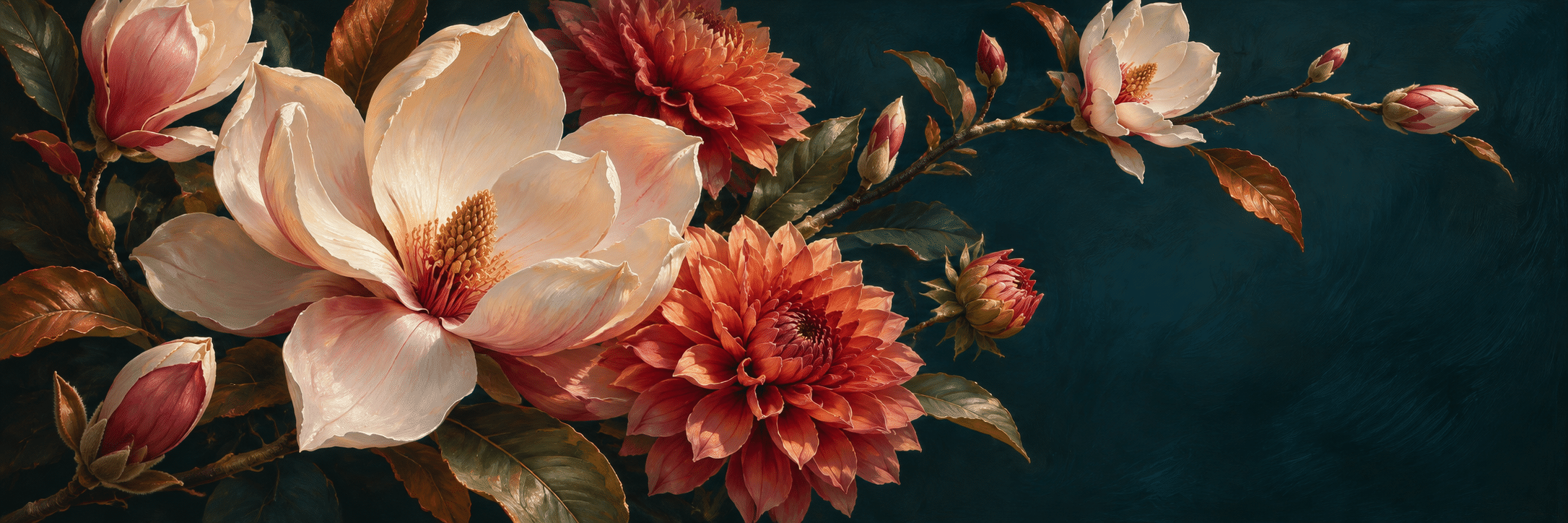
A visual introduction
Select an image for a closer look. Use the thumbnails, arrow keys or a swipe to compare examples. Zoom in to inspect details, or share the image that inspires you.
Creative toolbox · take this style further
Choose an input and a destination. Search sends your words to the chosen site; Copy & open puts them on your clipboard to paste there.
Create with AI
Turn your chosen input into an image prompt or a new creative direction.
ChatGPT
Copy your input and paste it into a ChatGPT conversation or image request.
Copy & open ChatGPT (new tab)Claude · Anthropic
Develop an image prompt or explore the style in a new Claude conversation.
Copy & open Claude · Anthropic (new tab)Midjourney
Paste your input into the Imagine bar on the Create page.
Copy & open Midjourney (new tab)Adobe Firefly
Copy your input, open Firefly, and paste it into the prompt field.
Copy & open Adobe Firefly (new tab)Leonardo.Ai
Copy your input, open Leonardo, and paste it into the generation field.
Copy & open Leonardo.Ai (new tab)Image search
Find visual references. Short, concrete keywords usually work best.
Lexica
Search AI images and prompts using your selected input.
Search with this input Lexica (new tab)Pexels
Search the photo and video library. Short keywords often work best.
Search with this input Pexels (new tab)Pixabay
Search photos, illustrations and other images.
Search with this input Pixabay (new tab)Unsplash
Search photographs using the style name or your own keywords.
Search with this input Unsplash (new tab)Wikimedia Commons
Search photographs, artworks and historical images. Check each file for its source and reuse terms.
Search with this input Wikimedia Commons (new tab)Art & research
Explore artists, collections and the ideas behind a style.
Wikipedia
Search for background reading. A style may not have its own article.
Search with this input Wikipedia (new tab)WikiArt
Copy your input into WikiArt’s search to explore artists and artworks.
Copy & open WikiArt (new tab)Europeana
Paste your keywords into the search to explore European museum, library and archive collections.
Copy & open Europeana (new tab)Inspiration
Discover portfolios and visual ideas from creative communities.
Instagram hashtags
Search a hashtag made from your input: spaces and punctuation are removed. Instagram may require sign-in.
Search with this input Instagram hashtags (new tab)ArtStation
Paste your input into artwork search for concept art, environments, characters and visual development.
Copy & open ArtStation (new tab)Behance
Paste your input into project search for illustration, design and visual storytelling.
Copy & open Behance (new tab)A closer look
Petal folds become broad planes, stems establish direction, and buds, open flowers and seedpods create different rhythms. A clear focal area and purposeful empty space give abundance a structure.
A floral approach, with the name kept in context
This page develops Flowerism as an AOI creative brief: let the structure of flowers organise an image through opening, branching, repetition and change. It does not describe a documented nineteenth-century movement founded by Monet, nor claim that AOI invented the word. The earlier entry’s founders and rise-and-decline narrative were unsupported and have been removed.
There is a documented artistic use of the name. Singapore artist Ye Ruoshi writes that she began her Flowerism series in 2003, developing close studies of flower structures after paintings of withering roses. Her account emphasises local and tropical flowers, their forms and colours. That named series belongs to her practice; the independent exercises below are not her work or a reconstruction of her style. [1]
Flowers have many histories in art
Flower painting is much broader than this working label. The National Gallery distinguishes flowers used symbolically from flowers as the subject of still lifes, and notes the popularity of flower-pieces in the Netherlands in the late seventeenth and early eighteenth centuries. Those histories should be studied through particular works and contexts rather than gathered into an invented movement. [2]
Botanical illustration has another purpose. Kew describes a collaboration between artists and scientists in which selected plant details support description and identification. An imagined bloom may be a convincing painting without being a reliable botanical record. Our examples explore composition; they do not certify a species, document a specimen or replace that scientific work. [3]
Make the flower determine the composition
Start with one observable relationship: petals unfold around a centre, a stem bends under a head, or a branch divides toward light. Enlarge that relationship into the image’s organising principle. A close crop can turn petal folds into broad planes; a sparse arrangement can make the distance between stems expressive; a seedpod can interrupt a sequence of open blooms.
This is the specific rule of the AOI exercise. If the flowers could be replaced with arbitrary ornaments without changing the composition, the idea has not yet developed very far. Let a petal’s edge redirect the eye, let a stem connect two zones, and let an interval of background give a crowded area room to breathe.
Colour and edges create depth
Choose one dominant colour relationship and a smaller counterpoint. Pale petals against dark blue-green can produce a luminous focal area; coral against a quiet grey-green can make a modest stem feel present without making the entire canvas shout. Avoid giving every blossom the same saturation, size and sharpness.
Edges carry much of the structure. A crisp overlap can explain which petal is in front, while a softer edge can let a turning form recede. Shadows need a consistent light logic even when the colour is invented. In a digital or generated study, inspect the point where each flower joins its stem: persuasive surface detail cannot repair an impossible attachment.
Growth includes more than perfect bloom
A bud, an open flower, a fading head and a dry pod offer different silhouettes. Their relationship can give an image a sense of time without supplying a fixed moral. A fallen petal may suggest change to one viewer and simply punctuate the table to another. State an intended reading as an interpretation, not a universal code.
For a quiet composition, leave one area almost empty and make a small material event matter: a glass rim, a bent stem, a reflected colour. For a more expansive work, vary the scale of the blossoms and keep a clear route through them. Abundance works best when it has structure. A field of equal-sized, equally sharp flowers easily becomes wallpaper.
From observed form toward abstraction
Simplification can retain the logic of a plant while changing its appearance. Reduce a flower to overlapping irregular discs, a pod to a dense silhouette, or a stem to a line that branches with purpose. Keep variation in the sequence so that the work does not become a mechanically repeated rosette.
The useful question is what survives the reduction. Does the form still seem to open, carry weight or turn toward another element? These are compositional tests for an original exercise. They do not establish a new botanical fact or prove a historical influence. A good abstract version should make its own decisions rather than merely blur a detailed bouquet.
Using the new visual studies
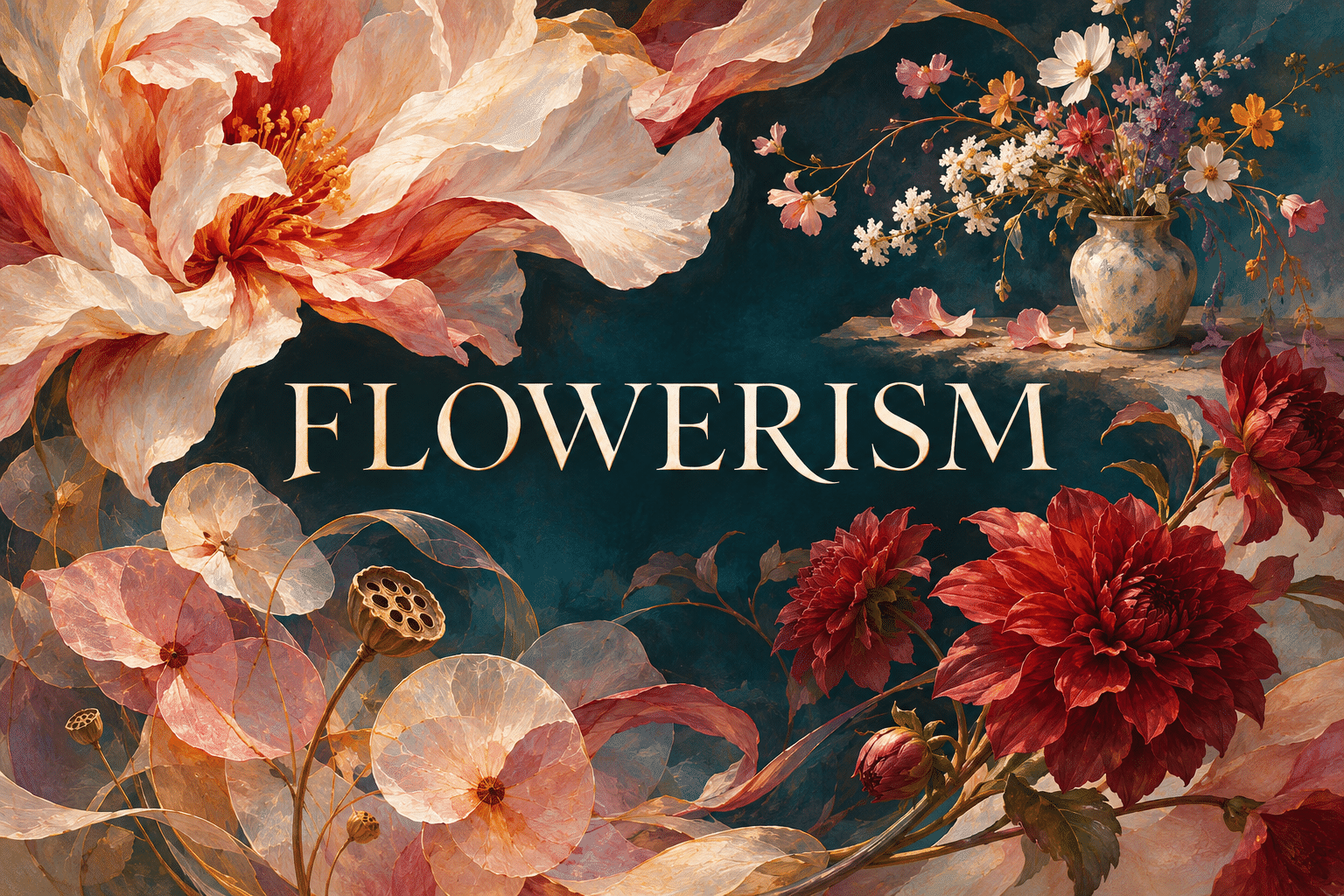
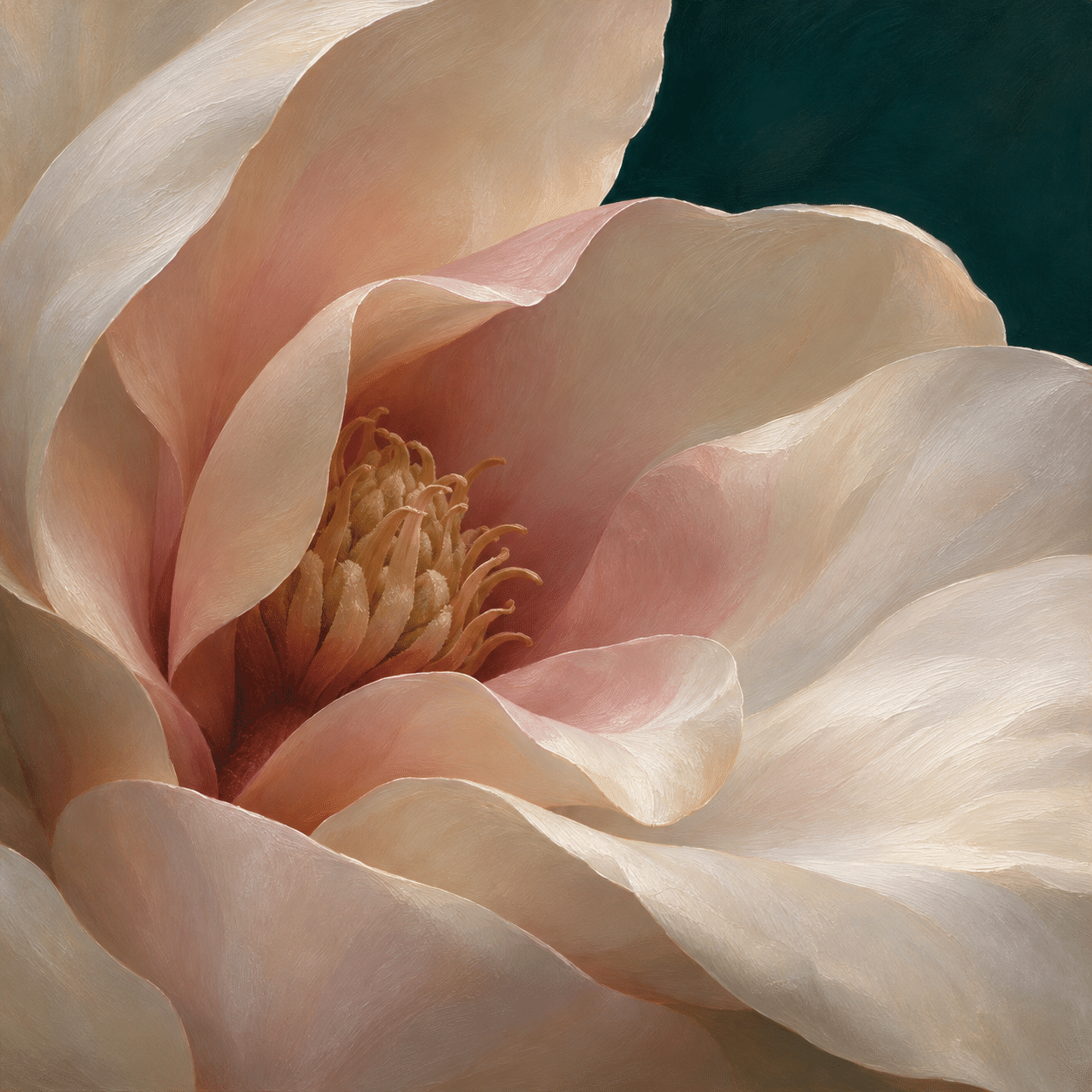
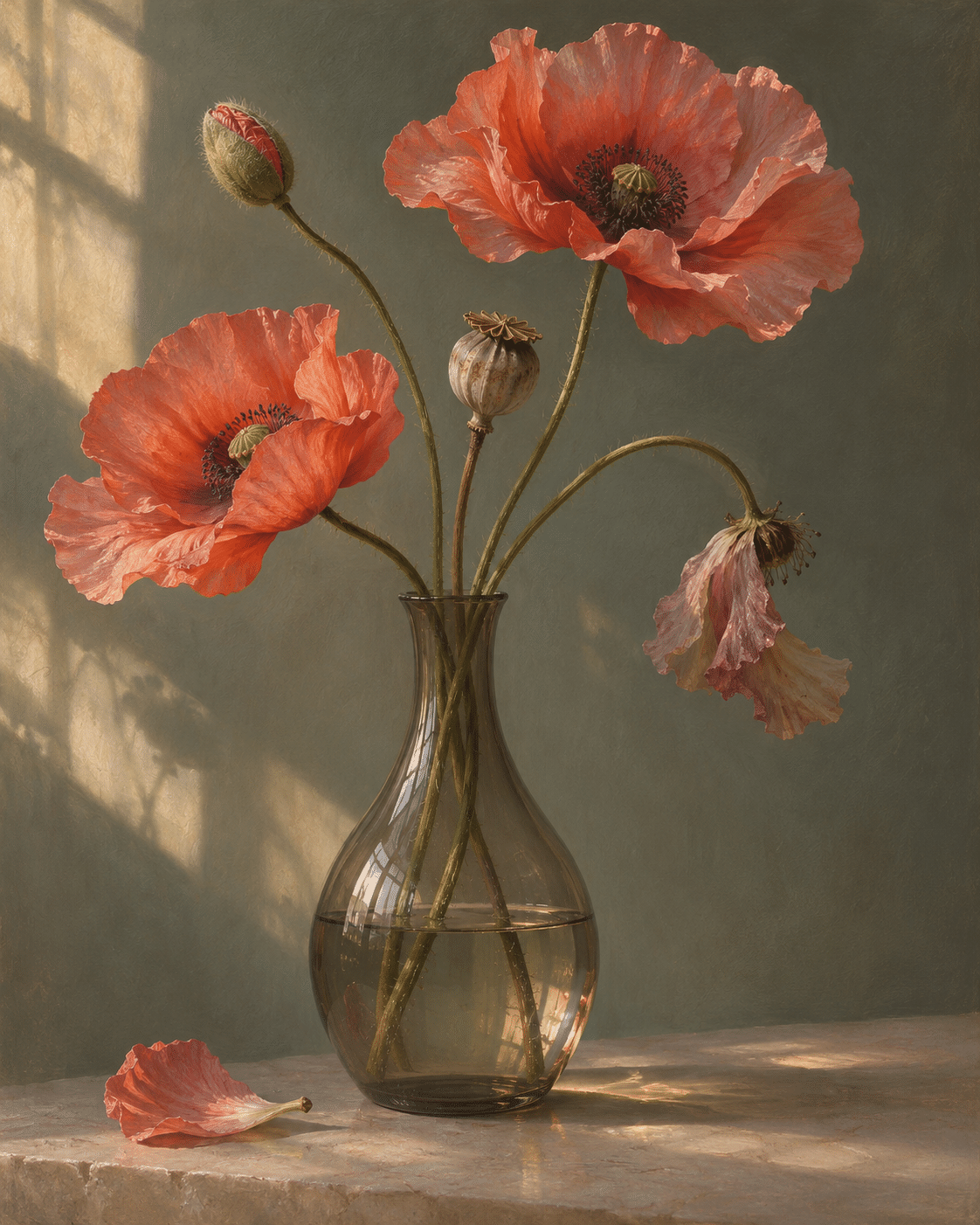
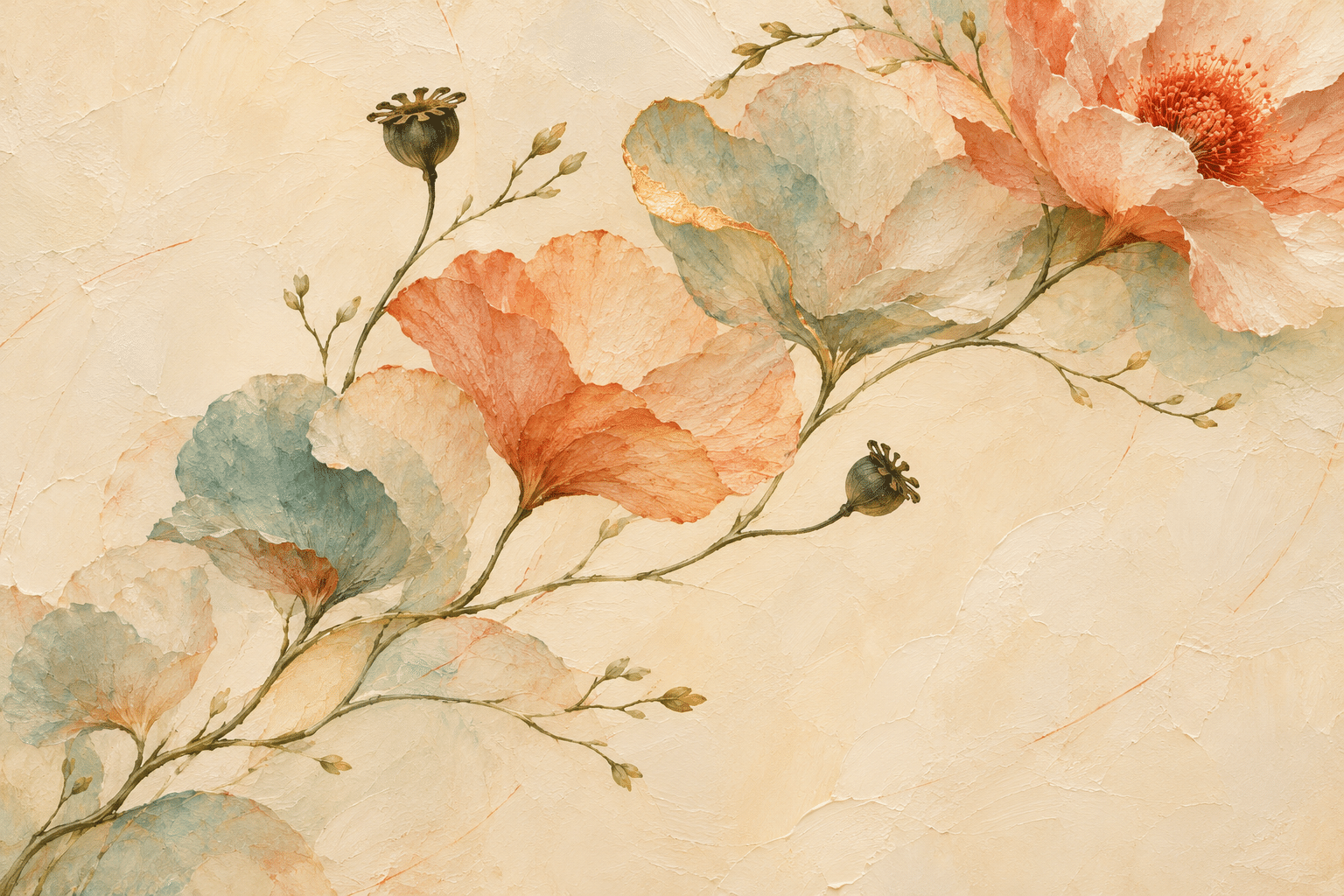
The enlarged pale flower examines folded volume and a close crop. The vase study compares stages of growth within a restrained still life. The abstract study tests how petal-like planes, branching lines and seedpod shapes can become a rhythm. The banner and central-title collage gather those ideas into a visual introduction.
All five are original AI-generated AOI interpretations. The first two can be checked for coherent attachment, light and spatial relationships; the abstract example should be judged by its rhythm and hierarchy. For a commissioned design, also test the intended crop and reproduction size. A beautiful large detail may become an indistinct patch when reduced.
Further exploration without false attribution
Read Ye Ruoshi’s own account for the documented series bearing the name. Use the National Gallery reference to follow historical flower painting, and Kew’s explanation to understand the different demands of botanical illustration. These sources answer different questions; none makes every floral picture a member of one movement.
The related AOI entry Complex Art and Flowerism explores intricate floral composition. Treat it as a neighbouring creative brief. Here the emphasis is on how growth, opening and change organise the image, whether the result is spare, richly painted or abstract.
A small poetic detour
Original words from the AOI studio.
Poetry
A petal turns and makes a room
for light that could not settle flat.
A stem leans past the brightest bloom;
a shadow keeps the shape of that.
The bud holds back its folded day.
The dry pod opens into air.
One fallen colour marks the table;
the empty space has something there.
The prompt workshop
Original creative exercises. These prompts create new illustrations, not documentary evidence.
A flower becomes a landscape of folds
Paint an original close view of an imagined pale flower. Use broad overlapping petals, a darker centre, restrained rose shadows and an asymmetrical wedge of background. Let the folds organise the image. No named-artist imitation or botanical-documentation claim.
A small arrangement shows time
Create an original still life of a few stems in a slender glass vase: open flowers, a bud, a fading head and a seedpod. Use coherent attachment, quiet window light and one fallen petal. Keep the setting sparse and the growth stages distinct.
Reduce growth to a visual rhythm
Create an original abstract floral composition from irregular translucent petal planes, branching lines and dark seedpod shapes. Establish a clear diagonal rhythm with one dense focal area and generous open space. Avoid a repeated wallpaper grid or a generic mandala.
People & works to explore
Creative worldbuilding: these names and works may be invented. They are not historical attributions.
Artists and practitioners
Ye Ruoshi — documented Flowerism series; a distinct practice, not the author of the AOI images
Paintings and other works
Ye Ruoshi, Flowerism series (begun 2003), documented in the artist’s own account
A smile from the studio
Jokes
The bouquet asked for a group portrait. The seedpod insisted on being included in its current condition.