
AOI creative concept
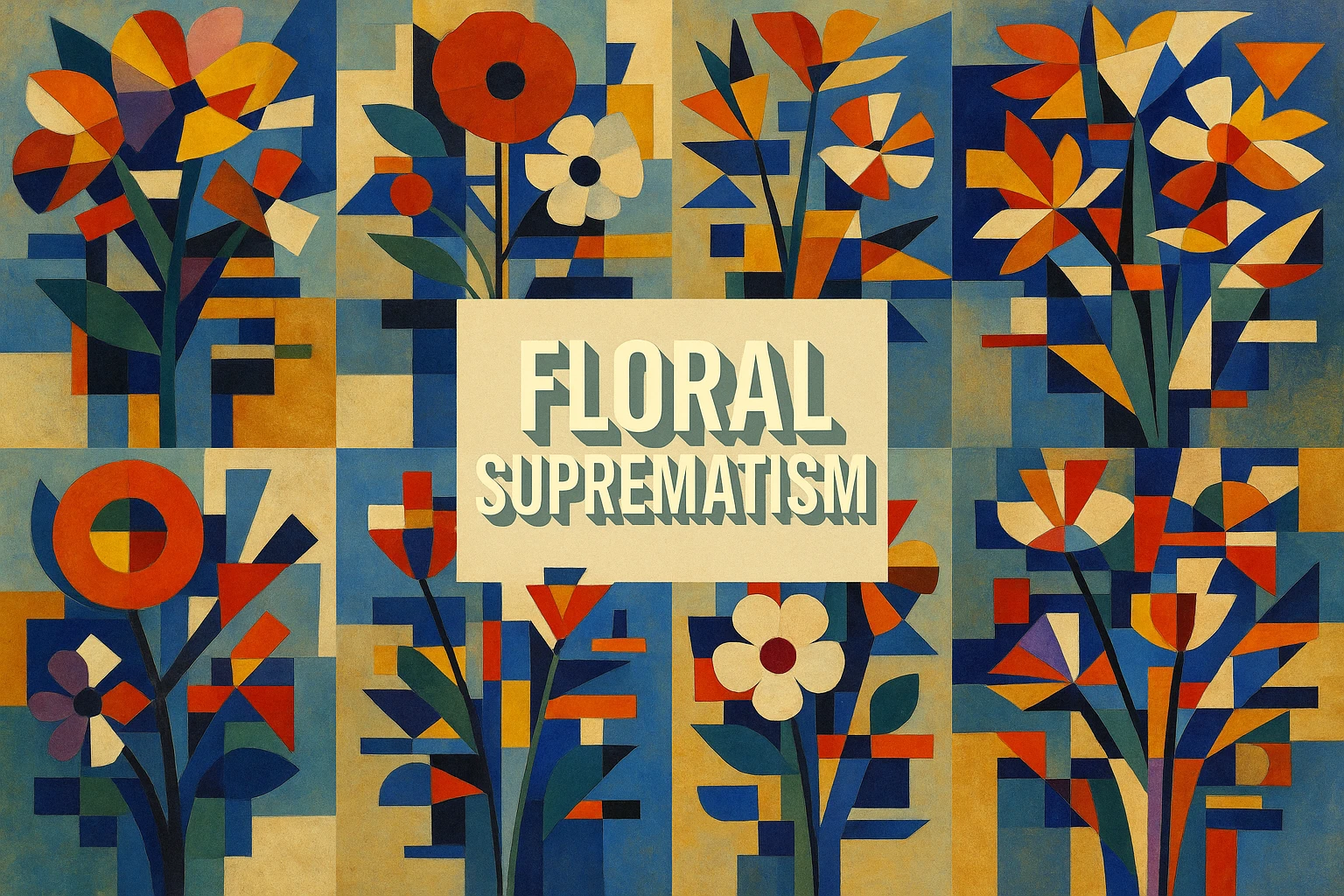
Floral Suprematism is an AOI hybrid brief that places recognizable flowers among flat geometric shapes. Its floral subject distinguishes it from the nonobjective aims associated with historical Suprematism.
An A⊕I –[-.+] creαt¡ve c⊕ncept, n⊕t αn estαbl¡she∂ h¡st⊕r¡cαl m⊕vement.
A visual introduction
Compare the retained archive interpretations with the visual principles below.
Select an image for a closer look. Use the thumbnails, arrow keys or a swipe to compare examples. Zoom in to inspect details, or share the image that inspires you.

Creative toolbox · take this style further
Choose an input and a destination. Search sends your words to the chosen site; Copy & open puts them on your clipboard to paste there.
Create with AI
Turn your chosen input into an image prompt or a new creative direction.
ChatGPT
Copy your input and paste it into a ChatGPT conversation or image request.
Copy & open ChatGPT (new tab)Claude · Anthropic
Develop an image prompt or explore the style in a new Claude conversation.
Copy & open Claude · Anthropic (new tab)Midjourney
Paste your input into the Imagine bar on the Create page.
Copy & open Midjourney (new tab)Adobe Firefly
Copy your input, open Firefly, and paste it into the prompt field.
Copy & open Adobe Firefly (new tab)Leonardo.Ai
Copy your input, open Leonardo, and paste it into the generation field.
Copy & open Leonardo.Ai (new tab)Image search
Find visual references. Short, concrete keywords usually work best.
Lexica
Search AI images and prompts using your selected input.
Search with this input Lexica (new tab)Pexels
Search the photo and video library. Short keywords often work best.
Search with this input Pexels (new tab)Pixabay
Search photos, illustrations and other images.
Search with this input Pixabay (new tab)Unsplash
Search photographs using the style name or your own keywords.
Search with this input Unsplash (new tab)Wikimedia Commons
Search photographs, artworks and historical images. Check each file for its source and reuse terms.
Search with this input Wikimedia Commons (new tab)Art & research
Explore artists, collections and the ideas behind a style.
Wikipedia
Search for background reading. A style may not have its own article.
Search with this input Wikipedia (new tab)WikiArt
Copy your input into WikiArt’s search to explore artists and artworks.
Copy & open WikiArt (new tab)Europeana
Paste your keywords into the search to explore European museum, library and archive collections.
Copy & open Europeana (new tab)Inspiration
Discover portfolios and visual ideas from creative communities.
Instagram hashtags
Search a hashtag made from your input: spaces and punctuation are removed. Instagram may require sign-in.
Search with this input Instagram hashtags (new tab)ArtStation
Paste your input into artwork search for concept art, environments, characters and visual development.
Copy & open ArtStation (new tab)Behance
Paste your input into project search for illustration, design and visual storytelling.
Copy & open Behance (new tab)A closer look
Simplified petals and stems share the surface with floating rectangles, squares and diagonal bars. Broad color areas and visible background spaces control the balance.
Recognizable flowers change the premise
MoMA describes Kazimir Malevich’s Suprematist vocabulary in terms of colored geometric forms and white backgrounds. This provides context for the geometry in the name, not evidence that Floral Suprematism was a historical school. Here the flowers remain identifiable, so the proposal deliberately brings representation back into a geometrically organized composition.
The retained archive example combines orange, red, blue and white flowers with green stems and separate colored bars on a pale ground. Its shapes overlap without forming a conventional naturalistic garden. The collage offers related arrangements of simplified flowers and geometric fields. Both are contemporary illustrations; neither is presented as a work by Malevich or another historical artist.
Let geometry and botany share the surface
Choose one flower shape and reduce it to a few broad petals, a center and a stem. Place two or three independent geometric forms around it. These forms should affect the balance of the composition rather than merely fill leftover gaps. A long diagonal can counter an upright stem, while a dark square can balance a large bright bloom.
Keep the background active. Spaces between shapes can establish direction and prevent the flower from becoming a sticker pasted over a crowded abstract painting. Work with a limited palette and vary the size of the forms before increasing their number. Flat color makes relationships clear; a lightly textured painted surface can add material interest without pretending to be an aged original.
Try a paired exercise: first keep the flower fully recognizable, then simplify it until only a few petal-like intervals remain. Notice where the image stops reading as a plant. That boundary is the useful subject of this brief. It can support a poster, textile sketch or original painted study, but it should be labelled as a contemporary hybrid when historical accuracy matters.
The prompt workshop
Original creative exercises. These prompts create new illustrations, not documentary evidence.
One flower and three forms
Create an original flat painted composition with one simplified red flower, a green stem, a blue square and two unequal diagonal bars on a warm pale ground. Leave generous spaces between forms and make their balance deliberate. No lettering or signature.
A geometric garden
Compose three differently sized flowers from broad petals and circles, interspersed with a few independent rectangles. Use red, blue, yellow, green and cream with a lightly painted surface. Keep flowers recognizable and avoid a naturalistic horizon. No text.
The edge of recognition
Create an original abstract study in which five petal-like planes almost form a flower but remain separated by pale background. Balance them with one long black bar and a small blue rectangle. Sparse composition, clear edges, no text.
Sources and further exploration
MoMA: Suprematism — context for the historical geometric vocabulary