
Photographic artistic practice
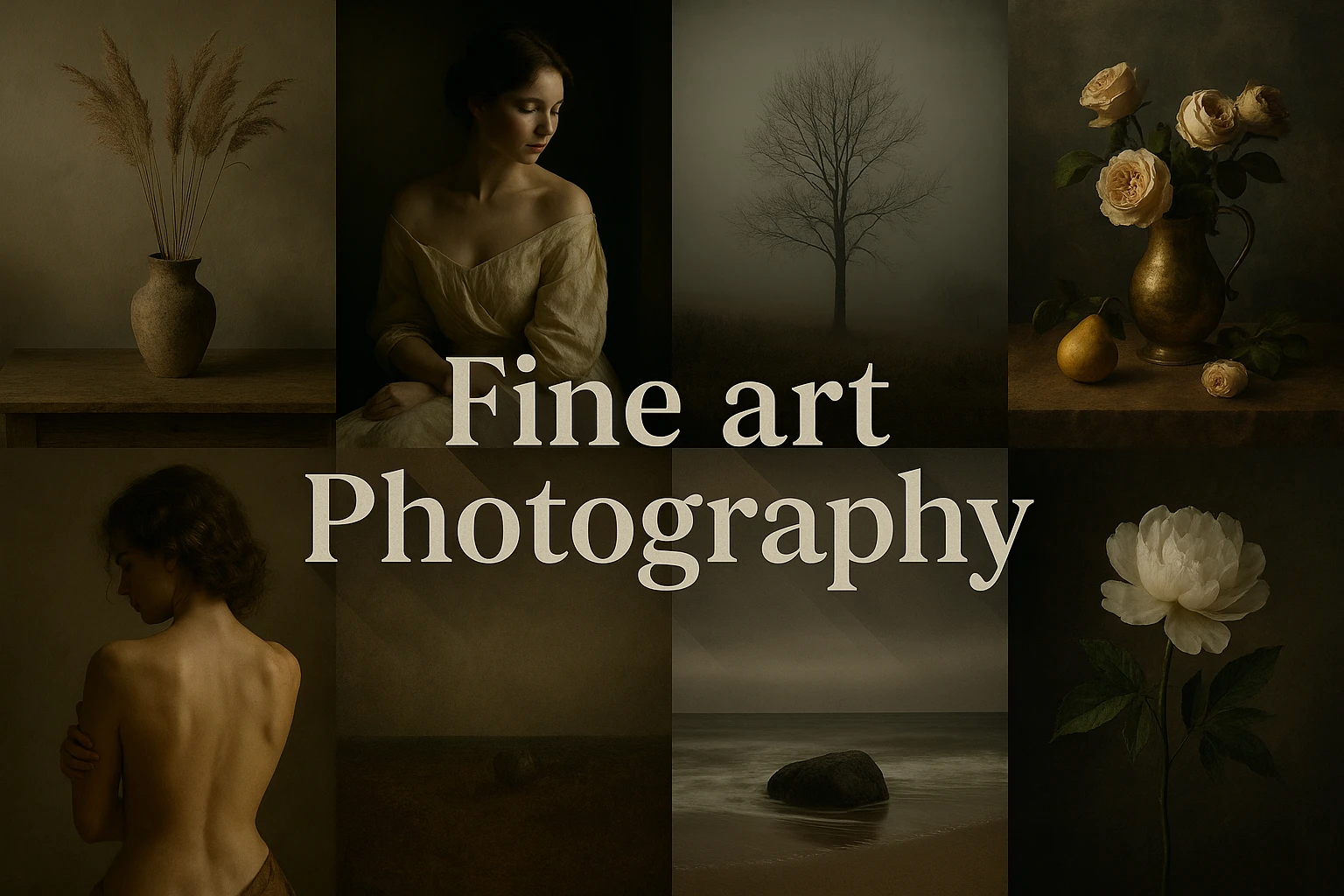
Fine art photography describes photography developed and presented as an artistic practice. It can include portraits, landscapes, staged scenes, abstraction and documentary approaches; no one subject or finishing effect defines it.
A visual introduction
Select an image for a closer look. Use the thumbnails, arrow keys or a swipe to compare examples. Zoom in to inspect details, or share the image that inspires you.
Creative toolbox · take this style further
Choose an input and a destination. Search sends your words to the chosen site; Copy & open puts them on your clipboard to paste there.
Create with AI
Turn your chosen input into an image prompt or a new creative direction.
ChatGPT
Copy your input and paste it into a ChatGPT conversation or image request.
Copy & open ChatGPT (new tab)Claude · Anthropic
Develop an image prompt or explore the style in a new Claude conversation.
Copy & open Claude · Anthropic (new tab)Midjourney
Paste your input into the Imagine bar on the Create page.
Copy & open Midjourney (new tab)Adobe Firefly
Copy your input, open Firefly, and paste it into the prompt field.
Copy & open Adobe Firefly (new tab)Leonardo.Ai
Copy your input, open Leonardo, and paste it into the generation field.
Copy & open Leonardo.Ai (new tab)Image search
Find visual references. Short, concrete keywords usually work best.
Lexica
Search AI images and prompts using your selected input.
Search with this input Lexica (new tab)Pexels
Search the photo and video library. Short keywords often work best.
Search with this input Pexels (new tab)Pixabay
Search photos, illustrations and other images.
Search with this input Pixabay (new tab)Unsplash
Search photographs using the style name or your own keywords.
Search with this input Unsplash (new tab)Wikimedia Commons
Search photographs, artworks and historical images. Check each file for its source and reuse terms.
Search with this input Wikimedia Commons (new tab)Art & research
Explore artists, collections and the ideas behind a style.
Wikipedia
Search for background reading. A style may not have its own article.
Search with this input Wikipedia (new tab)WikiArt
Copy your input into WikiArt’s search to explore artists and artworks.
Copy & open WikiArt (new tab)Europeana
Paste your keywords into the search to explore European museum, library and archive collections.
Copy & open Europeana (new tab)Inspiration
Discover portfolios and visual ideas from creative communities.
Instagram hashtags
Search a hashtag made from your input: spaces and punctuation are removed. Instagram may require sign-in.
Search with this input Instagram hashtags (new tab)ArtStation
Paste your input into artwork search for concept art, environments, characters and visual development.
Copy & open ArtStation (new tab)Behance
Paste your input into project search for illustration, design and visual storytelling.
Copy & open Behance (new tab)A closer look
Framing, light, sequence, scale and presentation should support an identifiable visual inquiry rather than merely signal refinement through monochrome, blur or a large print.
A purpose, not a filter
The category is broad and its boundaries are debated. A landscape or portrait can be part of fine art photography; those subjects are not opposing categories. Technical decisions and artistic intention also work together. A carefully chosen exposure, focus or printing method can be central to what the image communicates.
The V&A's photography collection includes historical and contemporary practices, books, prints and experimental approaches. That variety is a useful corrective to the idea that art photography must be a beautiful monochrome view of nature. Begin with the particular work and the question it develops.
Make the visual inquiry specific
Choose something you want to examine: a changing place, a repeated gesture, the relation between objects or the way an image constructs identity. A specific inquiry helps determine what belongs in the frame. “Evoke emotion” is too broad to guide every decision on its own.
Make several versions with controlled changes in distance, viewpoint or light. Compare how each alters the subject's significance. A closer view may turn context into abstraction; a wider one may reveal a social or spatial relationship. Keep the version that best serves the inquiry rather than automatically choosing the most spectacular one.
Editing is part of authorship
A sequence can create relationships that no individual image contains. Look for repetition, contrast and a purposeful change of pace. Remove photographs that merely repeat an effect without adding information. A short coherent series can be stronger than a large collection of individually attractive pictures.
Consider the final form early. A small intimate print, a large wall image and a photobook spread encourage different viewing behavior. The V&A's Photography Centre treats the book and expanded digital practice as significant parts of the medium, not secondary containers for the same unchanged picture.
Be precise about construction and evidence
Staging, compositing and other interventions can be legitimate artistic methods. Describe them honestly when the distinction matters to how the work is understood. A generated camera-like image is not documentation that a camera recorded an event.
For an original exercise, write a short statement naming the visual question and the decisions that support it. Then check the pictures against that statement. If the explanation promises more than the work shows, revise the work or narrow the claim.
The prompt workshop
Original creative exercises. These prompts create new illustrations, not documentary evidence.
A specific visual inquiry
Original photographic-art concept studying the traces of a repeated daily task: an empty repair bench with carefully observed wear and one moved tool, quiet light, precise framing, no fabricated documentary claim.
A coherent sequence
Three original photographic concept images of the same invented doorway at different stages of daily use, consistent viewpoint, meaningful changes in objects and light, restrained editing and no captions.
Scale and ambiguity
Original fine-art photographic concept of folded translucent fabric, close framing that balances recognizable material with abstraction, subtle tonal transitions, intentional negative space, no generic decorative texture.