
Subtractive and conceptual art practice
Erasure Works describes art in which removing, rubbing out, obscuring or withdrawing existing marks becomes a principal creative operation. The remaining traces and the act of removal can both carry meaning.
A visual introduction
Select an image for a closer look. Use the thumbnails, arrow keys or a swipe to compare examples. Zoom in to inspect details, or share the image that inspires you.
Creative toolbox · take this style further
Choose an input and a destination. Search sends your words to the chosen site; Copy & open puts them on your clipboard to paste there.
Create with AI
Turn your chosen input into an image prompt or a new creative direction.
ChatGPT
Copy your input and paste it into a ChatGPT conversation or image request.
Copy & open ChatGPT (new tab)Claude · Anthropic
Develop an image prompt or explore the style in a new Claude conversation.
Copy & open Claude · Anthropic (new tab)Midjourney
Paste your input into the Imagine bar on the Create page.
Copy & open Midjourney (new tab)Adobe Firefly
Copy your input, open Firefly, and paste it into the prompt field.
Copy & open Adobe Firefly (new tab)Leonardo.Ai
Copy your input, open Leonardo, and paste it into the generation field.
Copy & open Leonardo.Ai (new tab)Image search
Find visual references. Short, concrete keywords usually work best.
Lexica
Search AI images and prompts using your selected input.
Search with this input Lexica (new tab)Pexels
Search the photo and video library. Short keywords often work best.
Search with this input Pexels (new tab)Pixabay
Search photos, illustrations and other images.
Search with this input Pixabay (new tab)Unsplash
Search photographs using the style name or your own keywords.
Search with this input Unsplash (new tab)Wikimedia Commons
Search photographs, artworks and historical images. Check each file for its source and reuse terms.
Search with this input Wikimedia Commons (new tab)Art & research
Explore artists, collections and the ideas behind a style.
Wikipedia
Search for background reading. A style may not have its own article.
Search with this input Wikipedia (new tab)WikiArt
Copy your input into WikiArt’s search to explore artists and artworks.
Copy & open WikiArt (new tab)Europeana
Paste your keywords into the search to explore European museum, library and archive collections.
Copy & open Europeana (new tab)Inspiration
Discover portfolios and visual ideas from creative communities.
Instagram hashtags
Search a hashtag made from your input: spaces and punctuation are removed. Instagram may require sign-in.
Search with this input Instagram hashtags (new tab)ArtStation
Paste your input into artwork search for concept art, environments, characters and visual development.
Copy & open ArtStation (new tab)Behance
Paste your input into project search for illustration, design and visual storytelling.
Copy & open Behance (new tab)A closer look
Pale passages emerge from darker fields, ghost lines survive beneath revisions, and interrupted forms make absence visible.
Removal can be a positive action
An eraser is usually treated as a correction tool, but it can also make the image. Lift charcoal from a dark field and the cleared area becomes light; remove part of a contour and the viewer must complete it mentally. In these cases, subtraction is an active mark-making decision.
Erasure Works is used here as an umbrella description, not the name of one unified movement. Physical removal, digital masking and conceptual acts can share an interest in absence while remaining materially different. Explain what was actually done rather than letting the word erasure conceal the process.
A historical work with a specific context
SFMOMA’s account of Robert Rauschenberg’s Erased de Kooning Drawing, 1953, describes his request for a drawing from Willem de Kooning and de Kooning’s agreement. Rauschenberg then erased it. The museum emphasizes the role of the label and frame, developed with Jasper Johns, in identifying the act that produced the work.
This is a particular conceptual experiment, not a general instruction to destroy other people’s art. Its significance cannot be reduced to the pale appearance of the sheet. The relationship between artists, the chosen drawing and the surviving presentation all matter. A visually similar blank page would not automatically repeat those circumstances.
The material grammar of subtraction
Charcoal can produce soft lifted passages, while graphite may leave a more persistent sheen or embedded trace. Paper texture, pressure and the amount of material already deposited affect what can be removed. Test the support before committing to repeated abrasion, which can alter the surface as well as the image.
Use several kinds of edge. A sharply lifted line can describe a branch or rim; a broad rubbed passage can suggest atmosphere; a partly erased contour can hold an earlier position in view. The difference between these operations gives the drawing a history that uniform blankness does not provide.
Residual marks carry information
A ghost line may reveal revision, uncertainty or elapsed work. It can also become distracting if every abandoned contour remains equally strong. Decide which traces should be readable and which should recede. An erased figure does not have to disappear completely for its absence to become the subject.
Negative space and erasure are related but distinct. A region left untouched from the beginning has a different material history from one cleared after drawing. That difference may be invisible in reproduction. When the history matters, an accurate process note can help without forcing a single interpretation onto the viewer.
Composition and palette
A limited range of charcoal black, gray and paper white keeps attention on density and surface. Color can be introduced, but it should not replace the logic of removal. Begin with the darkest mass and locate the principal lifted area where it changes the image’s structure.
Reserve some quiet passages. If every inch is rubbed, scratched and revised, the eye loses a reference for what has changed. A stable dark region beside a fragile pale form makes subtraction easier to perceive. In a digital study, use masks and retained versions to distinguish reversible experimentation from a final flattened effect.
Meaning needs a reason
Erasure can address revision, memory, suppression, loss or the limits of representation. These are possibilities rather than meanings guaranteed by the technique. Ask what is being removed, what remains and why that relationship matters in this particular work. A pale patch alone cannot answer those questions.
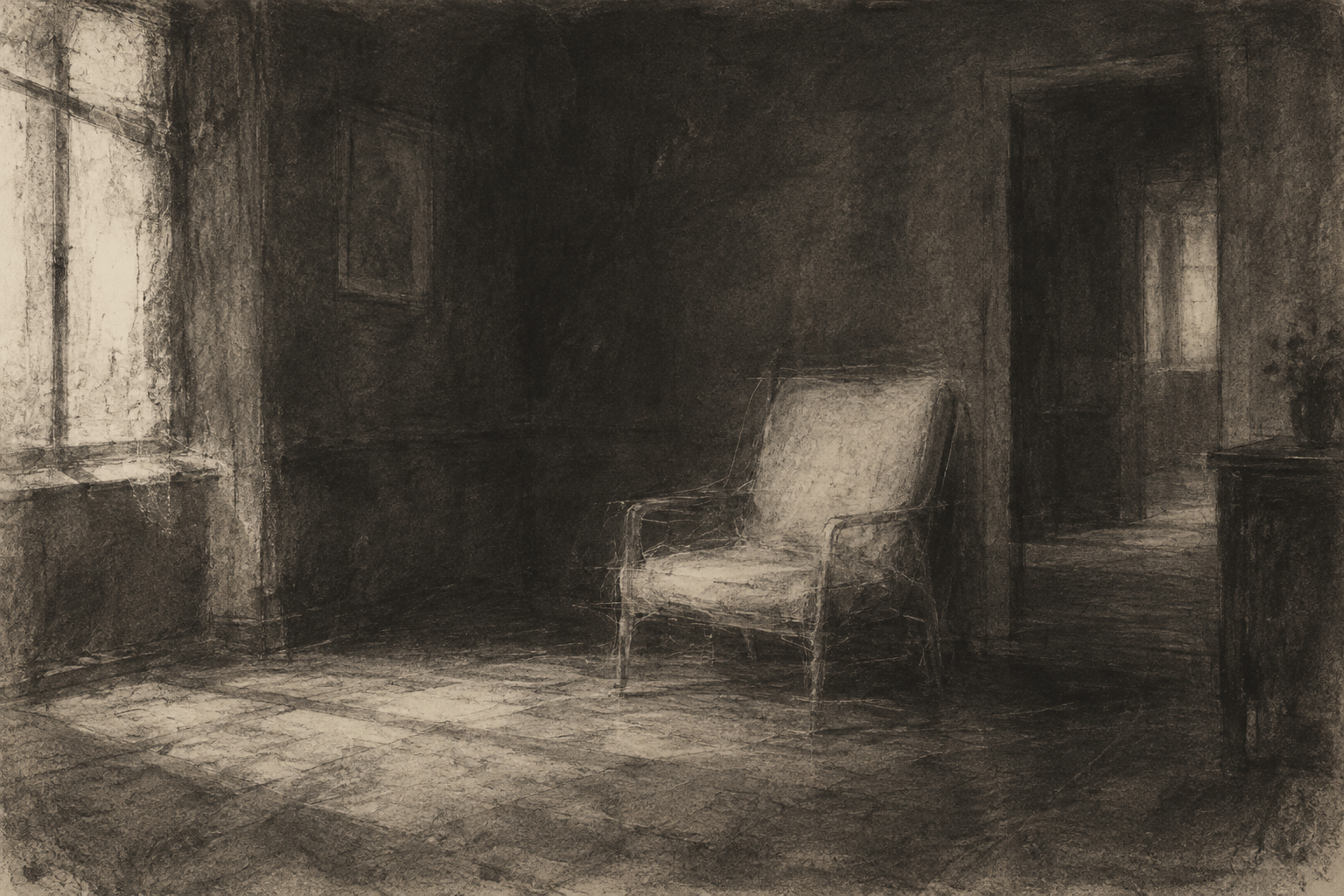
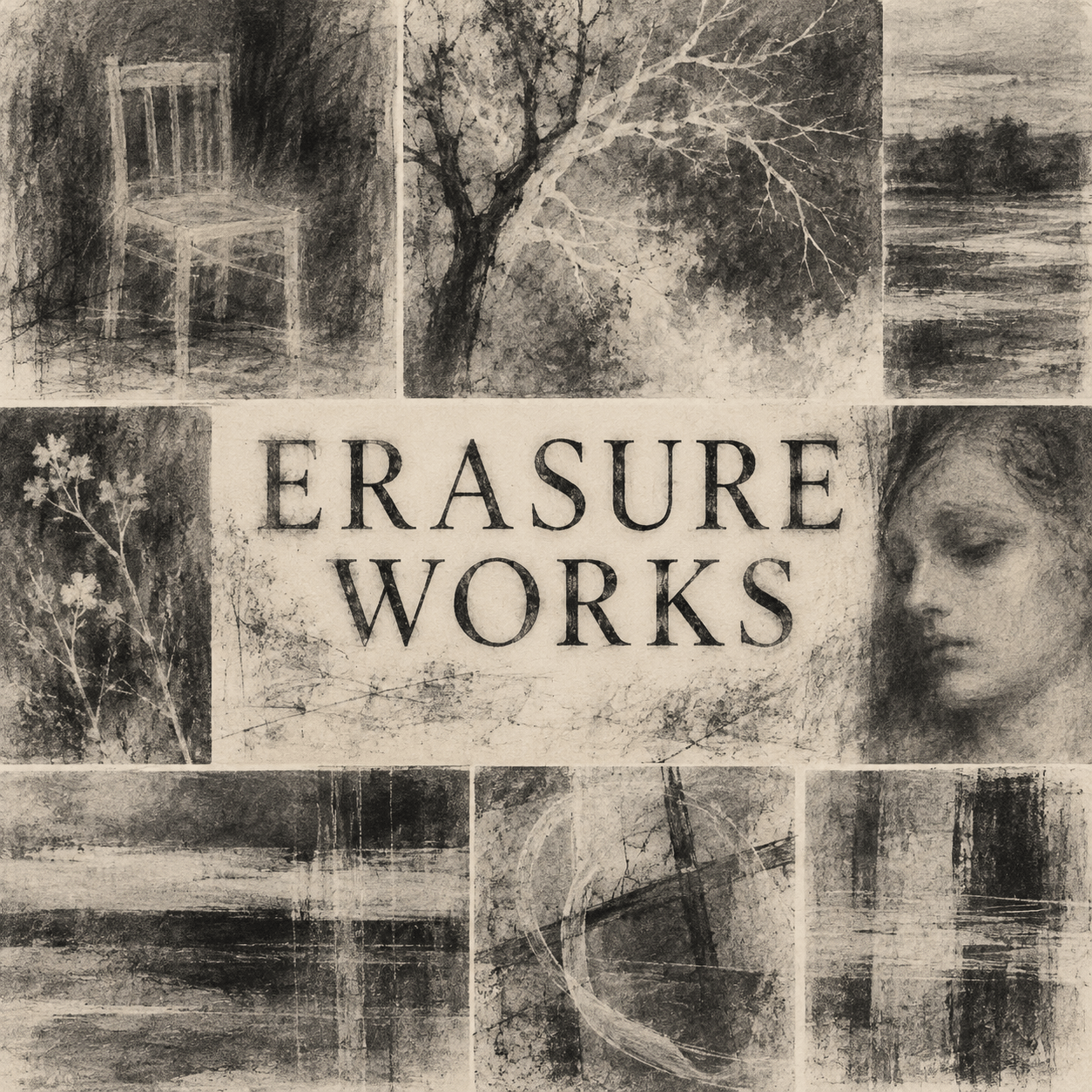
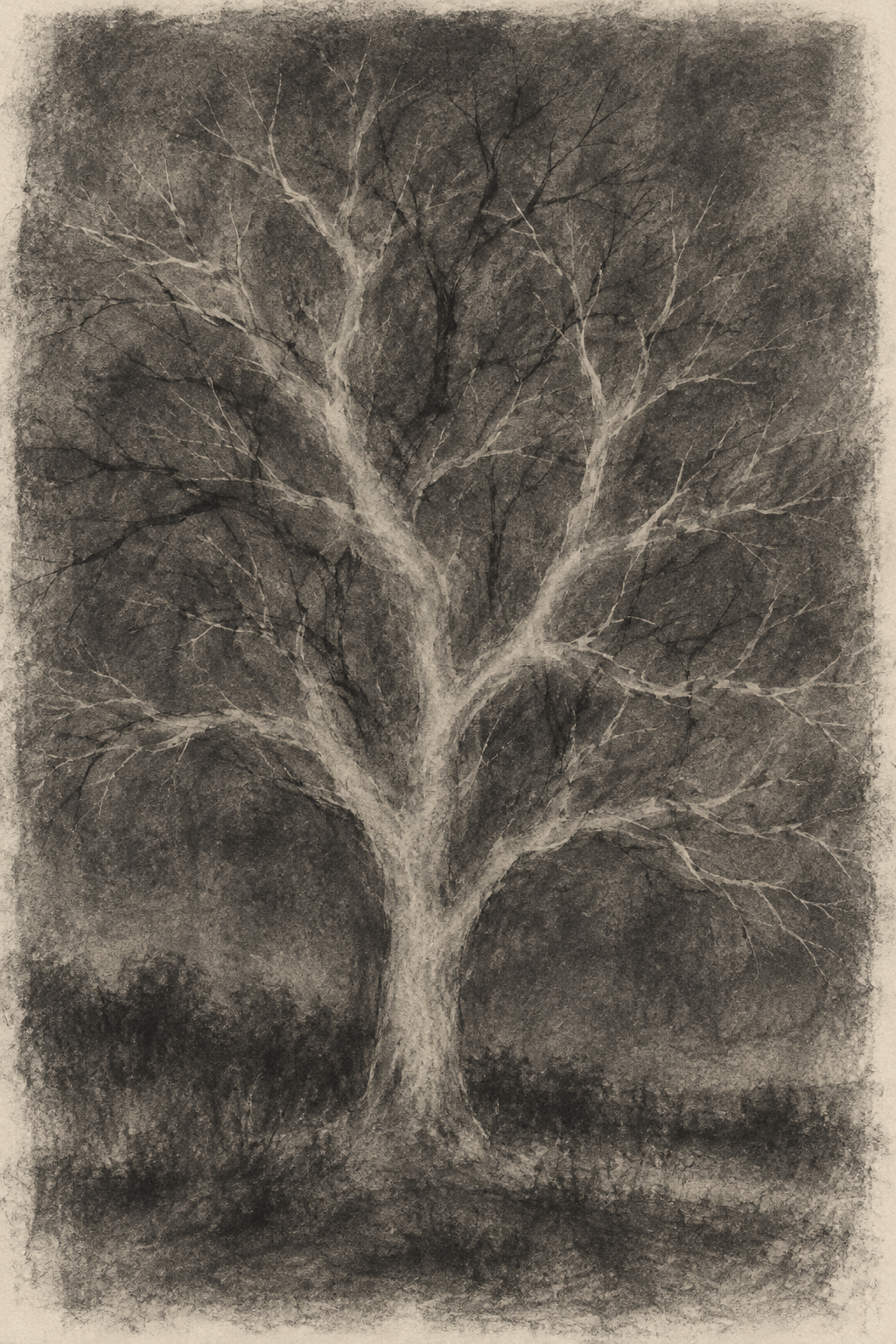
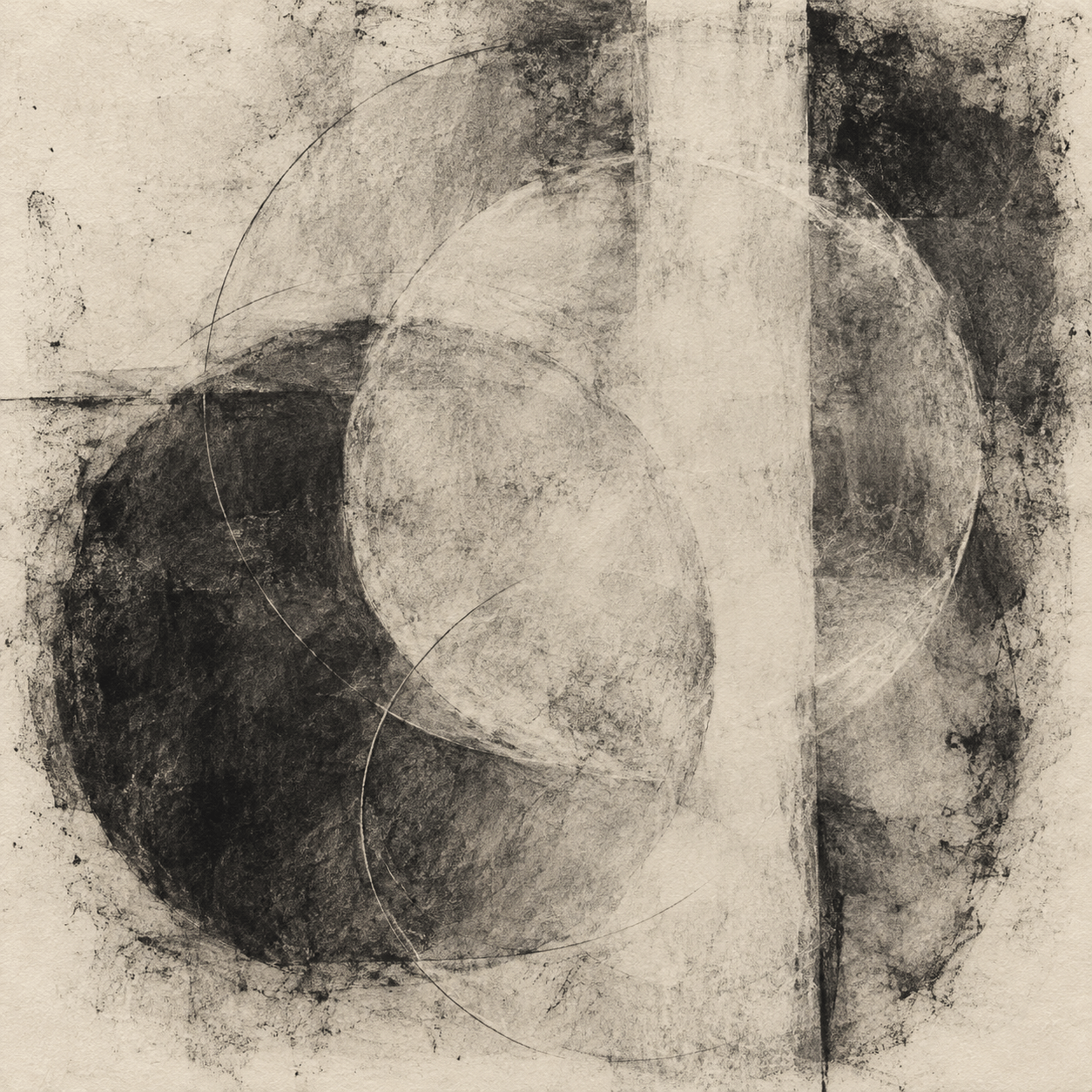
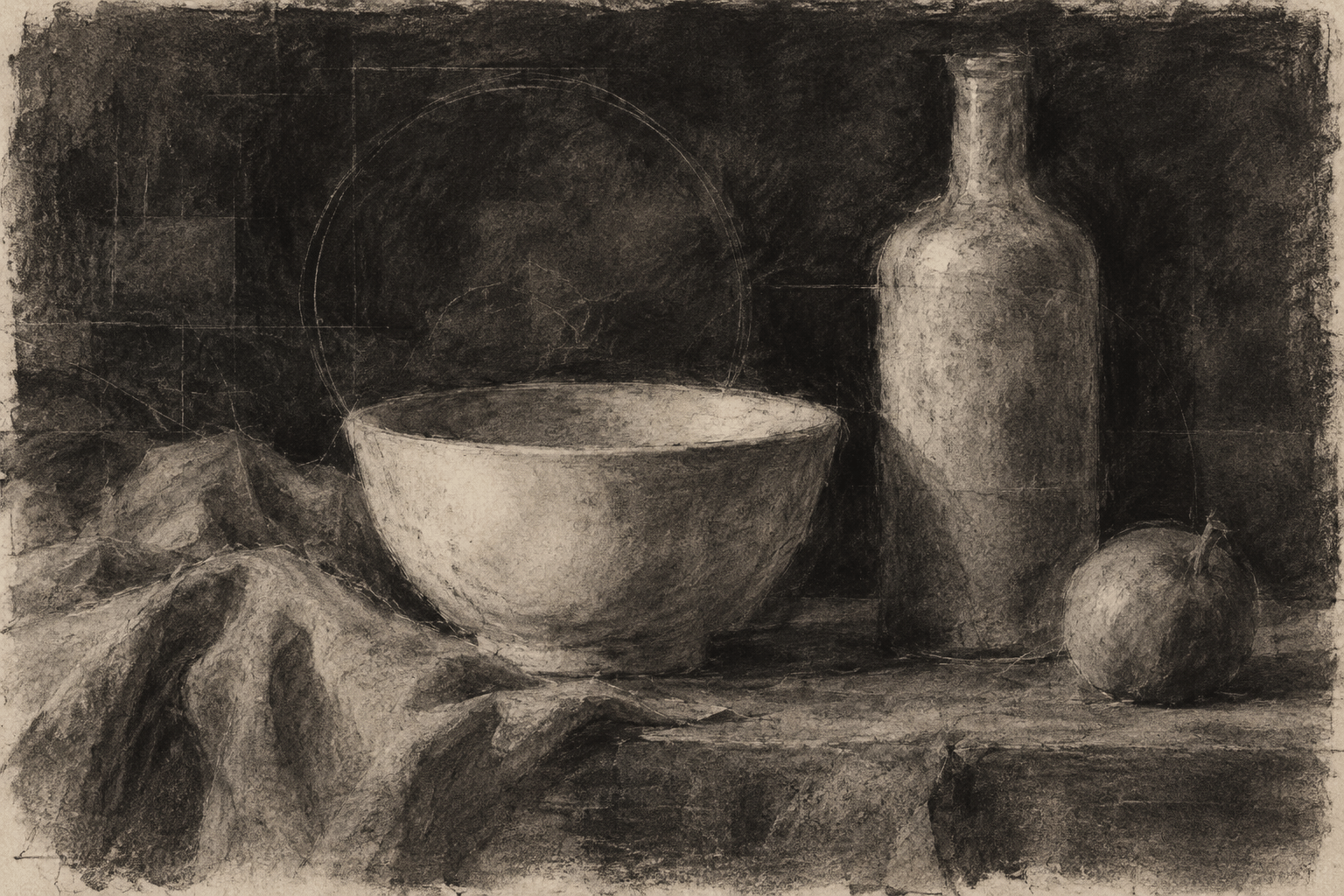
Work with your own material or a source you are entitled to transform. The new gallery is AI-generated and illustrates subtractive appearances; no original drawing was physically erased to make it. Its chair, tree, abstract field and still life demonstrate different ways a pale form can emerge through a darker visual field.
A practical exercise
Cover a small sheet with a moderate charcoal tone. Lift one simple form, then redraw only the edge needed to keep it legible. Make a second version with a softer boundary and a third with a visible ghost contour. Compare the effect of each choice on weight and presence.
Keep a photograph of an intermediate stage if the sequence is part of the work. It can reveal how the final image developed without pretending to recover everything that was removed. The aim is to make subtraction deliberate enough that the remaining surface feels necessary.
A small poetic detour
Original words from the AOI studio.
Poetry
What the Eraser Kept
I took a little darkness out;
a chair appeared where none had been.
The paper held a softer doubt,
a line too faint to call it clean.
What left the page was not the whole;
a trace remained to shape the hole.
The prompt workshop
Original creative exercises. These prompts create new illustrations, not documentary evidence.
Light lifted from charcoal
Create an AI interpretation of a pale empty chair emerging through rubbed charcoal on paper, residual ghost contours, varied edge softness and no white-paint appearance.
A branching absence
Create a subtractive-drawing interpretation of a bare tree as pale erased channels in a dark charcoal field, visible grain and traces of earlier branches.
A revision made visible
Create an abstract charcoal study with overlapping rubbed circles and one lifted vertical band, residual marks kept selectively, deliberate quiet space and no text.
A smile from the studio
Jokes
The eraser asked for credit. It had done most of the drawing.
Sources and further exploration
SFMOMA: Erased de Kooning Drawing — the work, its creation and its integral frame and label