
AOI creative interpretation · monumental scale
Epic Monumentalism is AOI's creative direction for images in which a dominant mass, a small human measure and a consequential event make scale feel meaningful. It can be solemn, wondrous or unsettling, with grandeur carried by structure rather than an excess of detail.
A visual introduction
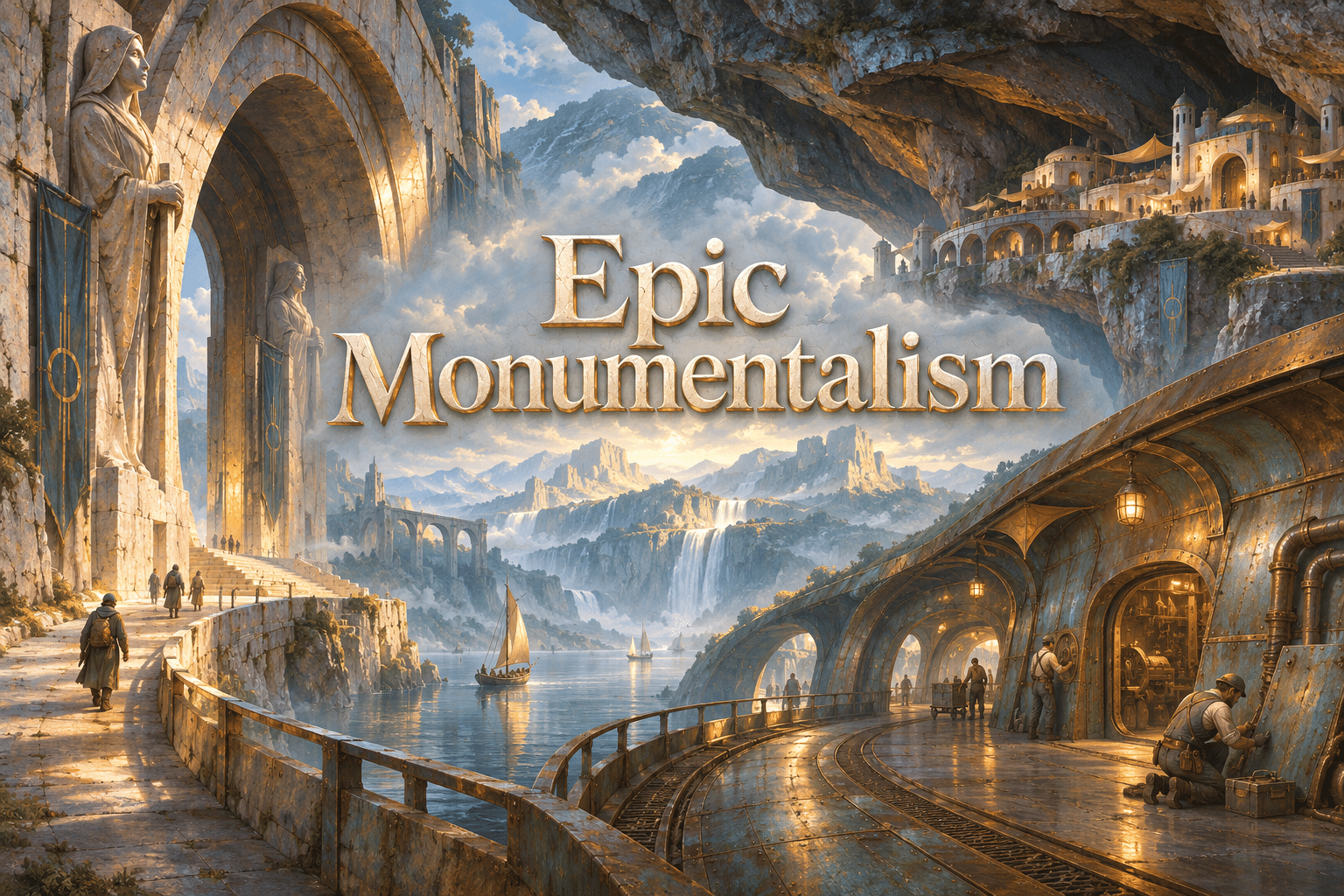
Seven original AI-generated interpretations: a dedicated banner, an artistic title collage and five standalone examples. The studies explore different subjects and compositional problems.
Select an image for a closer look. Use the thumbnails, arrow keys or a swipe to compare examples. Zoom in to inspect details, or share the image that inspires you.
Creative toolbox · take this style further
Choose an input and a destination. Search sends your words to the chosen site; Copy & open puts them on your clipboard to paste there.
Create with AI
Turn your chosen input into an image prompt or a new creative direction.
ChatGPT
Copy your input and paste it into a ChatGPT conversation or image request.
Copy & open ChatGPT (new tab)Claude · Anthropic
Develop an image prompt or explore the style in a new Claude conversation.
Copy & open Claude · Anthropic (new tab)Midjourney
Paste your input into the Imagine bar on the Create page.
Copy & open Midjourney (new tab)Adobe Firefly
Copy your input, open Firefly, and paste it into the prompt field.
Copy & open Adobe Firefly (new tab)Leonardo.Ai
Copy your input, open Leonardo, and paste it into the generation field.
Copy & open Leonardo.Ai (new tab)Image search
Find visual references. Short, concrete keywords usually work best.
Lexica
Search AI images and prompts using your selected input.
Search with this input Lexica (new tab)Pexels
Search the photo and video library. Short keywords often work best.
Search with this input Pexels (new tab)Pixabay
Search photos, illustrations and other images.
Search with this input Pixabay (new tab)Unsplash
Search photographs using the style name or your own keywords.
Search with this input Unsplash (new tab)Wikimedia Commons
Search photographs, artworks and historical images. Check each file for its source and reuse terms.
Search with this input Wikimedia Commons (new tab)Art & research
Explore artists, collections and the ideas behind a style.
Wikipedia
Search for background reading. A style may not have its own article.
Search with this input Wikipedia (new tab)WikiArt
Copy your input into WikiArt’s search to explore artists and artworks.
Copy & open WikiArt (new tab)Europeana
Paste your keywords into the search to explore European museum, library and archive collections.
Copy & open Europeana (new tab)Inspiration
Discover portfolios and visual ideas from creative communities.
Instagram hashtags
Search a hashtag made from your input: spaces and punctuation are removed. Instagram may require sign-in.
Search with this input Instagram hashtags (new tab)ArtStation
Paste your input into artwork search for concept art, environments, characters and visual development.
Copy & open ArtStation (new tab)Behance
Paste your input into project search for illustration, design and visual storytelling.
Copy & open Behance (new tab)A closer look
Give one mountain, structure, figure or abstract mass command of the frame. Establish its scale with a readable doorway, traveler or boat, then lead the eye toward a meaningful threshold or change. Use overlapping depth, atmospheric separation and light that reveals volume. Large quiet areas allow the decisive event to register.
The interpretation used here
AOI uses Epic Monumentalism as a descriptive visual brief, not as the name of a newly discovered historical school. It brings together three decisions: a dominant mass, a familiar measure of scale and an event that makes the encounter matter. A tiny person beside an enormous door is a starting point; a person arriving as that door opens gives the scale a narrative consequence.
Epic and monumental are already part of wider critical vocabularies. Birgit Neumann's 2013 article on postcolonial literatures discusses the relationship between epic form, monumental remembrance and challenges to its authority. That literary argument is context for thinking critically about grandeur, not documentation of an AOI painting movement. No exclusive invention of the words or the underlying idea is claimed here. [1]
Two comparisons, two kinds of scale
Thomas Cole's The Titan's Goblet (1833) gives an imagined landscape an enormous vessel holding a smaller world. The Metropolitan Museum of Art describes ruins around its rim, boats on the water and several competing interpretations. It does not supply a single settled explanation. The useful comparison for this workshop is relational scale: ordinary recognizable things make the extraordinary form readable. Cole is a reference, not an adherent of this AOI concept. [2]
Richard Serra's The Matter of Time (1994–2005) offers a different comparison. The Guggenheim Museum Bilbao describes eight weathering-steel sculptures whose changing passages shape the visitor's movement and perception. In a picture, we cannot reproduce the experience of walking through that installation, but we can ask where the viewer seems able to stand or pass. Monumentality can arise through enclosure and bodily orientation as well as a distant panoramic view. [3]
Make the size believable
Choose a primary scale anchor and keep its size consistent. A person, stair tread, boat or handrail gives the eye a familiar unit; repeating that unit at different depths helps establish distance. If nearby doors contradict the size of nearby figures, the illusion can collapse. Avoid relying on a meaningless speck that could equally be a person, a bird or a flaw in the image.
Divide depth into a foreground foothold, a middle passage and the dominant mass beyond it. Overlap explains which forms sit in front; receding contrast can help separate distances in a hazy atmosphere. Clear air may need less softening. A low viewpoint can enlarge a structure's presence, but it is an option, not a rule: an elevated view can reveal a monument's relation to an entire landscape.
Give the monument something to do
A monumental subject should affect the scene. A gate diverts a procession; a dam changes the path of water; a mountain shelters a settlement; a memorial creates a place to stop. Light can expose that relationship by finding an entrance or the edge of a human route. A structure that has no consequence beyond looking enormous often feels like a backdrop assembled from impressive parts.
For a restrained composition, let the main form occupy most of the frame and keep the decisive action small but clear. For a panoramic variation, allow the mass to sit off center while a river or road carries the approach toward it. For an intimate variation, crop the form so its full extent is never visible and use a doorway, seam or hand to establish the encounter. These three framings can share the same visual grammar without repeating the same vista.
Material, light and emotional tone
Stone, weathered metal, ice and cloud produce different kinds of grandeur. Broad planes can give stone weight; a continuous curve can make metal feel enclosing; translucent edges can give ice a brittle intensity. Describe where joints, supports and erosion belong before adding ornament. An imagined building need not be engineering documentation, but its masses should have intelligible relationships.
Golden light suggests ceremony in one scene and exhausted aftermath in another. Cool overcast light can make an enormous form feel quiet and exposed. A single beam can reveal depth, but a beam in every gap turns atmosphere into decoration. Keep some surfaces simple enough to read as volumes. Monumentality can survive a subdued palette and an empty sky; it does not require saturation, explosions or a crowd.
What grandeur asks the viewer to believe
Decide whether the image celebrates, questions or merely observes the dominant form. Where do ordinary people have room to act? What lies outside the ceremonial viewpoint? A cracked stair, a maintenance crew or a path that bypasses the official entrance can complicate the image without making its scale less convincing. This is an AOI editorial exercise in point of view, not a claim about the intentions of every historical monument.
Epic Monumentalism differs here from Epic Fantasy Matte Painting by its organizing emphasis: a single scale relationship and its consequence, rather than the broader craft or genre of environment-making. It differs from Maximalist Composition because it can succeed with very few elements. It can overlap with either approach, but scale, density and medium should remain separate decisions.
A three-pass workshop
First reduce the composition to three values and confirm that its largest shape is immediately legible. Then add one unmistakable human-scale anchor and a route connecting it to the main mass. Finally introduce the event: an opening, a crossing, a repair or a change of weather. Remove details that neither clarify scale nor deepen the encounter. Inspect the result at thumbnail size and check the small figures at full resolution.
The approach suits speculative landscapes, architectural illustration, covers and contemplative visual narratives. Caption generated scenes as original interpretations. The historical comparisons belong in the references; they are not evidence that an invented site, structure or ceremony actually existed.
Positive editorial perspective
AOI editorial perspective (AI-authored). The approach can make scale carry narrative and emotion with very few elements. A clear human measure and a consequential threshold give the viewer both orientation and a reason to care.
Negative editorial perspective
AOI editorial perspective (AI-authored). It easily slips into interchangeable giant-door imagery. Inconsistent scale, decorative fog and unexamined glorification weaken the result; specify an inhabitant's purpose and a credible spatial route.
Neutral editorial perspective
AOI editorial perspective (AI-authored). This is an AOI composition brief that can work across painting, architectural illustration and speculative imagery. Its historical comparisons clarify separate visual problems without establishing a unified historical movement.
A small poetic detour
Original words from the AOI studio.
Poetry
The stair begins beside a human shoe.
Above it, stone forgets the size of hands.
Cloud crosses where the highest windows were;
a bell takes time to reach the landing.
One worker lifts a lamp inside the gate.
The wall, immense and blind a moment earlier,
shows a seam.
We enter through the part that can be mended.
The prompt workshop
Original creative exercises. These prompts create new illustrations, not documentary evidence.
The first opening
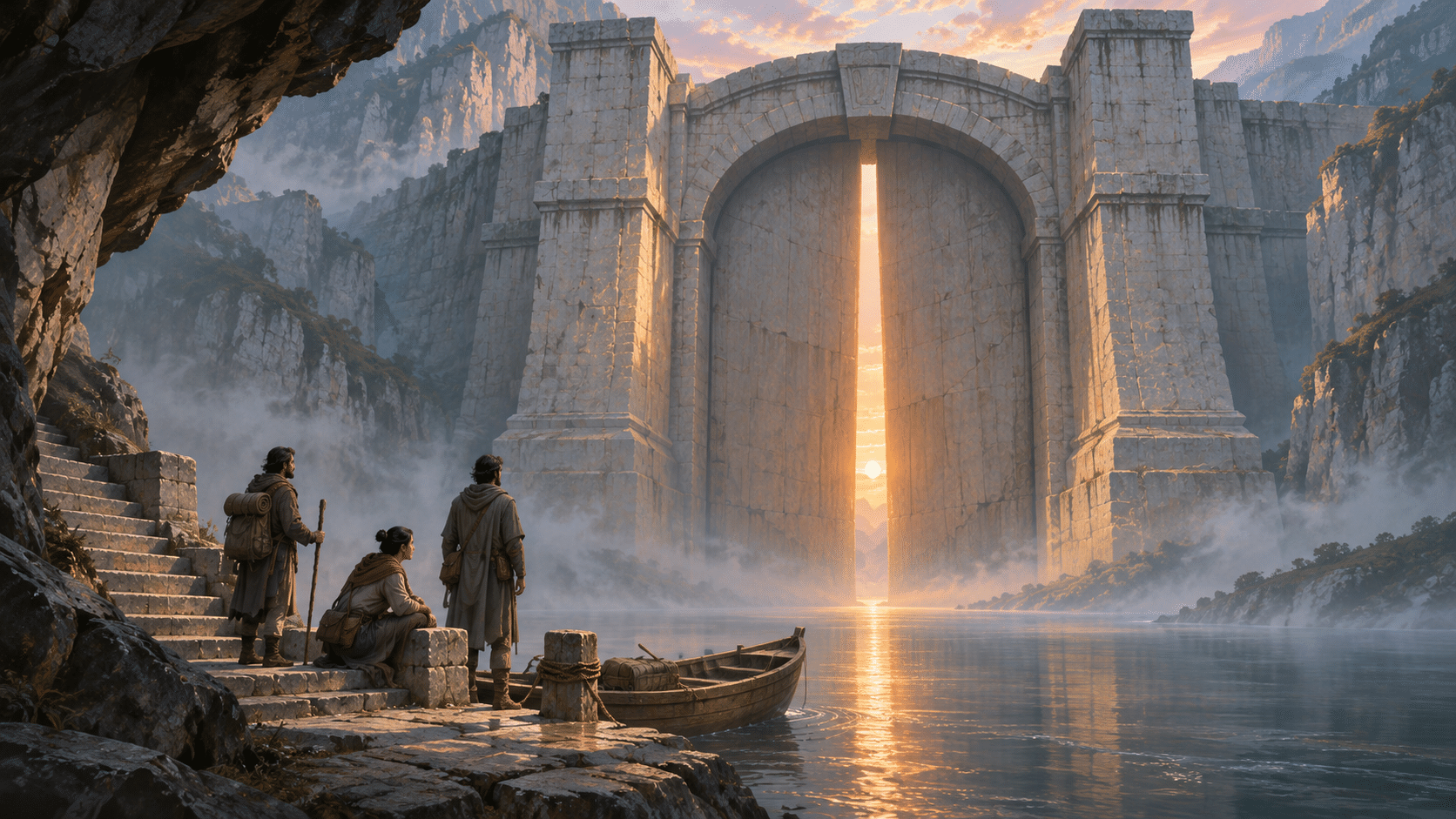
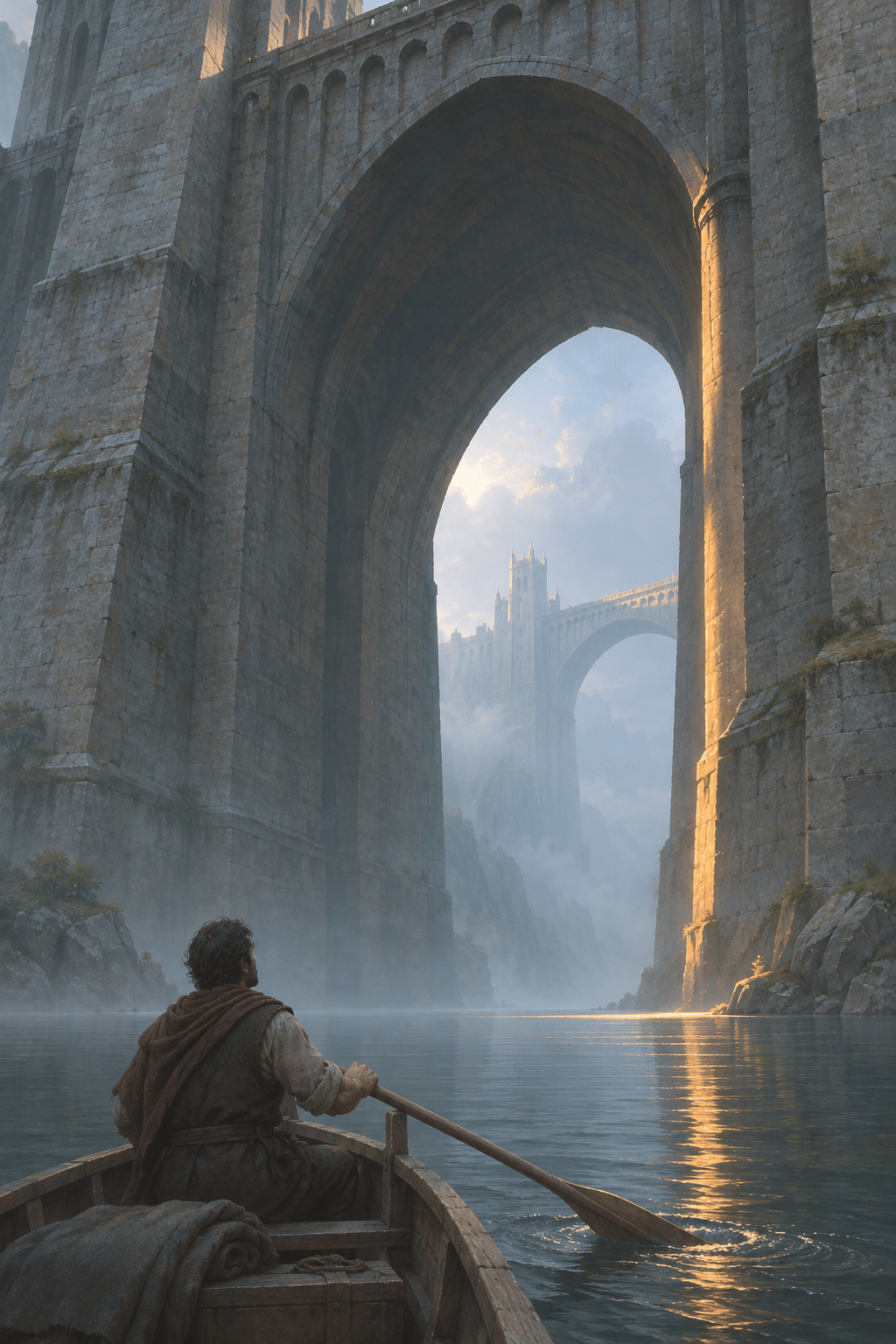
Create an original monumental landscape of a single immense stone gate opening above a small river landing at dawn. Three adult travelers and their boat establish a consistent scale. Organize the image into dark foreground rock, a misty approach and one dominant gate mass. Show thick piers, coherent joints and a narrow band of light at the opening. Restrained limestone, blue-gray mist and warm light; no lettering, logos or borrowed architectural landmark.
The event at the opening should explain why the structure matters.
The mountain's shelter
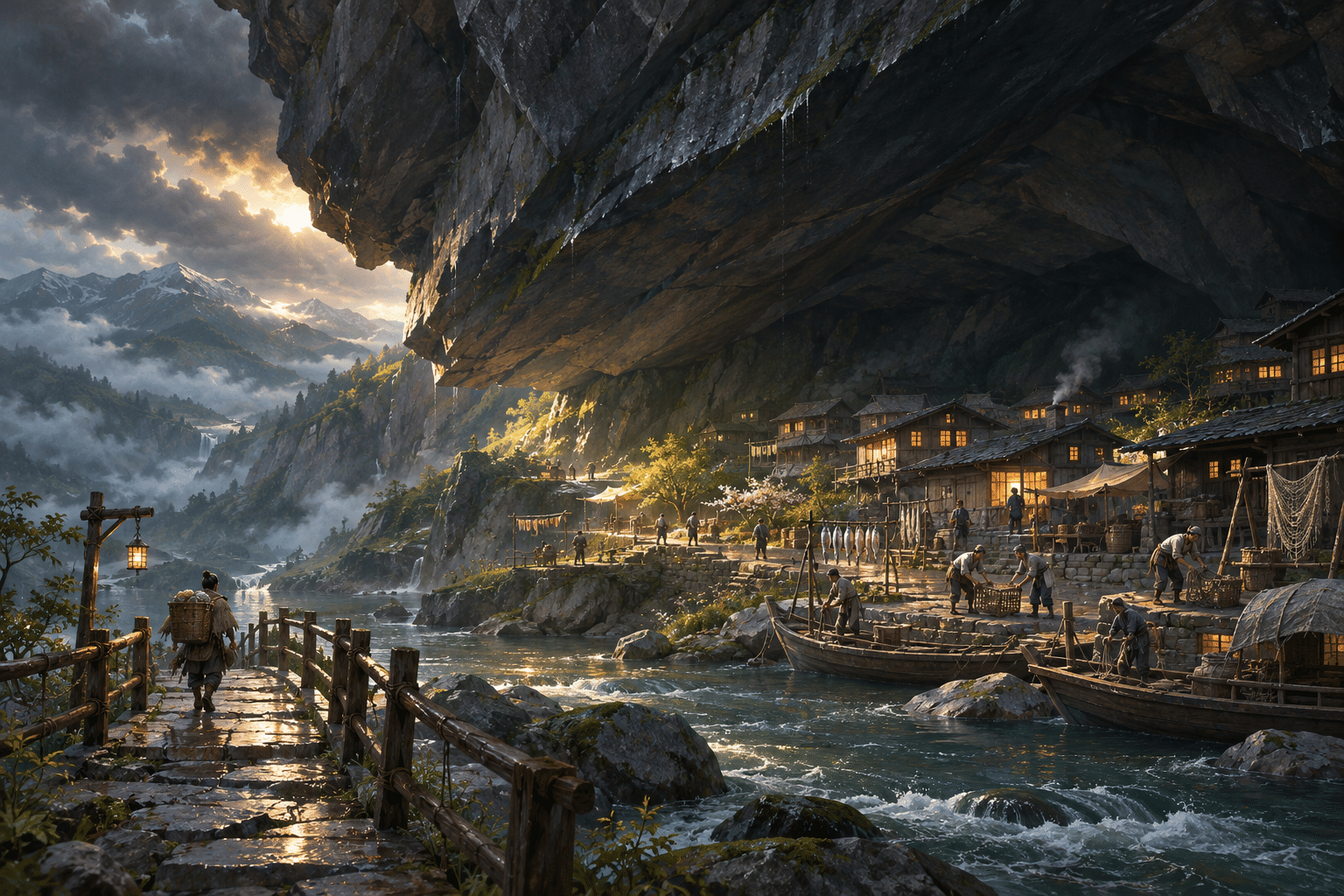
Paint an original panoramic landscape in which a vast overhanging mountain shelters a small settlement during a passing storm. Place the main mass off center; lead the eye along a river from a visible foreground footbridge to warm windows. Use credible scale changes, overlap and layered atmosphere, with broad quiet rock planes. Show people as active inhabitants, not indistinguishable dots. No text or signature.
Compare the settlement's agency with a scene where the giant form merely overwhelms it.
Inside the unfinished monument
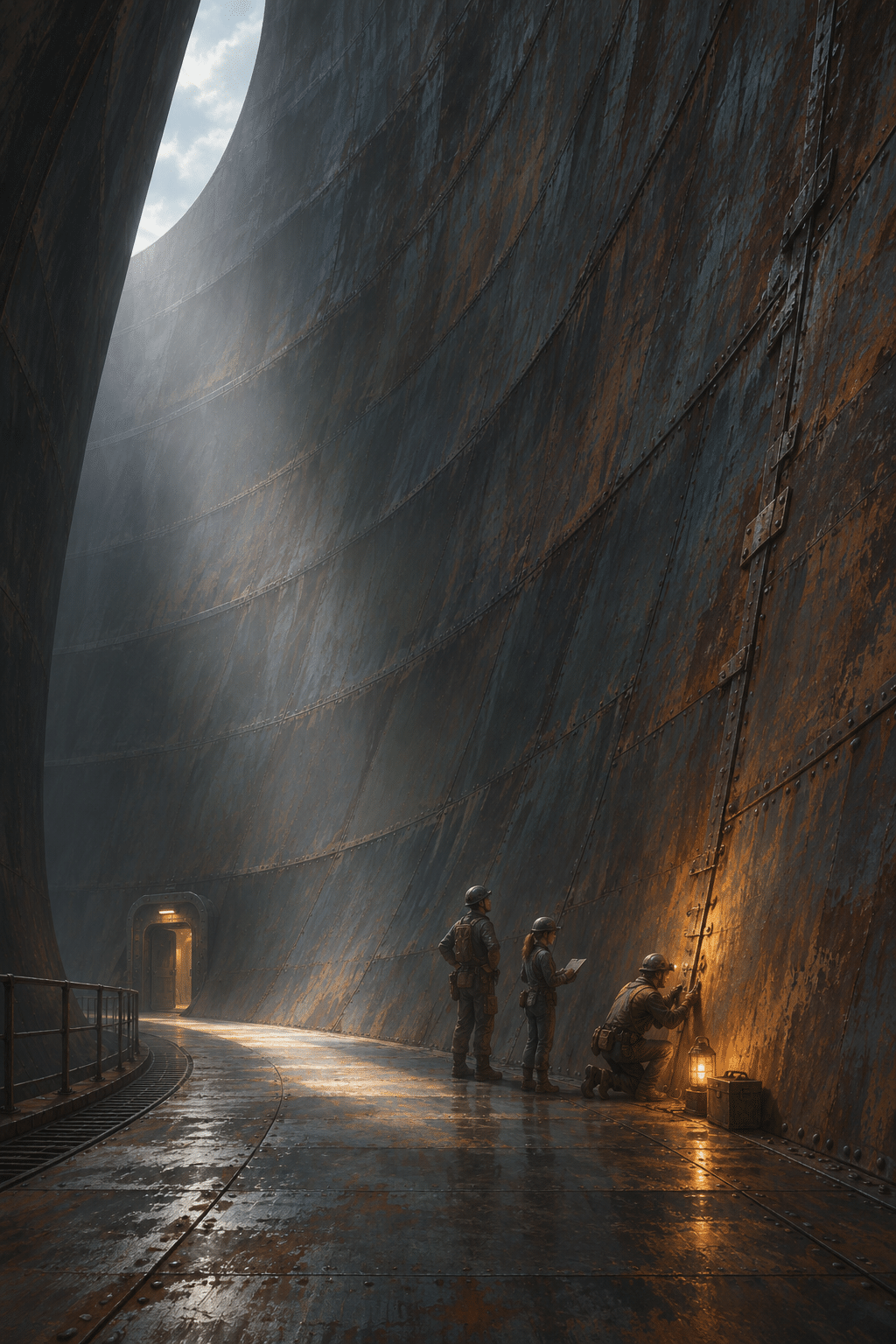
Create a near-monochrome architectural artwork from inside an immense imaginary curved structure. Its full outline remains beyond the frame. A small maintenance crew and a normal-sized doorway establish scale; one worker's light reveals a repair seam. Use weathered metal, a believable floor plane, a narrow sky opening and a clear route through the space. Quiet, immense and unresolved; no spectacle effects, text or signature.
Test monumentality through enclosure and use rather than a distant heroic view.
A smile from the studio
Jokes
The architect unveiled a gate so enormous that clouds needed entry permits. The client admired its grandeur, then asked where the doorbell was. 'At the summit.' 'And how do visitors announce themselves?' The architect considered the problem. 'Historically.' The maintenance team installed a small button at ground level and became the most beloved figures in the entire epic.