
Ecologically engaged artistic practice
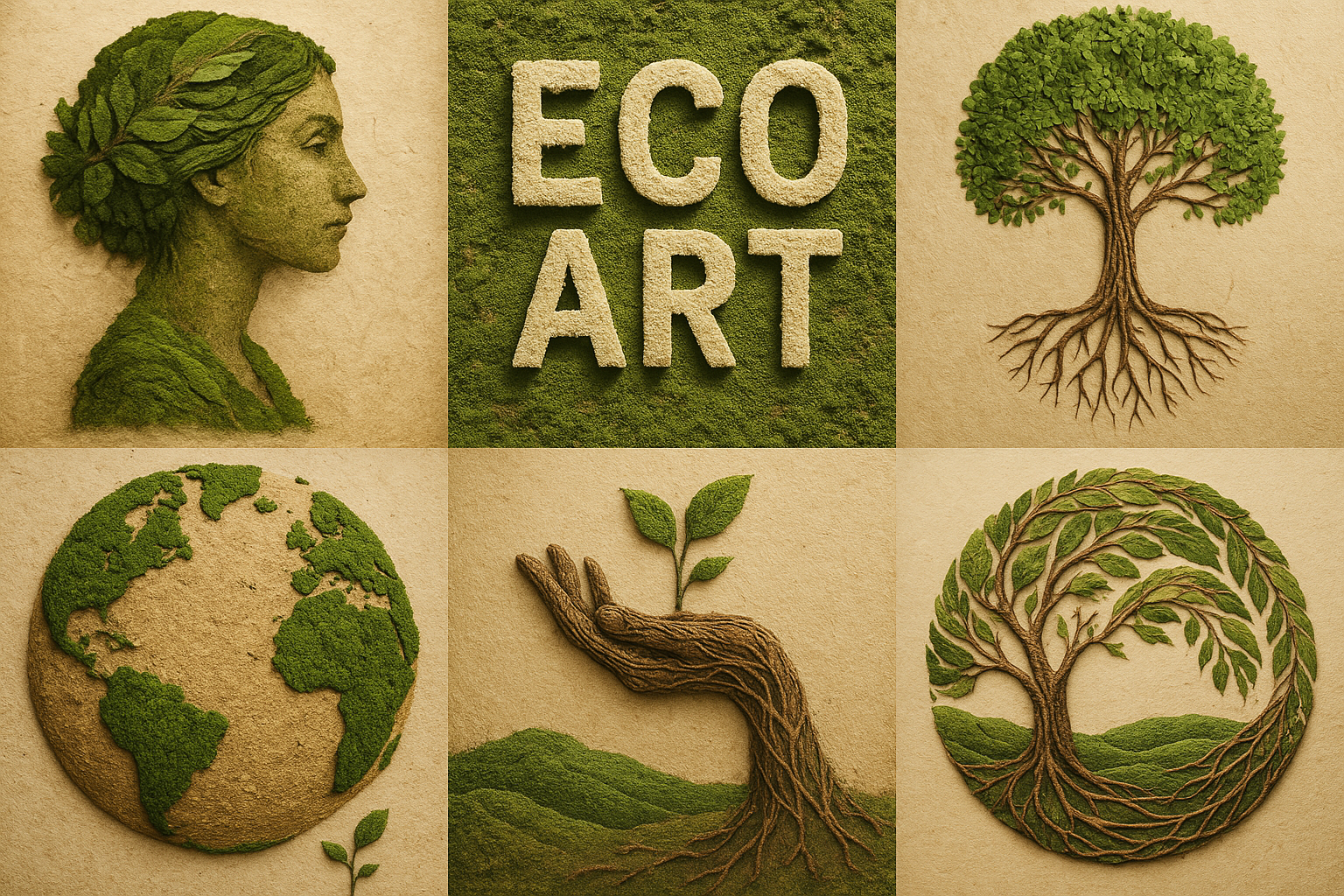
Eco Art is commonly used as a short form of ecological art. This practical companion focuses on developing and evaluating a project; the Ecological Art overview addresses the wider field. A green palette or natural material alone does not establish ecological value.
A visual introduction
Select an image for a closer look. Use the thumbnails, arrow keys or a swipe to compare examples. Zoom in to inspect details, or share the image that inspires you.
Creative toolbox · take this style further
Choose an input and a destination. Search sends your words to the chosen site; Copy & open puts them on your clipboard to paste there.
Create with AI
Turn your chosen input into an image prompt or a new creative direction.
ChatGPT
Copy your input and paste it into a ChatGPT conversation or image request.
Copy & open ChatGPT (new tab)Claude · Anthropic
Develop an image prompt or explore the style in a new Claude conversation.
Copy & open Claude · Anthropic (new tab)Midjourney
Paste your input into the Imagine bar on the Create page.
Copy & open Midjourney (new tab)Adobe Firefly
Copy your input, open Firefly, and paste it into the prompt field.
Copy & open Adobe Firefly (new tab)Leonardo.Ai
Copy your input, open Leonardo, and paste it into the generation field.
Copy & open Leonardo.Ai (new tab)Image search
Find visual references. Short, concrete keywords usually work best.
Lexica
Search AI images and prompts using your selected input.
Search with this input Lexica (new tab)Pexels
Search the photo and video library. Short keywords often work best.
Search with this input Pexels (new tab)Pixabay
Search photos, illustrations and other images.
Search with this input Pixabay (new tab)Unsplash
Search photographs using the style name or your own keywords.
Search with this input Unsplash (new tab)Wikimedia Commons
Search photographs, artworks and historical images. Check each file for its source and reuse terms.
Search with this input Wikimedia Commons (new tab)Art & research
Explore artists, collections and the ideas behind a style.
Wikipedia
Search for background reading. A style may not have its own article.
Search with this input Wikipedia (new tab)WikiArt
Copy your input into WikiArt’s search to explore artists and artworks.
Copy & open WikiArt (new tab)Europeana
Paste your keywords into the search to explore European museum, library and archive collections.
Copy & open Europeana (new tab)Inspiration
Discover portfolios and visual ideas from creative communities.
Instagram hashtags
Search a hashtag made from your input: spaces and punctuation are removed. Instagram may require sign-in.
Search with this input Instagram hashtags (new tab)ArtStation
Paste your input into artwork search for concept art, environments, characters and visual development.
Copy & open ArtStation (new tab)Behance
Paste your input into project search for illustration, design and visual storytelling.
Copy & open Behance (new tab)A closer look
The visual form may involve maps, installations, performances, living systems or documentation; it should make a particular environmental relationship understandable.
Begin with a question that can be investigated
Agnes Denes's account of Wheatfield—A Confrontation describes a planted field in lower Manhattan whose setting made land use and value central to the work. The project is useful to study because its form and location sharpened a specific question.
For a new proposal, identify the system involved: water movement, maintenance, waste, habitat or access to land. Replace an abstract instruction to “celebrate nature” with a question about what happens, who participates and what the audience should notice.
Choose a form that reveals the relationship
A map can show a flow, a performance can make labor visible, and an installation can bring a process into an encounter with viewers. The form should fit the question rather than default to decorative leaves and recycled-looking textures.
The Queens Museum's account of Mierle Laderman Ukeles connects maintenance work with the structures that sustain everyday life. It offers a useful example of environmental attention extending beyond attractive landscapes to labor and systems.
Distinguish intention, activity and outcome
An artwork can raise a question without proving that it repaired an ecosystem. Record what was actually done and what evidence supports any claimed result. A proposed planting, a completed planting and a demonstrated ecological benefit are different stages.
For a collaborative project, make contributors' roles visible and agree how their knowledge and work will be represented. A compelling image should not erase the people who maintain a site after an exhibition or event ends.
Plan for the life of the project
Consider materials, transport, maintenance and what happens when the work is removed. Reuse is one decision among several, not a universal guarantee of sustainability. Explain tradeoffs in concrete terms appropriate to the actual project.
The prompts below are visual concepts, not environmental assessments or records of completed interventions. Use them to test how a relationship could become visible. For the broader context, continue with AOI's Ecological Art article; the two labels refer to overlapping practice, not rival movements with invented separate origins.
A small poetic detour
Original words from the AOI studio.
Poetry
Leaf whispers softly, / Nature's palette woven bright,
/ Silent plea for Earth.
The prompt workshop
Original creative exercises. These prompts create new illustrations, not documentary evidence.
Make a flow visible
Original eco-art concept diagram showing a neighborhood’s rainwater journey through recognizable places, clear visual hierarchy and no invented measured data.
Maintenance as subject
Original installation proposal making the tools and repeated tasks of caring for a shared garden visible, contributors represented respectfully and no false documentary claim.
A project lifecycle
Original visual concept comparing the assembly, use and disassembly of a reusable exhibition structure, concrete material relationships rather than generic green symbolism.