
Site-related artistic practice
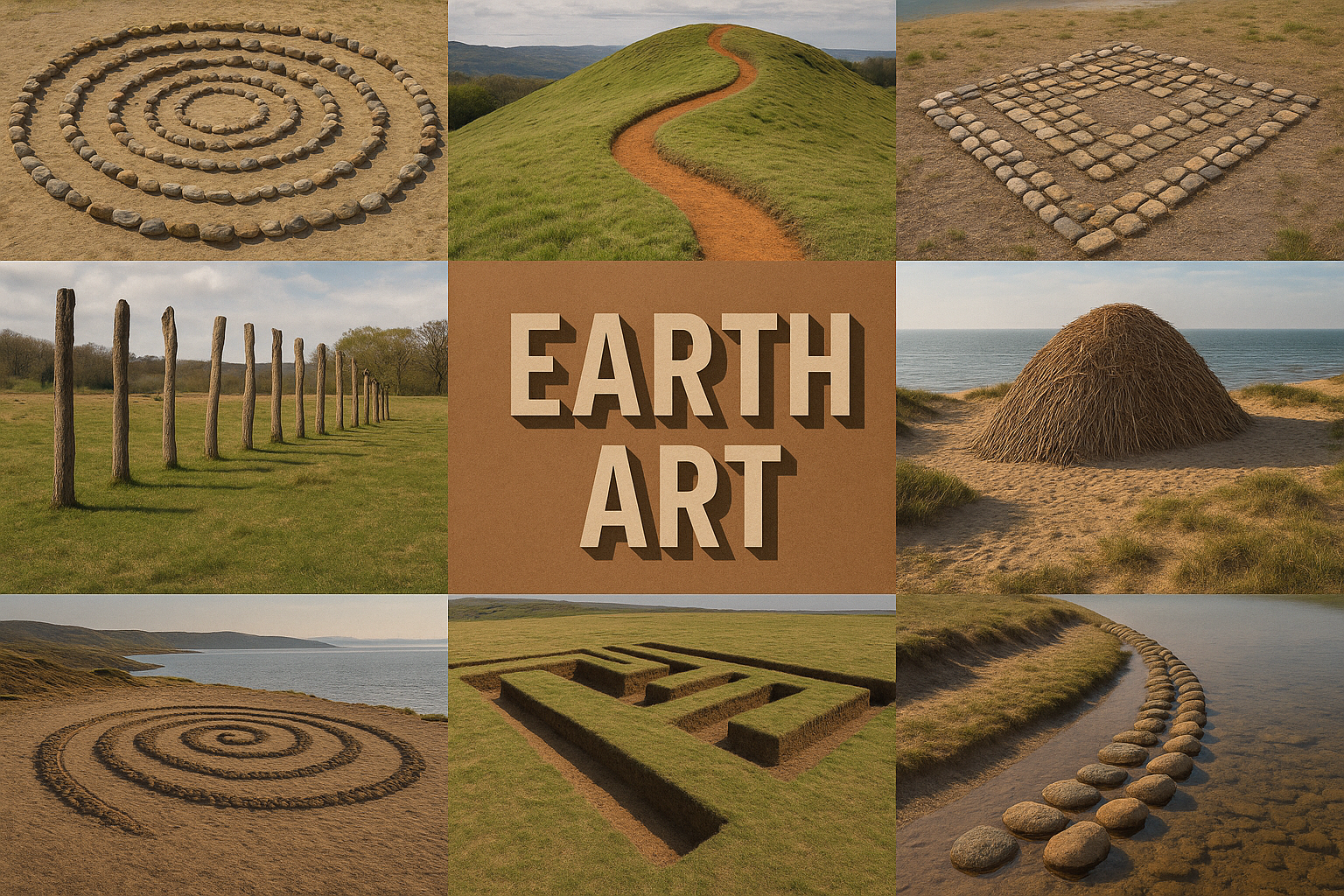
Earth Art, often discussed alongside Land Art, treats land, site and physical processes as central to a work. It can involve intervention, arrangement or an encounter with a place; it is not automatically ecological restoration or temporary sculpture.
A visual introduction
Select an image for a closer look. Use the thumbnails, arrow keys or a swipe to compare examples. Zoom in to inspect details, or share the image that inspires you.
Creative toolbox · take this style further
Choose an input and a destination. Search sends your words to the chosen site; Copy & open puts them on your clipboard to paste there.
Create with AI
Turn your chosen input into an image prompt or a new creative direction.
ChatGPT
Copy your input and paste it into a ChatGPT conversation or image request.
Copy & open ChatGPT (new tab)Claude · Anthropic
Develop an image prompt or explore the style in a new Claude conversation.
Copy & open Claude · Anthropic (new tab)Midjourney
Paste your input into the Imagine bar on the Create page.
Copy & open Midjourney (new tab)Adobe Firefly
Copy your input, open Firefly, and paste it into the prompt field.
Copy & open Adobe Firefly (new tab)Leonardo.Ai
Copy your input, open Leonardo, and paste it into the generation field.
Copy & open Leonardo.Ai (new tab)Image search
Find visual references. Short, concrete keywords usually work best.
Lexica
Search AI images and prompts using your selected input.
Search with this input Lexica (new tab)Pexels
Search the photo and video library. Short keywords often work best.
Search with this input Pexels (new tab)Pixabay
Search photos, illustrations and other images.
Search with this input Pixabay (new tab)Unsplash
Search photographs using the style name or your own keywords.
Search with this input Unsplash (new tab)Wikimedia Commons
Search photographs, artworks and historical images. Check each file for its source and reuse terms.
Search with this input Wikimedia Commons (new tab)Art & research
Explore artists, collections and the ideas behind a style.
Wikipedia
Search for background reading. A style may not have its own article.
Search with this input Wikipedia (new tab)WikiArt
Copy your input into WikiArt’s search to explore artists and artworks.
Copy & open WikiArt (new tab)Europeana
Paste your keywords into the search to explore European museum, library and archive collections.
Copy & open Europeana (new tab)Inspiration
Discover portfolios and visual ideas from creative communities.
Instagram hashtags
Search a hashtag made from your input: spaces and punctuation are removed. Instagram may require sign-in.
Search with this input Instagram hashtags (new tab)ArtStation
Paste your input into artwork search for concept art, environments, characters and visual development.
Copy & open ArtStation (new tab)Behance
Paste your input into project search for illustration, design and visual storytelling.
Copy & open Behance (new tab)A closer look
Ground, horizon, movement through space and changes in material or weather can shape the work; a photograph records a particular encounter rather than the entire site.
The site is part of the work
Dia's account of Robert Smithson's Spiral Jetty identifies its location, materials and continuing stewardship. The work cannot be fully understood as an isolated spiral shape detached from the Great Salt Lake and the experience of its setting.
This is a useful distinction from a sculpture merely placed outdoors. Ask what would change if the work moved elsewhere. If the answer is almost nothing, the site's role may be incidental rather than central to the concept.
Scale and viewpoint alter perception
A ground-level encounter, a distant view and an aerial photograph reveal different relationships. The apparent form may be clear from one position and fragmented from another. Movement and duration can therefore matter as much as a single image.
For an original proposal, show how a viewer approaches the work and what becomes visible along the way. Do not rely entirely on a spectacular overhead view if the intended experience occurs on foot.
Change is not always disappearance
Weather, water, vegetation and maintenance can alter a work. That does not mean all Earth Art is ephemeral or that every change was intended. Consult the specific artist's and steward's documentation before assigning a theory of decay to a project.
A concept study can compare several plausible states over time, clearly labelled as projections. Record what is supposed to remain stable and what may change. This gives the proposal more substance than a single image of a beautiful landscape intervention.
Environmental claims need evidence
Working with earth or natural materials does not automatically make a project environmentally beneficial. Site disturbance, material movement, access and long-term care need consideration in real projects. Keep Earth Art distinct from ecological art while acknowledging their possible overlaps.
Begin a small exercise with an authorized, low-impact setting or a model rather than altering a sensitive site. A generated image is useful for exploring relationships, but it is not evidence of a built earthwork or an ecological outcome. The strongest proposal explains why this place, this material and this duration belong together.
A small poetic detour
Original words from the AOI studio.
Poetry
Stones whisper secrets,
In nature's vast embrace,
Time shapes fleeting dreams.
The prompt workshop
Original creative exercises. These prompts create new illustrations, not documentary evidence.
Site as composition
Original concept study of a modest land-art arrangement in an authorized open setting, the ground and horizon shaping the design, no claim of construction.
A route through space
Original three-view proposal showing an earth-art concept from approach, eye level and distance, consistent site relationships rather than an aerial image alone.
Change over time
Original conceptual sequence of a small outdoor arrangement under changing light and weather, projected states clearly distinguished from documentation.