
Historical field of art
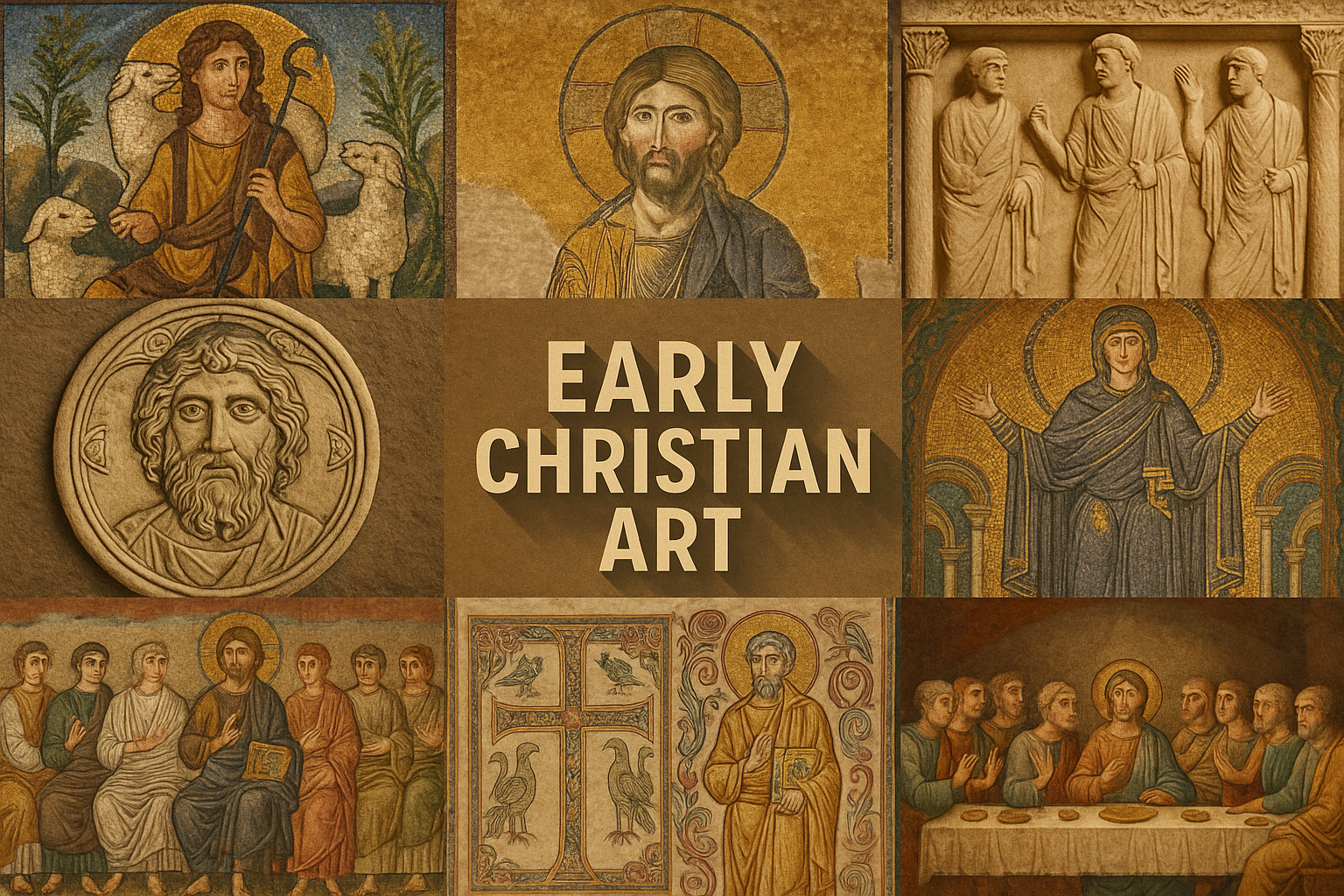
Early Christian art developed within the varied visual cultures of late antiquity. Its images and objects should be understood through their settings, materials and audiences, rather than as a single break with everything Roman.
A visual introduction
Select an image for a closer look. Use the thumbnails, arrow keys or a swipe to compare examples. Zoom in to inspect details, or share the image that inspires you.
Creative toolbox · take this style further
Choose an input and a destination. Search sends your words to the chosen site; Copy & open puts them on your clipboard to paste there.
Create with AI
Turn your chosen input into an image prompt or a new creative direction.
ChatGPT
Copy your input and paste it into a ChatGPT conversation or image request.
Copy & open ChatGPT (new tab)Claude · Anthropic
Develop an image prompt or explore the style in a new Claude conversation.
Copy & open Claude · Anthropic (new tab)Midjourney
Paste your input into the Imagine bar on the Create page.
Copy & open Midjourney (new tab)Adobe Firefly
Copy your input, open Firefly, and paste it into the prompt field.
Copy & open Adobe Firefly (new tab)Leonardo.Ai
Copy your input, open Leonardo, and paste it into the generation field.
Copy & open Leonardo.Ai (new tab)Image search
Find visual references. Short, concrete keywords usually work best.
Lexica
Search AI images and prompts using your selected input.
Search with this input Lexica (new tab)Pexels
Search the photo and video library. Short keywords often work best.
Search with this input Pexels (new tab)Pixabay
Search photos, illustrations and other images.
Search with this input Pixabay (new tab)Unsplash
Search photographs using the style name or your own keywords.
Search with this input Unsplash (new tab)Wikimedia Commons
Search photographs, artworks and historical images. Check each file for its source and reuse terms.
Search with this input Wikimedia Commons (new tab)Art & research
Explore artists, collections and the ideas behind a style.
Wikipedia
Search for background reading. A style may not have its own article.
Search with this input Wikipedia (new tab)WikiArt
Copy your input into WikiArt’s search to explore artists and artworks.
Copy & open WikiArt (new tab)Europeana
Paste your keywords into the search to explore European museum, library and archive collections.
Copy & open Europeana (new tab)Inspiration
Discover portfolios and visual ideas from creative communities.
Instagram hashtags
Search a hashtag made from your input: spaces and punctuation are removed. Instagram may require sign-in.
Search with this input Instagram hashtags (new tab)ArtStation
Paste your input into artwork search for concept art, environments, characters and visual development.
Copy & open ArtStation (new tab)Behance
Paste your input into project search for illustration, design and visual storytelling.
Copy & open Behance (new tab)A closer look
Figures, gestures and familiar motifs could acquire new meanings; narrative grouping and the relationship between an image and its setting are central to interpretation.
Continuity and reinterpretation
The Vatican Museums' account of early imagery describes the Christian reinterpretation of pastoral and other familiar themes, alongside the increasing use of biblical subjects. A shepherd image cannot be identified solely by assuming that every similar figure has the same religious meaning.
The Met's study of late antique and early Christian art presents this period as one of cultural transformation and invention. Avoid describing it simply as declining technical skill after classical art. Different visual priorities can be deliberate and meaningful.
Identify the object and its setting
A sarcophagus relief, wall painting, mosaic and small personal object function differently. Ask where the work was placed, how it was viewed and what can actually be established about its audience. Material evidence should guide interpretation.
For a formal study, note the image's divisions. A sequence of figures may be arranged to make relationships legible rather than to imitate one continuous naturalistic space. Repeated gestures or changes in scale may contribute to emphasis, but their meanings need a specific context.
Read imagery without inventing certainty
Use a museum's identification of a scene as a starting point, and distinguish confident identification from scholarly uncertainty. Do not assign a biblical name to an ambiguous generated figure and present that image as a historical example.
When comparing works, separate what is visible from what is inferred. A raised hand is an observable gesture; its precise narrative or ritual meaning may require additional evidence. This distinction makes the article more informative than a list of universal symbols.
Translate principles into an original study
An accessible exercise is to organize a simple narrative into a few clearly separated episodes. Use gesture, spacing and repeated visual elements to connect them. Choose a material vocabulary that fits the proposed object rather than combining every late antique feature at once.
A contemporary religious or secular interpretation should explain its own purpose. Generated examples can demonstrate narrative arrangement or relief-like form, but they are not reconstructions of lost Christian monuments. Preserve the difference between a historically documented source and a new visual response.
A small poetic detour
Original words from the AOI studio.
Poetry
Silent mosaics speak,
Walls whisper heavenly tales,
Light through faith-bound eyes.
The prompt workshop
Original creative exercises. These prompts create new illustrations, not documentary evidence.
Narrative relief study
Original contemporary relief concept telling a simple story of welcome in three episodes, clear gesture and shallow spatial divisions, no claim of an ancient find.
Material and meaning
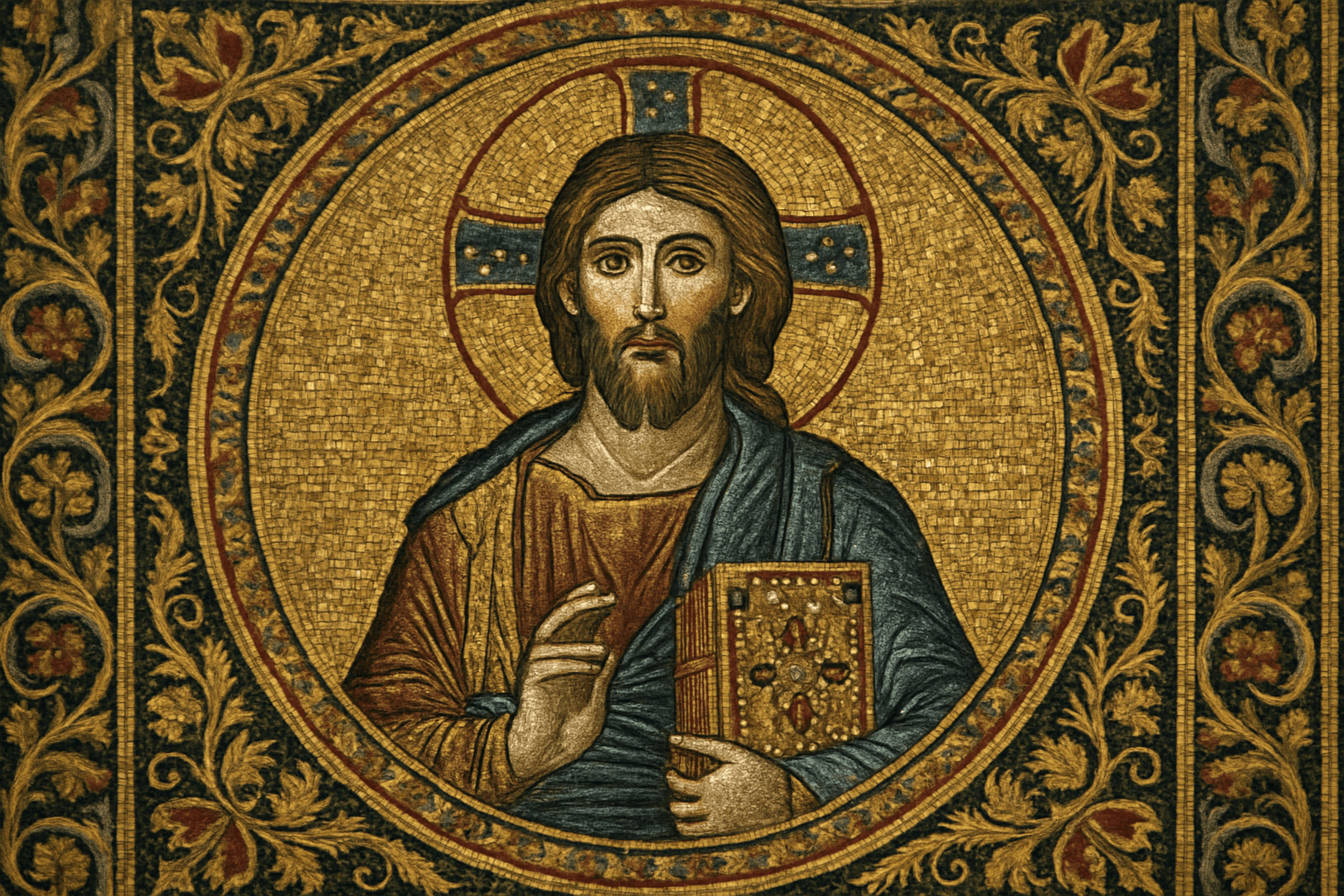
Original late-antique-inspired mosaic study of a garden and a small human gathering, coherent tessera scale and readable grouping, explicitly a modern interpretation.
A restrained scene
Original painted study using a few figures and repeated gestures to connect separate narrative moments, simple ground and careful spacing, no fabricated inscription.
Sources and further exploration
Vatican Museums — the Good Shepherd, Jonah and developing imagery