
Historical field of art · late antiquity
Early Christian art gave new meanings to familiar late-antique forms. Explore painted rooms, carved narratives, mosaics, architecture and small objects through their material and religious settings.
A visual introduction
Seven new AI-generated interpretations explore mosaic, painting, relief, architecture and a small clay object. They are contemporary studies, not historical reproductions or archaeological reconstructions. The earlier illustration remains for comparison.
Select an image for a closer look. Use the thumbnails, arrow keys or a swipe to compare examples. Zoom in to inspect details, or share the image that inspires you.

Creative toolbox · take this style further
Choose an input and a destination. Search sends your words to the chosen site; Copy & open puts them on your clipboard to paste there.
Create with AI
Turn your chosen input into an image prompt or a new creative direction.
ChatGPT
Copy your input and paste it into a ChatGPT conversation or image request.
Copy & open ChatGPT (new tab)Claude · Anthropic
Develop an image prompt or explore the style in a new Claude conversation.
Copy & open Claude · Anthropic (new tab)Midjourney
Paste your input into the Imagine bar on the Create page.
Copy & open Midjourney (new tab)Adobe Firefly
Copy your input, open Firefly, and paste it into the prompt field.
Copy & open Adobe Firefly (new tab)Leonardo.Ai
Copy your input, open Leonardo, and paste it into the generation field.
Copy & open Leonardo.Ai (new tab)Image search
Find visual references. Short, concrete keywords usually work best.
Lexica
Search AI images and prompts using your selected input.
Search with this input Lexica (new tab)Pexels
Search the photo and video library. Short keywords often work best.
Search with this input Pexels (new tab)Pixabay
Search photos, illustrations and other images.
Search with this input Pixabay (new tab)Unsplash
Search photographs using the style name or your own keywords.
Search with this input Unsplash (new tab)Wikimedia Commons
Search photographs, artworks and historical images. Check each file for its source and reuse terms.
Search with this input Wikimedia Commons (new tab)Art & research
Explore artists, collections and the ideas behind a style.
Wikipedia
Search for background reading. A style may not have its own article.
Search with this input Wikipedia (new tab)WikiArt
Copy your input into WikiArt’s search to explore artists and artworks.
Copy & open WikiArt (new tab)Europeana
Paste your keywords into the search to explore European museum, library and archive collections.
Copy & open Europeana (new tab)Inspiration
Discover portfolios and visual ideas from creative communities.
Instagram hashtags
Search a hashtag made from your input: spaces and punctuation are removed. Instagram may require sign-in.
Search with this input Instagram hashtags (new tab)ArtStation
Paste your input into artwork search for concept art, environments, characters and visual development.
Copy & open ArtStation (new tab)Behance
Paste your input into project search for illustration, design and visual storytelling.
Copy & open Behance (new tab)A closer look
Readable gestures, repeated figures, ordered gardens and narrative groupings can be more important than continuous illusionistic space. Surfaces range from painted plaster and shallow marble relief to individual mosaic tesserae; there is no single universal early Christian palette.
A historical field, not a single visual formula
Early Christian art concerns images, objects and buildings associated with the emergence and development of Christian communities in late antiquity. Its surviving material is diverse: a painted room in Roman Syria, a funerary relief in Rome and a later monumental mosaic do not share one audience, function or level of patronage. The category helps us ask related questions, but it should not flatten differences of place, date and use.
Christian artists and patrons worked within existing visual cultures. The Vatican Museums describe how pastoral, philosophical and other familiar themes could acquire Christian meanings, with biblical narratives appearing alongside inherited imagery. A shepherd is therefore not a self-explanatory religious label. Context, associated scenes and the particular object matter. Nor should changes in proportion or spatial treatment automatically be described as a decline from classical skill; legibility, emphasis and religious purpose can organize an image differently.
Start with a documented setting
The Christian building at Dura-Europos offers a particularly concrete case. Yale’s account dates its conversion from a house to approximately 240 CE and describes a meeting room and a separate decorated baptistery. The paintings were therefore part of an inhabited architectural and ritual setting. Yale also notes that scholars debate some scene identifications. A useful reading preserves that uncertainty rather than turning every damaged figure into a confidently named biblical episode.
The Vatican’s Pio Christian Museum provides a different route through sculpture, including the Good Shepherd statuette and Jonah sarcophagus. Compare a freestanding figure with a sequence of carved scenes: their scale, viewing conditions and ways of organizing attention differ. These documented sources should anchor historical discussion. The new AOI gallery is a set of contemporary visual exercises, not a reconstruction of the Dura building or a collection of newly discovered objects.
Read the surface before interpreting the symbol
Ask what the work is made from and what that material permits. Painted plaster can establish a scene through a few outlines and broad color areas. Shallow relief makes a body legible through overlap, edge and cast shadow. Mosaic organizes an image through countless small pieces whose direction can follow a wing, garment or ripple. A photograph can conceal these differences if every surface is treated as a smooth illustration.
Separate observation from interpretation. A raised hand, a drinking bird or a fish-shaped mark is visible; the meaning attached to it requires evidence. Similar motifs can circulate in different settings. Avoid a universal symbol dictionary in which every vine or bird means exactly the same thing. For a particular historical object, follow the holding institution’s identification and acknowledge alternatives where the source does.
Narrative, gesture and spatial order
A sequence of scenes can communicate through repeated protagonists and changes of action rather than one continuous viewpoint. Architectural divisions, trees and intervals of empty ground help the eye move between episodes. In an original exercise, decide whether the viewer should compare separate moments or read a single gathering. Mixing both systems without a clear hierarchy can make a narrative hard to follow.
Gesture needs restraint. A few large, legible movements often communicate more than a crowd of detailed hands. Consider the direction of a face, the distance between two figures and the relationship between the central action and surrounding space. Frontal presentation, shallow depth or an enlarged central figure should serve a chosen purpose rather than function as an automatic historical filter.
Palette, illumination and architectural scale
Choose color in relation to the proposed medium and setting. An original plaster study may use ochre, red-brown, muted green and blue. A mosaic exercise can explore strong contrasts between pale figures and a dark ground, with small reflective accents. Neither scheme represents every region or century. Gold everywhere can collapse a broad subject into a later, generalized sacred luxury aesthetic.
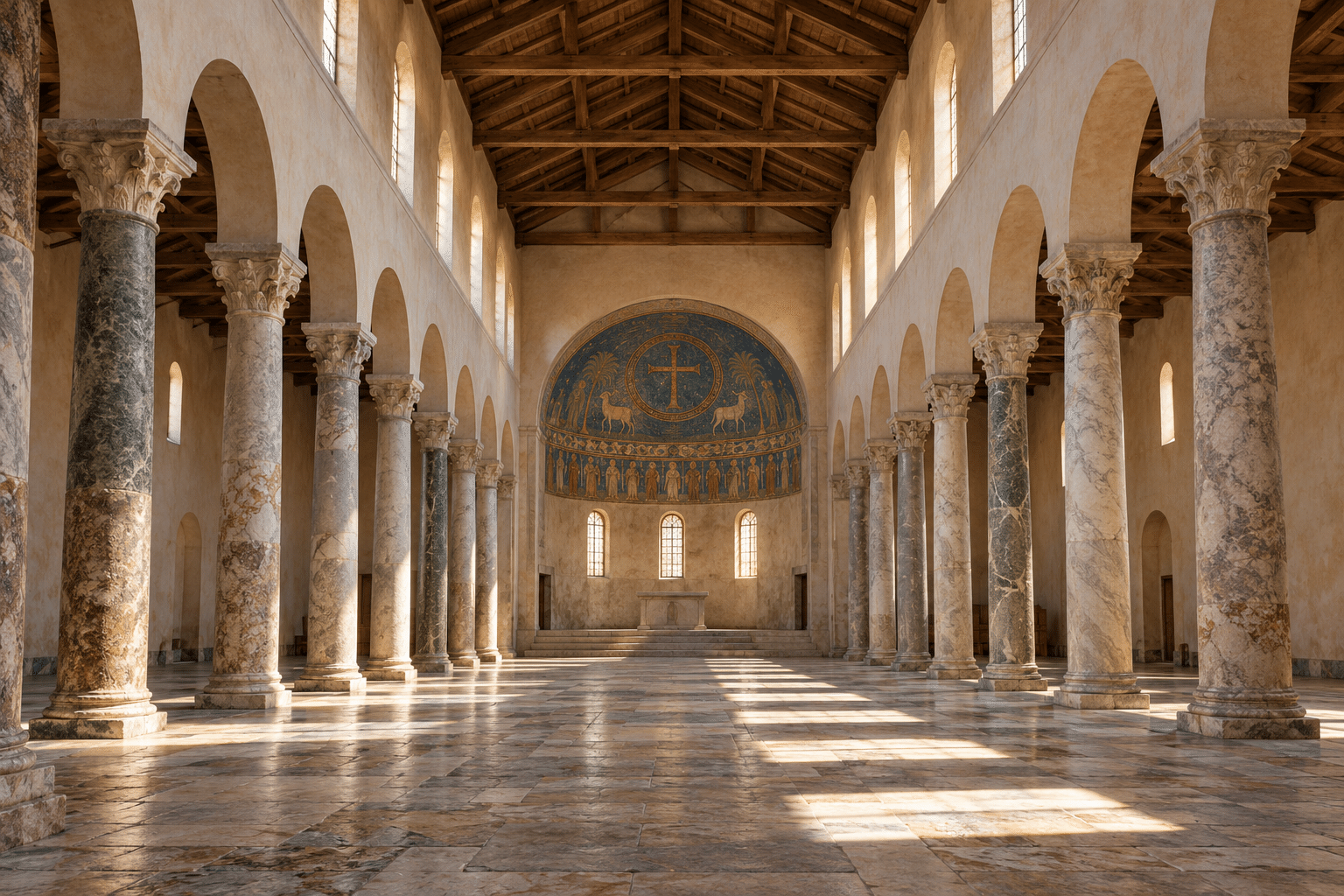
Architecture adds another scale of looking. In the gallery’s basilica-inspired interior, repeated columns and the long nave direct attention toward an apse, while daylight clarifies the structure. This is a contemporary spatial study. It should not be used as evidence for the exact appearance, furnishings or liturgical arrangements of a named early church. A convincing rendering and an archaeological reconstruction have different evidential requirements.
Five studies across materials and uses
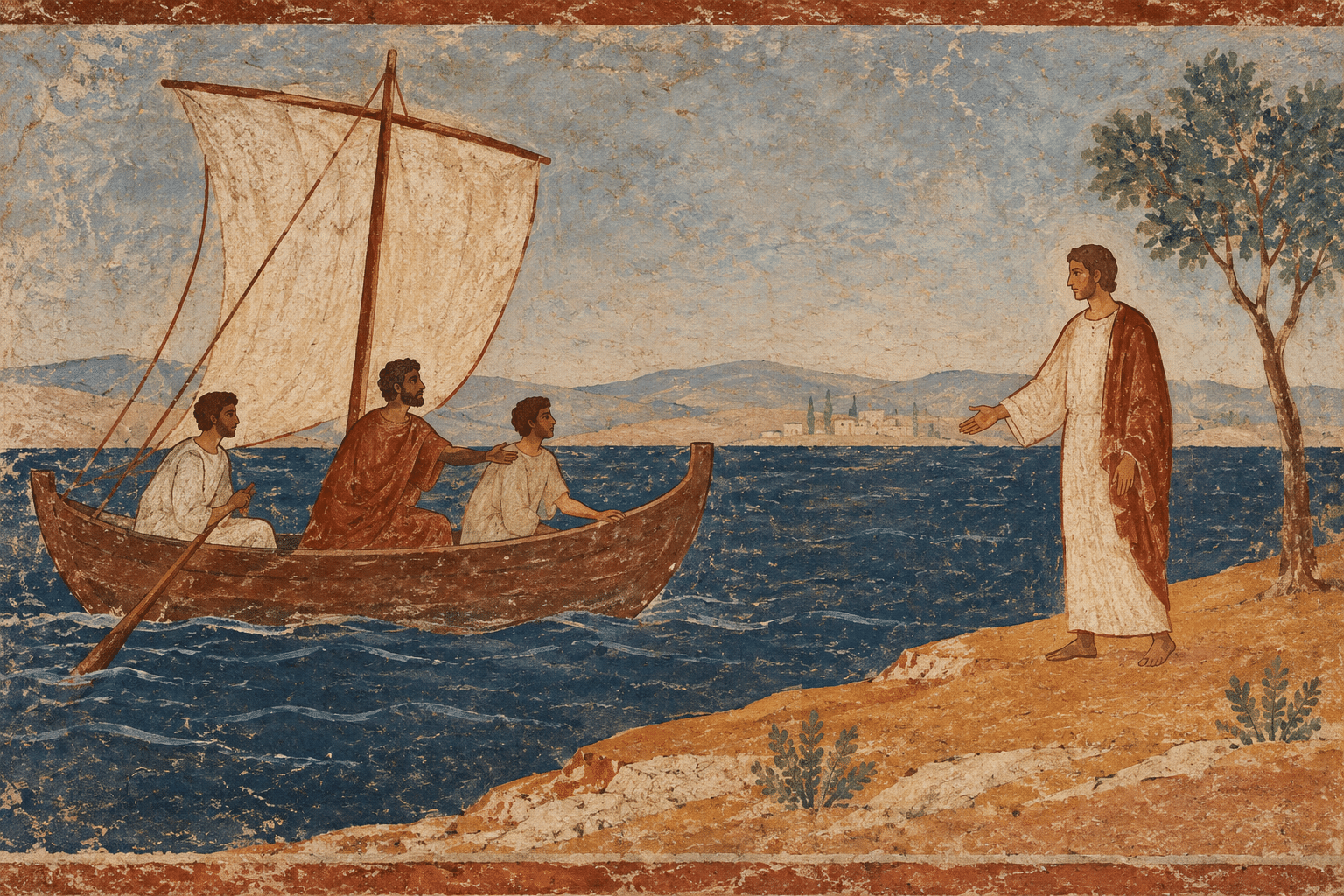
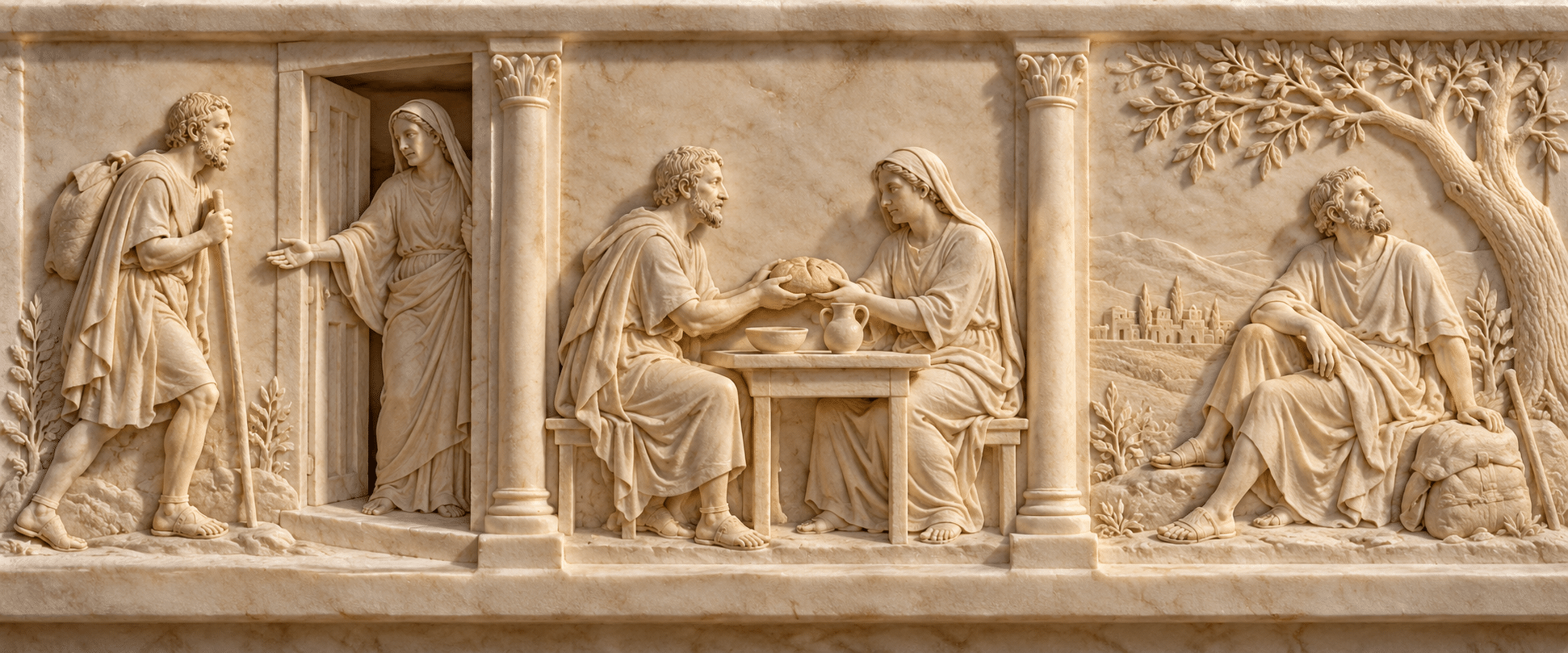
The painted boat scene explores arrival and reassurance through a few figures and an open bank. The marble relief separates a traveler’s welcome, shared food and rest into three episodes. These are invented narratives that demonstrate spacing and sequence; the relief’s relatively naturalistic bodies also make it useful for discussing continuity with classical visual languages.
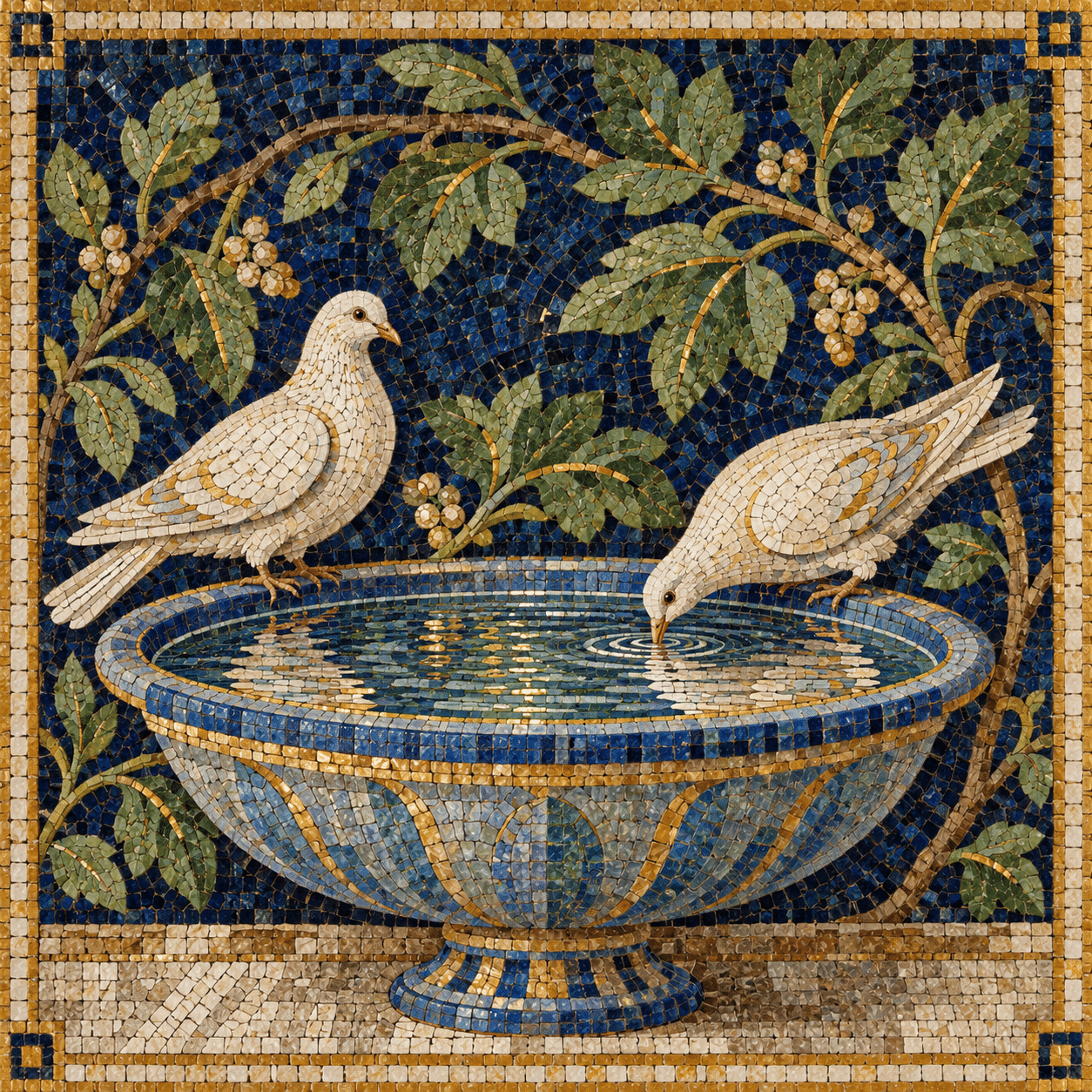
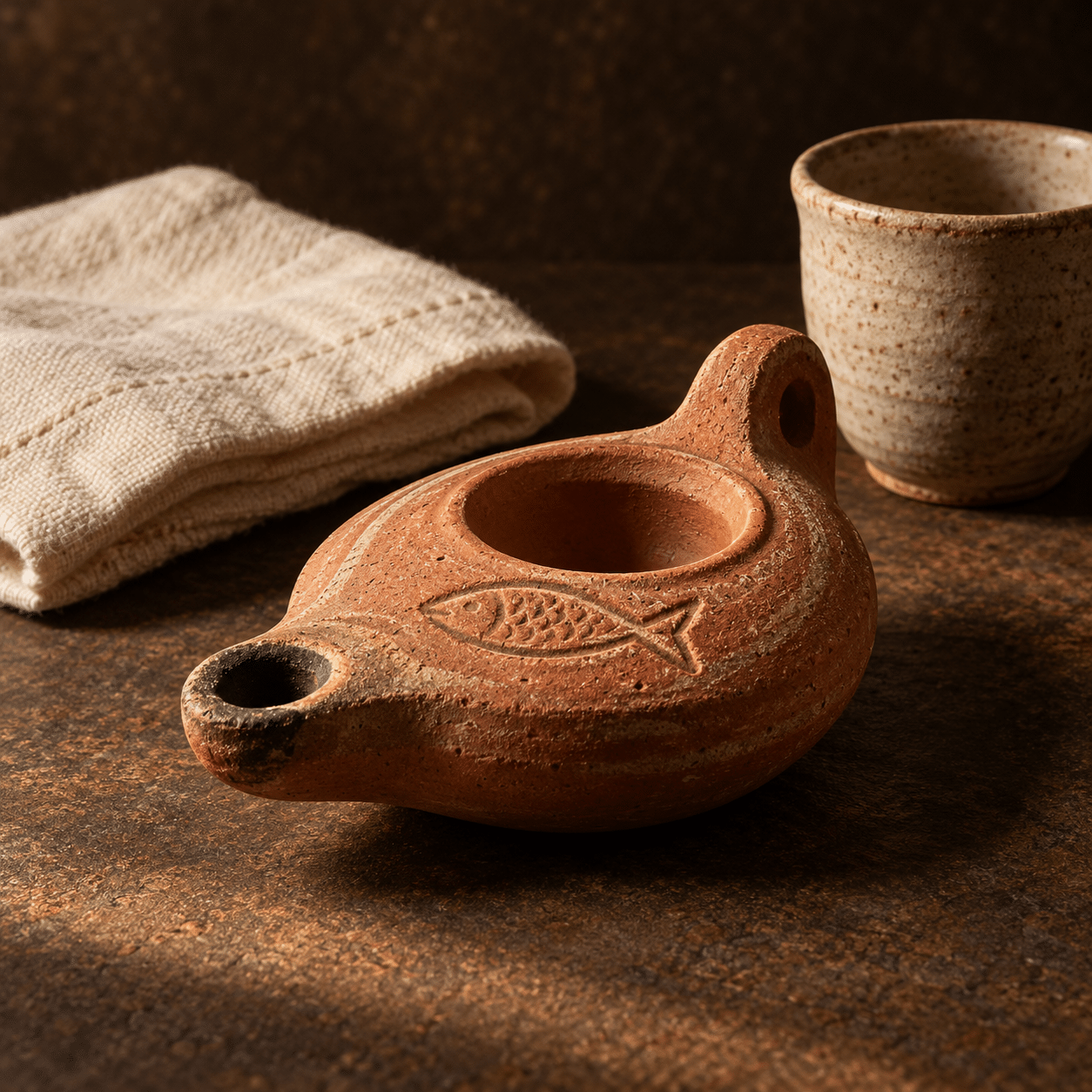
The dove-and-basin mosaic studies the direction of tesserae, repeated curves and a clear material surface. The basilica interior shifts attention from an object to movement through space. The terracotta lamp still life returns to intimate scale, where a small relief motif and a useful form meet. The fish design is a contemporary choice, not a claim that this generated object has historical provenance.
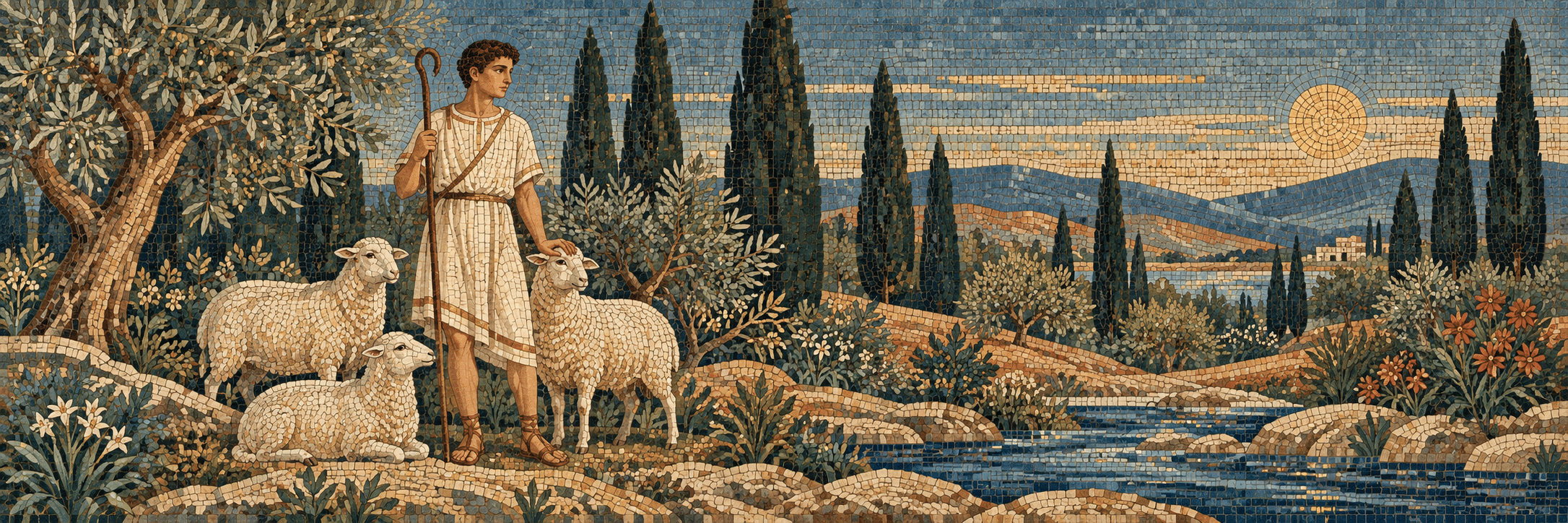
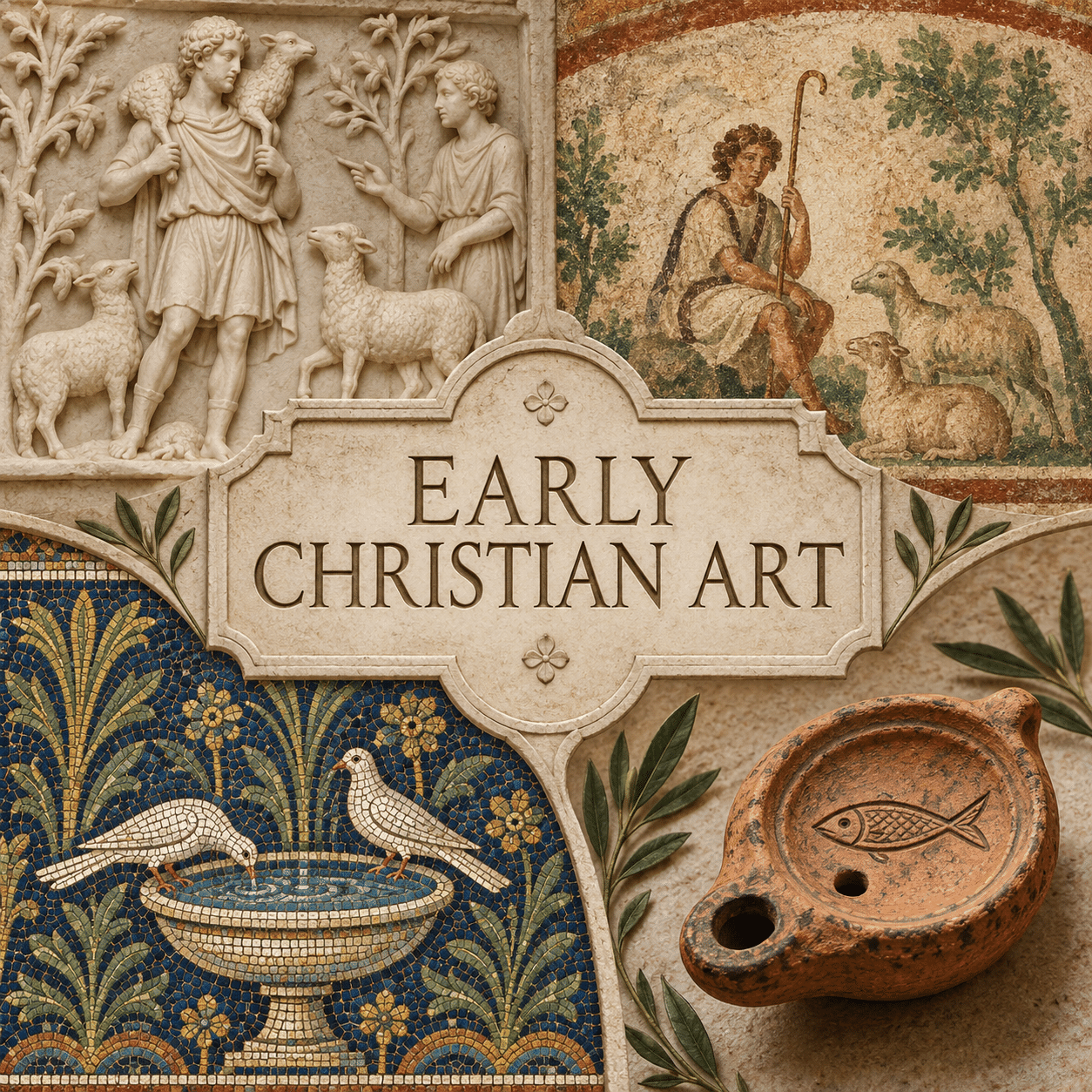
A dedicated shepherd-and-garden banner and a centrally titled collage introduce this range. The collage intentionally juxtaposes materials that should be considered separately in historical research. All new images are AI-generated interpretations; consult the museum and archaeological sources for actual objects, dates and attribution.
A practical workshop in responsible interpretation
Begin with one formal question: how can three moments be connected, how can a mosaic mark describe a curve, or how can a room guide attention? Choose one medium and one scale. Make a rough composition in which the focal action is readable without surface texture. Only then add the material characteristics that support it.
For prompts, use concrete phrases such as shallow narrative relief, separated episodes, restrained mineral colors, tesserae following contours, clerestory daylight and clear repeated gestures. State that the result is a contemporary study. Do not request a fake excavation record, invented inscription or falsely attributed masterpiece. Compare the result with a documented source to identify differences, not to certify authenticity.
Positive editorial assessment — AI-authored
This field rewards close attention to how material, gesture and setting make an image meaningful. The five studies help move beyond a single mosaic stereotype: the narrative relief can be read across time, the interior through space, and the lamp through intimate handling. Their strongest educational contribution is that change of scale and medium.
Critical editorial assessment — AI-authored
Beautiful generated surfaces can disguise historical uncertainty. The polished architecture and intact relief may appear more complete and coherent than surviving evidence allows, while familiar sacred motifs can encourage automatic interpretation. The corrective is explicit labelling, individual object research and comparison with actual fragmentary material. These images demonstrate visual possibilities; they cannot establish historical facts.
Neutral editorial assessment — AI-authored
Early Christian art is a broad historical subject suited to study through specific objects, buildings and communities. The exercises here examine material appearance, narrative structure and architectural attention. They are useful for contemporary illustration and visual analysis, while questions of dating, ritual use and iconographic identity require specialist evidence beyond a generated image.
A small poetic detour
Original words from the AOI studio.
Poetry
A Room for Looking
A hand is raised across the wall;
the painted distance stays.
A little boat approaches shore
through centuries of haze.
The stone repeats a folded sleeve,
the glass divides the light.
A bird bends down toward water held
in blue and patient white.
We do not know each missing name,
each room as it was then.
We leave the gaps their honest space
and learn to look again.
The prompt workshop
Original creative exercises. These prompts create new illustrations, not documentary evidence.
A narrative in three moments
Create an original shallow marble relief showing a traveler arriving, sharing bread and resting, in three clearly separated episodes. Use simple drapery, readable gestures, low spatial depth and raking light. A contemporary late-antique-inspired study, not an ancient object; no inscription.
Judge whether each episode is readable before adding carved detail.
Let the tesserae describe the form
Create a new mosaic study of two doves beside a blue basin, cream and ochre tesserae, a dark blue ground and one green vine. Make the small pieces follow the curves of wings and water. Restrained reflections, clear asymmetry, no text or copied historical composition.
The image visualizes a mosaic surface; it is not a physically assembled mosaic.
Light organizes a sacred room
Imagine a simple basilica-inspired interior with repeated columns, timber roof, high daylight and a distant restrained apse. Use coherent architecture and a calm sequence of light and shadow. Contemporary design interpretation, not a reconstruction of a named church; no Gothic or Baroque additions.
Keep architecture, materials and historical claims distinct.