
Historical field of painting
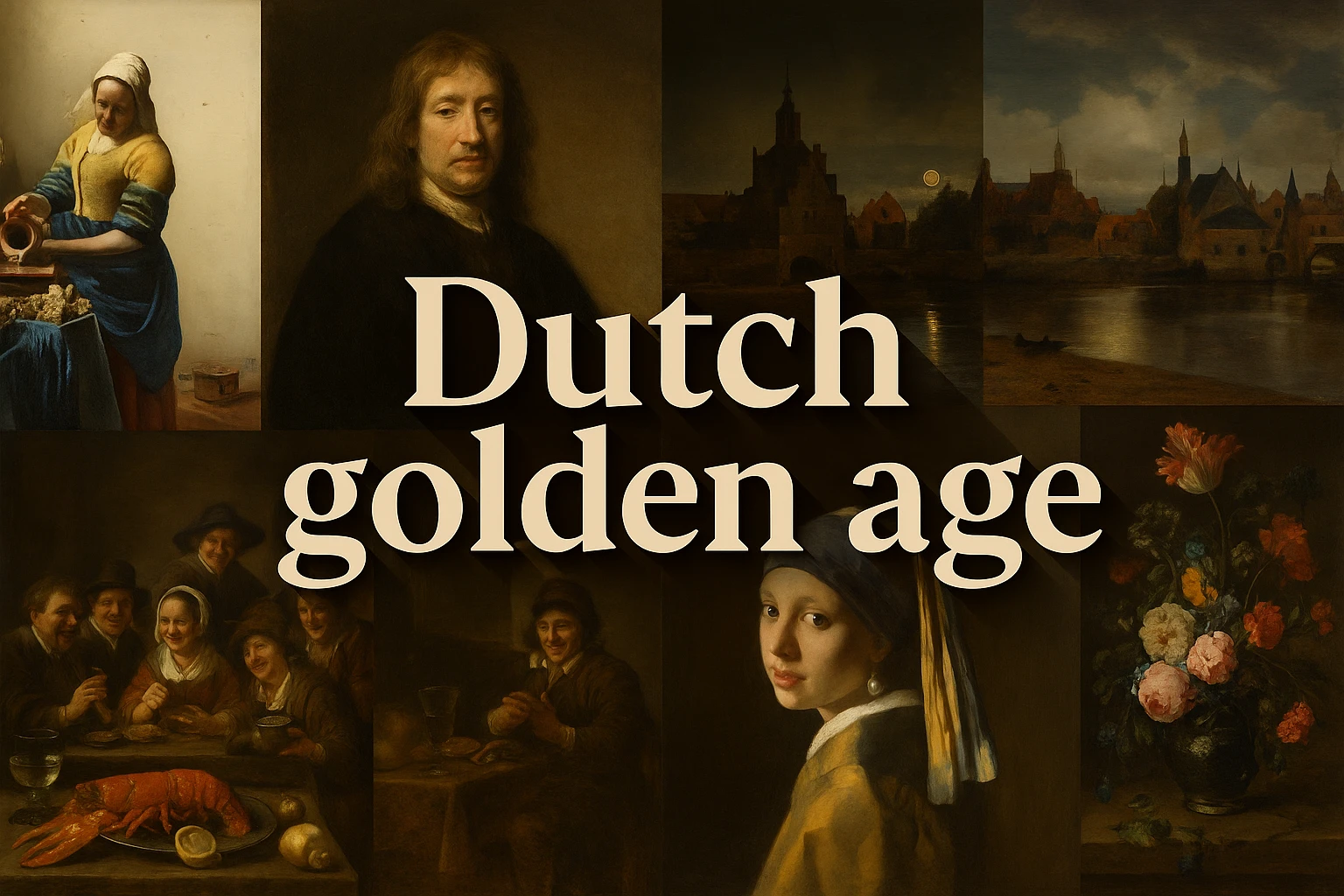
Dutch Golden Age painting refers to the remarkable range of seventeenth-century painting in the Dutch Republic. It includes portraits, landscapes, still lifes, domestic scenes and history paintings, with substantial differences between artists and cities.
A visual introduction
Select an image for a closer look. Use the thumbnails, arrow keys or a swipe to compare examples. Zoom in to inspect details, or share the image that inspires you.
Creative toolbox · take this style further
Choose an input and a destination. Search sends your words to the chosen site; Copy & open puts them on your clipboard to paste there.
Create with AI
Turn your chosen input into an image prompt or a new creative direction.
ChatGPT
Copy your input and paste it into a ChatGPT conversation or image request.
Copy & open ChatGPT (new tab)Claude · Anthropic
Develop an image prompt or explore the style in a new Claude conversation.
Copy & open Claude · Anthropic (new tab)Midjourney
Paste your input into the Imagine bar on the Create page.
Copy & open Midjourney (new tab)Adobe Firefly
Copy your input, open Firefly, and paste it into the prompt field.
Copy & open Adobe Firefly (new tab)Leonardo.Ai
Copy your input, open Leonardo, and paste it into the generation field.
Copy & open Leonardo.Ai (new tab)Image search
Find visual references. Short, concrete keywords usually work best.
Lexica
Search AI images and prompts using your selected input.
Search with this input Lexica (new tab)Pexels
Search the photo and video library. Short keywords often work best.
Search with this input Pexels (new tab)Pixabay
Search photos, illustrations and other images.
Search with this input Pixabay (new tab)Unsplash
Search photographs using the style name or your own keywords.
Search with this input Unsplash (new tab)Wikimedia Commons
Search photographs, artworks and historical images. Check each file for its source and reuse terms.
Search with this input Wikimedia Commons (new tab)Art & research
Explore artists, collections and the ideas behind a style.
Wikipedia
Search for background reading. A style may not have its own article.
Search with this input Wikipedia (new tab)WikiArt
Copy your input into WikiArt’s search to explore artists and artworks.
Copy & open WikiArt (new tab)Europeana
Paste your keywords into the search to explore European museum, library and archive collections.
Copy & open Europeana (new tab)Inspiration
Discover portfolios and visual ideas from creative communities.
Instagram hashtags
Search a hashtag made from your input: spaces and punctuation are removed. Instagram may require sign-in.
Search with this input Instagram hashtags (new tab)ArtStation
Paste your input into artwork search for concept art, environments, characters and visual development.
Copy & open ArtStation (new tab)Behance
Paste your input into project search for illustration, design and visual storytelling.
Copy & open Behance (new tab)A closer look
Observe the organization of light, surfaces and human attention; precise detail is one possibility, alongside economical brushwork, broad atmosphere and dramatic staging.
A field with many audiences
The Metropolitan Museum connects seventeenth-century Dutch painting to an expanding market and diverse secular subjects. The familiar label “Golden Age” describes extraordinary artistic production; it should not imply that prosperity was shared equally or detached from colonialism, slavery and war.
A domestic interior, civic portrait and marine painting addressed different interests. Begin with the particular work and its audience rather than assuming that every painter followed one national formula. The Royal Collection's account helps explain the importance of paintings made for purchasers beyond a single court.
Choose a genre before a palette
For a landscape, consider the relation between land and sky and the route that leads the eye into space. For a portrait, examine gesture, clothing and the interval between sitter and viewer. A still life invites attention to surfaces, arrangement and the implications of possessing particular objects.
These choices matter more than applying a brown filter. Compare sharp and soft edges, exposed and concealed detail, and quiet areas against concentrated highlights. A painting can feel convincing through selective description rather than the equal rendering of every object.
Naturalism is constructed
A scene that appears casually observed may be carefully arranged. Furniture, doorways, glances and patches of light can direct interpretation. Treat apparent realism as an artistic achievement, not proof that the picture is an unedited record of daily life.
Avoid assigning a fixed symbolic meaning to every lemon, flower or window without evidence about the particular work. An object may have several associations, and context matters. Museum collection entries are a better starting point than a universal symbol dictionary.
Make an original study
Choose one visual problem: the reflection of a window in a glass, a figure pausing at a doorway, or a low horizon beneath changing weather. Establish the largest light and dark shapes before adding fine texture.
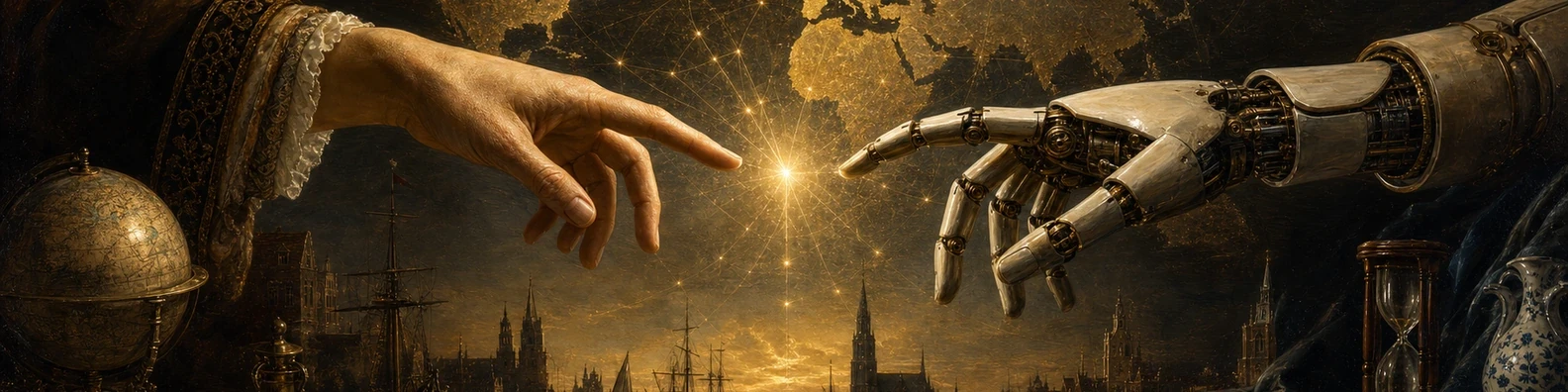
Then ask what the composition leaves out and whose viewpoint it adopts. A contemporary interpretation can learn from these paintings while acknowledging its own subject and time. The retained AOI images are interpretations, not newly identified seventeenth-century works.
The prompt workshop
Original creative exercises. These prompts create new illustrations, not documentary evidence.
Window and glass
Original painted study of a plain glass and folded linen beside a window, selective highlights and quiet warm shadows, carefully observed surfaces, no imitation signature.
A pause at the doorway
Original seventeenth-century Dutch-painting-inspired interior with an adult pausing at an open door, coherent perspective, restrained daylight and meaningful empty space.
Sky as the main event
Original low-horizon landscape with a narrow path and changing cloud light, economical foreground detail, atmospheric distance and a large articulated sky.