Drawing practice · spontaneous marks and deliberate illustration
A doodle can begin with a wandering line, a repeated shape or a tiny creature in the margin. Doodle drawing is a broad practice, not one historical movement with a founding manifesto. Its appeal lies in how little is needed to begin—and how much can happen once a mark invites another.
A visual introduction
Open any image to look closer, then browse the examples.
Creative toolbox · take this style further
Choose an input, adjust it, then open a tool. Search links pass your text to the destination. Copy & open copies it for you to paste into the generator; you start generation there.
ChatGPT
Copy your input and paste it into a ChatGPT conversation or image request.
Copy & open ChatGPT (new tab)Claude · Anthropic
Develop an image prompt or explore the style in a new Claude conversation.
Copy & open Claude · Anthropic (new tab)Midjourney
Paste your input into the Imagine bar on the Create page.
Copy & open Midjourney (new tab)Adobe Firefly
Copy your input, open Firefly, and paste it into the prompt field.
Copy & open Adobe Firefly (new tab)Leonardo.Ai
Copy your input, open Leonardo, and paste it into the generation field.
Copy & open Leonardo.Ai (new tab)Lexica
Search AI images and prompts using your selected input.
Search with this input Lexica (new tab)Pexels
Search the photo and video library. Short keywords often work best.
Search with this input Pexels (new tab)Pixabay
Search photos, illustrations and other images.
Search with this input Pixabay (new tab)Unsplash
Search photographs using the style name or your own keywords.
Search with this input Unsplash (new tab)Wikipedia
Search for background reading. A style may not have its own article.
Search with this input Wikipedia (new tab)WikiArt
Copy your input into WikiArt’s search to explore artists and artworks.
Copy & open WikiArt (new tab)Instagram hashtags
Search a hashtag made from your input: spaces and punctuation are removed. Instagram may require sign-in.
Search with this input Instagram hashtags (new tab)A closer look
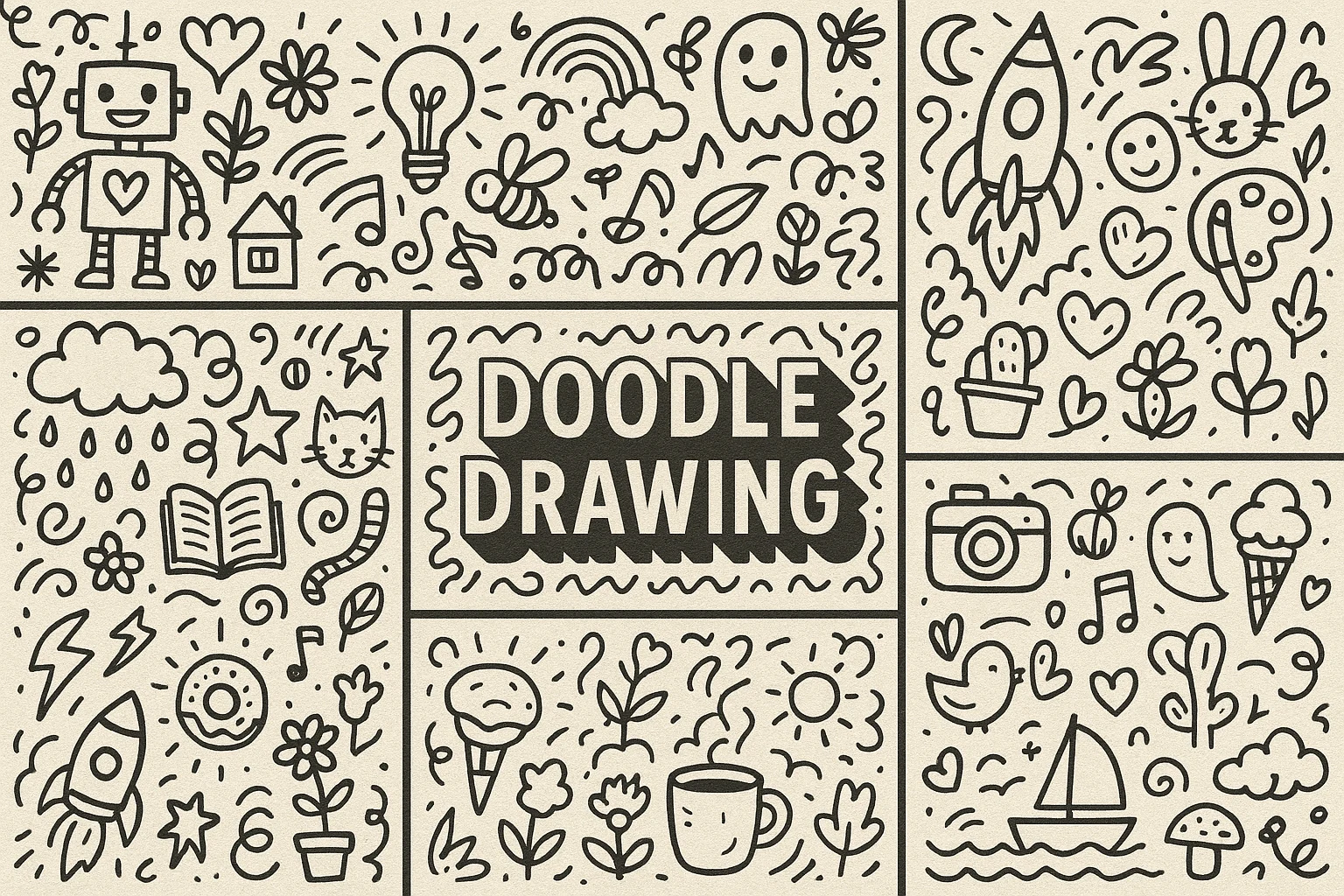
The archive collage groups robots, flowers, rockets, small faces and everyday objects into separate panels. Heavy black outlines hold the motifs together; cream paper and open spaces keep the busy surface readable. This is a composed illustration of a doodle vocabulary, not a record of someone drawing absent-mindedly.
A practice, not a compulsory look
Some doodles happen while attention is partly elsewhere. Others are made on purpose: a page of faces, a border of leaves, an improvised landscape. A finished illustration can borrow those informal marks and still involve planning, revisions and careful composition. Looking casual does not prove that an image was made without thought.
For this guide, the useful distinction is between a process and an appearance. Doodling describes an activity; doodle-style illustration describes a visual approach. Neither demands black ink, a single unbroken line or a cheerful mood. A page can be spare, dense, angular, tender or rather cross. The pen is not obliged to smile.
How small marks become a composition
Begin with a limited family of marks: loops, short dashes and rounded enclosures, for example. Repeat them with changes in scale. A large shape gives the eye a place to arrive; smaller marks can lead it onwards. Leave some areas comparatively quiet. Filling every gap is a choice, not a test you must pass.
In our collage, thick outlines and recurring circles make unlike subjects feel related. The panel divisions offer pauses. Try covering the central lettering and looking at the remaining forms: the balance depends on their size and spacing as much as their recognisability. A rocket and a flower can share a page because their marks cooperate, not because they tell the same story.
Doodling and automatic drawing are neighbours
MoMA describes André Masson’s Automatic Drawing (1924) as an ink drawing begun without a predetermined subject or composition. Rapid marks suggested bodies and objects; conscious additions could follow. This makes a useful comparison with improvisational drawing, but Surrealist automatism had its own artistic aims. An ordinary notebook doodle is not automatically a Surrealist work. [1]
At a different scale, Mr Doodle’s own shop describes characters, objects and patterns spreading across walls, furniture and other surfaces. That provides a contemporary example of a sustained doodle vocabulary. It does not make every doodle an imitation of one artist. Develop your own recurring shapes and characters before borrowing somebody else’s recognisable visual identity. [2]
Keep the concentration claims proportionate
Jackie Andrade’s study involved 40 participants listening to a monotonous mock telephone message. Half shaded printed shapes. That group recalled more information in a subsequent unexpected memory test. The result is interesting, but the task was constrained shading—not drawing an elaborate scene while listening to anything at all. [3]
It would be a large leap from that experiment to a promise that doodling always improves memory, learning or mental health. If you want to explore your own habits, compare similar low-stakes tasks and notice when marks help you remain present or compete with what you need to hear. This page offers a drawing practice, not a treatment or a universal productivity prescription.
Try a page with three different rhythms
Divide a sheet into three areas. In the first, leave generous gaps between five simple motifs. In the second, let the motifs touch. In the third, vary their scale so one becomes an anchor. Use the same pen and subjects throughout. Compare how spacing changes the energy before adding colour, texture or more detail.
Then select one small accident worth keeping: a lopsided face, an unexpected connection or a shape that became something else. Make a second version deliberately. The exercise moves between discovery and decision, which is often more productive than insisting that every mark must be either wholly spontaneous or perfectly controlled.
Using AI without inventing a human process
An image model can generate the appearance of loose ink marks, crowded icons or a playful notebook page. That output does not document a human hand wandering during a conversation. Describe it as AI-generated doodle-style illustration, and distinguish your own pen drawing from the model’s additions when combining them.
Ask for visible line weight, spacing, a limited set of motifs and a clear arrangement. Inspect the result for accidental lettering, merged objects and repetition that becomes monotonous. Keep the prompt and original output, then edit with a purpose. More detail is not always an improvement; sometimes the kindest editorial act is to give a small drawing a little room.
A small poetic detour
Original words from the AOI studio.
Poetry
The margin grows a door.
A small ink creature enters.
The agenda can wait.
The prompt workshop
Original creative exercises. These prompts create new illustrations, not documentary evidence.
Five motifs, room to breathe
Original doodle-style illustration: five invented little creatures and three simple plants, irregular black felt-tip outlines on warm cream paper, generous spaces, one larger focal creature, varied loops and dots, no text, logos or signature. Preserve a clear silhouette for every motif.
AOI creative prompt; label generated images as synthetic, not spontaneous human drawings.
From quiet margin to busy world
Create an original three-panel doodle-style study using cups, leaves and imaginary birds: sparse spacing, touching motifs, then varied scale with one focal bird. Consistent black line weight, cream background, no lettering, no copied characters.
Compare spacing and scale, not simply the quantity of detail.
People & works to explore
References discussed in this article. Consult the sources below for context.
Artists and practitioners
André Masson — related example of Surrealist automatic drawing, not a founder of doodling
Mr Doodle — contemporary artist using densely grouped characters and patterns
Paintings and other works
André Masson, Automatic Drawing (1924), ink on paper — a related but distinct practice