
Historical painting approach
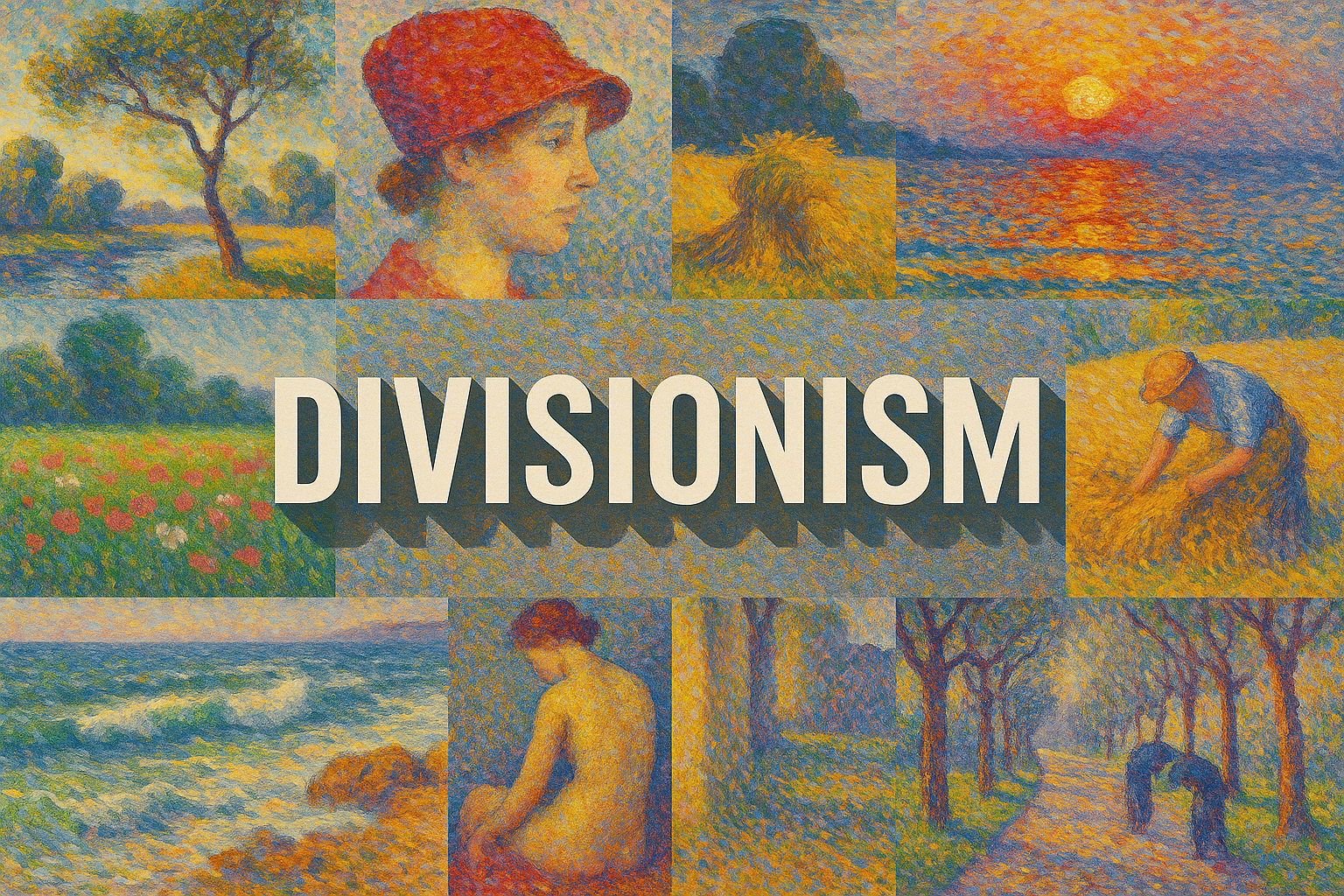
Divisionism separates colors into distinct marks so that their relationships can contribute to the perceived image. It is closely connected with Neo-Impressionism and has a significant Italian history; it is broader than painting only with uniform dots.
A visual introduction
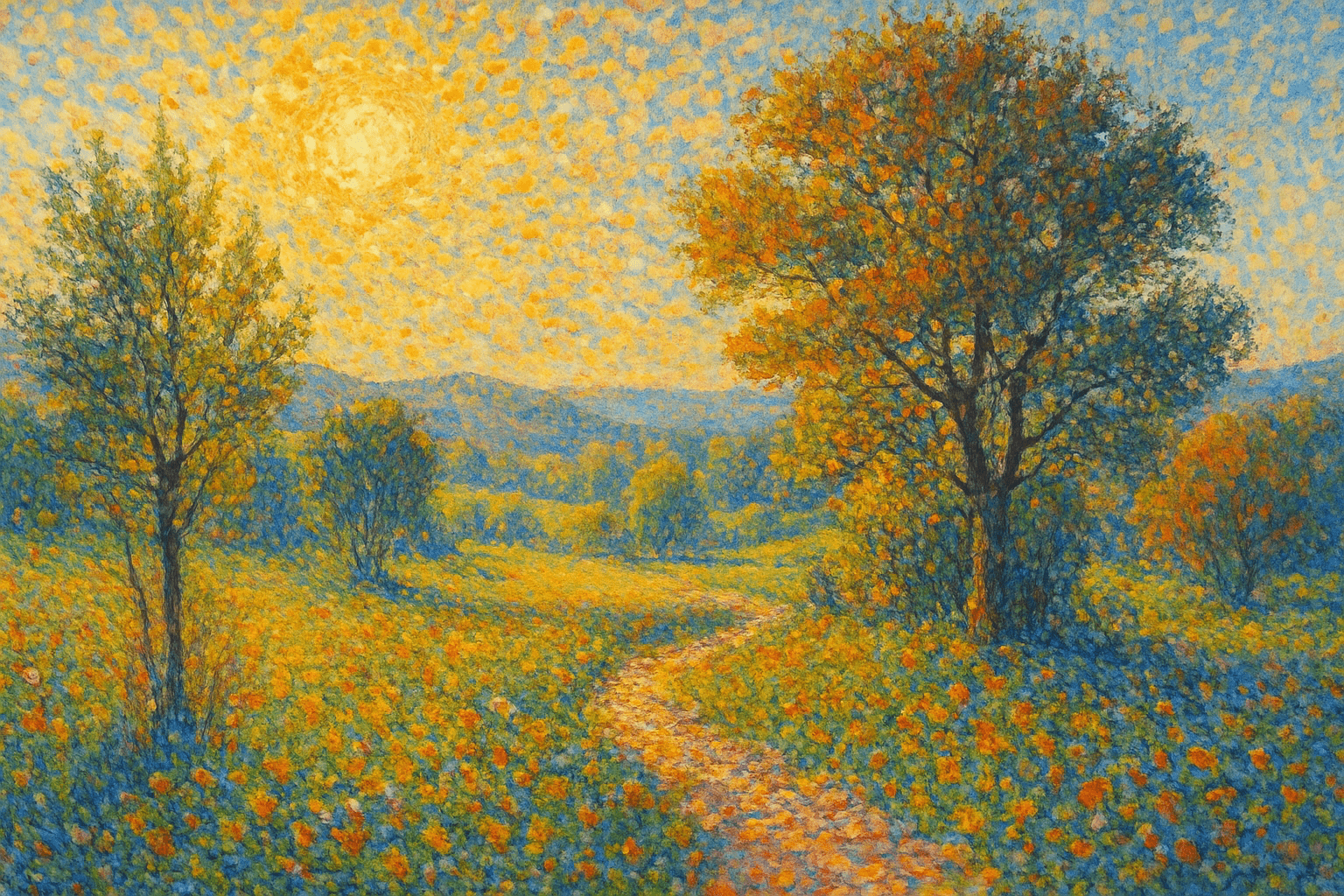
Select an image for a closer look. Use the thumbnails, arrow keys or a swipe to compare examples. Zoom in to inspect details, or share the image that inspires you.
Creative toolbox · take this style further
Choose an input and a destination. Search sends your words to the chosen site; Copy & open puts them on your clipboard to paste there.
Create with AI
Turn your chosen input into an image prompt or a new creative direction.
ChatGPT
Copy your input and paste it into a ChatGPT conversation or image request.
Copy & open ChatGPT (new tab)Claude · Anthropic
Develop an image prompt or explore the style in a new Claude conversation.
Copy & open Claude · Anthropic (new tab)Midjourney
Paste your input into the Imagine bar on the Create page.
Copy & open Midjourney (new tab)Adobe Firefly
Copy your input, open Firefly, and paste it into the prompt field.
Copy & open Adobe Firefly (new tab)Leonardo.Ai
Copy your input, open Leonardo, and paste it into the generation field.
Copy & open Leonardo.Ai (new tab)Image search
Find visual references. Short, concrete keywords usually work best.
Lexica
Search AI images and prompts using your selected input.
Search with this input Lexica (new tab)Pexels
Search the photo and video library. Short keywords often work best.
Search with this input Pexels (new tab)Pixabay
Search photos, illustrations and other images.
Search with this input Pixabay (new tab)Unsplash
Search photographs using the style name or your own keywords.
Search with this input Unsplash (new tab)Wikimedia Commons
Search photographs, artworks and historical images. Check each file for its source and reuse terms.
Search with this input Wikimedia Commons (new tab)Art & research
Explore artists, collections and the ideas behind a style.
Wikipedia
Search for background reading. A style may not have its own article.
Search with this input Wikipedia (new tab)WikiArt
Copy your input into WikiArt’s search to explore artists and artworks.
Copy & open WikiArt (new tab)Europeana
Paste your keywords into the search to explore European museum, library and archive collections.
Copy & open Europeana (new tab)Inspiration
Discover portfolios and visual ideas from creative communities.
Instagram hashtags
Search a hashtag made from your input: spaces and punctuation are removed. Instagram may require sign-in.
Search with this input Instagram hashtags (new tab)ArtStation
Paste your input into artwork search for concept art, environments, characters and visual development.
Copy & open ArtStation (new tab)Behance
Paste your input into project search for illustration, design and visual storytelling.
Copy & open Behance (new tab)A closer look
Threads, strokes or small patches retain their identity at close range while forming larger light, color and shape relationships from farther away.
Separation is the central decision
The Getty vocabulary distinguishes Divisionism's separated color from the narrower association of Pointillism with dots and short marks. The National Gallery's account of Italian Divisionism describes painters using threads of unmixed color and investigating the appearance of light.
These historical ambitions should not be turned into a promise that any two painted colors will mix optically into a predictable third. Pigments, spacing, contrast, lighting and viewing distance all affect what a viewer sees.
Establish the image before dividing the marks
Begin with a readable arrangement of light and dark masses. Then decide how separate colors will contribute within each area. A well-placed group of marks can describe a plane; a uniform scatter across the entire surface may weaken the underlying forms.
Try a small study with only a few color families. Keep their value roles distinct enough to preserve the subject at a distance. The aim is an active relationship among marks, not merely a textured overlay on a finished image.
Mark direction can carry structure
Short vertical strokes, longer curved threads and compact patches create different rhythms. Let them respond to the subject: a broad sky, a turning body and a reflective surface need not share the same mark pattern.
Check the work both close up and from the intended viewing distance. If the composition becomes unreadable, adjust the larger relationships rather than automatically adding more marks. If all colors merge into a dull area, reconsider spacing and the balance of neighboring values.
Technique can serve more than light effects
The National Gallery's Italian exhibition connects Divisionist practice with social and political concerns as well as visual experimentation. The technique is not restricted to sunny leisure scenes or decorative sparkle.
Choose an original subject whose structure benefits from divided color: workers moving through evening light, a garden in broken shade or a crowded interior. Explain how the marks support that particular scene. A digital interpretation can explore the principle while remaining clearly distinct from a physical painting and its pigments.
A small poetic detour
Original words from the AOI studio.
Poetry
Dots of vibrant hue,
converge to form light's pure dance,
colors whisper true.
The prompt workshop
Original creative exercises. These prompts create new illustrations, not documentary evidence.
Broken shade
Original painted garden study built from separate warm and cool marks, a clear underlying value structure and varied mark direction, no uniform dot filter.
Evening work
Original Divisionism-inspired scene of workers leaving a workshop at dusk, threads of color supporting bodies and light, readable silhouettes from a distance.
Two viewing distances
Original still life designed to show distinct color strokes up close and coherent rounded forms from farther away, controlled spacing and a limited palette.
Sources and further exploration
Getty AAT — Divisionism and its relation to Pointillism
National Gallery — Italian Divisionism, light and social subjects