
Original AOI concept · ordered layers and precise form
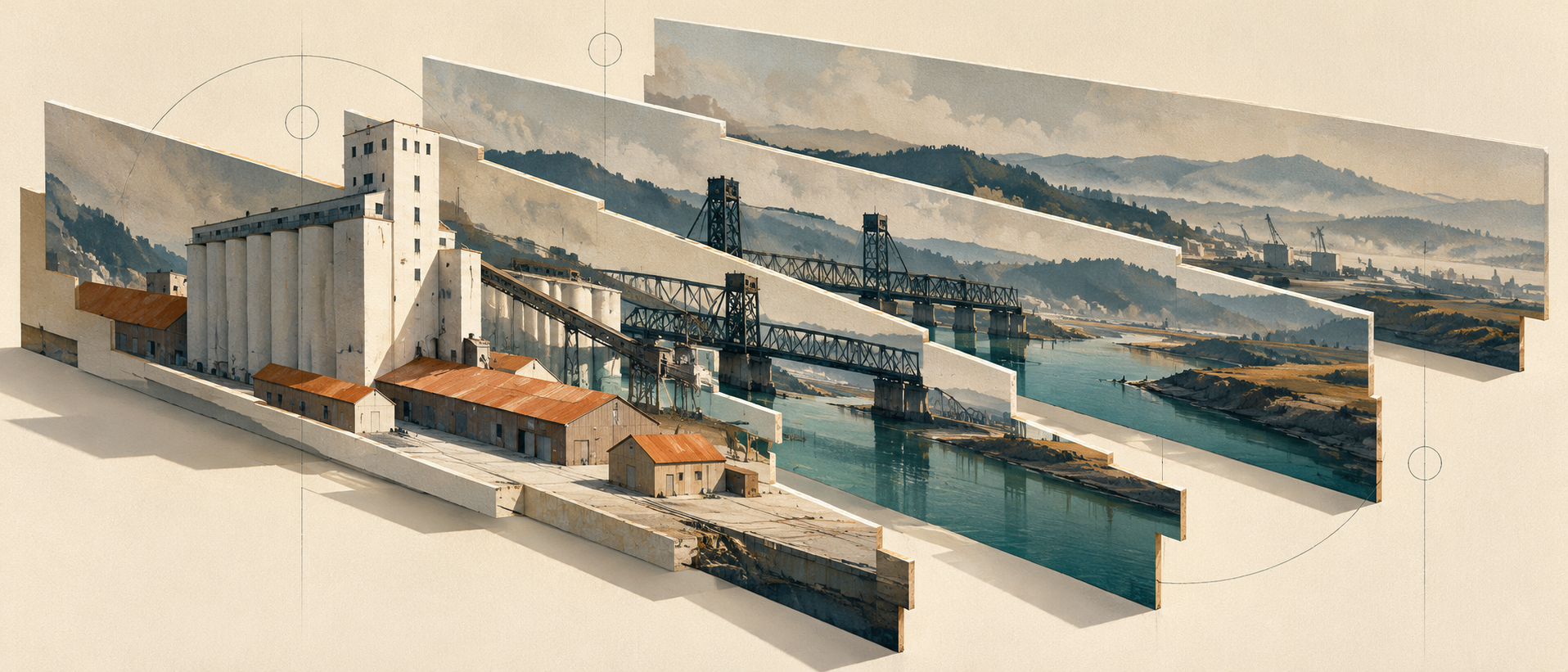
Deconstructed Layered Precisionism is an AOI concept that opens recognizable forms into precise, offset planes. Shared contours, measured gaps and selective transparency let the eye reconstruct the whole.
An A⊕I –[-.+] creαt¡ve c⊕ncept, n⊕t αn estαbl¡she∂ h¡st⊕r¡cαl m⊕vement.
A visual introduction
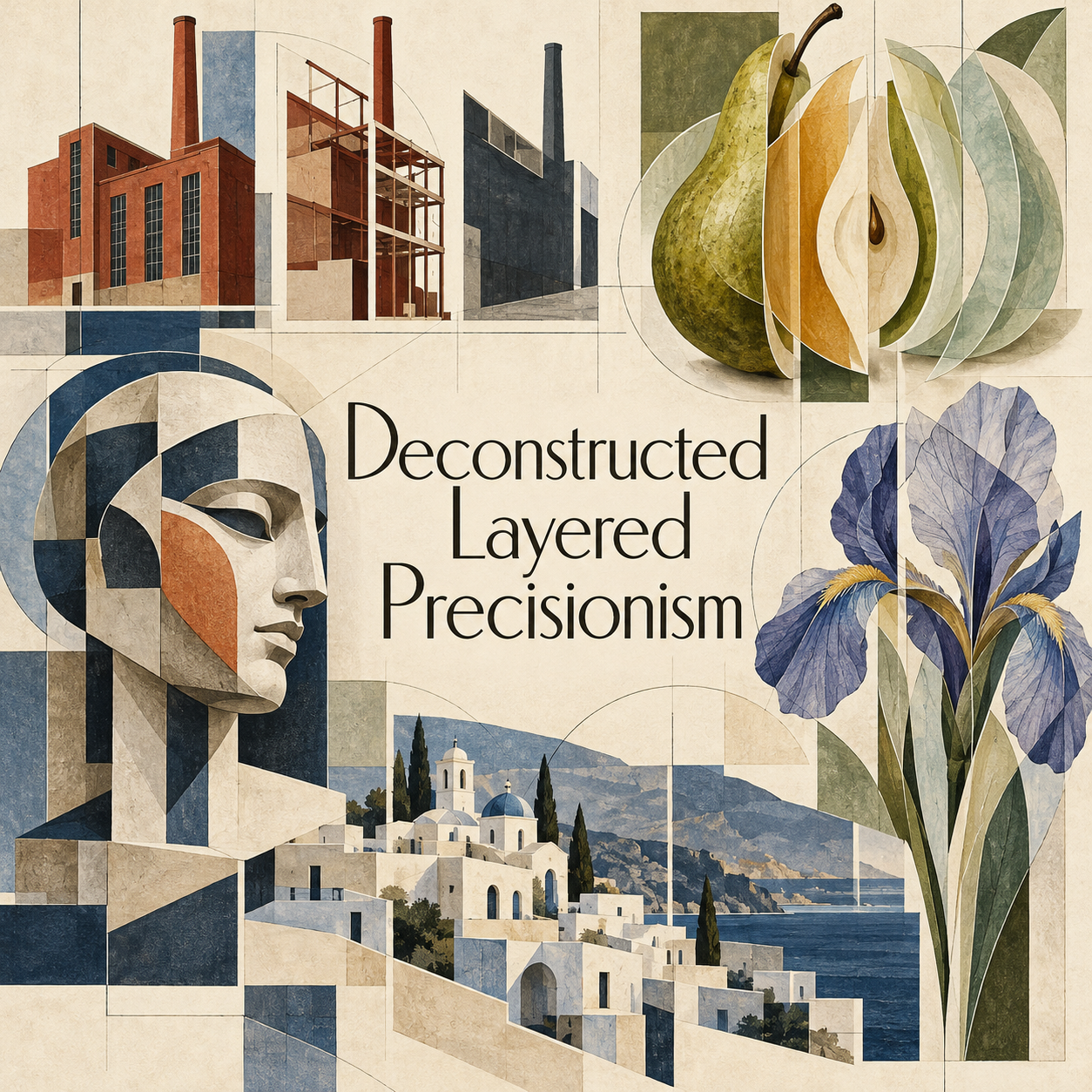
Nine original AI-generated AOI interpretations: a dedicated banner, a centrally titled collage and seven studies of industry, still life, a geometric head, a hillside town, botanical form, and elegant frontal and side-profile portraits.
Select an image for a closer look. Use the thumbnails, arrow keys or a swipe to compare examples. Zoom in to inspect details, or share the image that inspires you.


Creative toolbox · take this style further
Choose an input and a destination. Search sends your words to the chosen site; Copy & open puts them on your clipboard to paste there.
Create with AI
Turn your chosen input into an image prompt or a new creative direction.
ChatGPT
Copy your input and paste it into a ChatGPT conversation or image request.
Copy & open ChatGPT (new tab)Claude · Anthropic
Develop an image prompt or explore the style in a new Claude conversation.
Copy & open Claude · Anthropic (new tab)Midjourney
Paste your input into the Imagine bar on the Create page.
Copy & open Midjourney (new tab)Adobe Firefly
Copy your input, open Firefly, and paste it into the prompt field.
Copy & open Adobe Firefly (new tab)Leonardo.Ai
Copy your input, open Leonardo, and paste it into the generation field.
Copy & open Leonardo.Ai (new tab)Image search
Find visual references. Short, concrete keywords usually work best.
Lexica
Search AI images and prompts using your selected input.
Search with this input Lexica (new tab)Pexels
Search the photo and video library. Short keywords often work best.
Search with this input Pexels (new tab)Pixabay
Search photos, illustrations and other images.
Search with this input Pixabay (new tab)Unsplash
Search photographs using the style name or your own keywords.
Search with this input Unsplash (new tab)Wikimedia Commons
Search photographs, artworks and historical images. Check each file for its source and reuse terms.
Search with this input Wikimedia Commons (new tab)Art & research
Explore artists, collections and the ideas behind a style.
Wikipedia
Search for background reading. A style may not have its own article.
Search with this input Wikipedia (new tab)WikiArt
Copy your input into WikiArt’s search to explore artists and artworks.
Copy & open WikiArt (new tab)Europeana
Paste your keywords into the search to explore European museum, library and archive collections.
Copy & open Europeana (new tab)Inspiration
Discover portfolios and visual ideas from creative communities.
Instagram hashtags
Search a hashtag made from your input: spaces and punctuation are removed. Instagram may require sign-in.
Search with this input Instagram hashtags (new tab)ArtStation
Paste your input into artwork search for concept art, environments, characters and visual development.
Copy & open ArtStation (new tab)Behance
Paste your input into project search for illustration, design and visual storytelling.
Copy & open Behance (new tab)A closer look
Clear geometry separates into purposeful layers around a stable contour or axis. Exact edges, restrained gaps, muted color fields and selective soft shadows make disassembly feel ordered and legible.
A whole that remains available
Deconstructed Layered Precisionism is an original AOI proposal for making a recognizable subject visibly come apart without losing its organizing logic. A building, pear or flower is separated into a few purposeful planes. Repeated contours, shared axes and measured gaps keep the parts in conversation, so the viewer can imagine putting them back together.
The pleasure lies in that unfinished reconstruction. A facade slides away from its supporting rhythm; a petal's color separates from its outline. The image offers a coherent subject and a second account of how it was organized. The name describes this working approach, rather than a documented historical movement or a claim that layered imagery began here.
Historical context without a borrowed pedigree
Historical Precisionism provides one useful reference. The Metropolitan Museum of Art describes American artists around 1920 simplifying subjects into controlled geometry and clear contours. Their subjects included industrial settings, domestic architecture and still lifes of fruit or flowers. The AOI proposal borrows that concern for lucid form as a starting point, then makes selective separation its particular exercise.
Fragmentation and overlapping planes already have substantial histories. The Met's Cubism essay describes objects broken into facets and reassembled within shallow space. A recognizable whole is therefore not a novelty claim. Here, a repeatable offset and an obvious alignment reference are practical constraints for this specific series.
Deconstructivism is another comparison, especially for displaced architectural volumes. MoMA's documentation of its 1988 exhibition emphasizes forms that challenge expected stability and order. This AOI approach can produce tension too, but its chosen exercise is to preserve a legible route back through the layers. These sources explain neighboring practices; they do not authenticate the invented label.
Decide what the viewer must still recognize
Begin with one dominant silhouette or structural rhythm. A pear needs its narrowing shoulder and stem; an iris needs the relationship of stem, upright petals and falling petals. An industrial elevation might depend on a chimney and repeated windows. Identify that minimum before adding detail.
Keep one of those features steady while moving the others. An unchanged stem can hold several displaced petal planes together. In a townscape, a stair or terrace can guide the eye through interrupted buildings. If every part moves independently, the viewer receives a collection of fragments with no clear reason to connect them.
Give each layer a different job
Separate functions rather than merely copying the whole image. One plane might carry the outer contour, another the structural grid, another a shadow mass and another a translucent color field. Three or four useful layers often communicate more than a dozen nearly identical sheets.
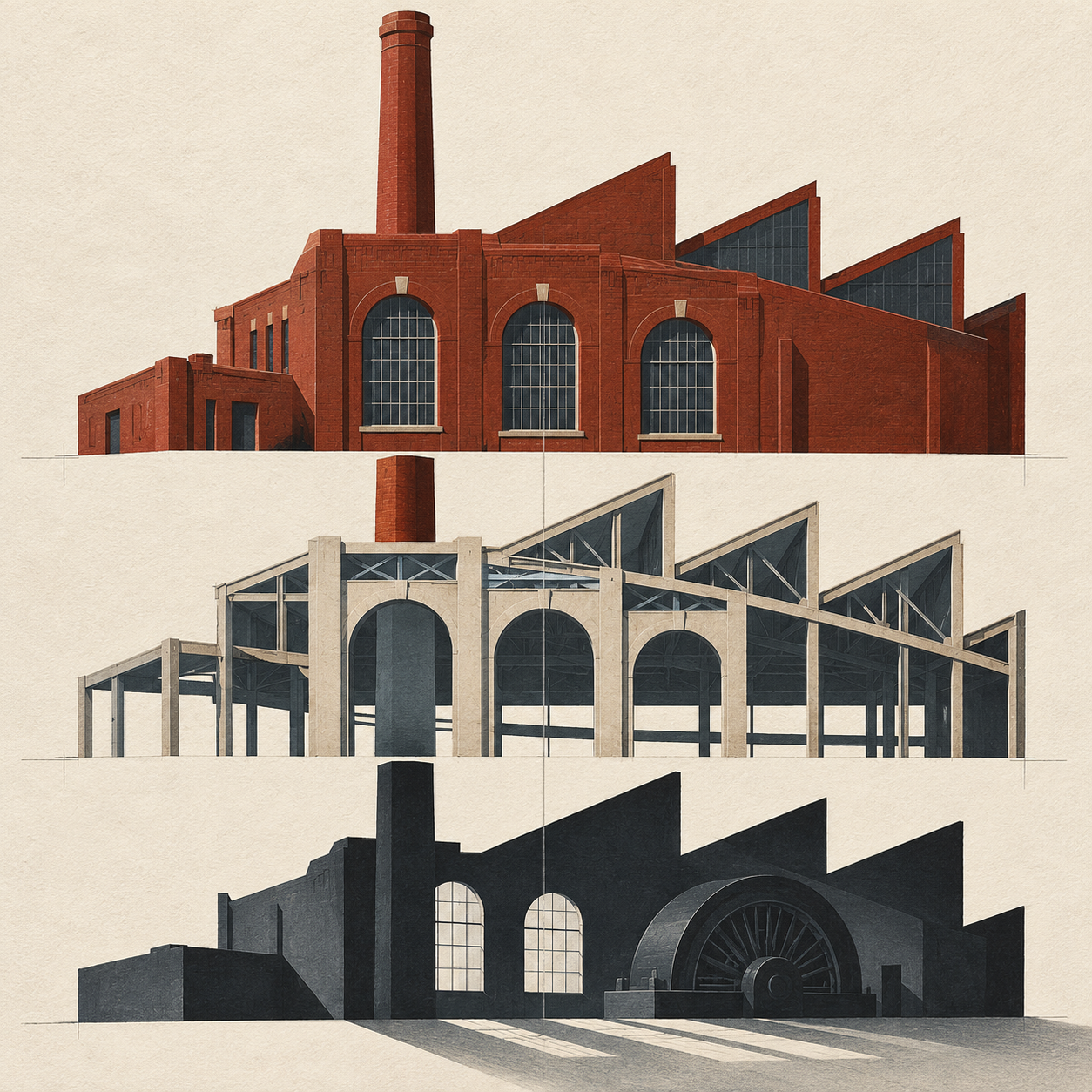
The factory study demonstrates an alternative to floating planes: three vertically separated registers distinguish brick facade, pale supporting frame and a dark silhouette with a turbine form. Shared architectural proportions connect the registers. This is analytical separation across the page, not a literal exploded drawing of a machine. Choose the arrangement that makes the relationship easiest to see.
Treat spacing as part of the drawing
A datum is simply a reference line or plane from which other positions can be judged. It can be visible as a fine line, or implied by aligned corners. Choose a dominant direction for displacement and let a few repeated endpoints reveal it.
Equal gaps create calm, procedural rhythm. A wider interval can announce a change of function or establish a focal pause. Use that exception deliberately. Small circles or drafting lines can help registration, but they should earn their space. They are visual cues in these illustrations, not measurements or engineering tolerances.
Hard edges, soft edges and transparent passages
Hard edges make a separation unambiguous: this plane ends here, and the next one begins there. They work especially well at a building corner, the edge of a cheek plane or a leaf's long silhouette. Closely spaced crisp edges also create a quick visual rhythm, which becomes tiring if it covers the entire image.
Softness can describe a different function. A pigment wash may let color taper across a petal; a modest cast shadow can locate one sheet above another. Preserve a firm neighboring contour so that softness reads as a chosen transition rather than uncertain drawing.
Transparency is useful when it reveals an otherwise hidden relationship. A pale overlay can carry an earlier contour through a shifted surface. Too many transparent planes flatten together into a grey patch. Keep a few opaque forms as anchors and check the overlaps against a simple background.
Let color explain the layers
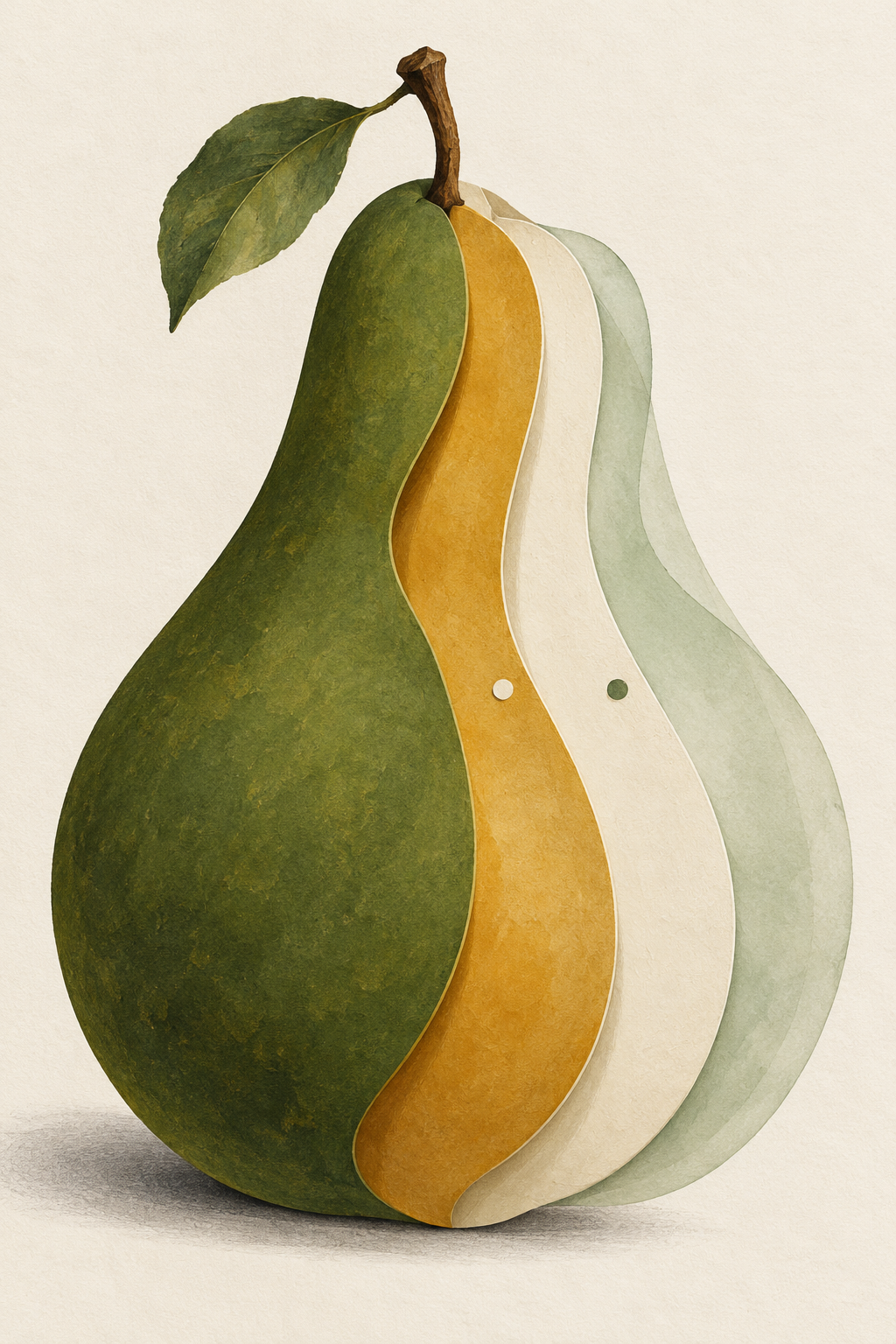
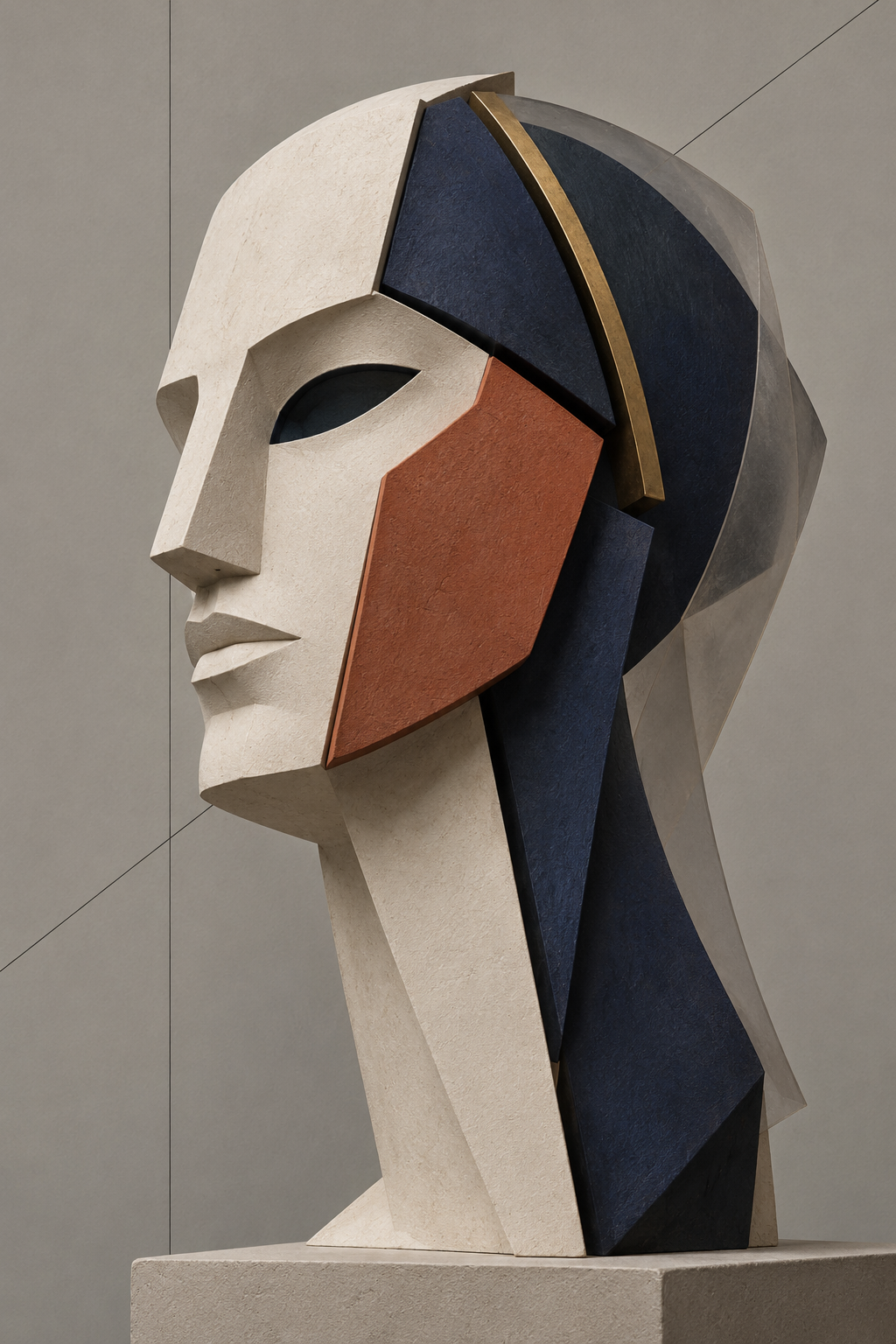
Assign color by role before adding decorative variety. In the pear study, green, ochre, ivory and pale celadon separate curved planes while preserving one fruit-like body. In the sculptural head, ivory, indigo and terracotta establish larger masses; the narrow brass-colored edge acts as an accent.
A limited palette makes slight offsets easier to notice. Strong hue differences can separate neighboring functions, while closely related tones make the same construction feel quieter. Check the picture in grayscale: if all boundaries disappear, hue is carrying more of the structure than intended. A deliberate near-monochrome version is also useful, provided value and spacing remain legible.
Seven studies, seven different questions
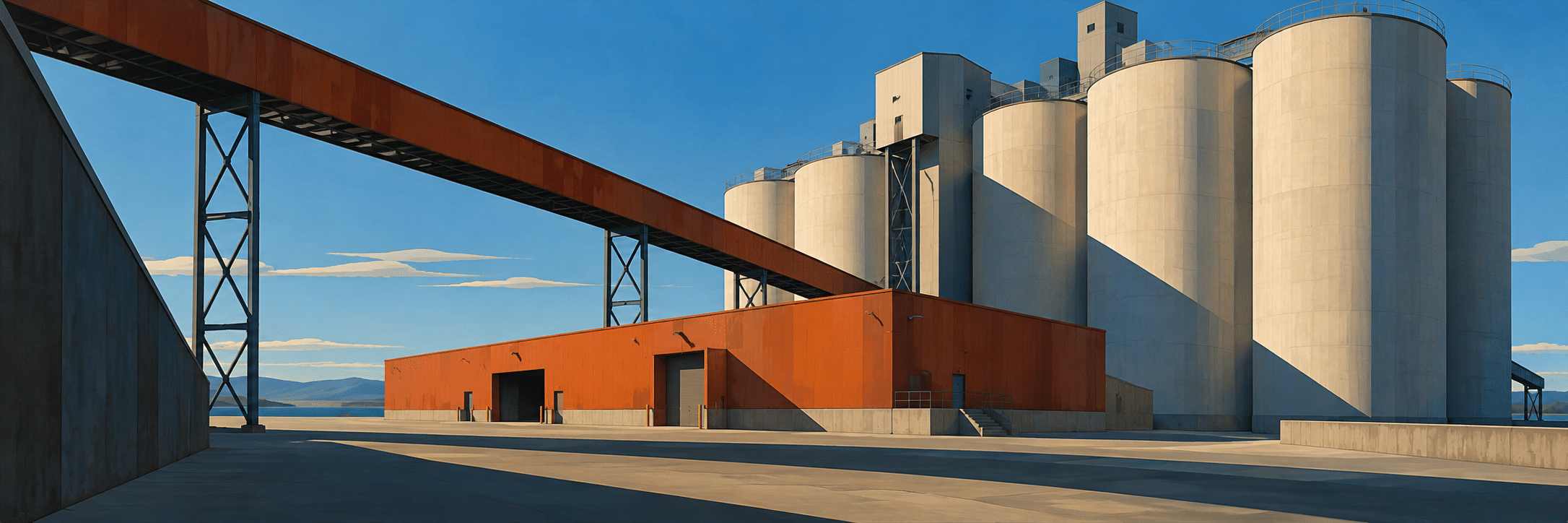
The industrial study asks how facade, frame and silhouette can share a recognizable order. The pear tests curved layers within a compact form. The fictional head treats the portrait as a crafted geometric sculpture, using broad planes and restrained gaps rather than anatomical sections.
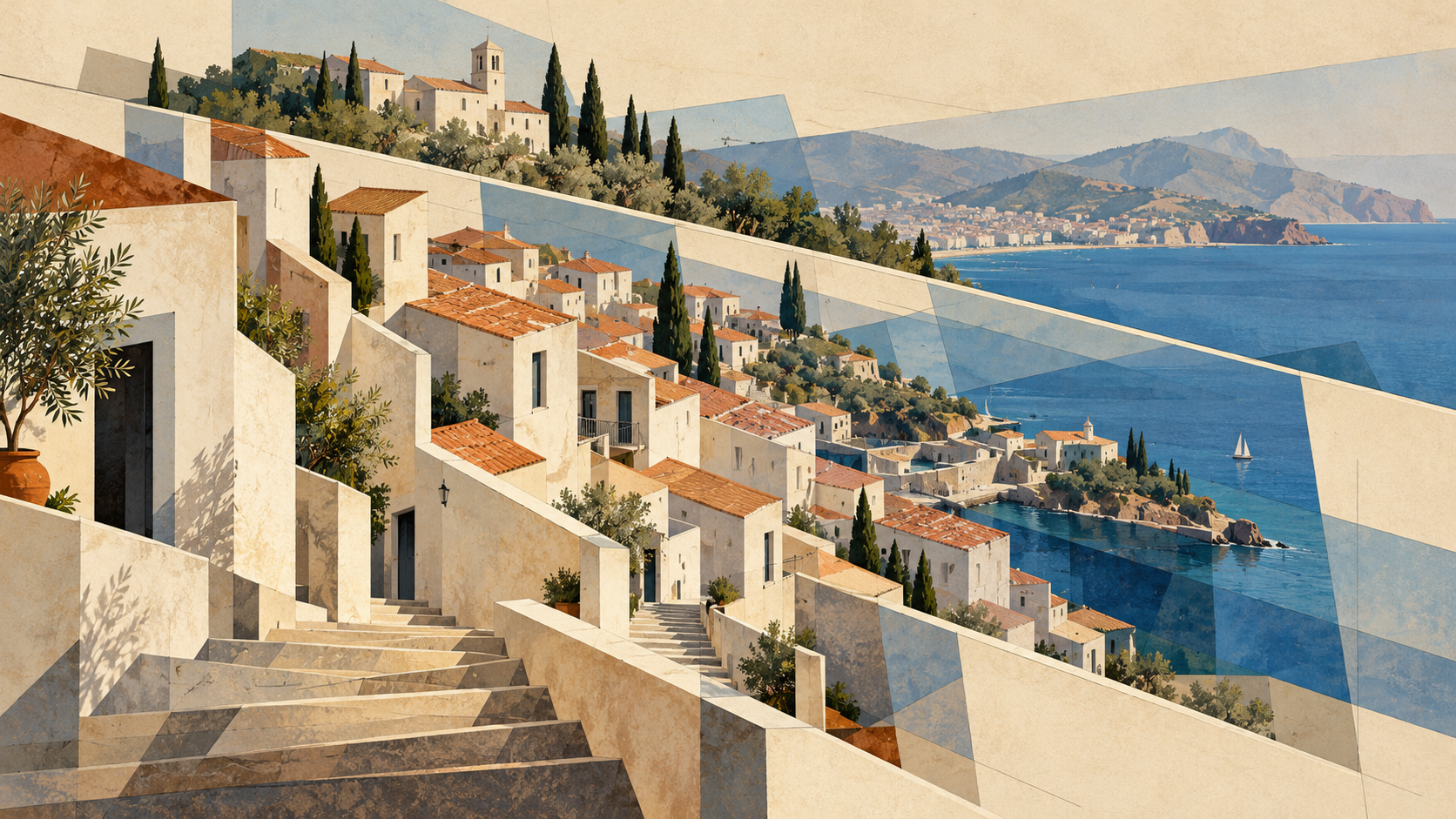
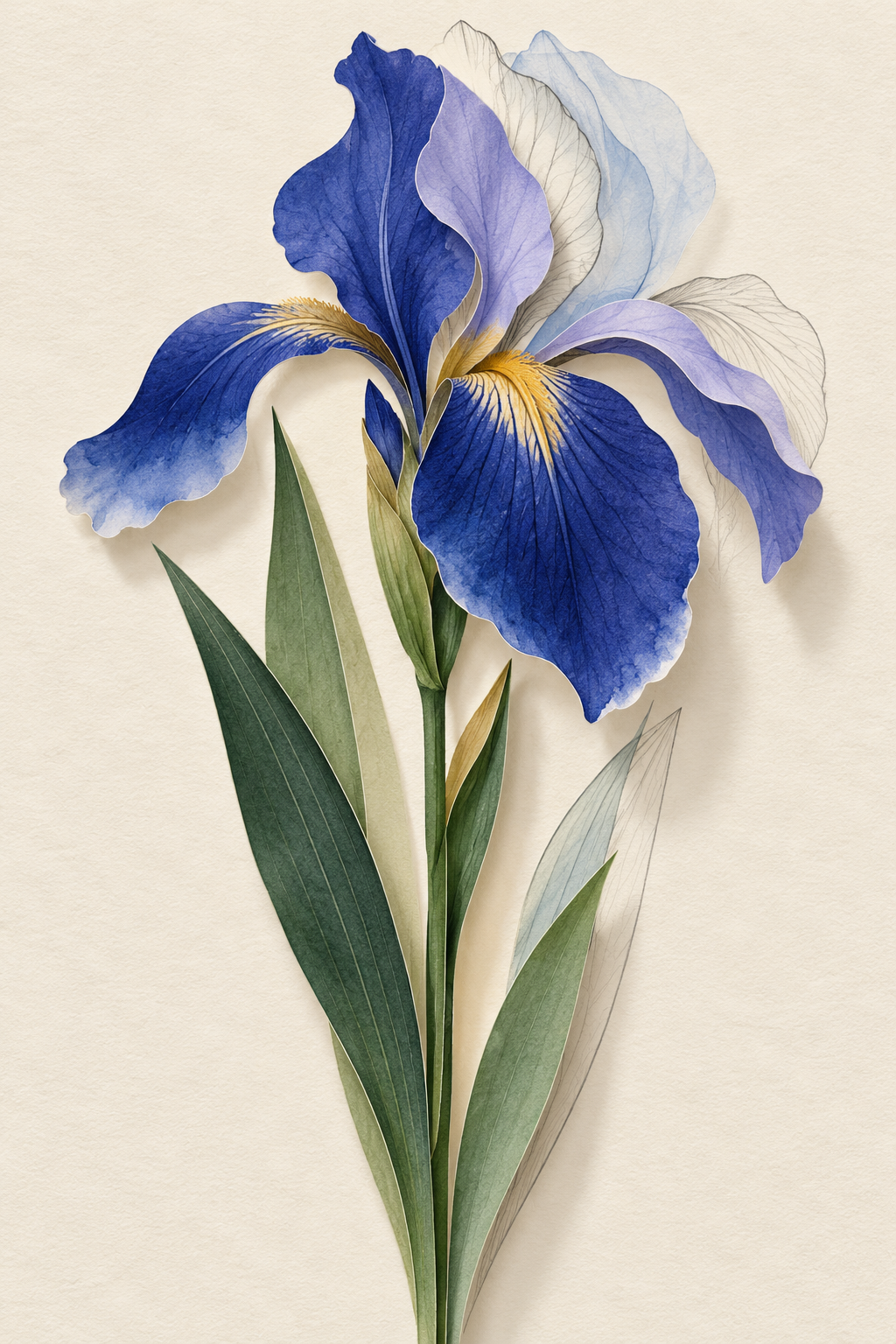
The hillside town tests continuity over a wider field: stairways, roofs and the coast must remain readable through translucent overlaps and displaced passages. The iris shifts the emphasis to fine contour, petal folds and softened pigment. Its continuous stem holds the more delicate layers together.
These are original AI-generated AOI interpretations. Their suggested materials—paper, vellum, plaster or painted wood—belong to the visual design. They are not documentary photographs of fabricated objects. The accompanying banner and titled collage introduce the same vocabulary at larger and smaller viewing scales.
Two additional adult portraits extend the study into editorial beauty. The frontal view keeps the facial axis and features intact while emerald, ivory and translucent layers shape the hair, silhouette and silk collar. In the side profile, terracotta, rose and charcoal planes enter the cheek, temple and neck, while the forehead-to-chin outline remains readable. The pair compares a stable central face with a more visibly separated profile; both are original AI-generated interpretations.
Develop a composition that survives simplification
Start with a thumbnail of the intact subject. Choose the feature that must remain legible, then sketch the role of each major plane. Move the planes in one direction before experimenting with a second. Decide which edges need precision and where a softer transition actually helps.
At thumbnail size, the subject should still read; at closer range, the gaps should reward attention. Remove a layer and compare the result. If nothing meaningful disappears, that layer was probably decoration. This approach suits editorial illustration, concept studies and sequences that reveal structure. It is less useful when a quick, undivided silhouette is the entire purpose of the image.
Positive editorial review — AI-authored
AI-authored editorial assessment. The approach is strongest when separation clarifies something the intact subject concealed. The factory's facade, frame and silhouette establish distinct kinds of order; the pear makes a smaller argument through curved color planes. A stable contour gives the viewer enough confidence to explore the gaps. Precision becomes expressive when each displacement changes how the whole is understood.
Negative editorial review — AI-authored
AI-authored editorial assessment. The concept can become an expensive-looking filter: duplicate a subject, shift the copies and add drafting marks. That produces decorative repetition without analysis. Equally spaced layers and identical shadows can make every subject resemble the same paper kit. Reduce the number of planes, assign each a purpose, and keep only the construction marks that help the eye connect them.
Neutral editorial review — AI-authored
AI-authored editorial assessment. Deconstructed Layered Precisionism is an AOI composition proposal suited to illustration, still life and studies of architectural or organic structure. Its usefulness depends on a readable source form and intentional separation. It can suggest how parts relate, but the images do not establish real construction, anatomy or botanical evidence. Historical Precisionism remains a separate subject.
A small poetic detour
Original words from the AOI studio.
Poetry
Registration marks
The chimney keeps its place above the town;
the wall steps sideways, careful not to fall.
A window lends its shadow to the ground,
then leaves a pale permission in the wall.
The pear unfolds its weather into green,
then ochre, then a thin unpainted air.
Its stem recalls the fruit it might have been;
the missing piece is present everywhere.
A flower parts its blue from how it bends.
One line remembers where the petals meet.
The edges loosen, but the order mends
the quiet distance underneath our feet.
I leave the layers open on the sheet.
The whole returns when looking makes them meet.
The prompt workshop
Original creative exercises. These prompts create new illustrations, not documentary evidence.
Open one familiar form
Create an original Deconstructed Layered Precisionism study of one pear on ivory paper. Keep its stem and shoulder recognizable while separating silhouette, volume and color into four gently offset curved planes. Use moss green, ochre, ivory and pale celadon, crisp contours, small purposeful gaps and one soft grounded shadow.
Give every plane a different role. The result is an invented formal study, not a biological cross-section.
Separate facade, frame and shadow
Imagine an original industrial elevation organized into three vertically separated registers: a brick facade, its pale structural rhythm and a charcoal silhouette containing one circular machinery form. Repeat the chimney axis and principal window spacing. Use restrained drafting lines, warm paper texture and clear negative intervals.
Compare an analytical arrangement on the page with floating planes. Preserve a recognizable relationship between registers.
Let an iris reveal its construction
Create a layered botanical interpretation of an iris with one continuous green stem. Separate blue petal color, graphite contour, vein rhythm and a translucent pale sheet through small measured offsets. Keep a few exact edges beside a soft pigment transition, with ample ivory space and restrained cast shadows.
The layering explores composition rather than botanical anatomy. Reduce opacity only where an overlap reveals a useful connection.
Your next inspiration
Discover another art style
Follow a visual thread to the next subject.
A smile from the studio
Jokes
The artist submitted a layered portrait to the gallery. The curator admired the ivory face, the indigo structure and the terracotta cheek, then asked whether everything was in the right place. “Within the composition, yes,” said the artist. “Relative to the person, we are allowing a little interpretive clearance.” The conservator requested an assembly drawing. The artist supplied one sheet for the silhouette, one for the structure and one for the shadows. A week later the gallery called: the portrait had arrived safely, but the courier was still looking for the crate containing the negative space.