
Contemporary online aesthetic
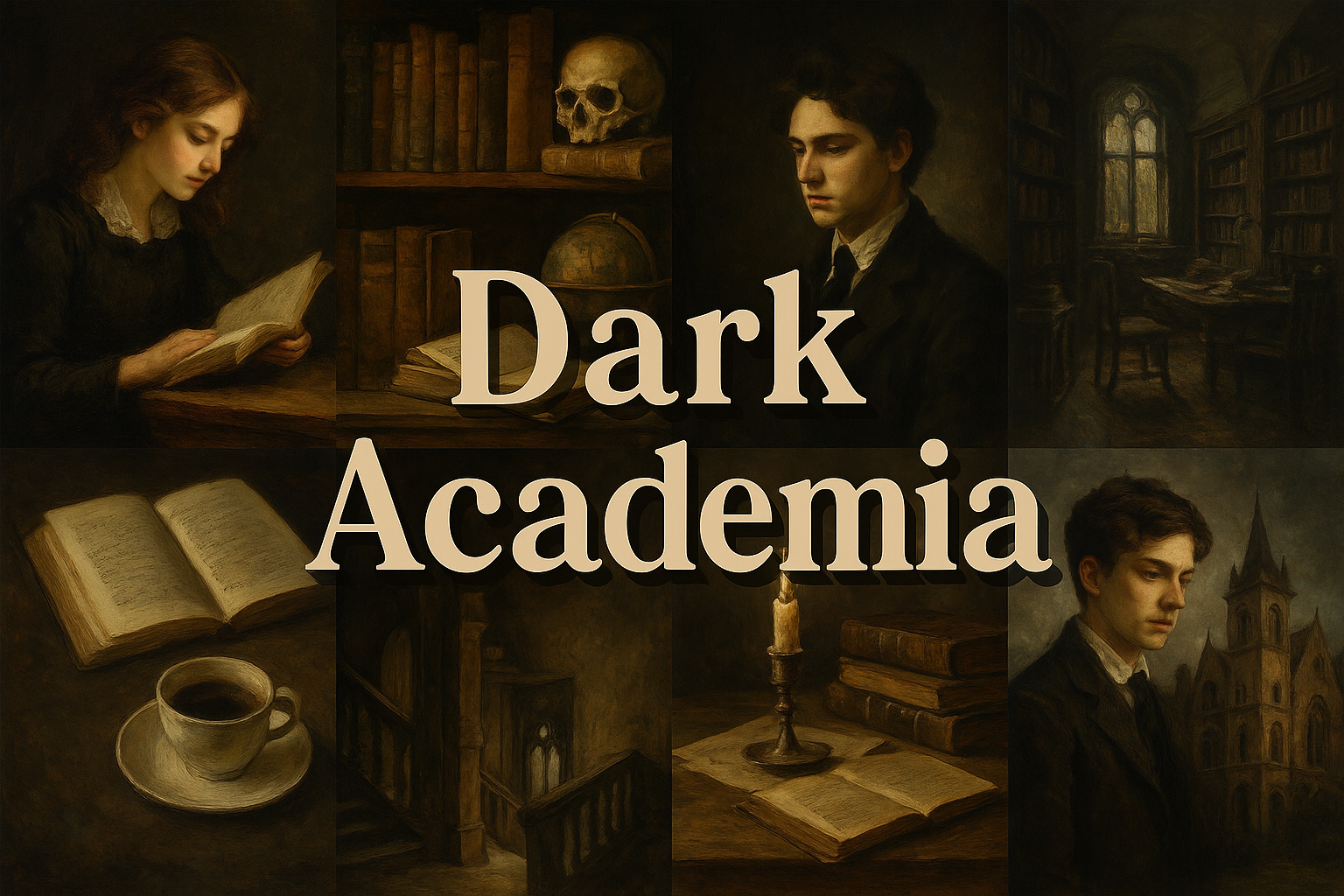
Dark Academia is an online aesthetic associated with books, academic settings, historical references and Gothic atmosphere. It is a selective imaginative world, not a description of all scholarship or a historical artistic movement.
A visual introduction
Select an image for a closer look. Use the thumbnails, arrow keys or a swipe to compare examples. Zoom in to inspect details, or share the image that inspires you.
Creative toolbox · take this style further
Choose an input and a destination. Search sends your words to the chosen site; Copy & open puts them on your clipboard to paste there.
Create with AI
Turn your chosen input into an image prompt or a new creative direction.
ChatGPT
Copy your input and paste it into a ChatGPT conversation or image request.
Copy & open ChatGPT (new tab)Claude · Anthropic
Develop an image prompt or explore the style in a new Claude conversation.
Copy & open Claude · Anthropic (new tab)Midjourney
Paste your input into the Imagine bar on the Create page.
Copy & open Midjourney (new tab)Adobe Firefly
Copy your input, open Firefly, and paste it into the prompt field.
Copy & open Adobe Firefly (new tab)Leonardo.Ai
Copy your input, open Leonardo, and paste it into the generation field.
Copy & open Leonardo.Ai (new tab)Image search
Find visual references. Short, concrete keywords usually work best.
Lexica
Search AI images and prompts using your selected input.
Search with this input Lexica (new tab)Pexels
Search the photo and video library. Short keywords often work best.
Search with this input Pexels (new tab)Pixabay
Search photos, illustrations and other images.
Search with this input Pixabay (new tab)Unsplash
Search photographs using the style name or your own keywords.
Search with this input Unsplash (new tab)Wikimedia Commons
Search photographs, artworks and historical images. Check each file for its source and reuse terms.
Search with this input Wikimedia Commons (new tab)Art & research
Explore artists, collections and the ideas behind a style.
Wikipedia
Search for background reading. A style may not have its own article.
Search with this input Wikipedia (new tab)WikiArt
Copy your input into WikiArt’s search to explore artists and artworks.
Copy & open WikiArt (new tab)Europeana
Paste your keywords into the search to explore European museum, library and archive collections.
Copy & open Europeana (new tab)Inspiration
Discover portfolios and visual ideas from creative communities.
Instagram hashtags
Search a hashtag made from your input: spaces and punctuation are removed. Instagram may require sign-in.
Search with this input Instagram hashtags (new tab)ArtStation
Paste your input into artwork search for concept art, environments, characters and visual development.
Copy & open ArtStation (new tab)Behance
Paste your input into project search for illustration, design and visual storytelling.
Copy & open Behance (new tab)A closer look
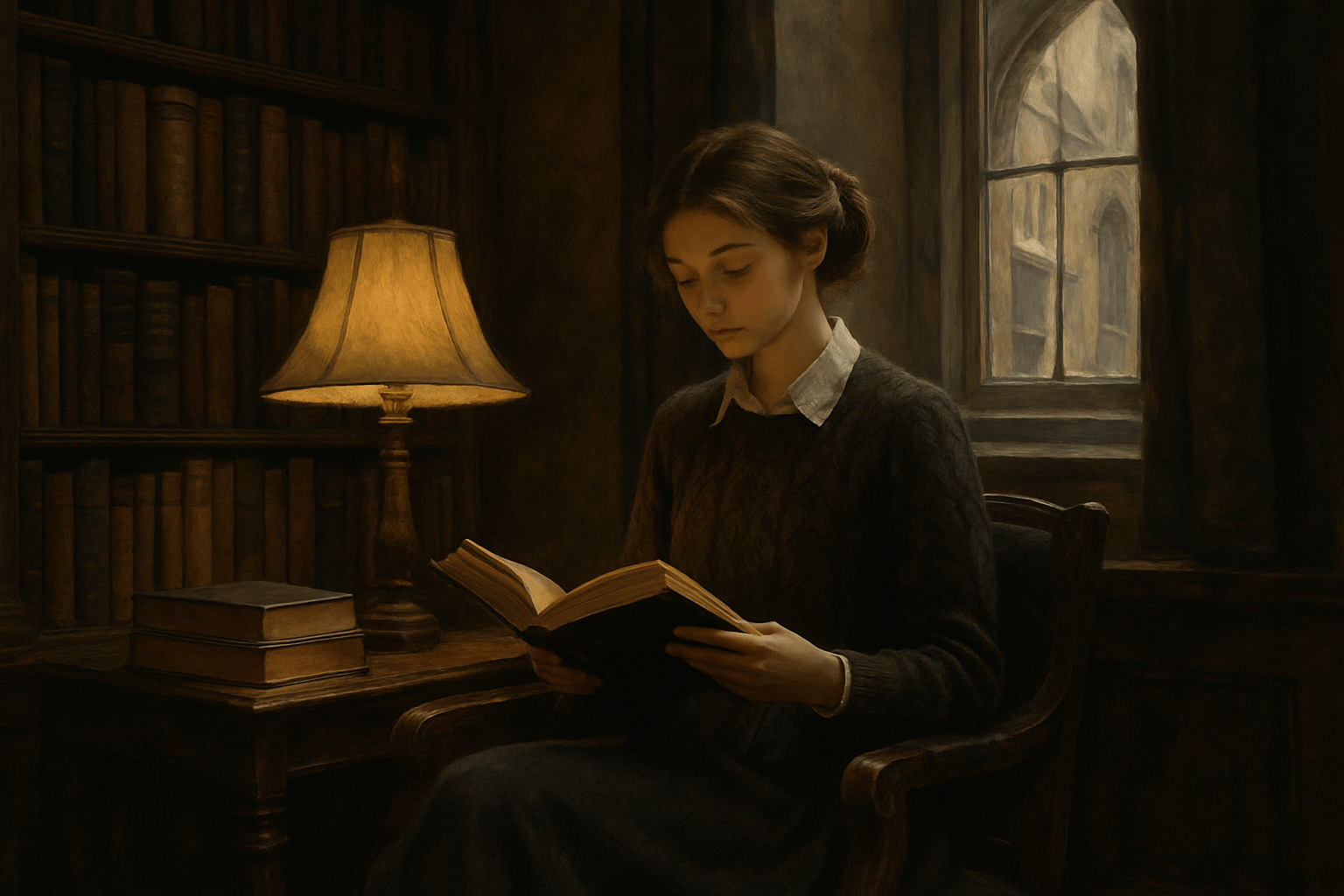
Directed light, layered paper and architectural framing can make study feel dramatic; a meaningful activity gives those familiar materials purpose.
An aesthetic of learning and its image
Research in Classical Receptions Journal examines Dark Academia's relationship with classical references and their modern reception. Other scholarship connects it with bookish self-presentation online. These accounts help distinguish an aesthetic identity from the actual conditions of academic work.
Begin by asking what the scene values. Is it curiosity, concentration, rivalry, memory or the mystery of an archive? A stack of old books is a visual cue, but the article or image becomes stronger when that cue participates in a specific situation.
Build light around an activity
A reading lamp, high window or corridor opening can establish a clear focal area. Let it illuminate the task: comparing pages, annotating a document or examining an object. Preserve enough surrounding detail to make the setting understandable.
Darkness should not make the image unreadable. Separate the figure, desk and background through value and edge choices. Warm brown is one option, not a requirement; cool daylight can produce an equally concentrated atmosphere.
Use references thoughtfully
Architecture, clothing and objects should belong to a coherent imagined setting. Avoid scattering unrelated historical fragments solely because they look scholarly. If the scene is a contemporary interpretation, let that be visible rather than claiming historical accuracy.
Scholarship also questions the aesthetic's selective and sometimes exclusionary picture of learning. A new image can broaden whose curiosity and work are represented without losing its atmospheric interest. Libraries and study are not the property of one class, culture or type of institution.
Let the subject exceed the mood board
Give the viewer something to discover: a comparison in progress, an unresolved question or a trace of a previous reader. These can make the scene more compelling than a perfectly arranged but unused desk.
For generated studies, avoid fake readable quotations and invented archival claims. Use original settings and a plausible activity. Evaluate whether the image communicates attention and inquiry, or merely repeats a collection of dimly lit props.
The prompt workshop
Original creative exercises. These prompts create new illustrations, not documentary evidence.
Study in progress
Original dark-academia-inspired scene of an adult comparing two illustrated books at a modest library desk, directed window light and plausible materials, no fabricated quotation.
A contemporary archive
Original atmospheric study room with a diverse group of adults examining a local-history object, readable gestures and restrained architectural framing.
An unanswered question
Original still life of notes, a magnifying glass and one unusual botanical specimen under a reading lamp, coherent task and selective detail, no fake historical label.
Sources and further exploration
Tori F. Lee — Dark Academia and the reception of classical culture