
Historical photographic process
A daguerreotype is a direct-positive photograph on a silver-plated copper surface. Its fine detail and reflective physical character distinguish it from paper-negative processes and from generic distressed vintage imagery.
A visual introduction
Select an image for a closer look. Use the thumbnails, arrow keys or a swipe to compare examples. Zoom in to inspect details, or share the image that inspires you.


Creative toolbox · take this style further
Choose an input and a destination. Search sends your words to the chosen site; Copy & open puts them on your clipboard to paste there.
Create with AI
Turn your chosen input into an image prompt or a new creative direction.
ChatGPT
Copy your input and paste it into a ChatGPT conversation or image request.
Copy & open ChatGPT (new tab)Claude · Anthropic
Develop an image prompt or explore the style in a new Claude conversation.
Copy & open Claude · Anthropic (new tab)Midjourney
Paste your input into the Imagine bar on the Create page.
Copy & open Midjourney (new tab)Adobe Firefly
Copy your input, open Firefly, and paste it into the prompt field.
Copy & open Adobe Firefly (new tab)Leonardo.Ai
Copy your input, open Leonardo, and paste it into the generation field.
Copy & open Leonardo.Ai (new tab)Image search
Find visual references. Short, concrete keywords usually work best.
Lexica
Search AI images and prompts using your selected input.
Search with this input Lexica (new tab)Pexels
Search the photo and video library. Short keywords often work best.
Search with this input Pexels (new tab)Pixabay
Search photos, illustrations and other images.
Search with this input Pixabay (new tab)Unsplash
Search photographs using the style name or your own keywords.
Search with this input Unsplash (new tab)Wikimedia Commons
Search photographs, artworks and historical images. Check each file for its source and reuse terms.
Search with this input Wikimedia Commons (new tab)Art & research
Explore artists, collections and the ideas behind a style.
Wikipedia
Search for background reading. A style may not have its own article.
Search with this input Wikipedia (new tab)WikiArt
Copy your input into WikiArt’s search to explore artists and artworks.
Copy & open WikiArt (new tab)Europeana
Paste your keywords into the search to explore European museum, library and archive collections.
Copy & open Europeana (new tab)Inspiration
Discover portfolios and visual ideas from creative communities.
Instagram hashtags
Search a hashtag made from your input: spaces and punctuation are removed. Instagram may require sign-in.
Search with this input Instagram hashtags (new tab)ArtStation
Paste your input into artwork search for concept art, environments, characters and visual development.
Copy & open ArtStation (new tab)Behance
Paste your input into project search for illustration, design and visual storytelling.
Copy & open Behance (new tab)A closer look
Precise small details, controlled tonal transitions and the presence of a reflective plate or protective presentation are more characteristic than heavy grain or blanket sepia coloring.
Understand the photographic object
The daguerreotype process was publicly announced in 1839. The Library of Congress describes it as a direct-positive process: the image is formed on the plate without a separate negative. Each plate is therefore a unique photographic object, even though a copy could be made by photographing it again.
This differs from the calotype's paper negative and multiple positive prints. When studying a historical image, read its collection record and medium. A dark portrait in an ornate frame is not enough to identify the process, and a digital reproduction cannot convey every property of the original surface.
Detail and stillness work together
Daguerreotypes can be remarkably detailed. The association of old photography with coarse grain and low resolution can therefore be misleading. The National Portrait Gallery notes the importance of technical refinements that shortened exposure times and supported portraiture. Avoid treating one exposure duration as a rule for the entire history of the process.
For an original visual interpretation, give attention to the face, hands and the arrangement of fabric. A steady pose can suggest concentration without becoming rigid. Let the background support the figure through value separation rather than surrounding it with an excess of antique props.
Consider the plate and its presentation
The image's reflective support is part of the experience. A case, protective glass or border can change how the viewer approaches it as an object. These features should be depicted coherently if included: the plate, reflections and frame need to occupy the same space.
Do not add random scratches simply to make an image seem old. Wear is not the defining visual principle of the medium. A contemporary interpretation can instead explore exact detail, a restrained tonal range and the tension between an intimate image and a polished surface.
Historical study and contemporary exercise
Compare a documented portrait with a still-life example and ask how the arrangement responds to the process. A stationary object offers different compositional possibilities from a sitter, but both can use light to establish volume and attention.
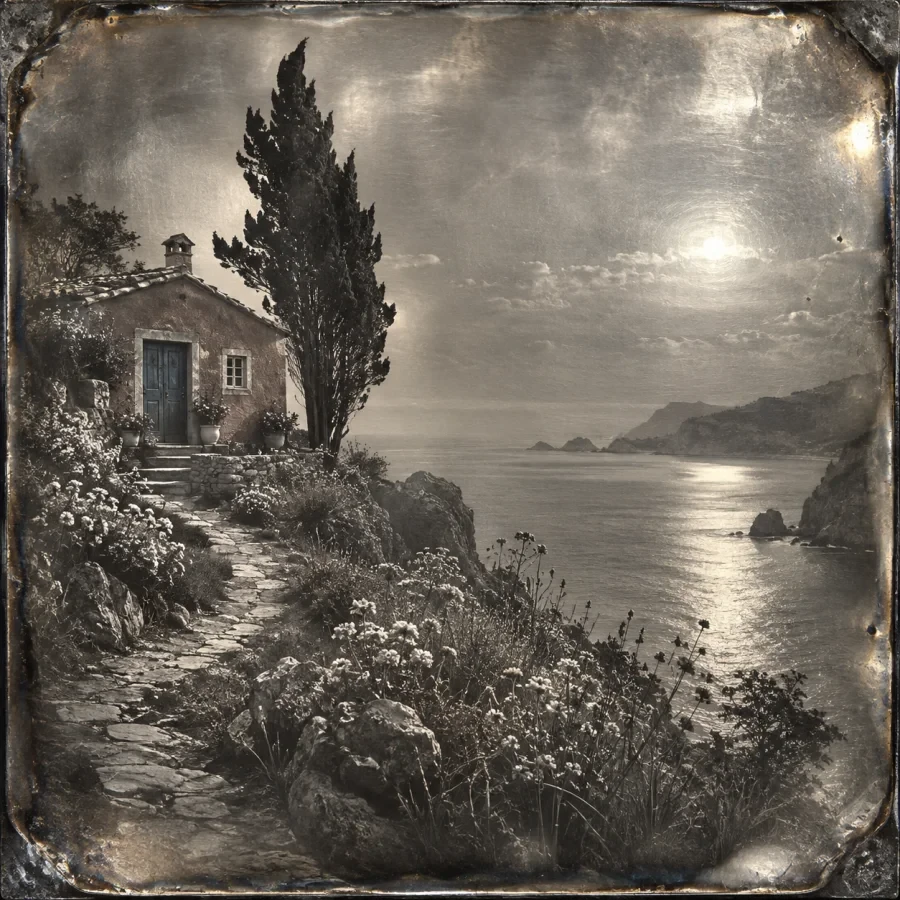
AOI's generated or retained interpretive images should not be mistaken for original nineteenth-century plates. State the contemporary origin of a study and keep fictional names, dates and archive marks out of its presentation.
The prompt workshop
Original creative exercises. These prompts create new illustrations, not documentary evidence.
A precise portrait study
Contemporary digital interpretation of a daguerreotype portrait, invented adult sitter, clear eyes and carefully arranged hands, fine fabric detail, restrained tonal transitions and subtle reflective plate quality, no false date.
Still life on a plate
Original still-life study of a plaster fragment and a folded cloth, finely resolved details, quiet directional light, subtle silver-plate presentation, no heavy grain or artificial scratches.
The image as an object
An original contemporary portrait plate shown in a simple open protective case, coherent glass reflection and material depth, carefully controlled light, no claim of antique authenticity or invented archive label.