
AOI creative concept
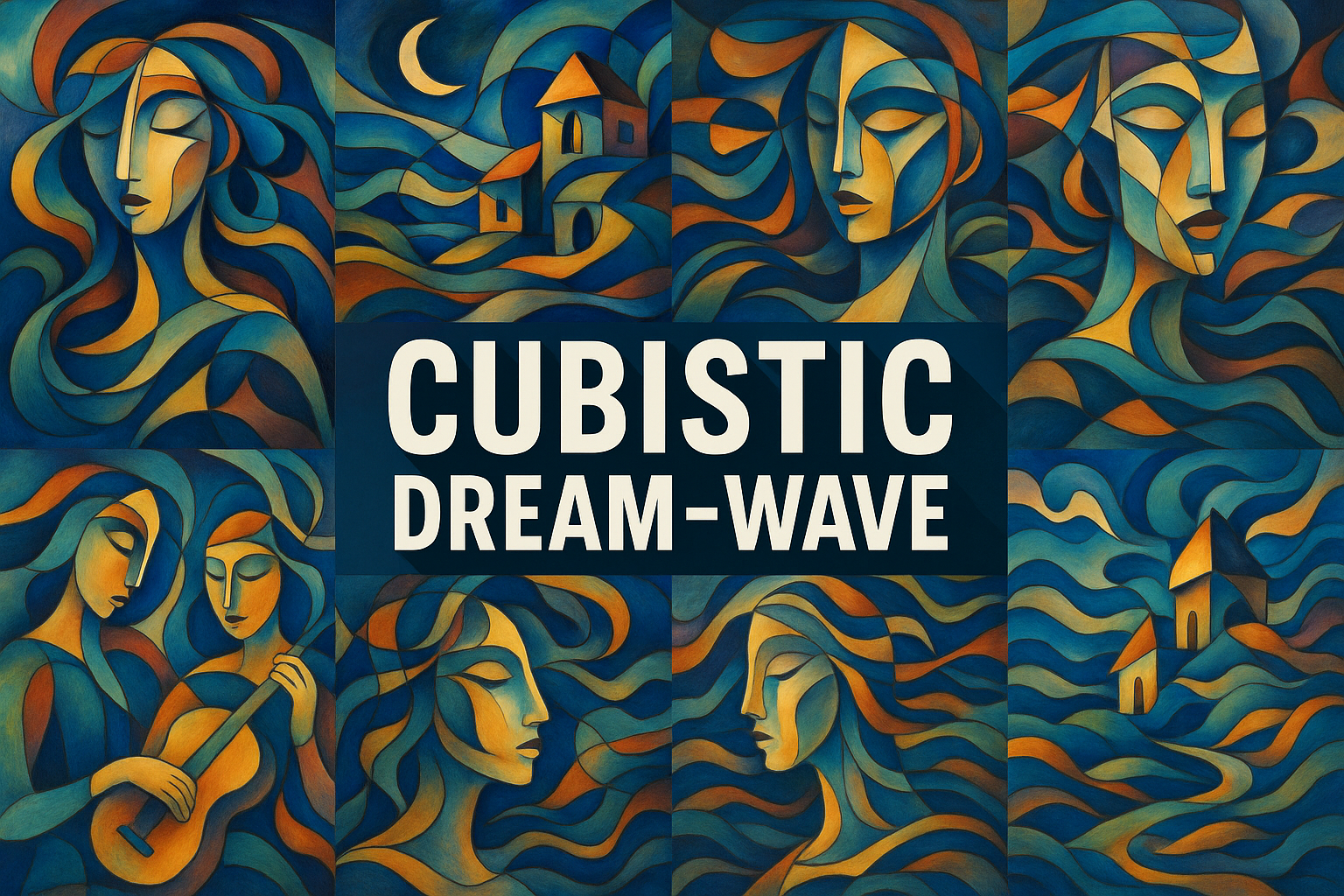
Cubistic Dream-wave is an AOI creative concept combining faceted subjects with flowing bands that connect figure and setting. It is a contemporary visual brief, not a documented branch of historical Cubism.
An A⊕I –[-.+] creαt¡ve c⊕ncept, n⊕t αn estαbl¡she∂ h¡st⊕r¡cαl m⊕vement.
A visual introduction
Compare the retained archive interpretations with the visual principles below.
Select an image for a closer look. Use the thumbnails, arrow keys or a swipe to compare examples. Zoom in to inspect details, or share the image that inspires you.

Creative toolbox · take this style further
Choose an input and a destination. Search sends your words to the chosen site; Copy & open puts them on your clipboard to paste there.
Create with AI
Turn your chosen input into an image prompt or a new creative direction.
ChatGPT
Copy your input and paste it into a ChatGPT conversation or image request.
Copy & open ChatGPT (new tab)Claude · Anthropic
Develop an image prompt or explore the style in a new Claude conversation.
Copy & open Claude · Anthropic (new tab)Midjourney
Paste your input into the Imagine bar on the Create page.
Copy & open Midjourney (new tab)Adobe Firefly
Copy your input, open Firefly, and paste it into the prompt field.
Copy & open Adobe Firefly (new tab)Leonardo.Ai
Copy your input, open Leonardo, and paste it into the generation field.
Copy & open Leonardo.Ai (new tab)Image search
Find visual references. Short, concrete keywords usually work best.
Lexica
Search AI images and prompts using your selected input.
Search with this input Lexica (new tab)Pexels
Search the photo and video library. Short keywords often work best.
Search with this input Pexels (new tab)Pixabay
Search photos, illustrations and other images.
Search with this input Pixabay (new tab)Unsplash
Search photographs using the style name or your own keywords.
Search with this input Unsplash (new tab)Wikimedia Commons
Search photographs, artworks and historical images. Check each file for its source and reuse terms.
Search with this input Wikimedia Commons (new tab)Art & research
Explore artists, collections and the ideas behind a style.
Wikipedia
Search for background reading. A style may not have its own article.
Search with this input Wikipedia (new tab)WikiArt
Copy your input into WikiArt’s search to explore artists and artworks.
Copy & open WikiArt (new tab)Europeana
Paste your keywords into the search to explore European museum, library and archive collections.
Copy & open Europeana (new tab)Inspiration
Discover portfolios and visual ideas from creative communities.
Instagram hashtags
Search a hashtag made from your input: spaces and punctuation are removed. Instagram may require sign-in.
Search with this input Instagram hashtags (new tab)ArtStation
Paste your input into artwork search for concept art, environments, characters and visual development.
Copy & open ArtStation (new tab)Behance
Paste your input into project search for illustration, design and visual storytelling.
Copy & open Behance (new tab)A closer look
Angular planes describe the subject while curved bands continue through hair, sky and surrounding space. Warm accents interrupt a predominantly cool palette.
A facet and a flowing line
The concept sets two kinds of shape against each other: a plane that changes direction sharply and a curve that carries the eye onward. In the retained portrait, orange and yellow facial planes emerge from blue and violet wave-like bands. The curves move around the face while the angular shapes preserve a readable central subject. The result is an archive interpretation, not a historical Cubist painting.
MoMA describes Cubism through geometric planes, compressed space and experiments with multiple viewpoints. Those ideas provide context for the word cubistic, but a portrait broken into triangles is not automatically an example of the historical movement. Nor does a dreamlike atmosphere establish a connection to a particular Surrealist work. This article proposes its own combination without assigning invented founders or dates.
Make the two structures cooperate
Begin with a simple face, vessel or small building. Divide it into a few large planes, then introduce one broad curve that crosses behind and partly through the subject. Repeat that curve at different widths. Preserve enough of the silhouette to keep the subject readable; distort selected relationships instead of scattering every feature.
Use color to connect the layers. A dark blue band can continue from the background into a shadow plane, while a warm cheek or window becomes the focal accent. Keep the wave rhythm directional and leave some broad, uncomplicated areas. Too many tiny facets will compete with the curves and turn the image into visual confetti.
For a second study, retain the same subject and palette but change the balance: let planes dominate one version and curves dominate the other. Compare which better communicates stillness, movement or uncertainty. The prompts are starting points for original illustrations. Their mood comes from deliberate shape relationships, not from a claim that the label has an established historical lineage.
The prompt workshop
Original creative exercises. These prompts create new illustrations, not documentary evidence.
A face between currents
Create an original abstract portrait of an invented adult with large ochre facial planes surrounded by broad blue and violet curved bands. Let some bands cross into shadow shapes while preserving a clear face. Quiet expression, painterly surface, no lettering or signature.
A village in waves
Illustrate a small imagined village with faceted roofs and walls threaded by sweeping blue-green bands that connect sky and ground. Use one warm window as a focal point, compressed space and a few large geometric planes. No text.
Two kinds of rhythm
Create an original still life of a jug and fruit using angular planes against three broad undulating bands. Restrict the palette to indigo, teal, ochre and muted coral. Make the object contours readable and leave quiet areas; no text.
Sources and further exploration
MoMA Learning: Cubism — geometric planes and multiple viewpoints