
AOI concept · speculative monumental architecture
Crualist Futuristic Brutalism makes infrastructure feel almost too large to inhabit. Vast concrete masses, exposed service systems and sharply recessed light establish a future in which a doorway or a lone worker becomes a vital measure of scale.
An A⊕I –[-.+] creαt¡ve c⊕ncept, n⊕t αn estαbl¡she∂ h¡st⊕r¡cαl m⊕vement.
A visual introduction
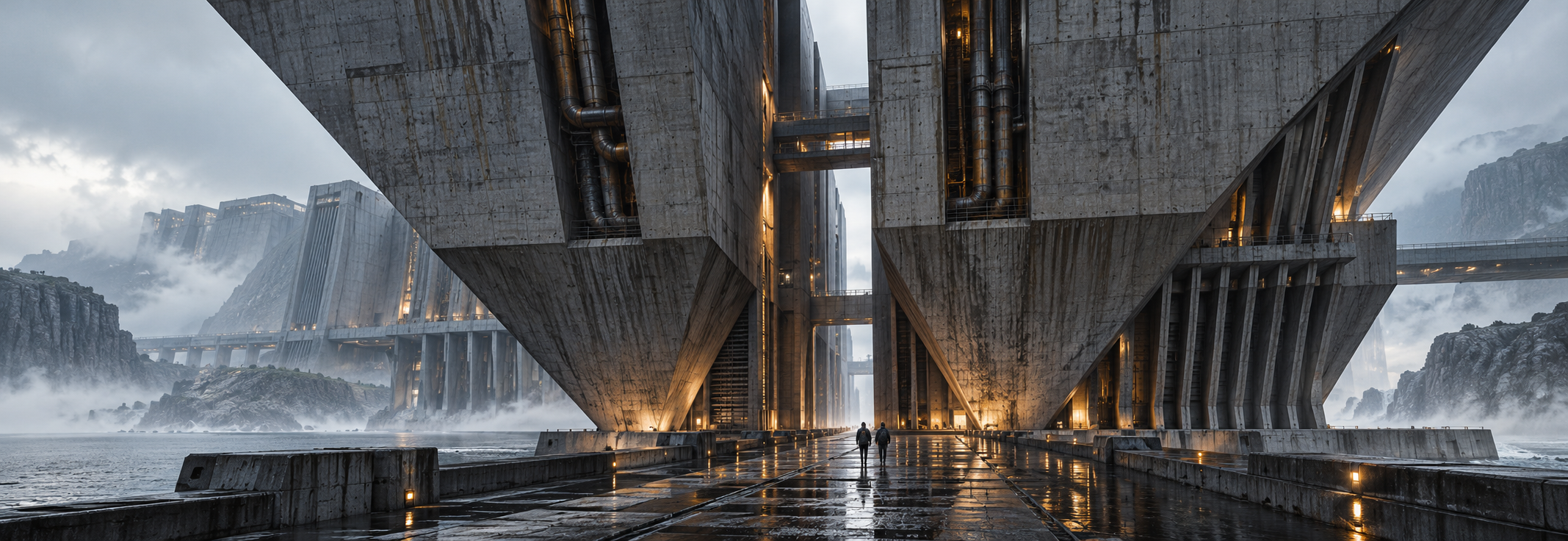
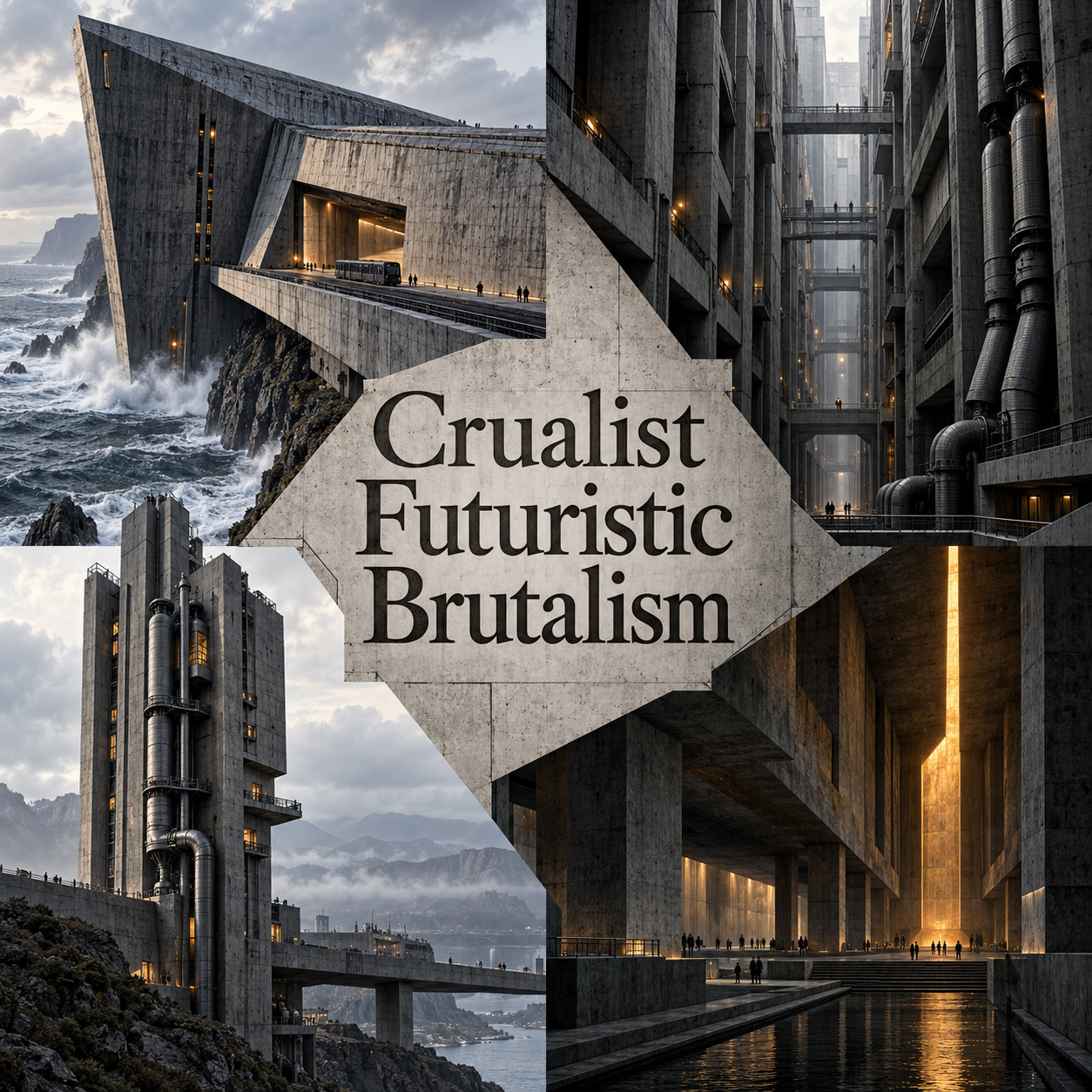
Five original AI-generated AOI interpretations: a dedicated banner, a centrally titled collage and three standalone studies.
Select an image for a closer look. Use the thumbnails, arrow keys or a swipe to compare examples. Zoom in to inspect details, or share the image that inspires you.
Creative toolbox · take this style further
Choose an input and a destination. Search sends your words to the chosen site; Copy & open puts them on your clipboard to paste there.
Create with AI
Turn your chosen input into an image prompt or a new creative direction.
ChatGPT
Copy your input and paste it into a ChatGPT conversation or image request.
Copy & open ChatGPT (new tab)Claude · Anthropic
Develop an image prompt or explore the style in a new Claude conversation.
Copy & open Claude · Anthropic (new tab)Midjourney
Paste your input into the Imagine bar on the Create page.
Copy & open Midjourney (new tab)Adobe Firefly
Copy your input, open Firefly, and paste it into the prompt field.
Copy & open Adobe Firefly (new tab)Leonardo.Ai
Copy your input, open Leonardo, and paste it into the generation field.
Copy & open Leonardo.Ai (new tab)Image search
Find visual references. Short, concrete keywords usually work best.
Lexica
Search AI images and prompts using your selected input.
Search with this input Lexica (new tab)Pexels
Search the photo and video library. Short keywords often work best.
Search with this input Pexels (new tab)Pixabay
Search photos, illustrations and other images.
Search with this input Pixabay (new tab)Unsplash
Search photographs using the style name or your own keywords.
Search with this input Unsplash (new tab)Wikimedia Commons
Search photographs, artworks and historical images. Check each file for its source and reuse terms.
Search with this input Wikimedia Commons (new tab)Art & research
Explore artists, collections and the ideas behind a style.
Wikipedia
Search for background reading. A style may not have its own article.
Search with this input Wikipedia (new tab)WikiArt
Copy your input into WikiArt’s search to explore artists and artworks.
Copy & open WikiArt (new tab)Europeana
Paste your keywords into the search to explore European museum, library and archive collections.
Copy & open Europeana (new tab)Inspiration
Discover portfolios and visual ideas from creative communities.
Instagram hashtags
Search a hashtag made from your input: spaces and punctuation are removed. Instagram may require sign-in.
Search with this input Instagram hashtags (new tab)ArtStation
Paste your input into artwork search for concept art, environments, characters and visual development.
Copy & open ArtStation (new tab)Behance
Paste your input into project search for illustration, design and visual storytelling.
Copy & open Behance (new tab)A closer look
Heavy wedges, deep structural bays, thick cores and narrow circulation routes; cool concrete and oxidized metal interrupted by tiny amber lights and pale atmospheric distance.
A deliberately severe AOI interpretation
Crualist preserves the spelling supplied for this original concept. The name describes an imagined architectural aesthetic, not a documented school or a claim about all Brutalist buildings. Its particular emphasis is an imbalance of scale: machinery and structure dominate, while human occupation survives in small, readable traces. A protected walkway, a control entrance or a modest train gives the monumental setting a purpose and makes its size intelligible.
Weight needs a path to the ground
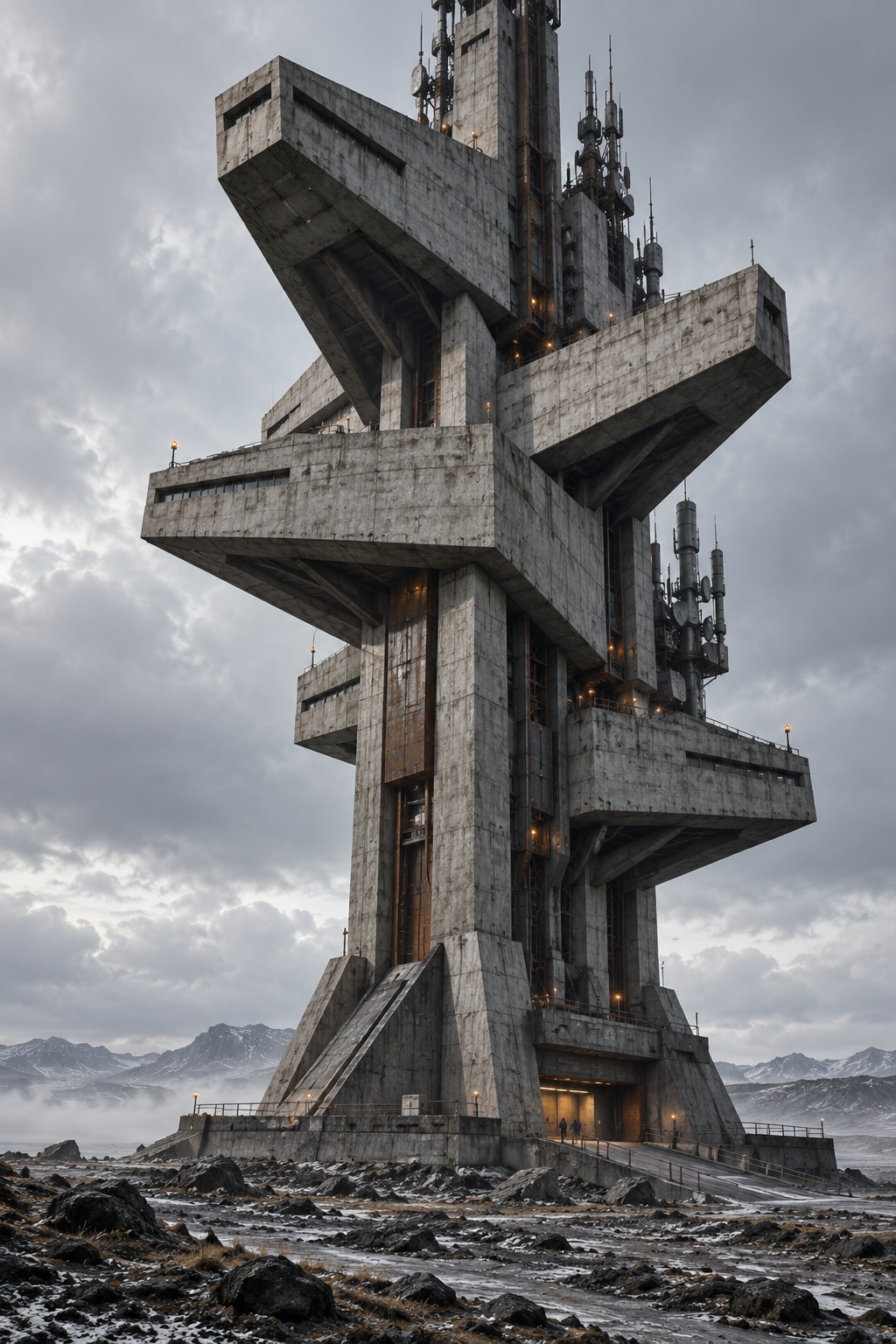
Begin with a small family of masses and show how they connect. Wedges need cores or supports; bridges need clear landing points; a ceiling must appear to bear on something. The tower study uses a thick central shaft and a broad base to make its projecting forms legible. Generative images can suggest a structural idea, but they are not engineering proposals. If a support seems to end in fog, strengthen the visible connection before adding more detail.
Expose systems selectively
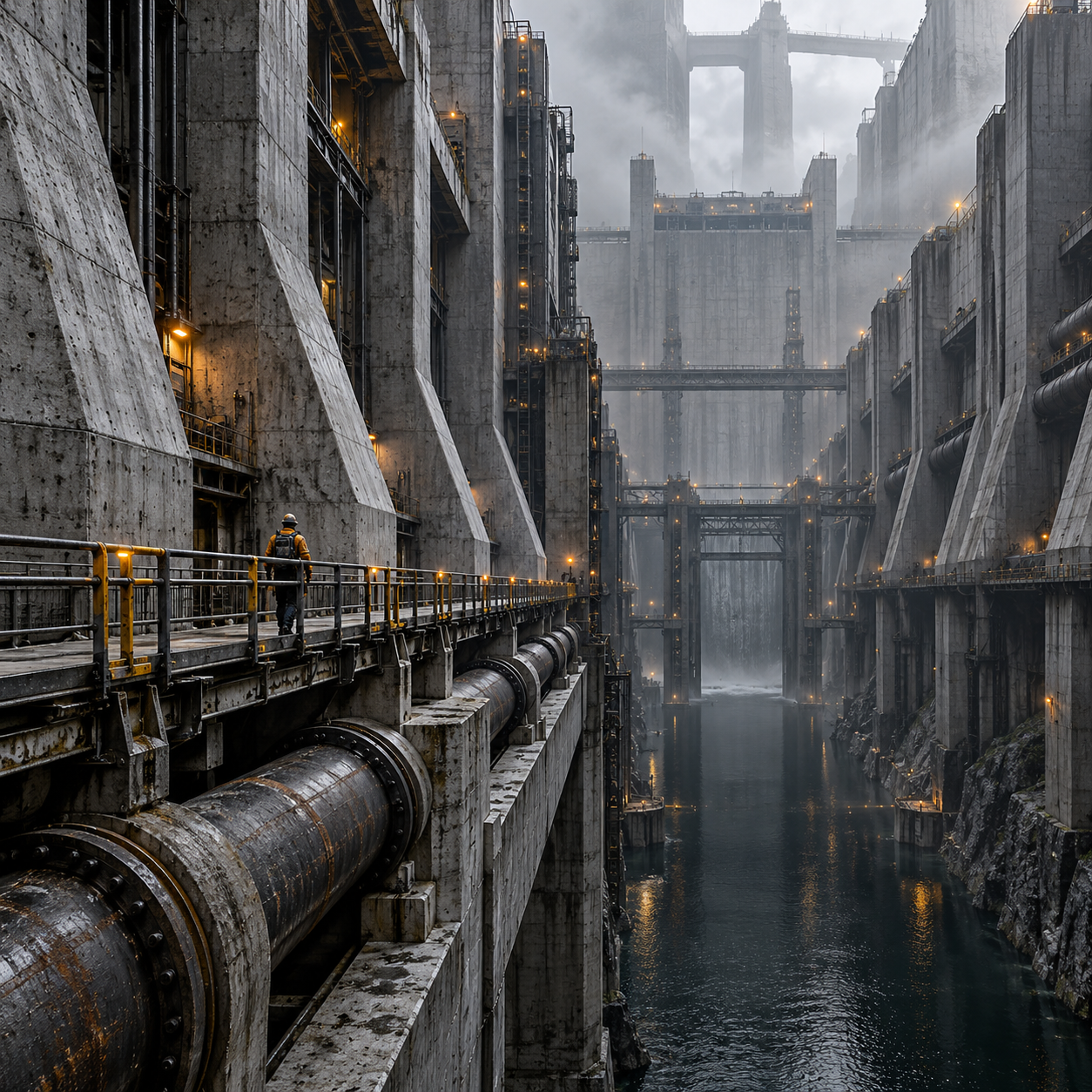
Pipes, conduits, maintenance stairs and ventilation recesses can explain how the building works. Place them along routes a viewer can follow. Random cables make a scene busy without adding plausibility. In the service canyon, the large pipe and narrow walkway lead toward a distant crossing; water and haze establish the depth below. Keep the main mass readable first, then use service elements to reveal scale and occupation.
Light should locate, not decorate
Use a limited hierarchy: pale sky or shaft light reveals the volume, dark recesses preserve depth, and small amber points identify access or activity. Avoid outlining every edge with neon, which changes heavy infrastructure into a luminous diagram. Hard foreground edges and quieter distant forms can convey depth without covering the scene in smoke. A single warm doorway is often enough to make an otherwise severe composition feel inhabited.
Different spaces, the same pressure
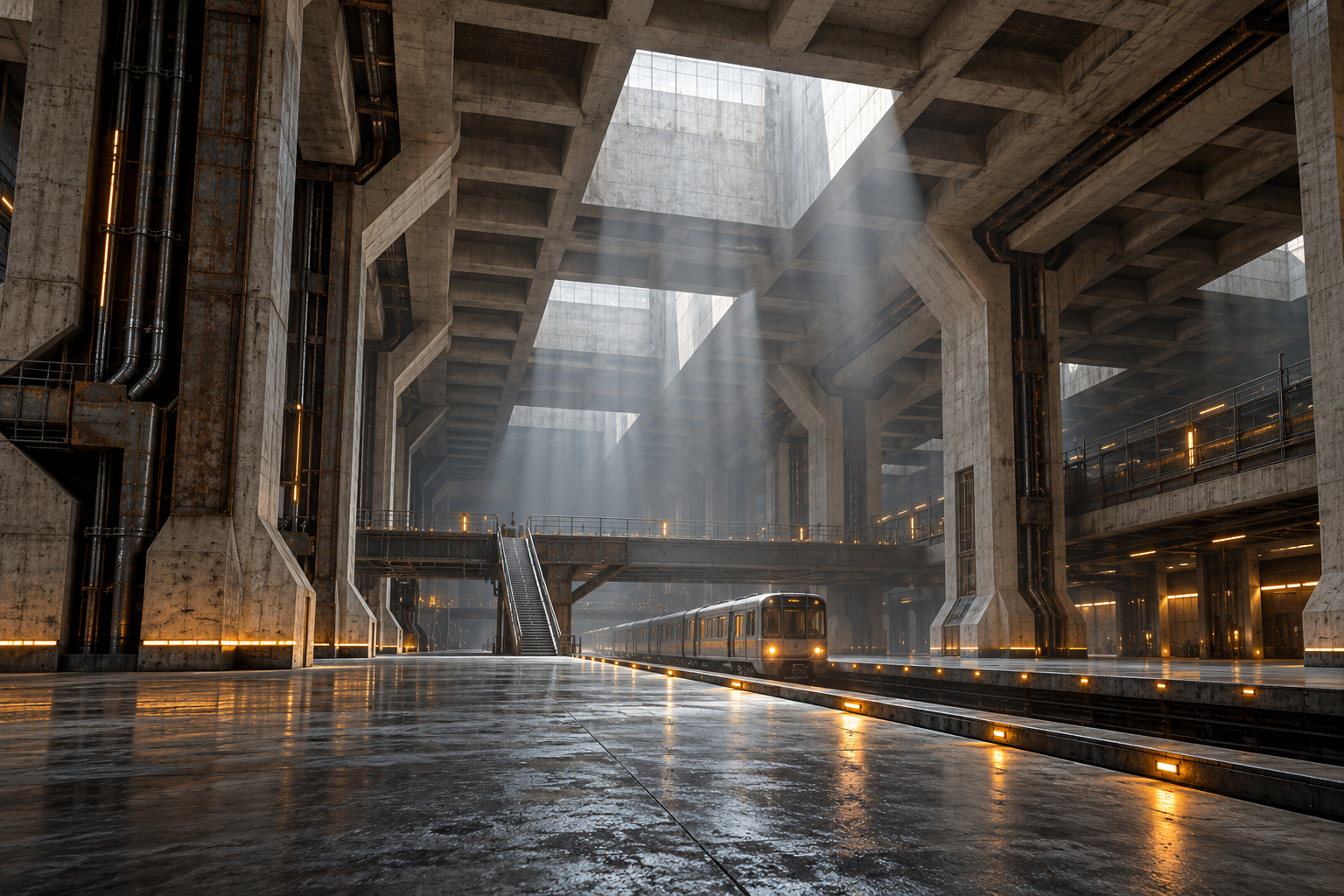
The transit hall applies the idea indoors: the train is familiar, the ceiling astonishingly oversized. The coastline banner uses an open horizon to separate the masses; the tower compresses their force into a vertical frame. These variations suit speculative environments, architectural concept art and fiction covers. The approach fails when every surface is equally monumental or distressed. Include small usable details and some unbroken planes so the viewer can distinguish design, maintenance and decay.
The historical comparison has limits
Brutalism has a wider history than ominous concrete scenery. The linked architectural overview discusses exposed structure, material legibility and social purpose as well as monumental buildings. Crualist Futuristic Brutalism borrows selected visual cues for fiction and deliberately exaggerates them. Its sense of oppressive scale is an artistic choice, not a definition of the real architectural movement.
A small poetic detour
Original words from the AOI studio.
Poetry
At platform level
The roof keeps half a mountain overhead.
A little train brings windows through the gray.
A worker's lamp, a patient point of red,
insists that someone comes this way each day.
The walls can make a continent of shade;
the stair still takes one ordinary stride.
We measure all the future we have made
by whether there is room to live inside.
The prompt workshop
Original creative exercises. These prompts create new illustrations, not documentary evidence.
Give mass a scale
Design an original futuristic concrete gateway with one small occupied entrance, a thick load-bearing core and a clear path toward it. Use cold daylight and one amber light.
Keep the door readable even at thumbnail size.
Follow the service route
Create a deep infrastructural canyon with exposed pipes, protected maintenance walkways and a distant bridge. Use repeated structural bays, credible supports and restrained atmospheric depth.
Let the service system explain the space.
Hard edge, soft distance
Show a monumental transit hall with crisp near columns and quieter far bays. Place a small train at the focal point and use overhead daylight to reveal the ceiling weight.
Reduce haze until the important supports remain visible.
Your next inspiration
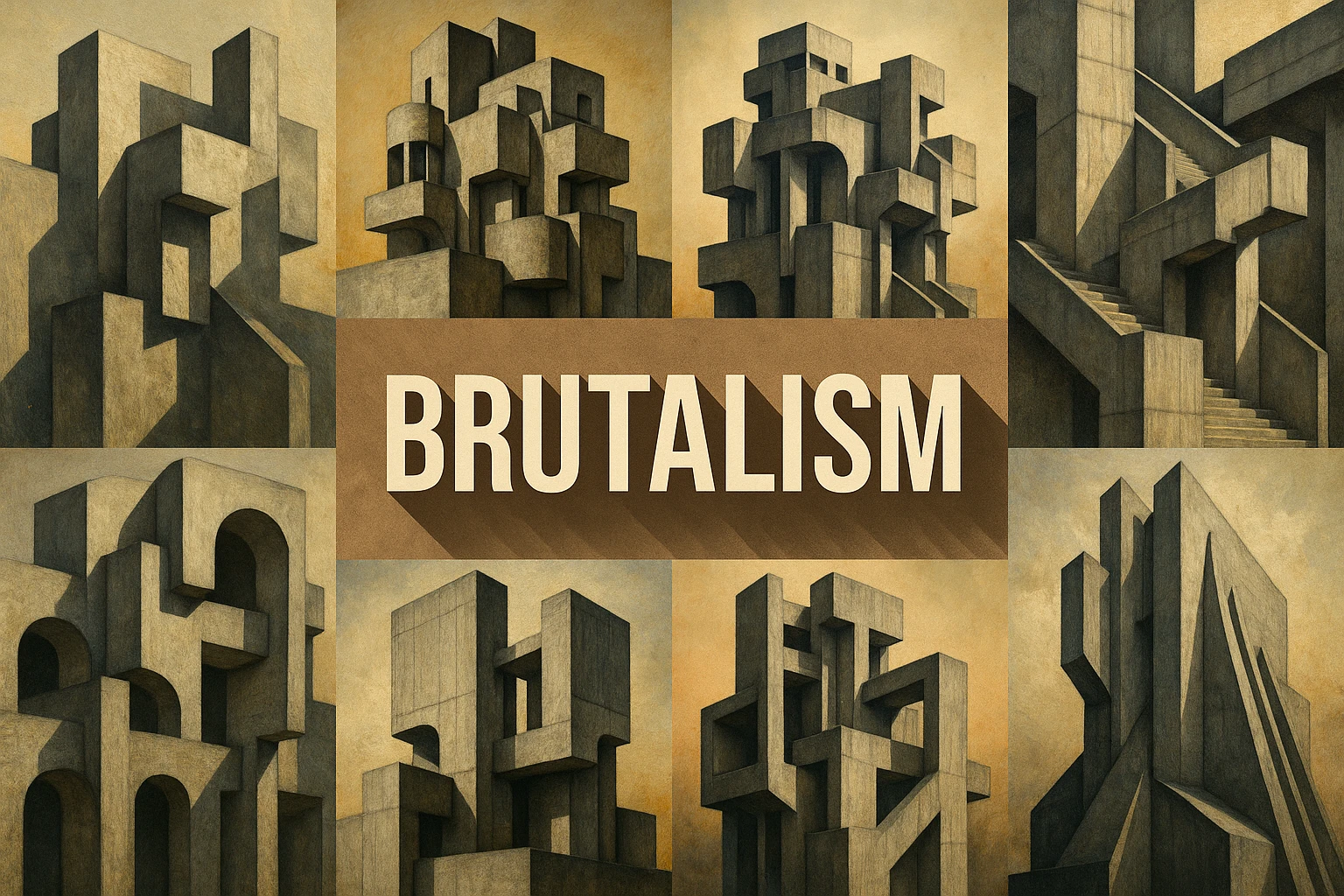
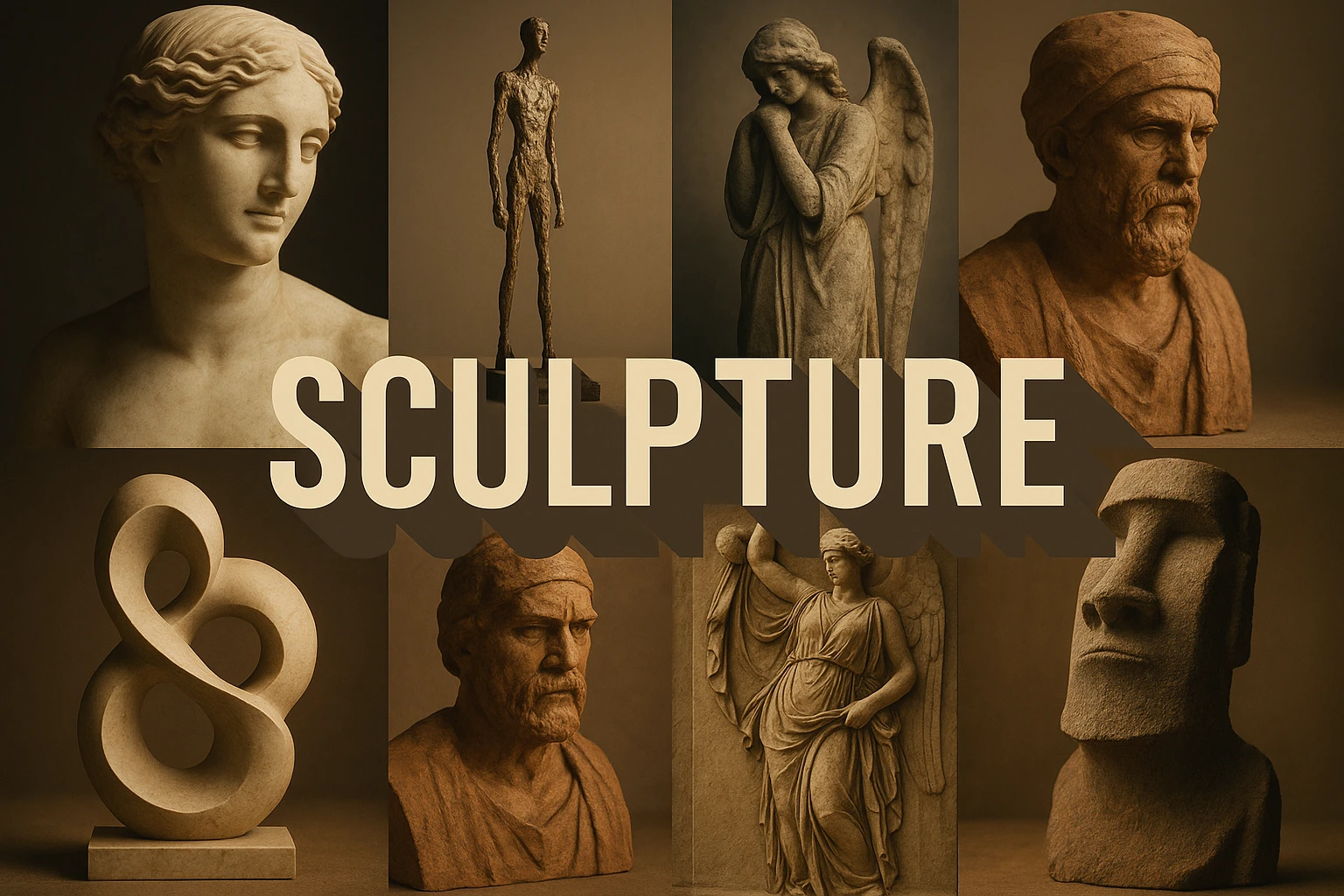
Discover another art style
Follow a visual thread to the next subject.

A smile from the studio
Jokes
The architect described the station as “intimate at the human scale.” The human was eventually located beside column 47, where they had been waiting for the lift since Tuesday. Facilities management proposed a wayfinding sign. The architect approved a sixty-metre concrete arrow.
Sources and further exploration
Wallpaper — historical context and the range of Brutalist architecture