
Historical avant-garde movement
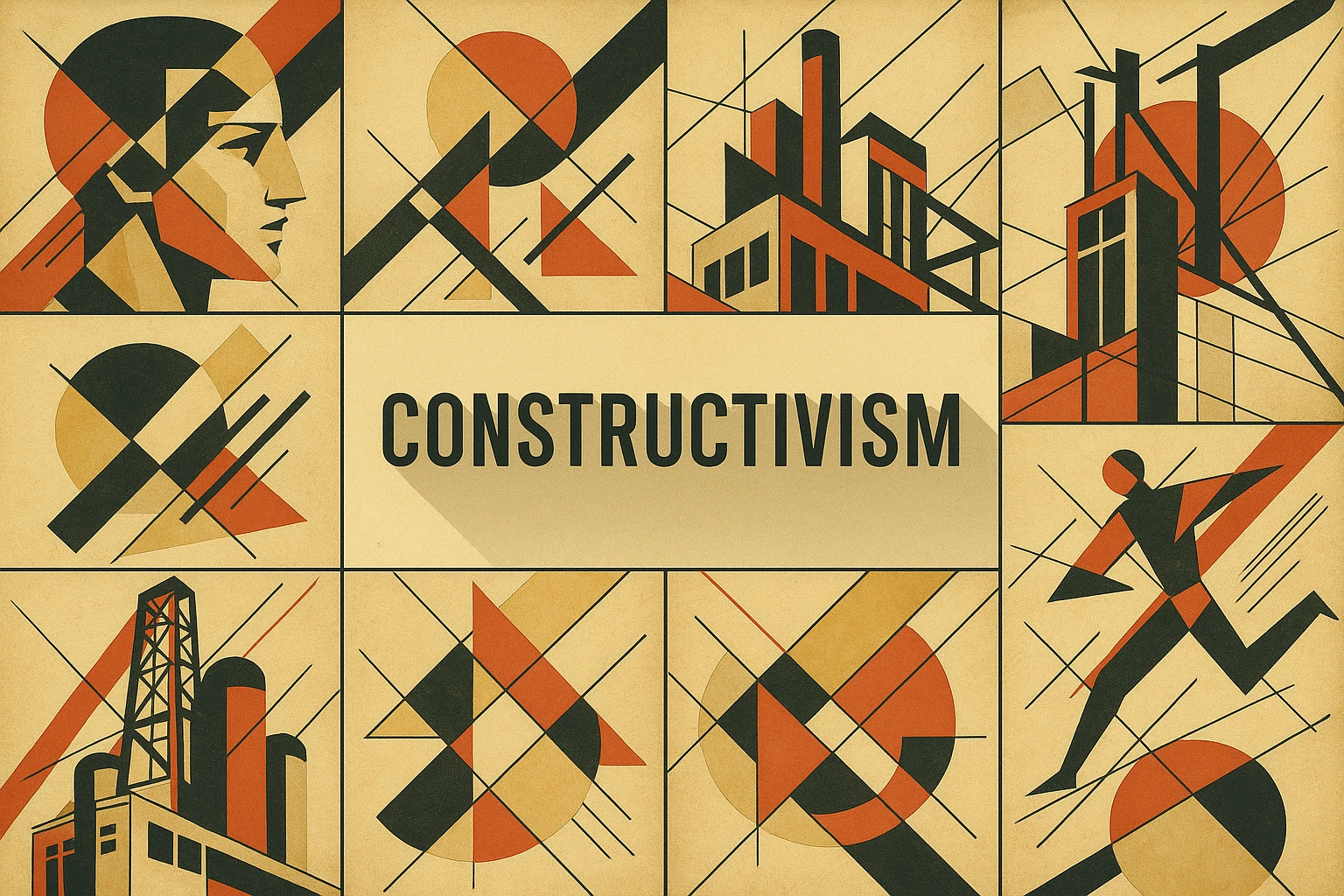
Constructivism emerged within the Russian avant-garde around the revolutionary period. It reconsidered the artist’s role through construction, materials and socially directed work, extending beyond a recognizable geometric poster look.
A visual introduction
Select an image for a closer look. Use the thumbnails, arrow keys or a swipe to compare examples. Zoom in to inspect details, or share the image that inspires you.
Creative toolbox · take this style further
Choose an input and a destination. Search sends your words to the chosen site; Copy & open puts them on your clipboard to paste there.
Create with AI
Turn your chosen input into an image prompt or a new creative direction.
ChatGPT
Copy your input and paste it into a ChatGPT conversation or image request.
Copy & open ChatGPT (new tab)Claude · Anthropic
Develop an image prompt or explore the style in a new Claude conversation.
Copy & open Claude · Anthropic (new tab)Midjourney
Paste your input into the Imagine bar on the Create page.
Copy & open Midjourney (new tab)Adobe Firefly
Copy your input, open Firefly, and paste it into the prompt field.
Copy & open Adobe Firefly (new tab)Leonardo.Ai
Copy your input, open Leonardo, and paste it into the generation field.
Copy & open Leonardo.Ai (new tab)Image search
Find visual references. Short, concrete keywords usually work best.
Lexica
Search AI images and prompts using your selected input.
Search with this input Lexica (new tab)Pexels
Search the photo and video library. Short keywords often work best.
Search with this input Pexels (new tab)Pixabay
Search photos, illustrations and other images.
Search with this input Pixabay (new tab)Unsplash
Search photographs using the style name or your own keywords.
Search with this input Unsplash (new tab)Wikimedia Commons
Search photographs, artworks and historical images. Check each file for its source and reuse terms.
Search with this input Wikimedia Commons (new tab)Art & research
Explore artists, collections and the ideas behind a style.
Wikipedia
Search for background reading. A style may not have its own article.
Search with this input Wikipedia (new tab)WikiArt
Copy your input into WikiArt’s search to explore artists and artworks.
Copy & open WikiArt (new tab)Europeana
Paste your keywords into the search to explore European museum, library and archive collections.
Copy & open Europeana (new tab)Inspiration
Discover portfolios and visual ideas from creative communities.
Instagram hashtags
Search a hashtag made from your input: spaces and punctuation are removed. Instagram may require sign-in.
Search with this input Instagram hashtags (new tab)ArtStation
Paste your input into artwork search for concept art, environments, characters and visual development.
Copy & open ArtStation (new tab)Behance
Paste your input into project search for illustration, design and visual storytelling.
Copy & open Behance (new tab)A closer look
Geometric relationships, directional tension, organized space and the interaction of image and typography can make a composition feel constructed rather than casually decorated.
Connect the visual language to its historical argument
MoMA places Constructivism within the Russian avant-garde around the October Revolution of 1917. Its artists questioned the idea of art as purely individual expression and explored a more social or utilitarian role. The museum's examples include work by Aleksandr Rodchenko, Varvara Stepanova, Liubov Popova, Vladimir Tatlin and El Lissitzky.
These artists did not all produce interchangeable red-and-black posters. Study the particular object: a spatial construction, design, painting or proposal asks different questions. A contemporary illustration may borrow geometric relationships without reproducing the historical political program.
Build relationships rather than scatter shapes
Begin with a dominant direction and a limited set of elements. A diagonal can create momentum, but it needs a counterweight or destination. A circle can interrupt a rectangular field, while an empty interval can make that interruption legible. The composition should remain convincing when reduced to a small diagram.
Decide whether elements overlap, interlock or occupy separate layers. Each relationship suggests a different spatial logic. Randomly rotating rectangles may create energy without creating structure. Ask what holds the arrangement together and which change would cause it to lose that coherence.
Typography and imagery must cooperate
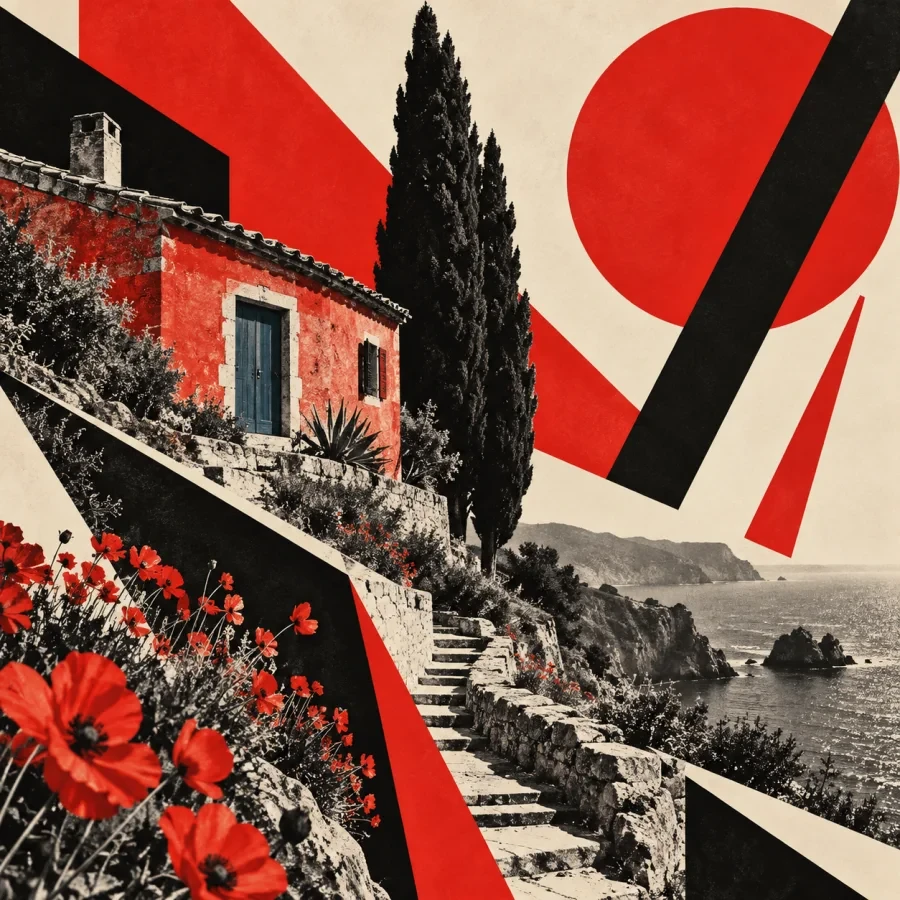
In a graphic exercise, words can function as scale, rhythm and direction as well as language. Give the reader a clear entry point and a deliberate sequence. If a photograph is included, its crop should participate in the geometry rather than sit inside the design as an unrelated rectangle.
For AI-assisted concepts, generate the visual arrangement and refine actual typography separately. Pseudo-Cyrillic marks are neither meaningful text nor evidence of historical authenticity. Use accurate language when a message is part of the finished work.
Test an original public message
Choose a contemporary, specific subject such as a neighborhood workshop or a public reading event. Make one composition organized around a single action and another around a repeated unit. Compare which communicates the event more clearly.
Keep historical attribution separate from this exercise. A generated geometric design is not an archival revolutionary poster. The useful lesson is to connect form, material and purpose, while recognizing the different circumstances in which the original works were made.
The prompt workshop
Original creative exercises. These prompts create new illustrations, not documentary evidence.
One directional structure
Original geometric poster concept for a community repair workshop, one strong diagonal balanced by a circular tool silhouette, black, cream and restrained red, clear empty area for later typography, no invented lettering.
Construction in space
Original abstract spatial construction of interlocking planes and open circular elements, visible material edges, balanced tension and negative space, studio light explaining connections, no copied historical artwork.
A repeated public rhythm
Contemporary graphic concept for a shared reading event, repeated book-like rectangles organized around one clear focal interval, limited palette, precise alignment and hierarchy, leave text areas blank.
Sources and further exploration
MoMA — Constructivism, its social argument and collection examples