
AOI creative concept
Complex Art and Flowerism is treated here as an AOI creative brief: an intricate floral composition whose many details remain organized around a clear focal point. The name describes this proposed approach, rather than a documented historical movement.
An A⊕I –[-.+] creαt¡ve c⊕ncept, n⊕t αn estαbl¡she∂ h¡st⊕r¡cαl m⊕vement.
A visual introduction
Compare the retained archive interpretations with the visual principles below.
Select an image for a closer look. Use the thumbnails, arrow keys or a swipe to compare examples. Zoom in to inspect details, or share the image that inspires you.

Creative toolbox · take this style further
Choose an input and a destination. Search sends your words to the chosen site; Copy & open puts them on your clipboard to paste there.
Create with AI
Turn your chosen input into an image prompt or a new creative direction.
ChatGPT
Copy your input and paste it into a ChatGPT conversation or image request.
Copy & open ChatGPT (new tab)Claude · Anthropic
Develop an image prompt or explore the style in a new Claude conversation.
Copy & open Claude · Anthropic (new tab)Midjourney
Paste your input into the Imagine bar on the Create page.
Copy & open Midjourney (new tab)Adobe Firefly
Copy your input, open Firefly, and paste it into the prompt field.
Copy & open Adobe Firefly (new tab)Leonardo.Ai
Copy your input, open Leonardo, and paste it into the generation field.
Copy & open Leonardo.Ai (new tab)Image search
Find visual references. Short, concrete keywords usually work best.
Lexica
Search AI images and prompts using your selected input.
Search with this input Lexica (new tab)Pexels
Search the photo and video library. Short keywords often work best.
Search with this input Pexels (new tab)Pixabay
Search photos, illustrations and other images.
Search with this input Pixabay (new tab)Unsplash
Search photographs using the style name or your own keywords.
Search with this input Unsplash (new tab)Wikimedia Commons
Search photographs, artworks and historical images. Check each file for its source and reuse terms.
Search with this input Wikimedia Commons (new tab)Art & research
Explore artists, collections and the ideas behind a style.
Wikipedia
Search for background reading. A style may not have its own article.
Search with this input Wikipedia (new tab)WikiArt
Copy your input into WikiArt’s search to explore artists and artworks.
Copy & open WikiArt (new tab)Europeana
Paste your keywords into the search to explore European museum, library and archive collections.
Copy & open Europeana (new tab)Inspiration
Discover portfolios and visual ideas from creative communities.
Instagram hashtags
Search a hashtag made from your input: spaces and punctuation are removed. Instagram may require sign-in.
Search with this input Instagram hashtags (new tab)ArtStation
Paste your input into artwork search for concept art, environments, characters and visual development.
Copy & open ArtStation (new tab)Behance
Paste your input into project search for illustration, design and visual storytelling.
Copy & open Behance (new tab)A closer look
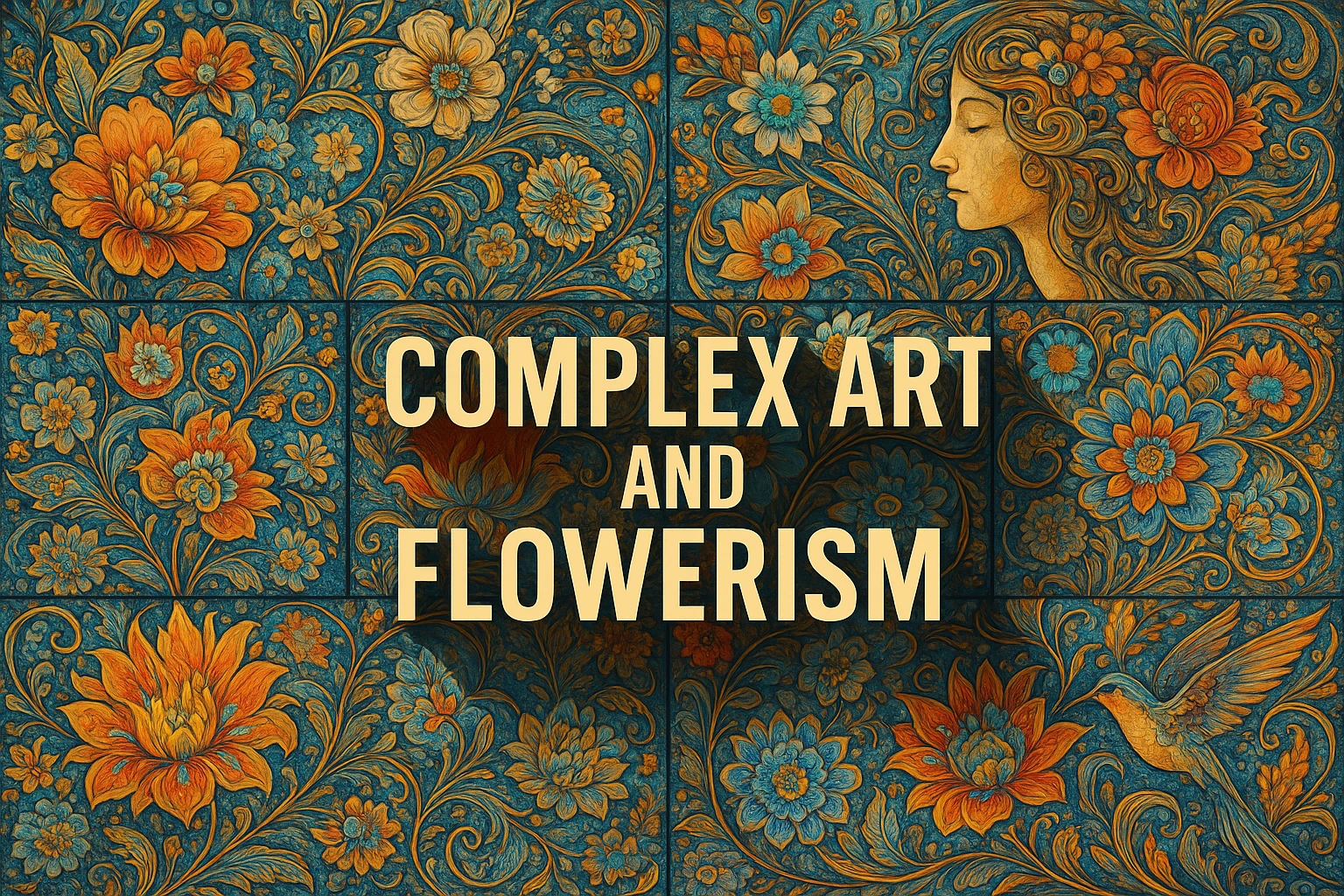
Branching stems connect large flowers, smaller blossoms and fine curled ornament. A restrained palette and a quieter focal area keep the dense pattern readable.
Complexity needs an order
The useful problem in this concept is how to make abundance legible. Start with a few large shapes, connect them with stems or broad curves, and only then introduce smaller leaves and decorative marks. Every scale should serve the composition. Adding the same amount of detail everywhere produces a surface that is busy but difficult to explore.
The retained portrait gives the eye a relatively calm face amid orange, yellow and blue flowers on a dark teal ground. Its enclosing stems create a decorative frame. This is an archive illustration, not an authenticated period portrait or a work attributed to a named artist. The accompanying collage varies the floral motifs while keeping a similar palette and curved line.
Build a garden that can be read
For a practical study, draw one large bloom and two smaller companions. Establish the spaces between them before filling those spaces with foliage. Repeat a curved stem at several sizes, but alter its direction so the pattern does not become a row of identical symbols. Keep the strongest light-dark contrast near the subject you want noticed first.
Color can do more organizing work than extra outlines. Choose one dark ground, two related flower colors and a small contrasting accent. Let some leaves merge into the background while a few edges remain crisp. If the focal point disappears when the image is viewed small, simplify the surrounding detail or reduce its contrast before adding more ornament.
This approach suits an illustrated book cover, a decorative panel or a patterned portrait. For a repeat pattern, test the joins separately; a framed composition is not automatically seamless. The brief does not prescribe botanical accuracy. If recognizable species matter, use observations or verified botanical references and distinguish them from invented petals. Complexity should reward a closer look without requiring the viewer to search for the subject.
The prompt workshop
Original creative exercises. These prompts create new illustrations, not documentary evidence.
One bloom, many scales
Create an original decorative floral illustration with one large coral flower, two smaller ochre blooms and branching teal foliage. Organize tiny curled details around broad readable shapes. Dark blue-green ground, visible ink-like outlines, a quiet area around the main bloom, no lettering.
A portrait in a garden
Illustrate an invented adult face surrounded by an intricate frame of flowers and curling stems. Keep the face calm and readable, place the densest detail toward the edges, and limit the palette to teal, coral and gold. No signature or text.
Detail without a center
Create a floral decorative panel with three unequal clusters linked by long stems. Vary large blooms, small leaves and fine curls; leave deliberate quiet channels between clusters. Flat ornamental space, restrained color, no text. This is a panel, not a seamless tile.