
Drawing medium
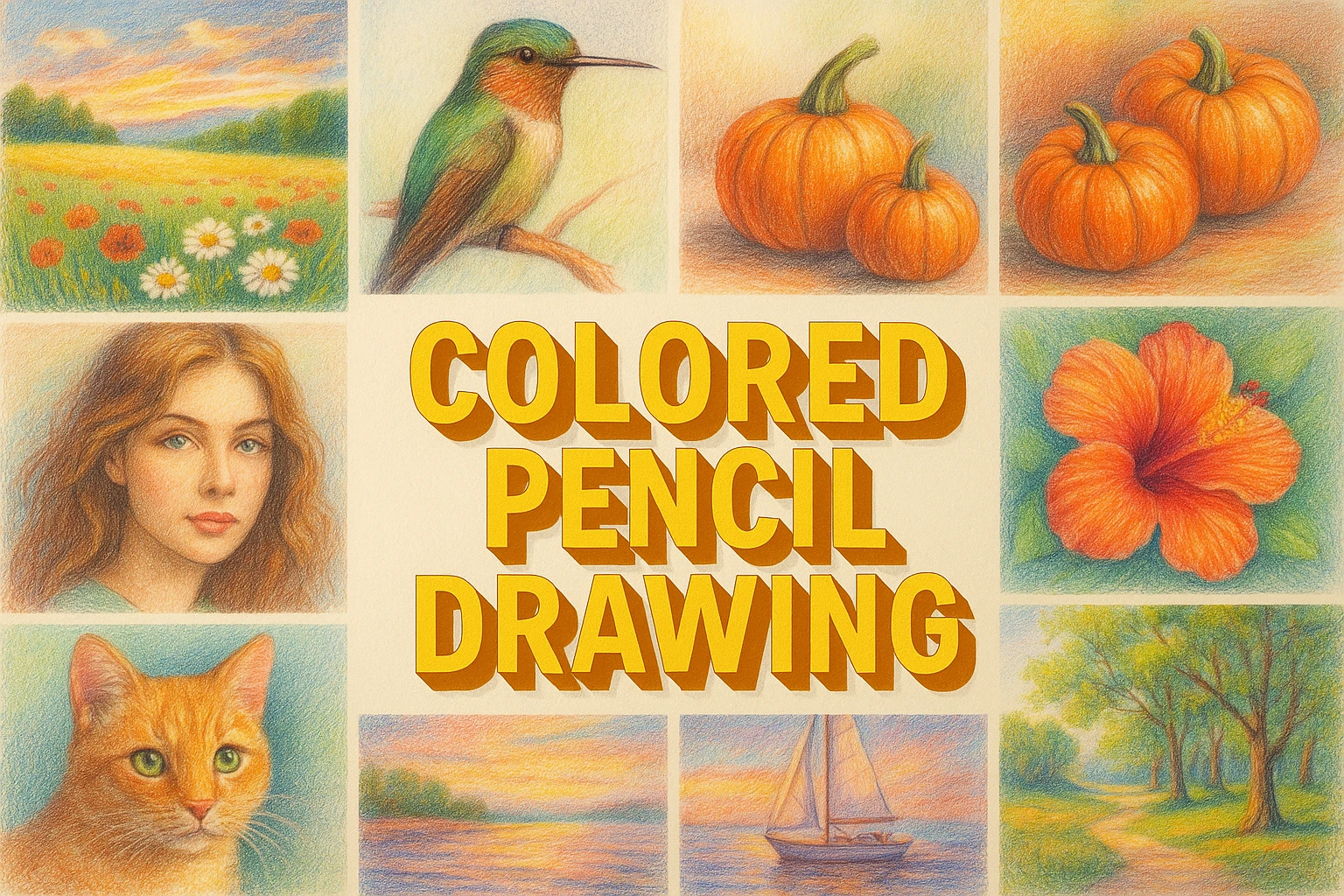
Colored pencil drawing builds an image through controlled deposits of pigment. Paper texture, pressure, layering order and the choice between visible strokes and polished areas determine its character.
A visual introduction
Select an image for a closer look. Use the thumbnails, arrow keys or a swipe to compare examples. Zoom in to inspect details, or share the image that inspires you.
Creative toolbox · take this style further
Choose an input and a destination. Search sends your words to the chosen site; Copy & open puts them on your clipboard to paste there.
Create with AI
Turn your chosen input into an image prompt or a new creative direction.
ChatGPT
Copy your input and paste it into a ChatGPT conversation or image request.
Copy & open ChatGPT (new tab)Claude · Anthropic
Develop an image prompt or explore the style in a new Claude conversation.
Copy & open Claude · Anthropic (new tab)Midjourney
Paste your input into the Imagine bar on the Create page.
Copy & open Midjourney (new tab)Adobe Firefly
Copy your input, open Firefly, and paste it into the prompt field.
Copy & open Adobe Firefly (new tab)Leonardo.Ai
Copy your input, open Leonardo, and paste it into the generation field.
Copy & open Leonardo.Ai (new tab)Image search
Find visual references. Short, concrete keywords usually work best.
Lexica
Search AI images and prompts using your selected input.
Search with this input Lexica (new tab)Pexels
Search the photo and video library. Short keywords often work best.
Search with this input Pexels (new tab)Pixabay
Search photos, illustrations and other images.
Search with this input Pixabay (new tab)Unsplash
Search photographs using the style name or your own keywords.
Search with this input Unsplash (new tab)Wikimedia Commons
Search photographs, artworks and historical images. Check each file for its source and reuse terms.
Search with this input Wikimedia Commons (new tab)Art & research
Explore artists, collections and the ideas behind a style.
Wikipedia
Search for background reading. A style may not have its own article.
Search with this input Wikipedia (new tab)WikiArt
Copy your input into WikiArt’s search to explore artists and artworks.
Copy & open WikiArt (new tab)Europeana
Paste your keywords into the search to explore European museum, library and archive collections.
Copy & open Europeana (new tab)Inspiration
Discover portfolios and visual ideas from creative communities.
Instagram hashtags
Search a hashtag made from your input: spaces and punctuation are removed. Instagram may require sign-in.
Search with this input Instagram hashtags (new tab)ArtStation
Paste your input into artwork search for concept art, environments, characters and visual development.
Copy & open ArtStation (new tab)Behance
Paste your input into project search for illustration, design and visual storytelling.
Copy & open Behance (new tab)A closer look
Fine lines can coexist with broad layered color; exposed paper produces sparkle and softness, while denser passages create stronger color and smoother surfaces.
The paper is part of the drawing
A colored pencil does not behave like a small paintbrush. Its mark is shaped by the point, pressure and surface beneath it. Faber-Castell's technique guidance contrasts smooth and textured papers: a smoother support favors continuous detail, while a coarser surface interrupts the stroke. Test the actual pencil and paper together before committing to an elaborate image.
Begin with a small patch showing a light layer, a denser layer and two overlapping colors. This gives a more useful prediction than the pencil's painted barrel. The paper's own color also participates wherever the deposit remains translucent or broken.
Layer before forcing the finish
Derwent recommends practicing controlled pressure, comparing the order of layers and recording successful mixtures. Light early passes leave room to adjust relationships. Pressing hard immediately can make a patch difficult to modify and create an uneven sheen before the larger color structure is settled.
Choose stroke direction according to the form. Curving marks can describe a rounded fruit; repeated straight marks can emphasize woven cloth. Where a smooth passage is useful, overlap strokes patiently instead of drawing a hard boundary around every change of color.
Build light with relationships
Decide where the paper should remain visible and reserve the strongest dark accents. A highlight is convincing because of the values and edges around it, not simply because white pigment has been added. Compare the object's local color with the light falling on it and the reflected color nearby.
Faber-Castell suggests exploring complementary colors for darkening as well as black. Treat this as an experiment, since pigments and mixtures differ. Make a small comparison first, then choose the mixture that gives the required warmth, coolness and depth.
Burnishing is a choice, not a requirement
Burnishing compresses and blends a heavily worked area toward a smoother finish. Derwent distinguishes it from blending that leaves the surface more receptive to further color. Use the polished effect where it serves the subject; a drawing can also succeed through visible hatching and the grain of the support.
For a final check, view the drawing from a distance and close up. The first view tests composition and value; the second reveals stroke control and unintended debris. In generated illustrations, ask for a consistent mark scale and meaningful variation instead of a generic texture applied over a photograph.
The prompt workshop
Original creative exercises. These prompts create new illustrations, not documentary evidence.
A simple layered study
Original colored-pencil drawing of one pear on ivory paper, light layered strokes following the form, reserved paper highlight, cool reflected shadow, visible grain around the edges, no painted texture.
Contrasting surfaces
Colored-pencil still life of a glazed cup, folded linen and a walnut, deliberate differences between burnished glaze, directional fabric strokes and fine shell marks, restrained palette and coherent side light.
Keep the marks visible
An original landscape drawing in colored pencil, open cross-hatching and broken color on textured warm paper, broad quiet sky, concentrated dark accents around a single tree, no photographic overlay.