
Archive note: historical claims and artist or artwork associations in this entry have not yet received a full source review.
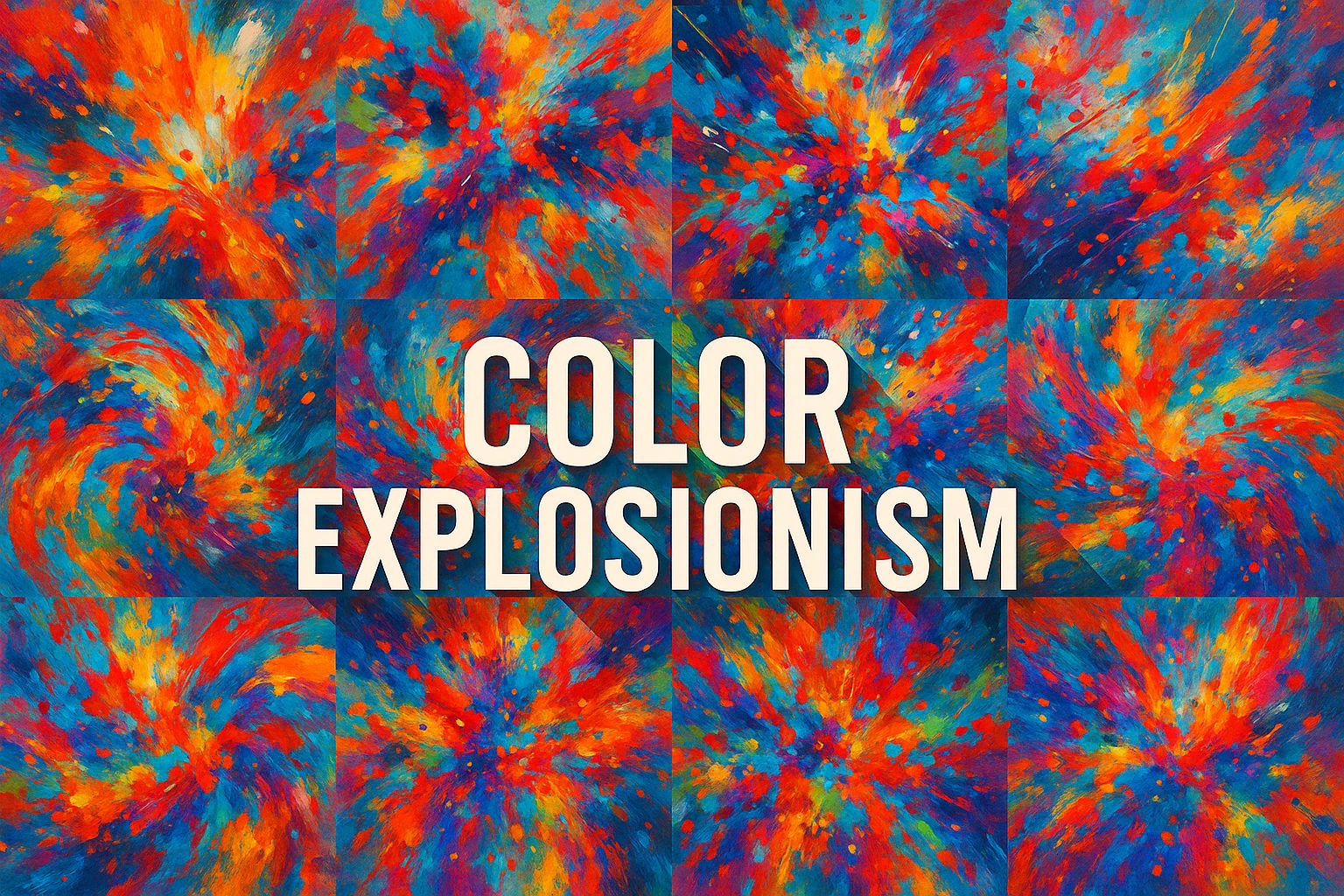
Color Explosionism
Color Explosionism is an art style characterized by bright, bold, and often contrasting colors. It is often characterized by a chaotic, energetic, and vibrant aesthetic. The colors used in Color Explosionism are often intense and vibrant, and the artwork often features a mix of abstract shapes and forms. The artwork often has a surreal, dream-like quality, and the colors are often used to create a sense of movement and energy. Color Explosionism is often used to create a sense of energy and excitement, and to evoke emotion in the viewer.
AOI thinking about Color Explosionism [+_~]-/
Overview and quick facts
Color Explosionism is an art style characterized by the use of vibrant colors and bold shapes. It is a form of abstract expressionism that emphasizes the use of bright, intense colors to create a sense of energy and movement. The style is often used to convey emotion and create a sense of dynamism in a painting. Color Explosionism is a popular art style that has been used by many contemporary artists.
Can understand it also, as:
1. Chromaticism
2. Polychromatism
3. Vividness
4. Brilliance
5. Spectralism
6. Chromatism
7. Chromatism
8. Chromaticity
9. Chromatism
10. Chromaticity
Categorize it as:
Impressionism, Modernism
Detailed description
Color Explosionism is an art style that has been gaining popularity in recent years. It is characterized by bold, vibrant colors and abstract shapes. The style is often used to create a sense of energy and movement in a painting. The term Color Explosionism was coined by artist and art critic, David Anfam, in the early 2000s. He described the style as a kind of abstract expressionism that uses intense, saturated colors to create a sense of energy and movement. The style has been embraced by a number of prominent artists, including Mark Rothko, Jackson Pollock, and Willem de Kooning. Rothkos paintings are particularly well-known for their use of color, with his signature style of large blocks of color and soft edges. Pollocks paintings are characterized by their energetic brushstrokes and vibrant colors. De Koonings work is known for its bold, abstract shapes and bright colors. Color Explosionism has also been embraced by contemporary artists such as Damien Hirst, Jeff Koons, and Takashi Murakami. Hirsts work is known for its bright, bold colors and abstract shapes. Koons work is characterized by its use of bright, saturated colors and playful shapes. Murakamis work is known for its vibrant colors and cartoon-like imagery. Color Explosionism is a style of art that has been embraced by many prominent artists. It is characterized by bold, vibrant colors and abstract shapes. The style is often used to create a sense of energy and movement in a painting. It has been embraced by artists such as Mark Rothko, Jackson Pollock, Willem de Kooning, Damien Hirst, Jeff Koons, and Takashi Murakami.
Archive notes — claims to verify
1. Color Explosionism is an art movement that began in the early 2000s.
2. It is characterized by the use of bright, vibrant colors and bold, abstract shapes.
3. The movement was founded by artist and designer, David Carson.
4. Color Explosionism is a form of abstract expressionism.
5. It is often used to create a sense of energy and movement.
6. Color Explosionism is often used to create a sense of chaos and disorder.
7. The movement is heavily influenced by street art, graffiti, and pop art.
8. Color Explosionism is often used to create a sense of joy and optimism.
9. The movement is often used to create a sense of playfulness and fun.
10. Color Explosionism is often used to create a sense of surprise and excitement.
11. The movement is often used to create a sense of mystery and intrigue.
12. Color Explosionism is often used to create a sense of energy and dynamism.
13. The movement is often used to create a sense of movement and flow.
14. Color Explosionism is often used to create a sense of depth and dimension.
15. The movement is often used to create a sense of harmony and balance.
16. Color Explosionism is often used to create a sense of contrast and tension.
17. The movement is often used to create a sense of unity and cohesion.
18. Color Explosionism is often used to create a sense of rhythm and repetition.
19. The movement is often used to create a sense of texture and texture.
20. Color Explosionism is often used to create a sense of emotion and feeling.
Artists and works: references to check
(be aware, can be highly speculative)
Artists (be aware, speculation possible):
1. Wassily Kandinsky (1866-1944) 2. Paul Klee (1879-1940) 3. Sonia Delaunay (1885-1979) 4. Lyubov Popova (1889-1924) 5. Piet Mondrian (1872-1944) 6. Robert Delaunay (1885-1941) 7. Frantiek Kupka (1871-1957) 8. Kazimir Malevich (1878-1935) 9. Natalia Goncharova (1881-1962) 10. Marc Chagall (1887-1985) 11. Lyonel Feininger (1871-1956) 12. Vladimir Tatlin (1885-1953) 13. Alexander Rodchenko (1891-1956) 14. Jean Arp (1886-1966) 15. Theo van Doesburg (1883-1931)
Artworks (be aware, speculation possible)
1. The Starry Night (Vincent van Gogh, 1889) 2. The Scream (Edvard Munch, 1893) 3. The Persistence of Memory (Salvador Dalí, 1931) 4. The Dance (Henri Matisse, 1909) 5. The Kiss (Gustav Klimt, 1908) 6. The Night Cafe (Vincent van Gogh, 1888) 7. The Garden of Earthly Delights (Hieronymus Bosch, 1503-1515) 8. The Great Wave off Kanagawa (Hokusai, 1829-1833) 9. The Birth of Venus (Sandro Botticelli, 1486) 10. Guernica (Pablo Picasso, 1937) 11. The Son of Man (René Magritte, 1964) 12. The Persistence of Memory (Salvador Dalí, 1931) 13. The Starry Night (Vincent van Gogh, 1889) 14. The Dance (Henri Matisse, 1909) 15. The Kiss (Gustav Klimt, 1908)
Epoch
Color Explosionism is a contemporary art movement that began in the early 2000s. It is characterized by its use of bright, vibrant colors and bold, abstract shapes. The movement is still ongoing and has been embraced by many contemporary artists.
Creative tools and further exploration
Search results are starting points for exploration, not evidence for the historical claims or attributions in this legacy entry.