
Stop-motion animation technique
Claymation uses malleable sculpted forms within stop-motion animation. Its distinctive possibilities come from physical volume, changing shape and carefully staged movement, not merely from a clay-like surface texture.
A visual introduction
Select an image for a closer look. Use the thumbnails, arrow keys or a swipe to compare examples. Zoom in to inspect details, or share the image that inspires you.


Creative toolbox · take this style further
Choose an input and a destination. Search sends your words to the chosen site; Copy & open puts them on your clipboard to paste there.
Create with AI
Turn your chosen input into an image prompt or a new creative direction.
ChatGPT
Copy your input and paste it into a ChatGPT conversation or image request.
Copy & open ChatGPT (new tab)Claude · Anthropic
Develop an image prompt or explore the style in a new Claude conversation.
Copy & open Claude · Anthropic (new tab)Midjourney
Paste your input into the Imagine bar on the Create page.
Copy & open Midjourney (new tab)Adobe Firefly
Copy your input, open Firefly, and paste it into the prompt field.
Copy & open Adobe Firefly (new tab)Leonardo.Ai
Copy your input, open Leonardo, and paste it into the generation field.
Copy & open Leonardo.Ai (new tab)Image search
Find visual references. Short, concrete keywords usually work best.
Lexica
Search AI images and prompts using your selected input.
Search with this input Lexica (new tab)Pexels
Search the photo and video library. Short keywords often work best.
Search with this input Pexels (new tab)Pixabay
Search photos, illustrations and other images.
Search with this input Pixabay (new tab)Unsplash
Search photographs using the style name or your own keywords.
Search with this input Unsplash (new tab)Wikimedia Commons
Search photographs, artworks and historical images. Check each file for its source and reuse terms.
Search with this input Wikimedia Commons (new tab)Art & research
Explore artists, collections and the ideas behind a style.
Wikipedia
Search for background reading. A style may not have its own article.
Search with this input Wikipedia (new tab)WikiArt
Copy your input into WikiArt’s search to explore artists and artworks.
Copy & open WikiArt (new tab)Europeana
Paste your keywords into the search to explore European museum, library and archive collections.
Copy & open Europeana (new tab)Inspiration
Discover portfolios and visual ideas from creative communities.
Instagram hashtags
Search a hashtag made from your input: spaces and punctuation are removed. Instagram may require sign-in.
Search with this input Instagram hashtags (new tab)ArtStation
Paste your input into artwork search for concept art, environments, characters and visual development.
Copy & open ArtStation (new tab)Behance
Paste your input into project search for illustration, design and visual storytelling.
Copy & open Behance (new tab)A closer look
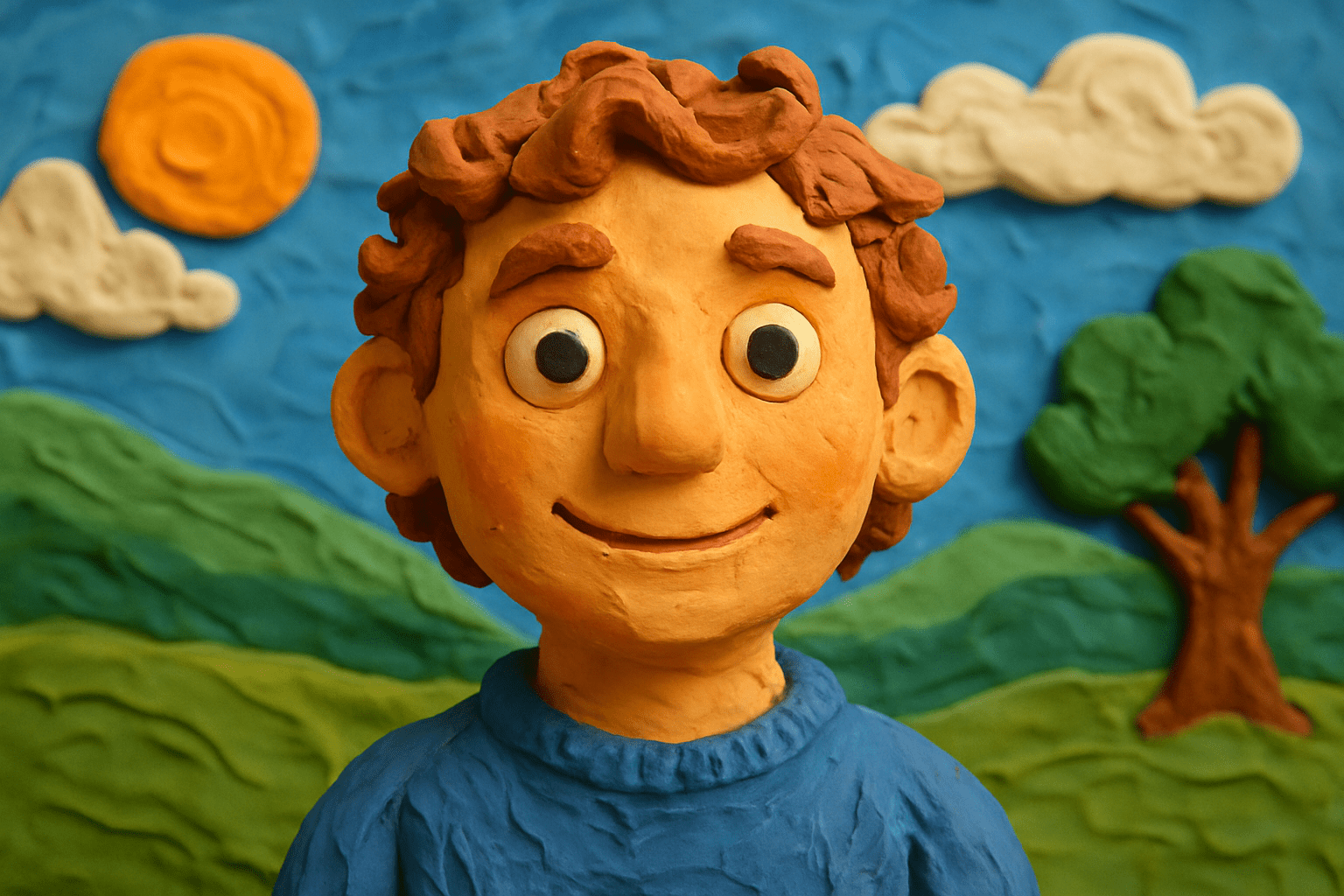
Rounded or deliberately angular modeled forms, tangible surface marks, coherent miniature lighting and expressive poses make the material and performance readable.
A material approach within stop motion
Stop-motion animation records a sequence of individually arranged frames. Claymation uses clay or similarly malleable modeling material as an important part of the animated subject. Other stop-motion work may rely on rigid puppets, replacement parts, paper or found objects. A clay-looking digital render can evoke the material without being a record of this physical process.
Aardman's teaching separates sculpting for the camera from the fundamentals of timing, spacing and performance. This is a helpful distinction: a well-made model is only the beginning. The arrangement of successive poses determines what it appears to think, feel and do.
Sculpt for the camera's view
Test the silhouette before adding small features. A nose, hand or prop that reads clearly on the workbench may merge with the body from the camera's angle. Keep the most expressive features large enough to survive the final image size. Small surface marks can communicate touch, but excessive texture can compete with the performance.
Give the character a stable relationship to the floor and the objects it handles. If the pose suggests weight, the feet, support and shadow should agree. Materials and supports vary by production; do not assume every clay figure is a solid lump without an internal structure.
Movement depends on spacing
For an original exercise, animate a simple shape noticing another object. Plan a resting pose, a small anticipation, the main action and a settling pose. The distance between positions changes the perceived speed. A pause can make a reaction readable, while constant motion may make the same action feel restless.
Shape changes should have a purpose. A stretched mouth, compressed body or transformed object can be expressive when the viewer understands the starting form and the event. Random deformation loses the sense of a coherent character.
Light a small physical world
Use a consistent main light and inspect cast shadows across the planned movement. Unintended variations in exposure or illumination can distract from the action. Choose background details that establish scale without crowding the silhouette.
When creating a still, describe it as a clay-animation concept or material study. It can show modeling and staging, but claims about timing require a sequence. The retained illustration is a visual reference for this discussion, not proof that a physical stop-motion production was used.
The prompt workshop
Original creative exercises. These prompts create new illustrations, not documentary evidence.
A clear gesture
Original clay-animation concept still of a small handmade gardener inspecting an oversized seed, readable pose and silhouette, modest fingerprints in clay, miniature potting bench, consistent soft side light, no existing characters.
Weight and contact
A clay-model character lifting a heavy round parcel, bent knees and grounded feet, hands visibly contacting the object, coherent cast shadows, simple miniature studio set, original design.
Shape transformation study
Three original clay-animation storyboard frames: a squat clay lump notices a bell, stretches upward, then settles into a rounded shape; clear spacing and consistent camera, plain backdrop, tangible modeled volume.
Sources and further exploration
Aardman Academy — sculpting, timing, spacing and performance with clay
Aardman Academy — puppet construction and stop-motion practice