
AOI creative concept · not a historical movement
Claustrophobism is used here as an AOI creative concept for images that make space feel restrictive. It is not presented as a documented historical movement with founders or a manifesto. The useful question is compositional: how can an image make a room seem to close around its subject?
An AOI creative concept, not an established historical movement.
A visual introduction
Open any image to look closer, then browse the examples.
A closer look
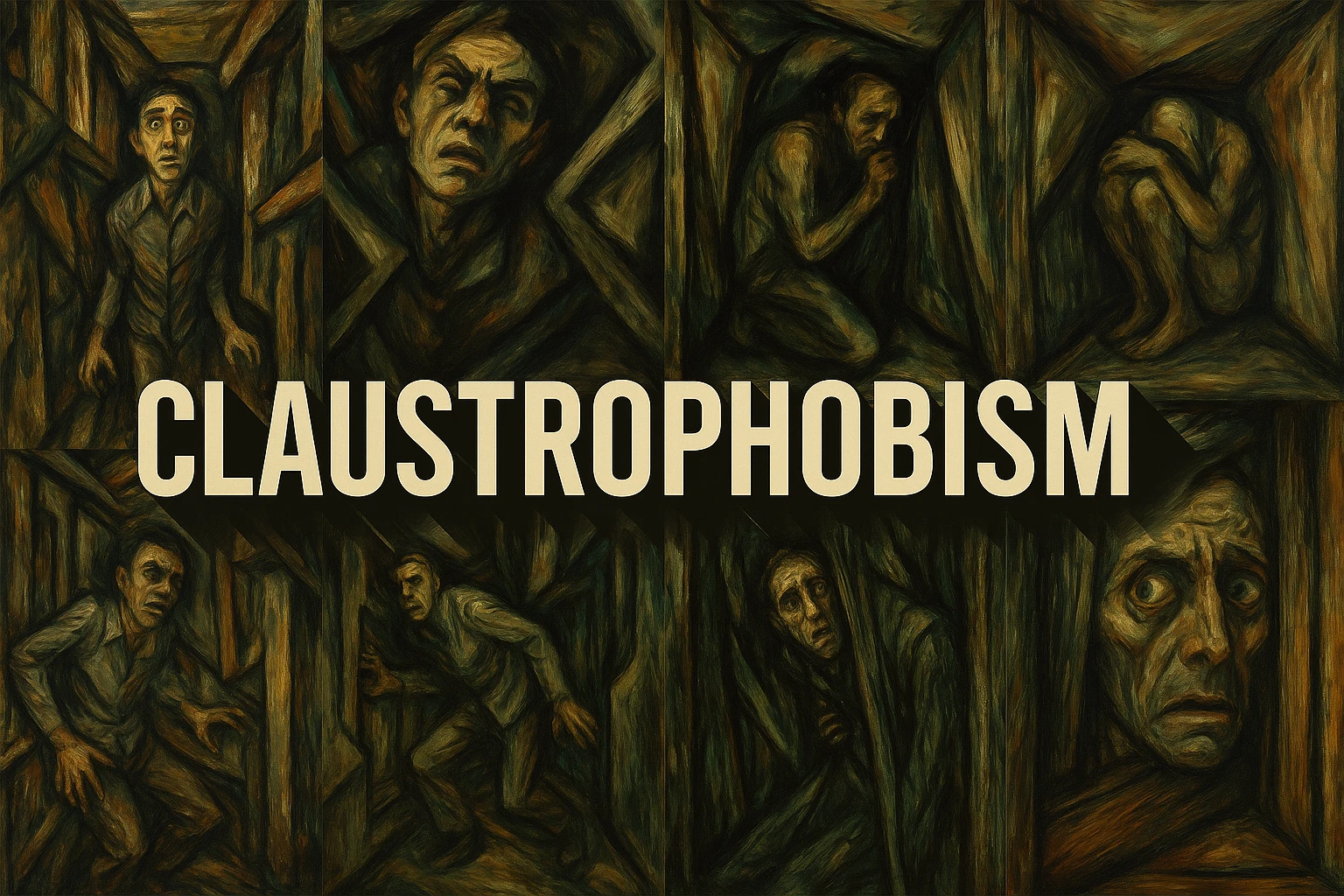
The archive collage presses solitary figures into narrow, angular spaces. Ochre highlights expose faces and hands against near-black walls, while diagonal beams crowd the bodies. Its repeated distressed expressions make the intended mood explicit; the geometry does much of the quieter work.
Pressure can be built without a frightened face
Begin with the relation between figure and frame. A shoulder cut by the edge, a ceiling placed close to the head, or an exit hidden behind another surface can reduce the apparent room available to move. Repeated vertical divisions can turn an otherwise ordinary interior into a sequence of restrictions. These are proposals for making pictures, not diagnostic signs of a viewer’s mental state.
The most obvious version fills every corner and gives the subject an alarmed expression. A more interesting version might contain a calm face and one impossible spatial relationship: a doorway too narrow to use, or a corridor whose far end returns to its beginning. The image asks the viewer to discover the constraint rather than printing the emotion across a forehead.
A documented comparison, not an invented ancestry
John Vassos’s illustrated book Phobia (1931) provides a historical comparison. Cooper Hewitt describes its twenty-three phobias and the use of simplified Art Deco geometry to turn the visual language of modernity toward anxiety. Claustrophobia is among its subjects. Vassos is not identified here as a member or founder of Claustrophobism; the museum source supports the particular book and its design context. [1]
That separation is essential. A visual resemblance does not establish a movement, and a modern working label cannot recruit earlier artists after the fact. The comparison is useful because it offers a question: how can forms associated with order or progress also suggest unease? Our creative concept remains an invitation to experiment, without borrowing a fictitious pedigree.
Reading the archive image
The upper-left figure is hemmed in by slanted walls, while the close-up beside it replaces architectural distance with an enlarged face. Elsewhere, bent knees and folded arms repeat the inward direction of the surrounding planes. The limited ochre-black palette joins these different arrangements. Those observations concern this generated image; they are not evidence of authentic artworks or clinical experience.
The collage also reveals a weakness worth learning from. Its panels repeatedly tell us that the person is distressed, leaving little ambiguity. To develop the idea, change the social setting: an immaculate waiting room, an overfilled domestic shelf, or a desk beneath a ceiling of paperwork. Constraint can come from an arrangement of ordinary things, without turning a person into an emblem of suffering.
An exercise in changing one variable
Draw the same empty room three times. In the first, show the floor, ceiling and a clear exit. In the second, crop the ceiling and move the exit close to the edge. In the third, let a foreground object conceal part of the opening. Keep lighting and colour constant so you can judge what the geometry changes.
For an AI study, describe those spatial decisions explicitly and compare outputs against them. A model may add grimacing figures or cinematic darkness that you never requested; reject those shortcuts if they obscure the experiment. Caption the chosen image as an original synthetic composition. A useful result makes the arrangement of space legible, not merely unpleasant.
People & works to explore
Creative worldbuilding: these names and works may be invented. They are not historical attributions.
Paintings and other works
John Vassos, Phobia (1931) — contextual comparison only; not a Claustrophobism work
Sources and further exploration
[1] Cooper Hewitt — Pessimistic Optimism: John Vassos’s Phobia