
Film and television · comparative overview
A cinematic style is a pattern of choices through which a film or television series organises what we see, hear and understand over time. It includes staging, framing, movement, editing, performance, production design and sound. This overview explains how those choices work together across different kinds of screen storytelling, and how to compare them without reducing a film to a colour preset.
A visual introduction
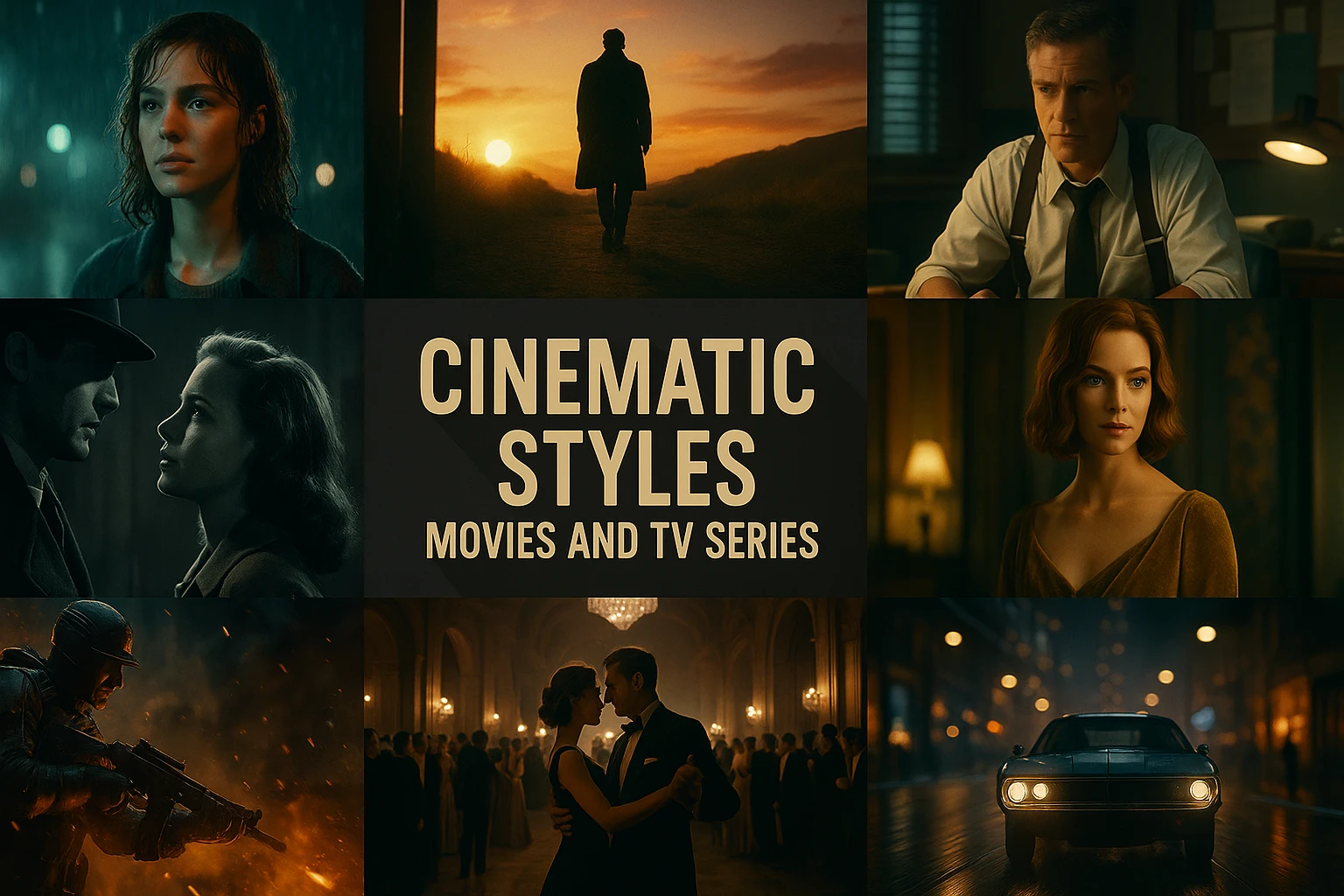
Select an image for a closer look. Use the thumbnails, arrow keys or a swipe to compare examples. Zoom in to inspect details, or share the image that inspires you.
Creative toolbox · take this style further
Choose an input and a destination. Search sends your words to the chosen site; Copy & open puts them on your clipboard to paste there.
Create with AI
Turn your chosen input into an image prompt or a new creative direction.
ChatGPT
Copy your input and paste it into a ChatGPT conversation or image request.
Copy & open ChatGPT (new tab)Claude · Anthropic
Develop an image prompt or explore the style in a new Claude conversation.
Copy & open Claude · Anthropic (new tab)Midjourney
Paste your input into the Imagine bar on the Create page.
Copy & open Midjourney (new tab)Adobe Firefly
Copy your input, open Firefly, and paste it into the prompt field.
Copy & open Adobe Firefly (new tab)Leonardo.Ai
Copy your input, open Leonardo, and paste it into the generation field.
Copy & open Leonardo.Ai (new tab)Image search
Find visual references. Short, concrete keywords usually work best.
Lexica
Search AI images and prompts using your selected input.
Search with this input Lexica (new tab)Pexels
Search the photo and video library. Short keywords often work best.
Search with this input Pexels (new tab)Pixabay
Search photos, illustrations and other images.
Search with this input Pixabay (new tab)Unsplash
Search photographs using the style name or your own keywords.
Search with this input Unsplash (new tab)Wikimedia Commons
Search photographs, artworks and historical images. Check each file for its source and reuse terms.
Search with this input Wikimedia Commons (new tab)Art & research
Explore artists, collections and the ideas behind a style.
Wikipedia
Search for background reading. A style may not have its own article.
Search with this input Wikipedia (new tab)WikiArt
Copy your input into WikiArt’s search to explore artists and artworks.
Copy & open WikiArt (new tab)Europeana
Paste your keywords into the search to explore European museum, library and archive collections.
Copy & open Europeana (new tab)Inspiration
Discover portfolios and visual ideas from creative communities.
Instagram hashtags
Search a hashtag made from your input: spaces and punctuation are removed. Instagram may require sign-in.
Search with this input Instagram hashtags (new tab)ArtStation
Paste your input into artwork search for concept art, environments, characters and visual development.
Copy & open ArtStation (new tab)Behance
Paste your input into project search for illustration, design and visual storytelling.
Copy & open Behance (new tab)A closer look
Look beyond an attractive frame. Follow the relationship between successive shots, the use of off-screen space, changes of rhythm and recurring visual or sonic motifs. Animation, documentary, live-action drama and experimental work can each develop distinctive systems of attention.
Style, genre, medium and movement
These terms answer different questions. Genre groups works through conventions such as suspense, comedy or the musical. Medium and production method describe how images are made, including live action, drawn animation, stop motion and computer animation. A historical movement situates work in a particular artistic and social context. Style describes the formal decisions visible and audible in the work itself.
A science-fiction film can be visually restrained or spectacularly expressionistic. A comedy can use patient long takes or rapid cutting. A television series may change its style within an episode to distinguish a memory from a present-tense event. Treat these categories as intersecting tools, not boxes that prescribe one inevitable appearance.
The frame: bodies, spaces and attention
Mise-en-scène concerns what is arranged for the camera: setting, objects, costume, light and the placement or movement of performers. These elements can tell a story before anyone speaks. A character standing apart from a group, an unused chair at a table or a doorway dividing a room may establish a relationship without explanatory dialogue. Film Education's terminology guide provides a useful starting vocabulary. [2]
Ask what the arrangement allows us to notice first and what it withholds. Dense staging may reward exploration; an empty background can make a small gesture decisive. Neither is inherently more sophisticated. The relevant question is whether the distribution of information serves this moment in the story.
The camera: a position in relation to events
Camera distance, height, angle, lens choice and movement shape our access to a situation. A close view can isolate a reaction while concealing its cause. A wider view may let us compare several people at once. Movement can follow action, discover something previously hidden or make the observer's presence felt.
Avoid translating technical choices into fixed emotional formulas. A low angle does not always mean power, and a handheld image does not automatically mean truth. Interpret the choice in relation to the surrounding shots, the performance and the information the viewer already has. The same framing can become comic, threatening or tender in different sequences.
Editing: relationships between images
A cut can connect a look to its object, move across time, juxtapose ideas or interrupt an expected action. Continuity editing often helps viewers construct a stable space, while deliberate discontinuities can make that construction uncertain. Neither approach is simply a measure of technical competence; the effect depends on whether the pattern is purposeful and intelligible.
For a practical comparison, imagine someone hearing a knock. Showing the door before their reaction gives the viewer shared information. Holding on the listener while keeping the door unseen creates a different uncertainty. Cutting to an unrelated place may turn the moment into a parallel action or an association. The room and performer can stay unchanged while the editing changes the meaning.
Sound makes a world beyond the frame
Dialogue, ambience, effects, music and silence all organise attention. A sound can reveal activity outside the image or continue across a cut to connect two spaces. Music can support a scene's apparent emotion, complicate it or establish a pattern that becomes meaningful only when it returns. A quiet passage can be an active formal choice rather than an absence of design.
Try analysing a short sequence twice: first attend to the image, then listen without watching. Which events are established by sound alone? Which apparent visual meanings change when the soundtrack returns? A still-image prompt can describe implied sound, but it cannot reproduce timing, musical development or the actual experience of a sound bridge.
Several approaches worth comparing
An observational approach may favour sustained attention to behaviour and the surrounding space. An expressionistic approach can distort scale, light or setting to externalise a subjective experience. Graphic stylisation may organise the image through strong silhouettes, flattened space or conspicuous colour relationships. These are useful analytical tendencies, not mutually exclusive genres or universal definitions of realism.
A work may combine them. A plainly staged conversation can be interrupted by an abstract title sequence; a restrained drama can use one highly stylised dream; an animation can move between flat graphic passages and volumetric scenes. Notice when the work changes its rules and what motivates the change.
Movies and serial television
A feature film can establish and transform a visual pattern within a bounded running time. A series can return to locations, gestures and motifs across episodes, letting the viewer recognise a change against a longer history. That does not make one form inherently richer. It creates different opportunities for repetition, variation and delayed consequences.
Compare an early and a later appearance of the same room. Has the blocking changed? Is the familiar viewpoint now withheld? Does a recurring colour belong to a different character? A series can preserve a coherent design language while individual episodes make distinctive choices. Credit should reflect collaboration among directors, cinematographers, designers, editors, animators, performers and sound teams, rather than attributing every decision to one famous name.
Historical context without a checklist of stereotypes
Terms such as German Expressionism, Italian Neorealism and the French New Wave refer to historically situated bodies of work. They are not interchangeable prompt modifiers for crooked buildings, natural light or jump cuts. Research a particular film, its makers and its production context before treating it as an example of a movement. Formal resemblance alone does not establish historical membership.
The same caution applies to national cinema. A country contains many languages, industries, audiences and artistic disagreements. Compare specific works and production contexts instead of giving every film from one place the same palette or temperament.
A repeatable viewing method
Choose a short sequence and write down its basic action without interpretation. Then record a small set of observable choices: shot distance, camera movement, spatial arrangement, transitions and sound. Look for a pattern, identify one exception and explain what that exception changes. Yale's Film Analysis guide offers terminology and sequence-analysis examples for developing this process. [1]
Support an interpretation with those observations. 'The scene feels isolated' is a response; 'the speaker remains separated from the group by a doorway, and no reverse shot brings us into that group' begins to explain how the response is produced. Leave room for alternative readings that account for the same evidence.
Turning analysis into an original creative brief
Specify a situation, a point of view and a formal constraint. For instance: two strangers waiting in a closed station, observed from a fixed distant camera, with one warm source of light and a change revealed through off-screen sound. For a storyboard, describe the sequence and its transitions. For a still illustration, describe the decisive frame and acknowledge that the temporal effects remain proposals.
The companion Cinematic Styles article focuses on constructing individual shots and visual studies. This overview keeps the broader question in view: how a complete screen work develops meaning through images, sound and time.
The prompt workshop
Original creative exercises. These prompts create new illustrations, not documentary evidence.
A scene told through distance
Create an original three-frame storyboard of two strangers waiting in a closed railway station. Use a fixed distant viewpoint, clear separation between the figures and one warm practical lamp. Change only their blocking across the frames; no existing film characters.
The same event, different information
Design an original paired storyboard for a person hearing a knock: version A reveals the door first; version B stays on the listener and keeps the source outside the frame. Consistent setting and light, clearly different control of information.
A recurring location
Create three original keyframes of the same family kitchen at different stages of a fictional television story. Keep architecture and camera position constant; change seating relationships, one recurring colour accent and the distribution of light. Express narrative development through observable choices.