
Historical and cultural field
Celtic art is a broad label applied to material from different periods and regions, as well as later revivals. Understanding a particular object requires its date, place, medium and context; knotwork alone cannot represent the whole field.
A visual introduction
Select an image for a closer look. Use the thumbnails, arrow keys or a swipe to compare examples. Zoom in to inspect details, or share the image that inspires you.

Creative toolbox · take this style further
Choose an input and a destination. Search sends your words to the chosen site; Copy & open puts them on your clipboard to paste there.
Create with AI
Turn your chosen input into an image prompt or a new creative direction.
ChatGPT
Copy your input and paste it into a ChatGPT conversation or image request.
Copy & open ChatGPT (new tab)Claude · Anthropic
Develop an image prompt or explore the style in a new Claude conversation.
Copy & open Claude · Anthropic (new tab)Midjourney
Paste your input into the Imagine bar on the Create page.
Copy & open Midjourney (new tab)Adobe Firefly
Copy your input, open Firefly, and paste it into the prompt field.
Copy & open Adobe Firefly (new tab)Leonardo.Ai
Copy your input, open Leonardo, and paste it into the generation field.
Copy & open Leonardo.Ai (new tab)Image search
Find visual references. Short, concrete keywords usually work best.
Lexica
Search AI images and prompts using your selected input.
Search with this input Lexica (new tab)Pexels
Search the photo and video library. Short keywords often work best.
Search with this input Pexels (new tab)Pixabay
Search photos, illustrations and other images.
Search with this input Pixabay (new tab)Unsplash
Search photographs using the style name or your own keywords.
Search with this input Unsplash (new tab)Wikimedia Commons
Search photographs, artworks and historical images. Check each file for its source and reuse terms.
Search with this input Wikimedia Commons (new tab)Art & research
Explore artists, collections and the ideas behind a style.
Wikipedia
Search for background reading. A style may not have its own article.
Search with this input Wikipedia (new tab)WikiArt
Copy your input into WikiArt’s search to explore artists and artworks.
Copy & open WikiArt (new tab)Europeana
Paste your keywords into the search to explore European museum, library and archive collections.
Copy & open Europeana (new tab)Inspiration
Discover portfolios and visual ideas from creative communities.
Instagram hashtags
Search a hashtag made from your input: spaces and punctuation are removed. Instagram may require sign-in.
Search with this input Instagram hashtags (new tab)ArtStation
Paste your input into artwork search for concept art, environments, characters and visual development.
Copy & open ArtStation (new tab)Behance
Paste your input into project search for illustration, design and visual storytelling.
Copy & open Behance (new tab)A closer look
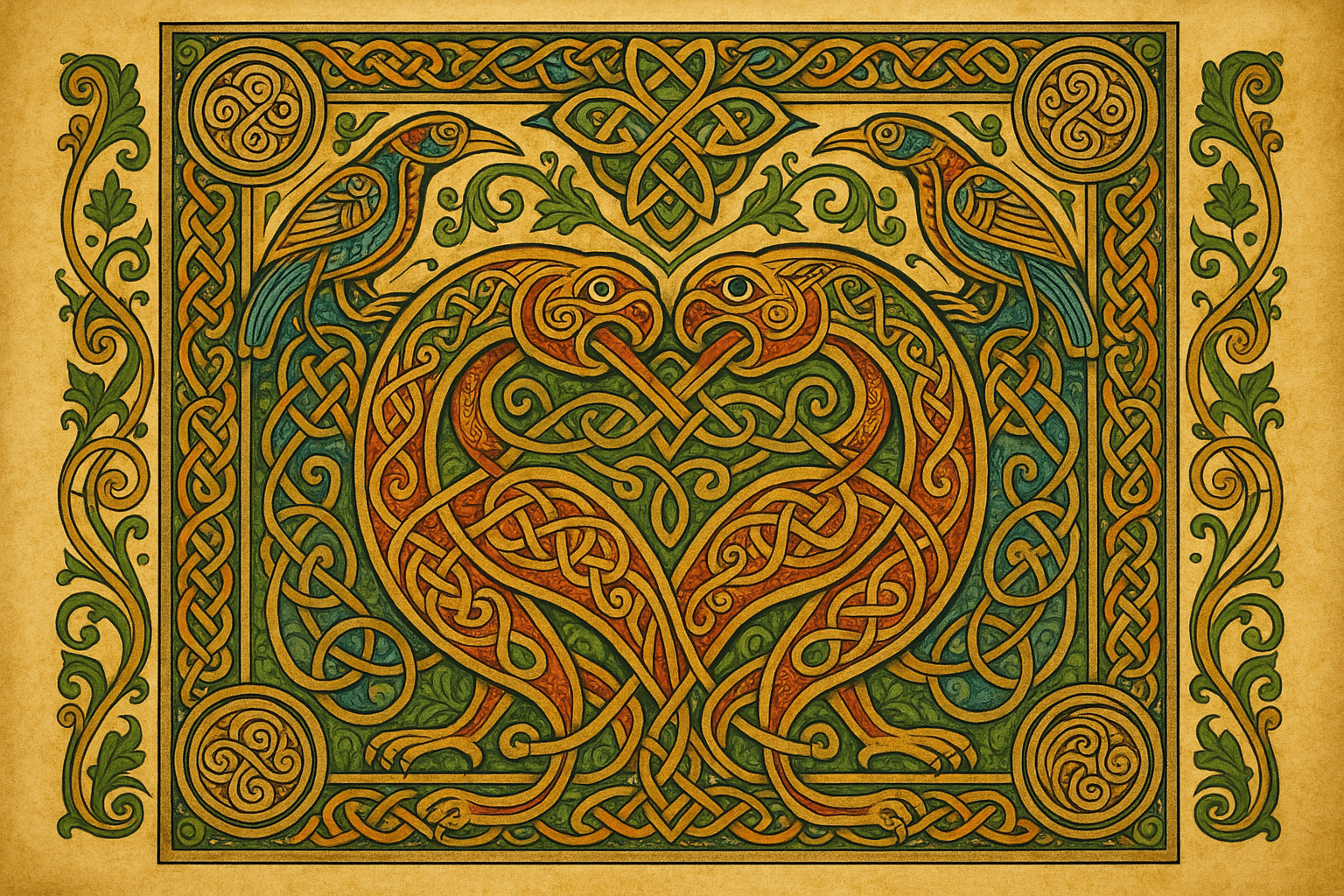
Curving lines, rhythmic transformations and intricate surface divisions can create relationships between ornament and object, but the appropriate vocabulary depends on the specific tradition.
Treat the label with care
The British Museum's Celts exhibition catalogue emphasizes that the meaning of “Celtic” has changed and remains a subject of research. Ancient objects, early medieval works and modern expressions of identity should not be collapsed into one timeless style.
Start with a documented object rather than an imagined universal symbolism. Note its material, probable use and archaeological context where known. A shield, mirror, manuscript and modern decorative print invite different questions.
Study a line as a sequence of decisions
The British Museum's Desborough Mirror provides a concrete example. Its bronze back carries a complex curving design with engraved and hatched passages. The pattern is related to the shape and surface of the mirror rather than floating independently of it.
For an original exercise, establish the object's outline first. Let a large curve divide the field, then introduce smaller responses. Vary density so that the eye can follow the principal rhythm. Complexity becomes more convincing when the major relationships remain legible.
Ornament belongs to a material
A design engraved into metal behaves differently from a painted manuscript border or a carved surface. Consider line width, depth, reflectivity and wear. Avoid adding identical glowing grooves to every material and calling the result historically accurate.
Test the pattern at its intended scale. An intricate detail that works in a close-up may disappear on a small object. The relationship between decorated and quieter areas often matters more than the total number of motifs.
Make the interpretation accountable
Do not assign ancient spiritual meanings to an invented knot or claim that one motif universally expresses a modern personal value. Explain which documented formal qualities informed the new work and where invention begins.
A useful comparison can place an Iron Age metalwork reference beside a later manuscript reference while keeping their contexts distinct. For generated examples, identify the result as a contemporary study. It is neither an archaeological reconstruction nor evidence of an authentic object unless supported by a separate documented research process.
A small poetic detour
Original words from the AOI studio.
Poetry
Spirals entwining,
whispers of ancient oak trees—
time’s circle unbound.
The prompt workshop
Original creative exercises. These prompts create new illustrations, not documentary evidence.
Curves on bronze
Original contemporary bronze-mirror design study with a coherent large curving pattern, selective hatched fields and realistic engraved depth, not an archaeological object.
Pattern and silhouette
Original ornamental object concept in which flowing lines respond to an oval silhouette, clear hierarchy between broad curves and smaller details, restrained material rendering.
Compare materials
Original paired design study applying the same invented curving rhythm to engraved metal and painted paper, visibly different line behavior and no invented ancient symbolism.
Sources and further exploration
British Museum — Celts, art and the changing meaning of identity
British Museum — the Desborough Mirror, material and engraved design