
Prehistoric rock art: drawing, painting and engraving
A contour meets a wall: cave imagery shows how pigment, incised lines and natural rock forms can make animals feel present. This guide separates archaeological evidence from contemporary visual experiments.
A visual introduction
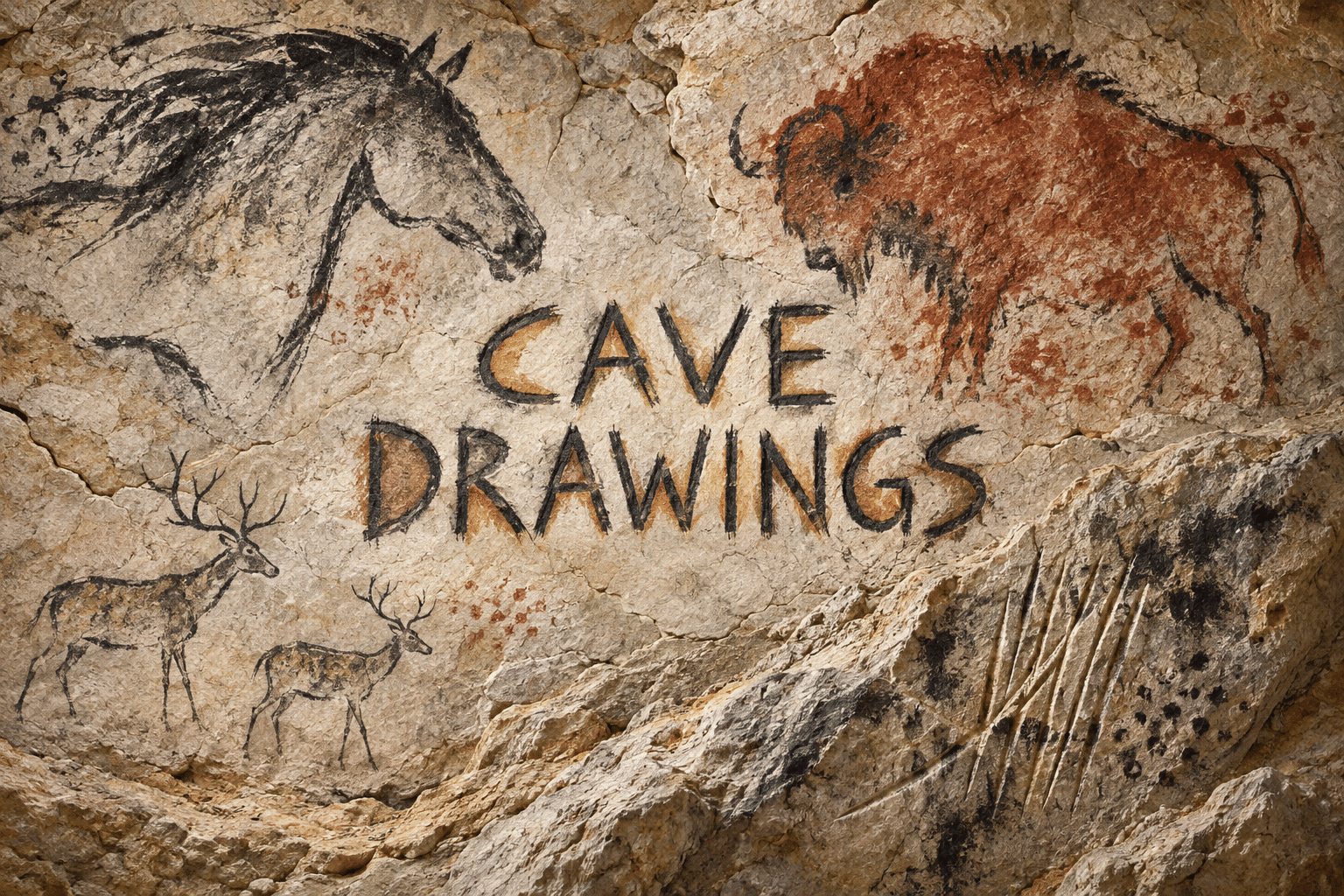
An original contemporary study of contour, pigment and relief. Modern title lettering belongs to this editorial collage, not to prehistoric imagery.
Select an image for a closer look. Use the thumbnails, arrow keys or a swipe to compare examples. Zoom in to inspect details, or share the image that inspires you.


Creative toolbox · take this style further
Choose an input and a destination. Search sends your words to the chosen site; Copy & open puts them on your clipboard to paste there.
Create with AI
Turn your chosen input into an image prompt or a new creative direction.
ChatGPT
Copy your input and paste it into a ChatGPT conversation or image request.
Copy & open ChatGPT (new tab)Claude · Anthropic
Develop an image prompt or explore the style in a new Claude conversation.
Copy & open Claude · Anthropic (new tab)Midjourney
Paste your input into the Imagine bar on the Create page.
Copy & open Midjourney (new tab)Adobe Firefly
Copy your input, open Firefly, and paste it into the prompt field.
Copy & open Adobe Firefly (new tab)Leonardo.Ai
Copy your input, open Leonardo, and paste it into the generation field.
Copy & open Leonardo.Ai (new tab)Image search
Find visual references. Short, concrete keywords usually work best.
Lexica
Search AI images and prompts using your selected input.
Search with this input Lexica (new tab)Pexels
Search the photo and video library. Short keywords often work best.
Search with this input Pexels (new tab)Pixabay
Search photos, illustrations and other images.
Search with this input Pixabay (new tab)Unsplash
Search photographs using the style name or your own keywords.
Search with this input Unsplash (new tab)Wikimedia Commons
Search photographs, artworks and historical images. Check each file for its source and reuse terms.
Search with this input Wikimedia Commons (new tab)Art & research
Explore artists, collections and the ideas behind a style.
Wikipedia
Search for background reading. A style may not have its own article.
Search with this input Wikipedia (new tab)WikiArt
Copy your input into WikiArt’s search to explore artists and artworks.
Copy & open WikiArt (new tab)Europeana
Paste your keywords into the search to explore European museum, library and archive collections.
Copy & open Europeana (new tab)Inspiration
Discover portfolios and visual ideas from creative communities.
Instagram hashtags
Search a hashtag made from your input: spaces and punctuation are removed. Instagram may require sign-in.
Search with this input Instagram hashtags (new tab)ArtStation
Paste your input into artwork search for concept art, environments, characters and visual development.
Copy & open ArtStation (new tab)Behance
Paste your input into project search for illustration, design and visual storytelling.
Copy & open Behance (new tab)A closer look
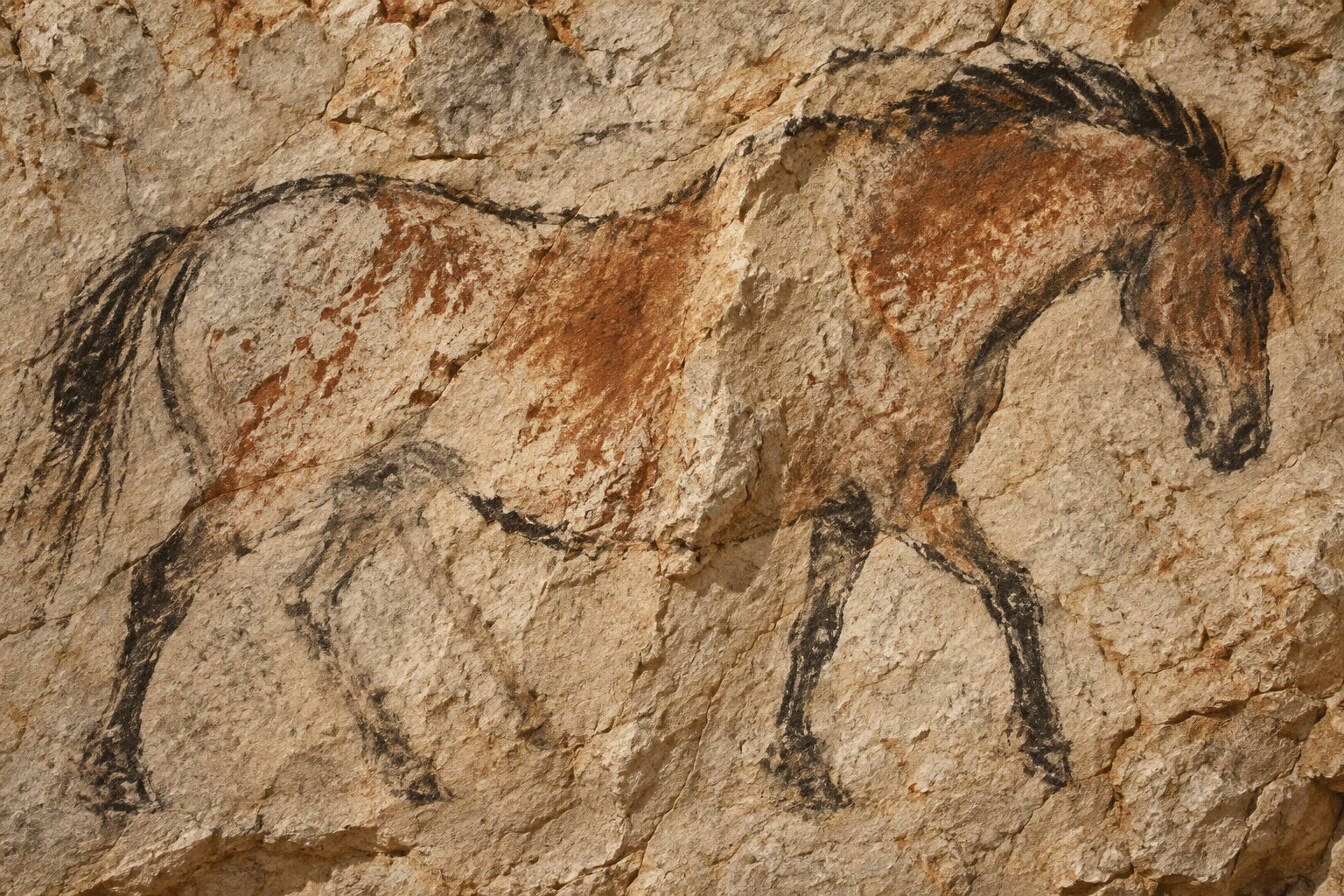
Economical animal contours, selective shading, earth pigments and irregular stone relief; the surface participates in the image.
A broad subject, not a single movement
Cave Drawings is a convenient umbrella term, not the name of a unified art movement. Drawing deposits a line; painting builds areas of pigment; engraving cuts or scratches a surface. These processes can coexist in cave art. This guide concentrates on examples from Palaeolithic France, especially Lascaux and Chauvet, rather than presenting their imagery as a universal language shared by every rock-art tradition.
The surviving marks reward close looking. UNESCO describes Chauvet’s animal figures through their anatomical precision, shading, volume and movement. Calling such work merely primitive misses the decisions that make it convincing. Nor should a modern illustration of a hunter be taken as evidence that every cave panel recorded a hunt. The purpose of an individual image cannot be read directly from its silhouette.
Let the wall do some of the drawing
At Lascaux, the French Ministry of Culture explains that hardness and texture influenced which techniques were practical. Some figures also incorporate natural rock features into their anatomy. Look for the point where a drawn back meets a ridge, or a shaded flank opens into bare stone. The ground is an active part of the composition, not a texture pasted behind it.
For a contemporary study, choose one decisive curve: the neck of a horse, the shoulder of a bison or the back of a deer. Vary the pressure and allow a few interruptions. Use shading selectively to turn the body; leave enough unmarked space for the contour to remain legible. Repeated outlines can suggest motion in a modern experiment, but do not label that interpretation as a proven ancient intention.
Pigment is specific, not a sepia filter
The Lascaux research resource identifies iron-based reds and yellows and manganese-based blacks in that region; it contrasts these with charcoal used in other regions. A black mark is therefore not automatically charcoal. For an accessible modern exercise, charcoal and artist-grade red ochre offer a useful limited palette, without pretending to reproduce a particular site’s recipe.
Avoid covering everything in the same brown haze. Let pale ground, dry dark lines and a small area of warm pigment perform different jobs. A crisp edge beside a rubbed patch makes the material readable. Over-polished gradients, uniform animal stamps and decorative symbols added without context quickly turn the exercise into a generic prehistoric poster.
Make a contemporary interpretation
Start on textured paper or a digital stone-like ground, never on an archaeological surface. Draw one animal from observation or a suitable reference, simplify its outline, then adjust the composition to one ridge or crack. Keep a clear focal point. Try removing a third of the marks: if the animal still has weight and direction, those marks were probably unnecessary.
This approach is useful for expressive drawing, material studies and editorial illustration about memory or place. It is unsuitable as documentary evidence without a documented source. The images here are AI-generated contemporary interpretations, not photographs, facsimiles or archaeological reconstructions. Their captions describe the visible artwork rather than assigning it an invented age, site or cultural origin.
The prompt workshop
Original creative exercises. These prompts create new illustrations, not documentary evidence.
One contour, one animal
Create an original contemporary drawing of one wild horse in side profile on pale irregular limestone-like ground. Use an economical charcoal contour and a restrained patch of red ochre. Let one ridge suggest the shoulder, leave quiet space around the body, and keep the anatomy coherent. No lettering, hunters or decorative symbols. A modern interpretation, not a reproduction of an archaeological panel.
Compose with the surface
Create an original contemporary composition of a bison and two smaller deer drawn across an uneven stone-like surface. Use varied scale, selective dark contours and sparse earth-red pigment. Let cracks separate the figures and a convex ridge support the bison’s flank. Avoid a regular grid, uniform silhouettes and a staged hunting story. Do not copy a specific archaeological panel.
How little can a line say?
Make a contemporary experimental drawing in which a horse emerges from only a few charcoal lines and rubbed ochre marks on textured paper. Leave part of the back undrawn where a fold suggests its curve. Contrast one crisp edge with a soft smudge. Preserve the sense of weight without filling the whole silhouette. No text or claims of historical authenticity.