
AOI landscape interpretation with Jamaican art context
An AOI landscape interpretation using patterned vegetation, expressive scale and layered space, informed by Jamaican Intuitive art without claiming one Caribbean-wide school.
A visual introduction
Select an image for a closer look. Use the thumbnails, arrow keys or a swipe to compare examples. Zoom in to inspect details, or share the image that inspires you.

Creative toolbox · take this style further
Choose an input and a destination. Search sends your words to the chosen site; Copy & open puts them on your clipboard to paste there.
Create with AI
Turn your chosen input into an image prompt or a new creative direction.
ChatGPT
Copy your input and paste it into a ChatGPT conversation or image request.
Copy & open ChatGPT (new tab)Claude · Anthropic
Develop an image prompt or explore the style in a new Claude conversation.
Copy & open Claude · Anthropic (new tab)Midjourney
Paste your input into the Imagine bar on the Create page.
Copy & open Midjourney (new tab)Adobe Firefly
Copy your input, open Firefly, and paste it into the prompt field.
Copy & open Adobe Firefly (new tab)Leonardo.Ai
Copy your input, open Leonardo, and paste it into the generation field.
Copy & open Leonardo.Ai (new tab)Image search
Find visual references. Short, concrete keywords usually work best.
Lexica
Search AI images and prompts using your selected input.
Search with this input Lexica (new tab)Pexels
Search the photo and video library. Short keywords often work best.
Search with this input Pexels (new tab)Pixabay
Search photos, illustrations and other images.
Search with this input Pixabay (new tab)Unsplash
Search photographs using the style name or your own keywords.
Search with this input Unsplash (new tab)Wikimedia Commons
Search photographs, artworks and historical images. Check each file for its source and reuse terms.
Search with this input Wikimedia Commons (new tab)Art & research
Explore artists, collections and the ideas behind a style.
Wikipedia
Search for background reading. A style may not have its own article.
Search with this input Wikipedia (new tab)WikiArt
Copy your input into WikiArt’s search to explore artists and artworks.
Copy & open WikiArt (new tab)Europeana
Paste your keywords into the search to explore European museum, library and archive collections.
Copy & open Europeana (new tab)Inspiration
Discover portfolios and visual ideas from creative communities.
Instagram hashtags
Search a hashtag made from your input: spaces and punctuation are removed. Instagram may require sign-in.
Search with this input Instagram hashtags (new tab)ArtStation
Paste your input into artwork search for concept art, environments, characters and visual development.
Copy & open ArtStation (new tab)Behance
Paste your input into project search for illustration, design and visual storytelling.
Copy & open Behance (new tab)A closer look
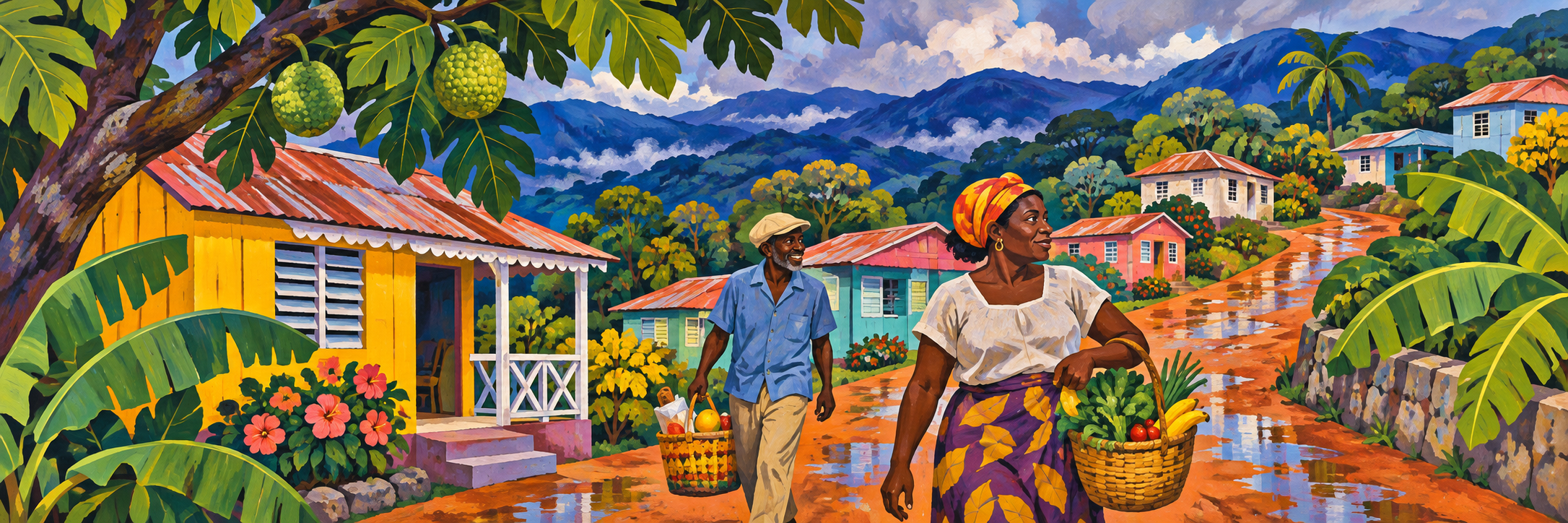
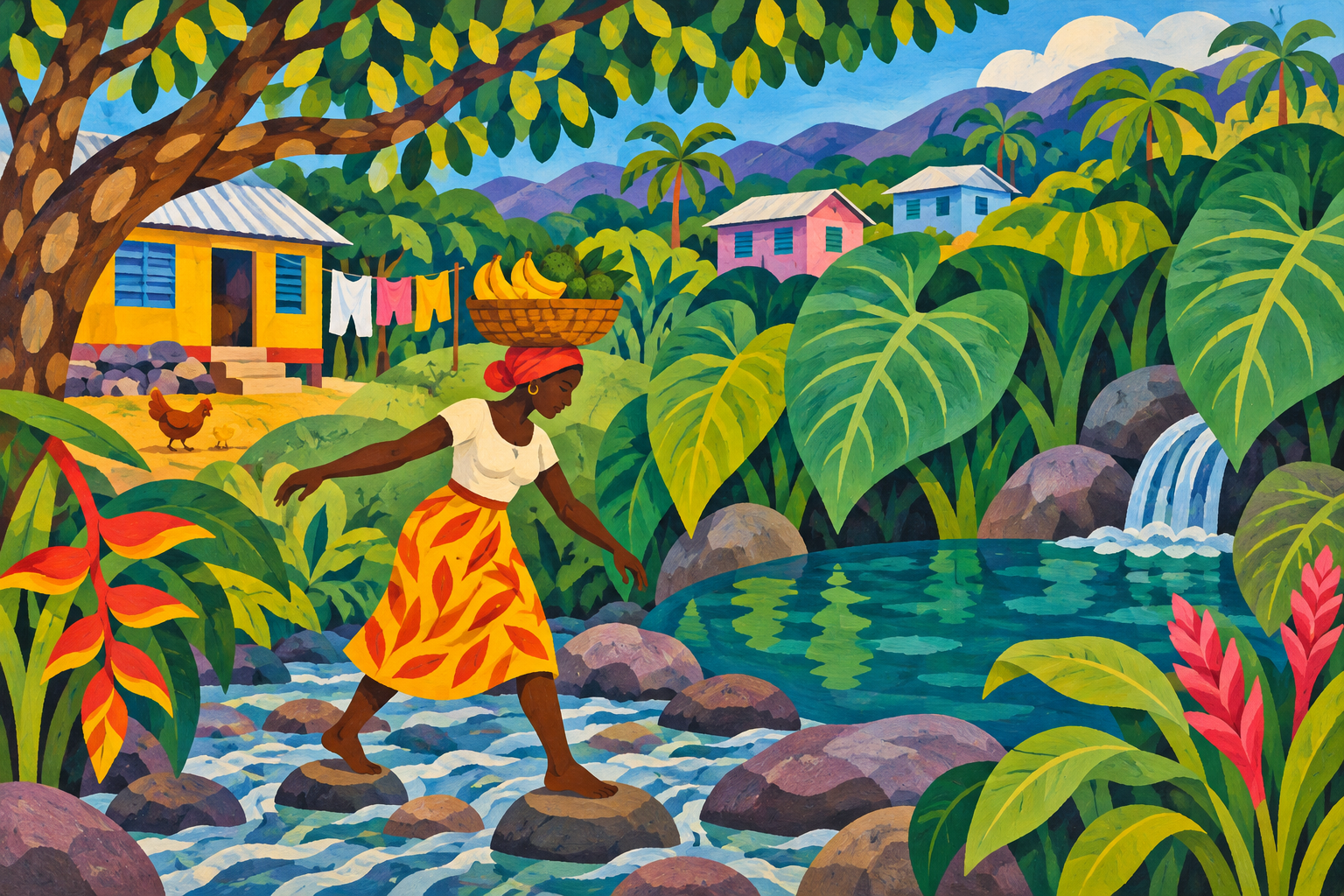
Interlocking hills and garden plots; repeated leaf shapes; compact houses; vivid matte color; paths that carry the eye; people integrated through daily activity rather than scenic decoration.
A descriptive label with a specific historical reference
Caribbean Intuitive Landscape is used here as an AOI descriptive interpretation, not the name of a documented movement covering the entire Caribbean. Its historical reference is more specific: Jamaican Intuitive art. Curator Veerle Poupeye discusses how David Boxer's 1979 exhibition The Intuitive Eye helped establish that category, and why its boundaries and assumptions deserve scrutiny.
Intuitive does not mean unthinking, innocent of culture or interchangeable with every self-taught practice. Poupeye questions the romantic idea of artists isolated from history. John Dunkley, Kapo Reynolds and Everald Brown belong to that discussion, but their different practices should not be compressed into a single recipe. The visual proposals below are AOI's own compositional experiments.
Make a place, not a postcard
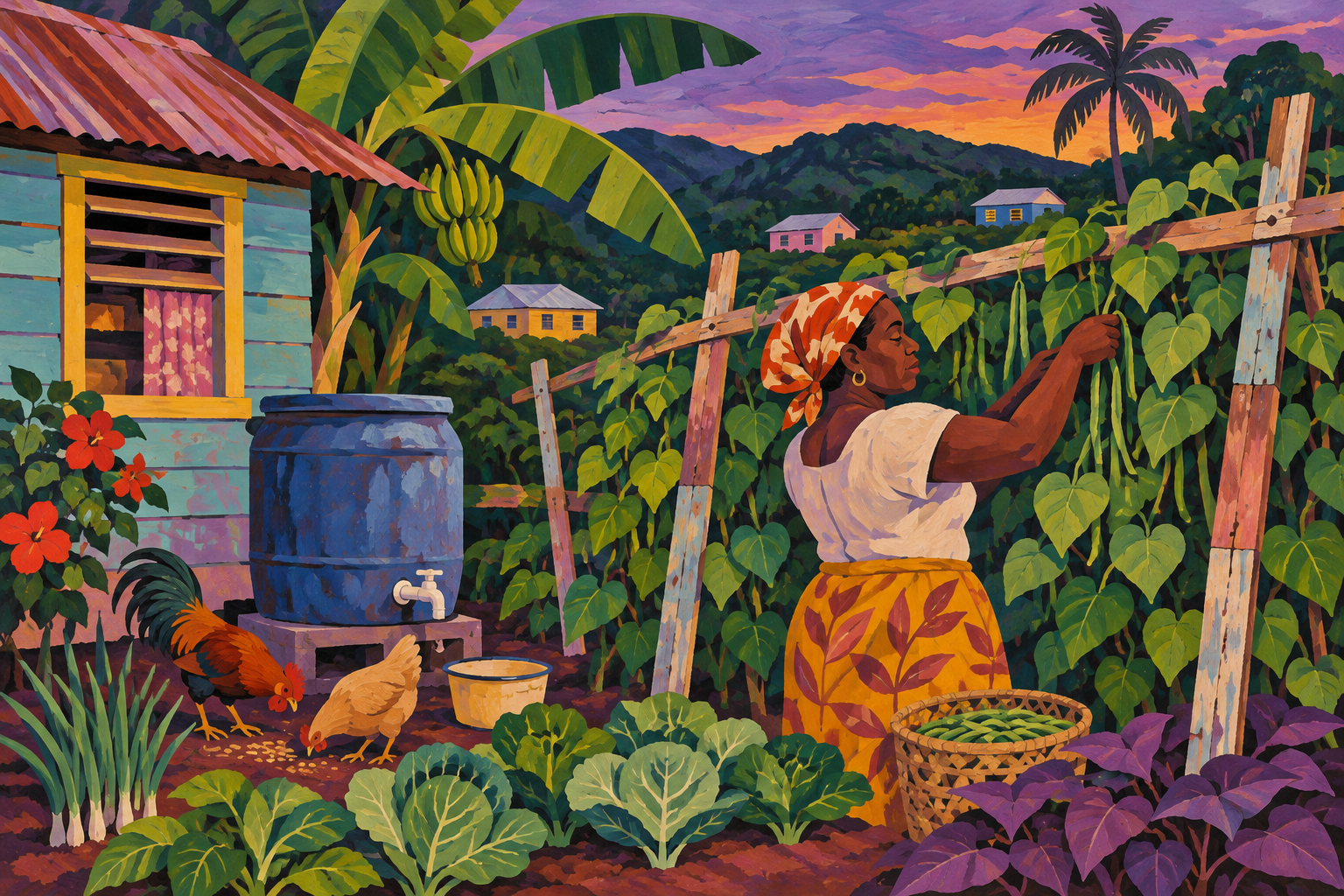
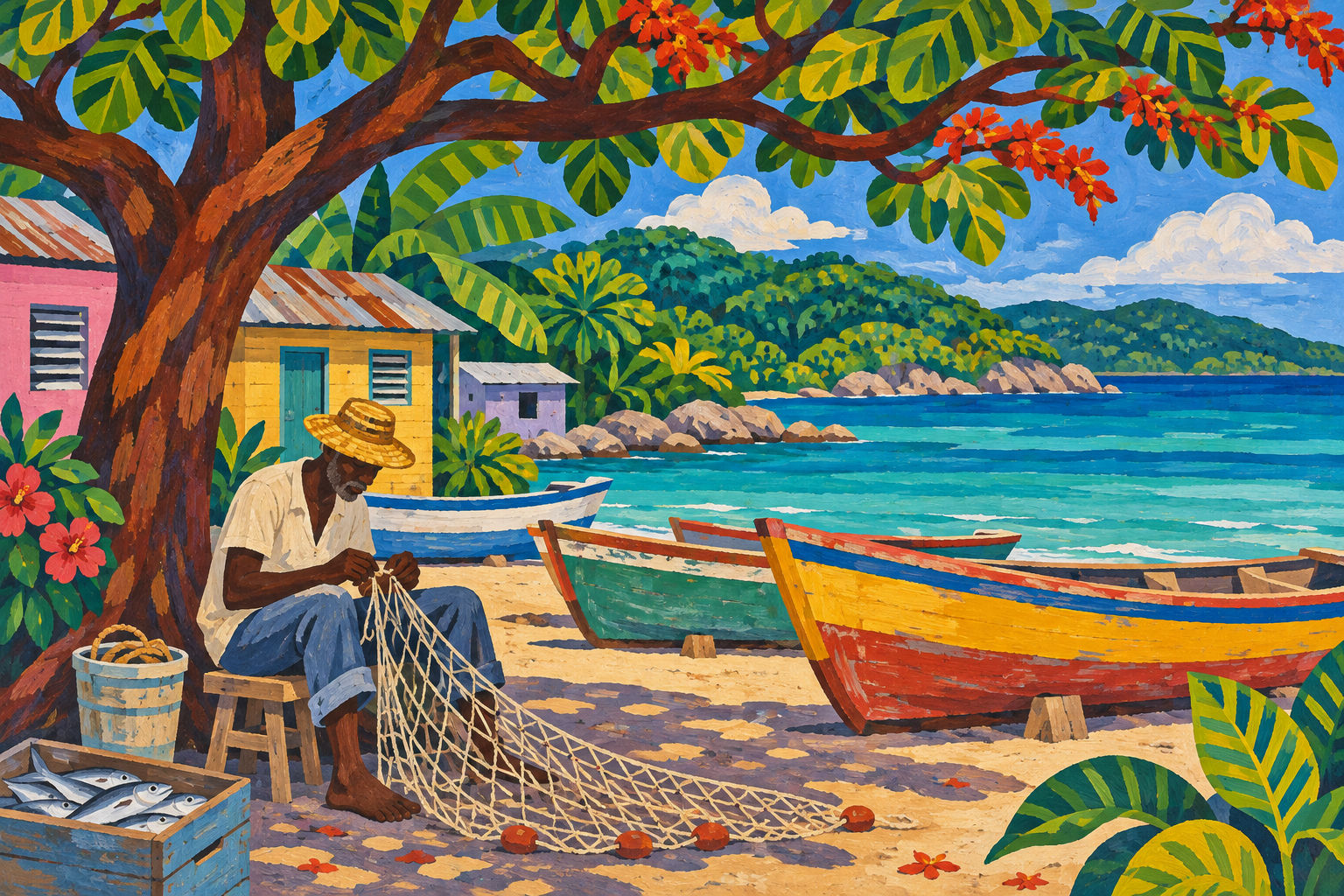
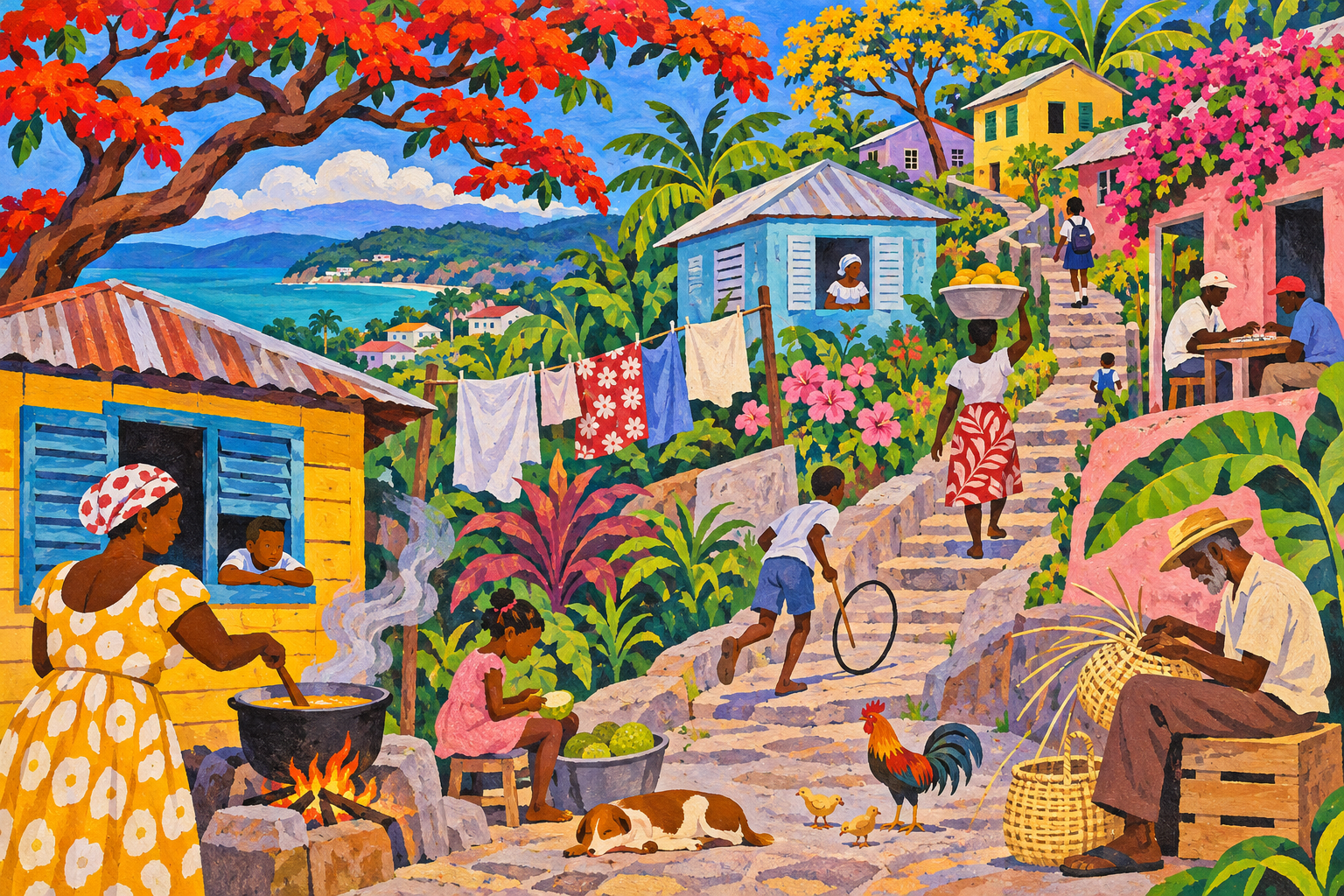
Build the image around relationships: a footpath joining houses, a garden beside a water barrel, a fishing boat near a working net. Flattening depth can make those relationships legible. Let the foreground garden rise almost vertically, with hills stacked behind it and a narrow sky holding the composition together.
Repeat leaves in families of shapes without making every tree identical. A large breadfruit canopy can counter a small cluster of houses; violet shadows can bind orange soil and deep green growth. Expressive scale should give something importance, not randomly enlarge objects. An oversized tree might organize a whole neighborhood, while a small figure remains readable through one precise gesture.
Color, observation and invention
Choose an actual landscape context to study before inventing a scene. Vegetation, roof shapes, paths and everyday objects should belong together. A painted surface can remain imaginative while respecting what grows, how people move and how buildings meet the ground. Do not use an undifferentiated collection of tropical symbols as shorthand for a region.
For a digital interpretation, request matte color masses, visible contour decisions and patterned foliage rather than photographic depth of field. Limit the brightest accents to a few meaningful places. A river crossing, a kitchen garden at dusk and a hillside after rain offer different spatial problems; they need not all become turquoise beaches.
Where this interpretation works—and where it fails
The approach can support illustrated stories, garden imagery and invented neighborhood scenes when the setting receives close attention. Routes and repeated shapes create a readable visual narrative even at small sizes. At a larger scale, tiny practical details can reward looking without becoming a catalogue of exotic props.
Its chief failure is the tourist fantasy: timeless, picturesque people placed in a landscape that exists only for an outside viewer. Another is the suggestion that rich pattern proves cultural authenticity. Describe generated work as an original interpretation, identify specific historical references separately and allow ordinary work, weather and contemporary life into the picture.
Positive editorial perspective
AOI editorial perspective (AI-authored). Expressive scale and repeated foliage can make a landscape feel organized by attention and memory. The strongest compositions turn paths, gardens and ordinary work into active subjects rather than scenery.
Negative editorial perspective
AOI editorial perspective (AI-authored). The label becomes misleading when it flattens diverse Caribbean cultures into a cheerful tropical formula. Replace stock paradise imagery with specific observation, and distinguish the AOI proposal from the Jamaican historical category.
Neutral editorial perspective
AOI editorial perspective (AI-authored). This is a descriptive framework for original landscape experiments. It can guide spatial layering and color rhythm, but it neither authenticates an image culturally nor defines the work of every artist described as Intuitive.
A small poetic detour
Original words from the AOI studio.
Poetry
The path climbs slowly through the green,
Past roofs the rain has polished clean.
A bucket waits beside a door;
The garden asks for nothing more.
One leaf repeats another's curve,
Then bends away, allowed to swerve.
The hills lie folded, blue on blue;
A neighbor's washing cuts them through.
No paradise has closed the gate:
There is a net that cannot wait.
And in the painted evening light,
Small working things hold up the night.
The prompt workshop
Original creative exercises. These prompts create new illustrations, not documentary evidence.
Start with a garden
Original AOI interpretive landscape of a small hillside kitchen garden after rain, layered shallow space, rhythmic breadfruit leaves, a water barrel and one person tending beans, matte green and burnt-orange color, simple coherent paths, no text or copied artwork.
Make the work and setting specific; avoid a generic resort view.
Follow a neighborhood path
An invented Caribbean hillside neighborhood informed by observed architecture and plants, a winding footpath linking modest houses, laundry, a market basket and shared garden, patterned foliage, deliberate expressive scale, violet shadows, warm ground, original painted interpretation, no imitation of a named artist.
Use the path as the narrative spine; make each activity legible.
Let the night reorganize color
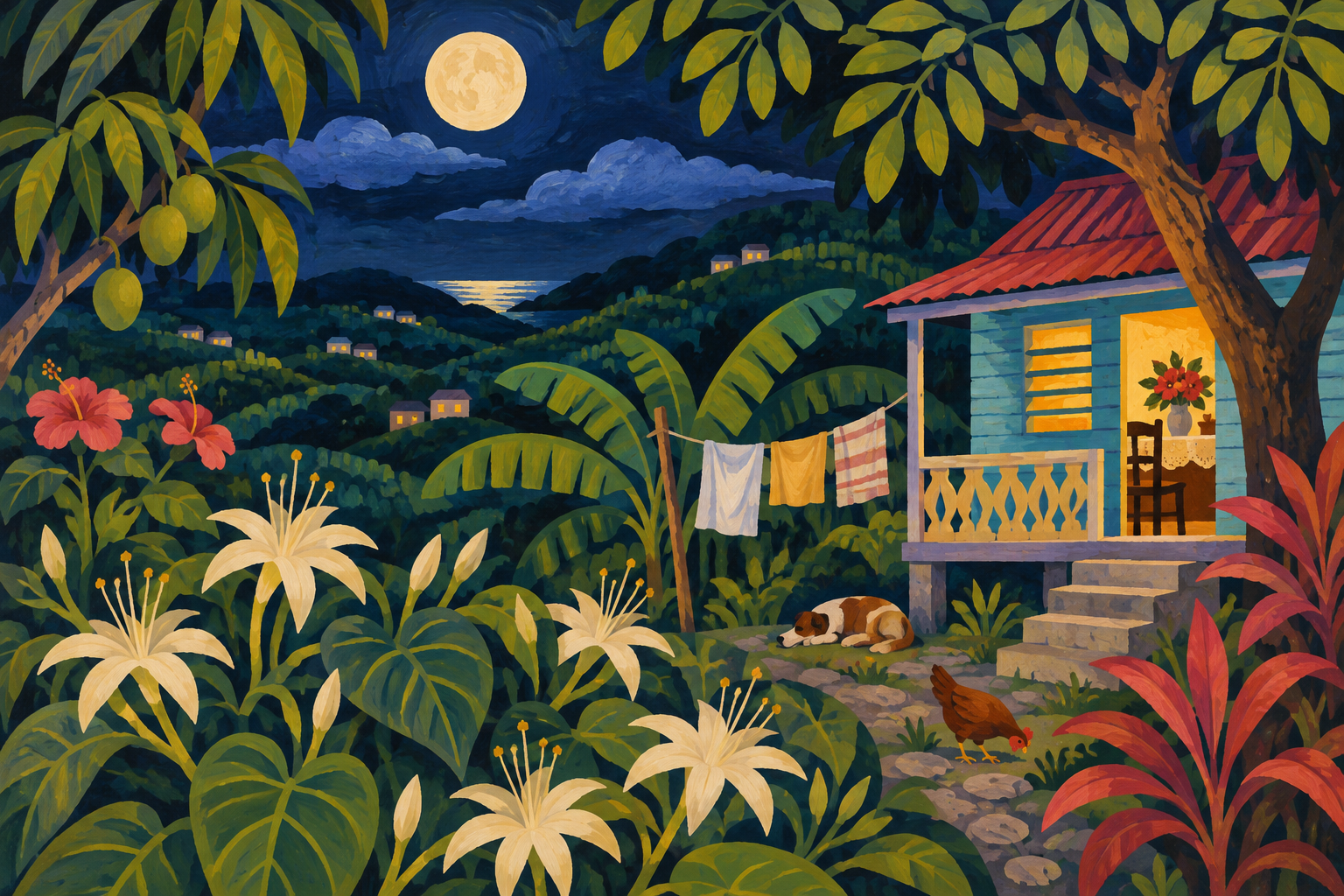
An original moonlit hillside garden, layered blue-black vegetation, pale flowers, one warmly lit doorway, repeated leaves interrupted by irregular branches, matte painted surface and shallow lyrical space, no lettering or signatures.
Keep the invented setting clearly identified; preserve useful detail in dark passages.
A smile from the studio
Jokes
The painter made the breadfruit tree larger than every house on the hill. The architect objected to the scale. The gardener asked whether the tree would also handle the shade, the lunch and the neighborhood meeting. When everyone said yes, the architect agreed it deserved the larger office.