
Technical drawing and reproduction aesthetic
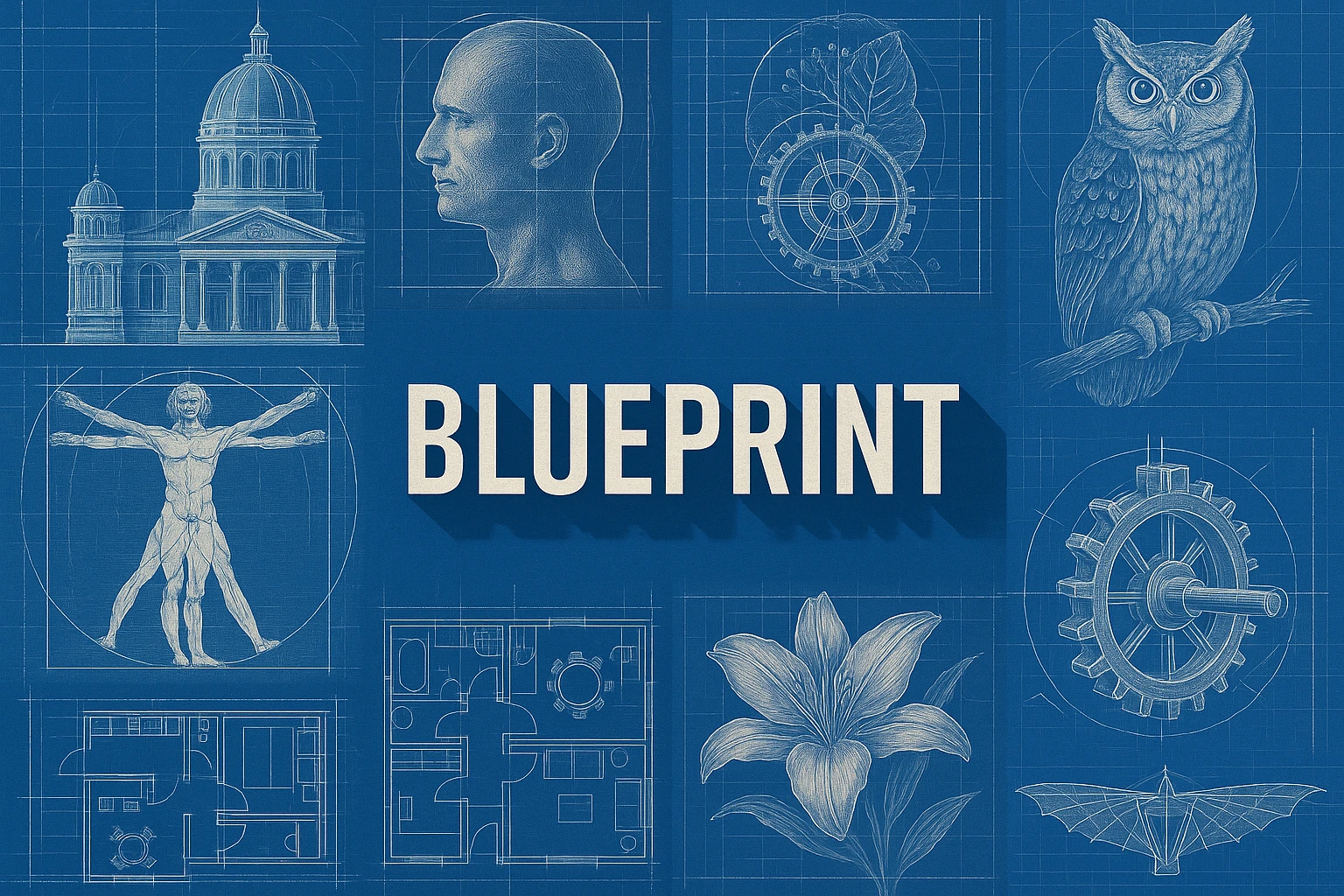
Blueprint refers to a historical method of reproducing drawings and, by extension, a recognizable technical-drawing aesthetic. It is not an independent painting movement founded by abstract artists.
A visual introduction
Select an image for a closer look. Use the thumbnails, arrow keys or a swipe to compare examples. Zoom in to inspect details, or share the image that inspires you.
Creative toolbox · take this style further
Choose an input and a destination. Search sends your words to the chosen site; Copy & open puts them on your clipboard to paste there.
Create with AI
Turn your chosen input into an image prompt or a new creative direction.
ChatGPT
Copy your input and paste it into a ChatGPT conversation or image request.
Copy & open ChatGPT (new tab)Claude · Anthropic
Develop an image prompt or explore the style in a new Claude conversation.
Copy & open Claude · Anthropic (new tab)Midjourney
Paste your input into the Imagine bar on the Create page.
Copy & open Midjourney (new tab)Adobe Firefly
Copy your input, open Firefly, and paste it into the prompt field.
Copy & open Adobe Firefly (new tab)Leonardo.Ai
Copy your input, open Leonardo, and paste it into the generation field.
Copy & open Leonardo.Ai (new tab)Image search
Find visual references. Short, concrete keywords usually work best.
Lexica
Search AI images and prompts using your selected input.
Search with this input Lexica (new tab)Pexels
Search the photo and video library. Short keywords often work best.
Search with this input Pexels (new tab)Pixabay
Search photos, illustrations and other images.
Search with this input Pixabay (new tab)Unsplash
Search photographs using the style name or your own keywords.
Search with this input Unsplash (new tab)Wikimedia Commons
Search photographs, artworks and historical images. Check each file for its source and reuse terms.
Search with this input Wikimedia Commons (new tab)Art & research
Explore artists, collections and the ideas behind a style.
Wikipedia
Search for background reading. A style may not have its own article.
Search with this input Wikipedia (new tab)WikiArt
Copy your input into WikiArt’s search to explore artists and artworks.
Copy & open WikiArt (new tab)Europeana
Paste your keywords into the search to explore European museum, library and archive collections.
Copy & open Europeana (new tab)Inspiration
Discover portfolios and visual ideas from creative communities.
Instagram hashtags
Search a hashtag made from your input: spaces and punctuation are removed. Instagram may require sign-in.
Search with this input Instagram hashtags (new tab)ArtStation
Paste your input into artwork search for concept art, environments, characters and visual development.
Copy & open ArtStation (new tab)Behance
Paste your input into project search for illustration, design and visual storytelling.
Copy & open Behance (new tab)A closer look
Pale lines on a blue field, coordinated views, line-weight hierarchy and purposeful annotation make a blueprint-like image readable as a description of an object or space.
Start with a drawing that explains something
The historical blue print is connected to cyanotype, a photographic process that uses light-sensitive iron compounds. The V&A documents its use for architectural and engineering drawings. Its purpose was reproduction: distributing information from a drawing, rather than establishing a school of painting with a shared manifesto.
The term now also appears in digital illustrations that imitate this appearance. Such an image may be a visual concept without being a usable technical document. Distinguish the two. An attractive drawing of a fictional machine should not imply that the machine has been engineered or checked for construction.
Give each view a job
A plan describes arrangement from above; an elevation describes a face; a section reveals what a cut through the object would expose. Keep these views coordinated. If a window or wheel changes position between them, the graphic loses its explanatory logic even if the individual panels look impressive.
For a creative study, begin with a simple invented object and choose two views that answer different questions. Reserve an enlarged detail for a connection that would otherwise be difficult to understand. Repeating the same silhouette at several sizes adds less information than a carefully selected section.
Lines need a hierarchy
Use stronger lines for primary boundaries and quieter ones for secondary information. Keep annotation away from essential intersections. A dimension line should connect to the feature it describes; an arrow should lead somewhere specific. Decorative ticks and meaningless numbers can imitate technical density while making the image less useful.
White-on-blue contrast is a recognizable convention, but color alone does not produce a convincing blueprint. Test the design in grayscale and at a reduced size. The object, its important divisions and the relationship between views should remain legible.
Make the concept status explicit
Generated lettering and dimensions require manual checking if the image will be used beyond visual exploration. For a purely artistic study, omit fabricated measurements and use unlabelled guide lines. Actual plans require appropriate design tools and subject expertise.
The most interesting blueprint-inspired art makes a thought process visible: how parts relate, what is concealed and which detail deserves explanation. Treat the blue surface as a setting for that information, not a substitute for it.
The prompt workshop
Original creative exercises. These prompts create new illustrations, not documentary evidence.
Explain a simple object
Blueprint-inspired concept drawing of an original folding desk lamp, coordinated side and top views, pale lines on deep blue, clear line-weight hierarchy, one enlarged hinge detail, no invented measurements or lettering.
Reveal the interior
Original technical-illustration concept of a small garden pavilion, coherent plan, elevation and cutaway section, restrained white-on-blue linework, meaningful empty space, no construction certification or dimension text.
A poetic mechanism
An imaginary mechanical seed dispenser shown as a blueprint-like explanatory plate, readable gears and containers, one exploded connection, consistent geometry, sparse guide lines, no pseudo-technical labels.
Sources and further exploration
V&A — cyanotype and its architectural and engineering uses
MoMA glossary — plan, elevation and other architectural drawing views