
Cultural-critical term and original AOI visual interpretation
Explore Berlinism as a cultural idea through sourced Berlin art history, urban imagery and original AOI studies in painting, montage and watercolor.
A visual introduction
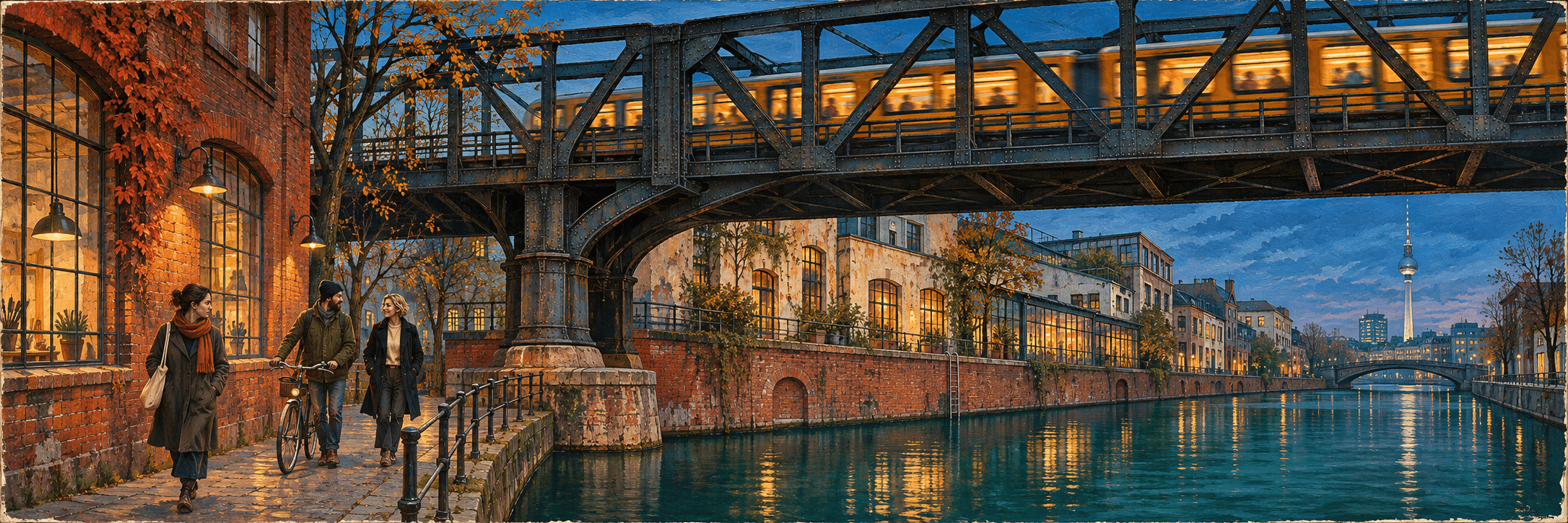
Five new AI-generated AOI interpretations use painting, paper montage and watercolor to explore urban layers. Imagined scenes and geography are not historical documents. The documented works discussed in the article are linked to their museum records and are not reproduced here.
Select an image for a closer look. Use the thumbnails, arrow keys or a swipe to compare examples. Zoom in to inspect details, or share the image that inspires you.
Creative toolbox · take this style further
Choose an input and a destination. Search sends your words to the chosen site; Copy & open puts them on your clipboard to paste there.
Create with AI
Turn your chosen input into an image prompt or a new creative direction.
ChatGPT
Copy your input and paste it into a ChatGPT conversation or image request.
Copy & open ChatGPT (new tab)Claude · Anthropic
Develop an image prompt or explore the style in a new Claude conversation.
Copy & open Claude · Anthropic (new tab)Midjourney
Paste your input into the Imagine bar on the Create page.
Copy & open Midjourney (new tab)Adobe Firefly
Copy your input, open Firefly, and paste it into the prompt field.
Copy & open Adobe Firefly (new tab)Leonardo.Ai
Copy your input, open Leonardo, and paste it into the generation field.
Copy & open Leonardo.Ai (new tab)Image search
Find visual references. Short, concrete keywords usually work best.
Lexica
Search AI images and prompts using your selected input.
Search with this input Lexica (new tab)Pexels
Search the photo and video library. Short keywords often work best.
Search with this input Pexels (new tab)Pixabay
Search photos, illustrations and other images.
Search with this input Pixabay (new tab)Unsplash
Search photographs using the style name or your own keywords.
Search with this input Unsplash (new tab)Wikimedia Commons
Search photographs, artworks and historical images. Check each file for its source and reuse terms.
Search with this input Wikimedia Commons (new tab)Art & research
Explore artists, collections and the ideas behind a style.
Wikipedia
Search for background reading. A style may not have its own article.
Search with this input Wikipedia (new tab)WikiArt
Copy your input into WikiArt’s search to explore artists and artworks.
Copy & open WikiArt (new tab)Europeana
Paste your keywords into the search to explore European museum, library and archive collections.
Copy & open Europeana (new tab)Inspiration
Discover portfolios and visual ideas from creative communities.
Instagram hashtags
Search a hashtag made from your input: spaces and punctuation are removed. Instagram may require sign-in.
Search with this input Instagram hashtags (new tab)ArtStation
Paste your input into artwork search for concept art, environments, characters and visual development.
Copy & open ArtStation (new tab)Behance
Paste your input into project search for illustration, design and visual storytelling.
Copy & open Behance (new tab)A closer look
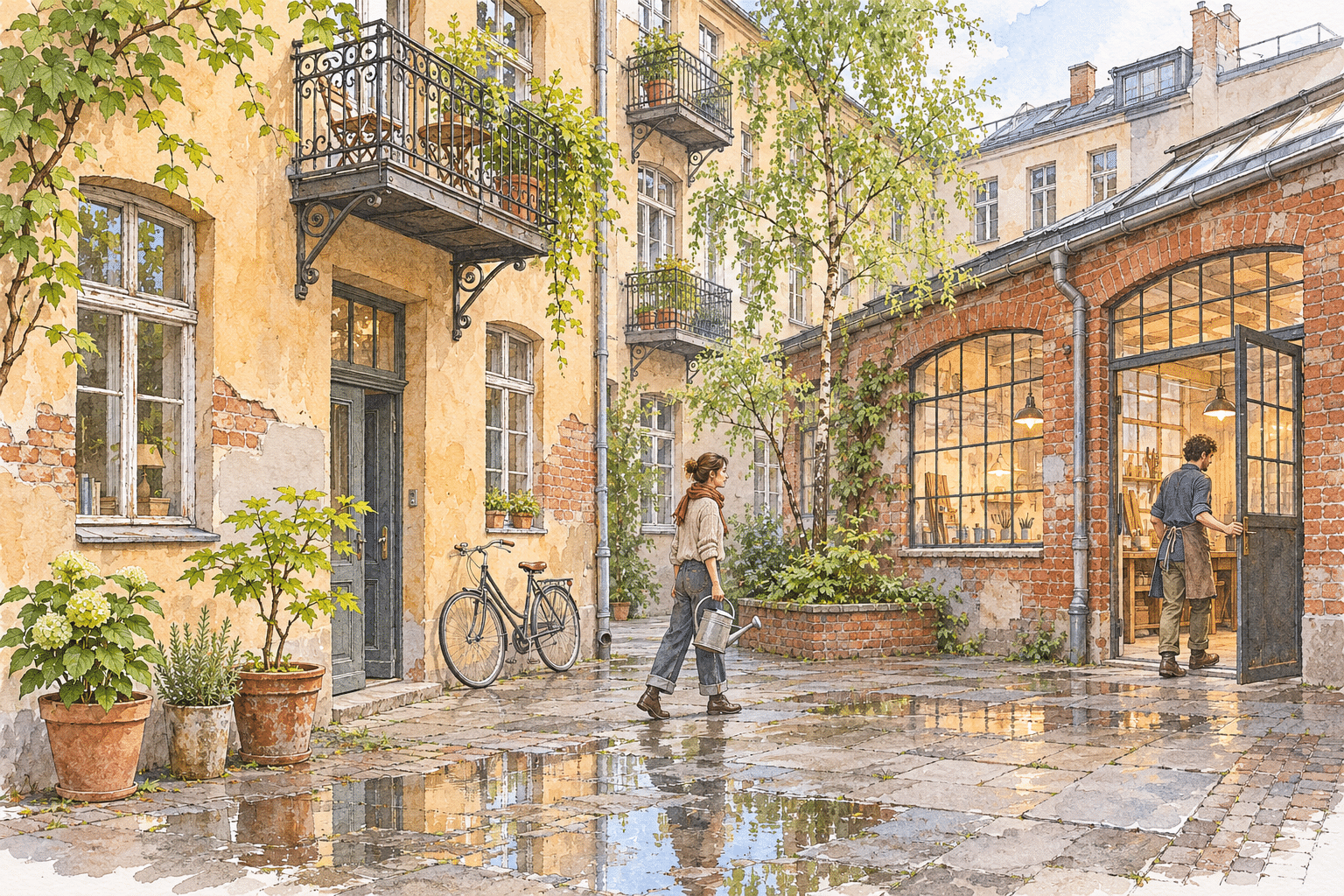
Riveted steel, brick arches, window grids and everyday figures form layered city images. In the AOI studies, warm ochre and rust meet ink teal; dense structures alternate with quiet water or paper. These are chosen visual devices, not the rules of a documented historical Berlinism school.
A name for a city imagined
A city can become an image before we arrive: a railway crossing, a room full of music, a promise of reinvention. Berlinism is useful here as a question about that imagined city. The word has documented use in cultural criticism, but the sources reviewed for this article do not establish the unified nineteenth-century art movement previously described in this entry.
In her 2022 essay Familiar Spectacles: Nightclub Space in TV Berlin, film scholar Kim Wilkins discusses Agata Pyzik’s use of Berlinism for a romanticized image of Berlin as a place of hedonism and transgression. Wilkins examines how television nightclub scenes repeat and market that imaginary. This is a critical account of cultural representation, not a membership list or a formal painting method. [1]
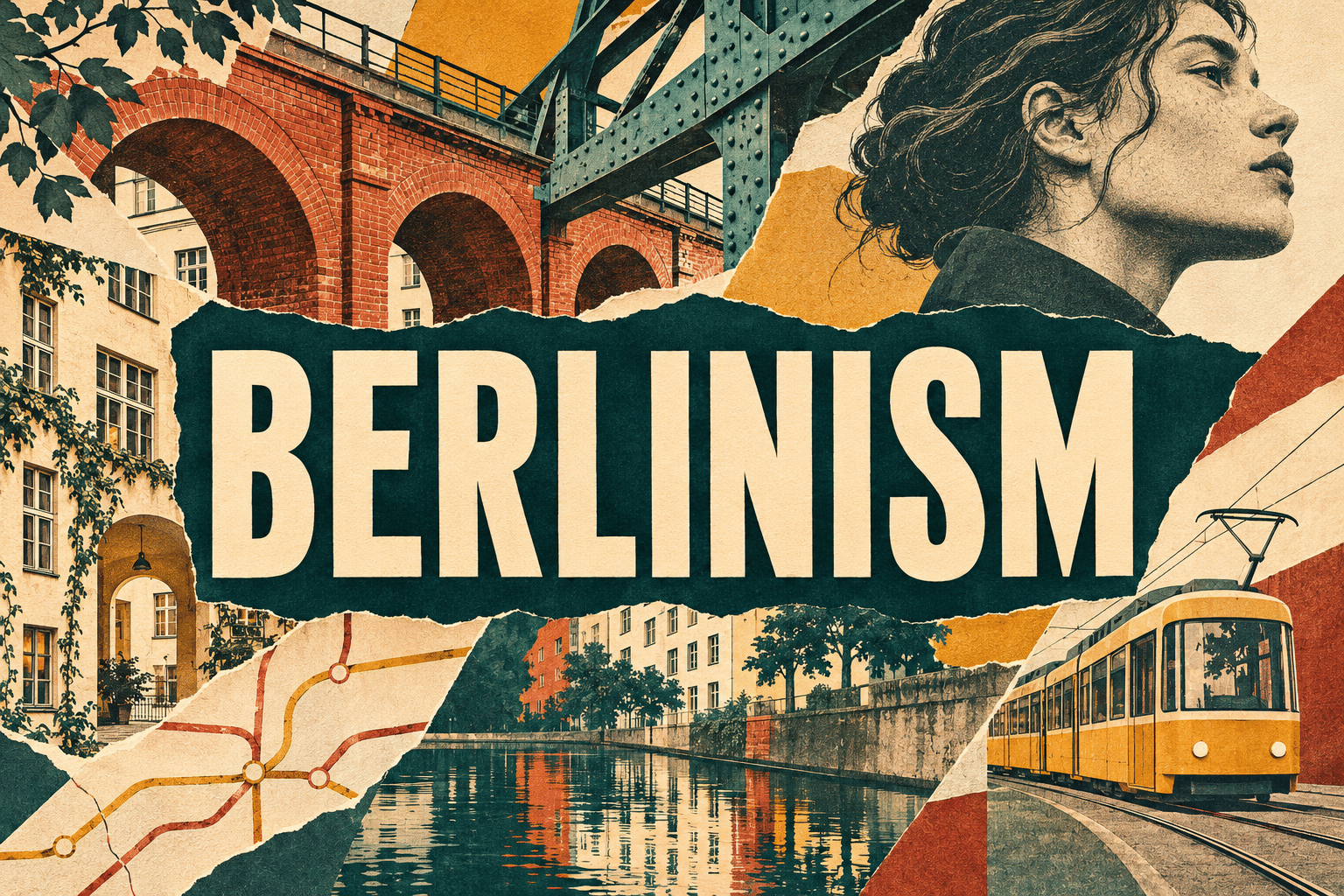
The gallery takes a separate, openly creative step. AOI uses the entry as a workshop in urban layers: infrastructure, inhabited spaces, printed fragments and ordinary movement. These contemporary interpretations are not presented as the historical meaning of Pyzik’s term or as recovered works from a forgotten school.
Separate the histories
Berlin has hosted many different artistic projects. The Berlin Secession, founded in 1898 with Max Liebermann as its first president, is a documented organization. The Berlinische Galerie describes its exhibitions as accommodating a range of modern approaches. That diversity matters: a shared city does not turn different artists into members of one Berlinist movement. [2]
The Bauhaus chronology also needs precision. Walter Gropius founded the school in Weimar in 1919; its Berlin phase was 1932–1933. After moving from Dessau to a former telephone factory in Berlin-Steglitz, it faced Nazi repression. Police and SA sealed the premises in April 1933, and the faculty resolved to dissolve the school that July. Describing this as a style simply falling out of fashion erases the political circumstances. [3, 4]
Buildings require their own attribution rather than a convenient style label. The present Brandenburg Gate was designed by Carl Gotthard Langhans and built in 1788–1791. The previous attribution here to Schinkel in 1815 was incorrect. Its presence in a contemporary montage would not make it a Berlinism artwork. [5]
Two works, two ways of seeing Berlin
Ernst Ludwig Kirchner’s Potsdamer Platz (1914), an oil painting in the Neue Nationalgalerie, offers a particular interpretation of an identifiable city space. The museum record connects its figures and setting to Berlin street life and notes changes made after the outbreak of war. Follow the institutional image and compare the compressed space, pointed forms and relationship between the two foreground figures and their surroundings. These are questions about this painting, not evidence of a Berlinism school. [6]
Hannah Höch’s Cut with the Kitchen Knife Dada through the Last Weimar Beer-Belly Cultural Epoch in Germany is catalogued by the same museum as a 1919 paper collage. Its disassembled public figures and machinery make montage an argument about society and authority. The museum records its appearance at the First International Dada Fair in Berlin in 1920. Look for how changes of scale and abrupt joins create relationships that a continuous painted view would not. [7]
Kirchner and Höch are therefore contextual references, not claimed members of a Berlinist group. Their works also have meanings that cannot be reduced to an attractive urban palette. The links below lead to the documented originals; the generated images in this gallery are different works with different purposes.
Reading the new image studies
Canal Beneath the Evening Train makes the railway a long horizontal weight above reflective water. The walkers, bicycle and lighted windows supply human scale. Its compressed, invented city geography should be read as an atmospheric painting, not a view from a named bridge or a reconstruction of a particular year.
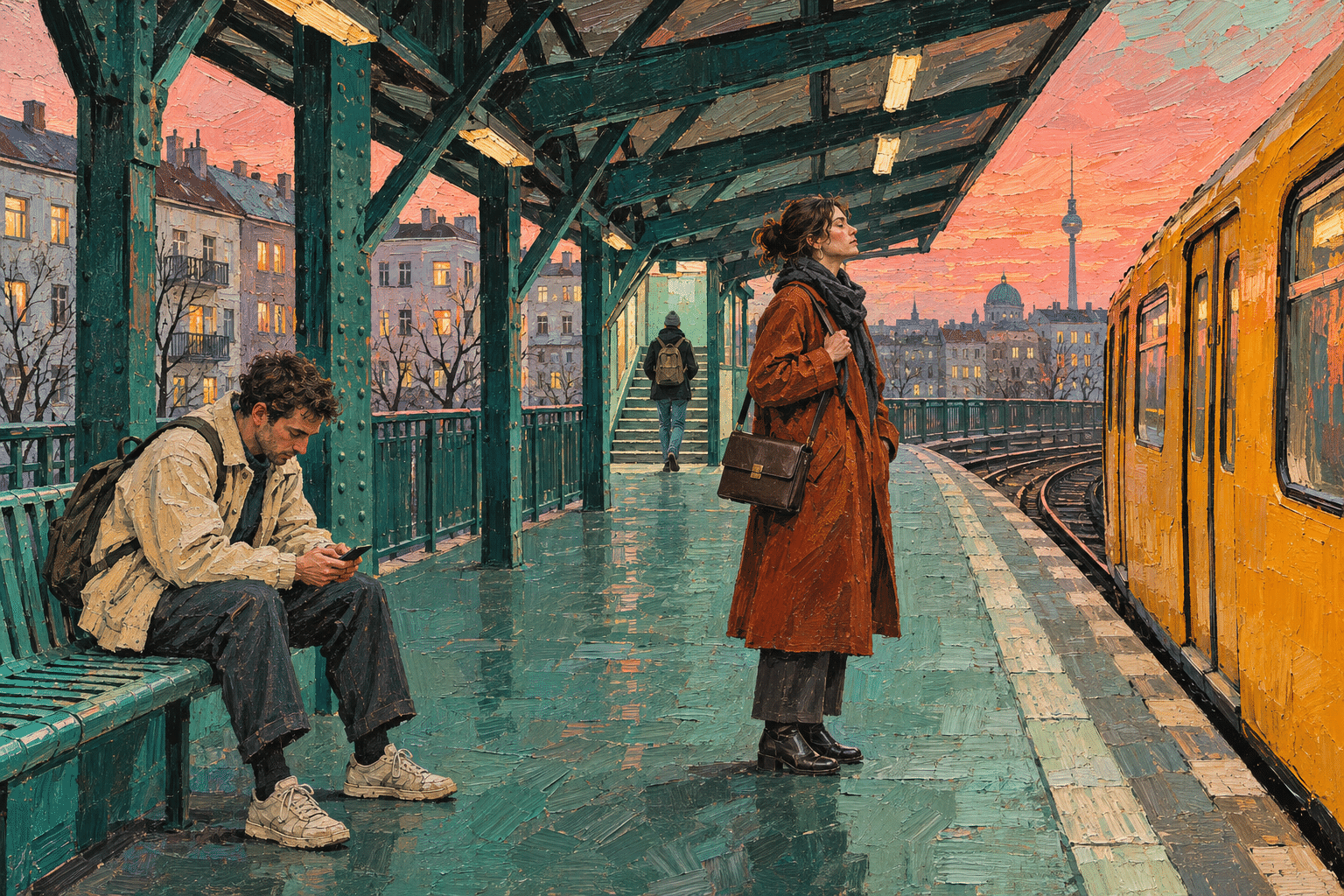
Last Train, First Light brings the same warm and cool palette into a tighter space. Three commuters have different orientations and occupy unequal intervals. The overhead beams make a strong rhythm, while the open platform gives the figures room to remain separate. The subject is waiting rather than spectacle.
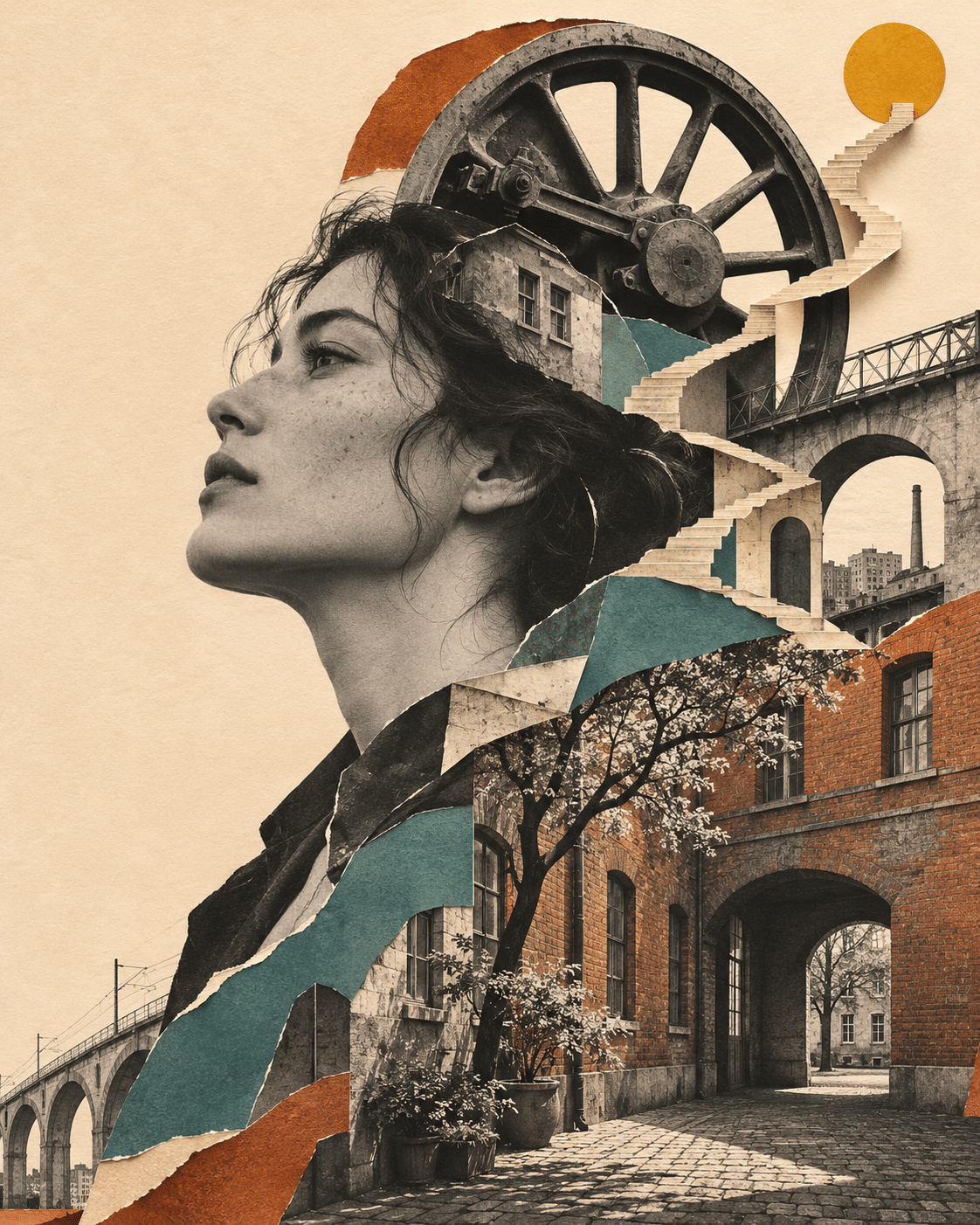
City Made of Cut Edges breaks that continuity. A portrait, railway wheel and impossible staircase share the page through visible paper seams. The wheel can suggest mechanical repetition; the staircase can suggest aspiration or disorientation. Those are possible readings of this new image, not borrowed historical facts.
Courtyard After Rain slows the pace. Thin ink lines and transparent washes replace heavy paint and cut paper. A watering can, workshop doorway and puddles make maintenance and daily activity worth looking at. The titled collage connects these approaches through an asymmetrical arrangement of urban fragments, with BERLINISM clearly centered.
Build an image around a relationship
Begin with one relationship: a person beneath a vast bridge, a face interrupted by a facade, or a small plant against weathered masonry. Give that relationship a dominant shape. Add secondary details only when they strengthen its rhythm or meaning. A skyline crowded with every recognizable monument usually makes each one less convincing.
Choose a medium with consequences. Thick paint can make a platform feel weighty; cut paper exposes discontinuity; watercolor lets light and reserved paper soften a courtyard. Let those differences affect the composition instead of applying three surface filters to the same scene.
For a generator, describe the subject, spatial logic, medium and light before invoking the entry’s name. Inspect human anatomy, repeated windows, rail geometry and the balance of busy and quiet areas. If the picture is an invented scene, label it accordingly. A persuasive visual surface is not proof of a real location or event.
Keep the city larger than its image
This approach can serve an editorial illustration, a visual essay, an imagined exhibition poster or a personal urban sketchbook. Its strongest question is what a chosen image makes visible. Who works here, waits here, repairs things or returns home? What disappears when the city is represented only through nightlife or monuments?
An attractive atmosphere can open curiosity, but it should not replace specific histories or turn residents into scenery. Use Berlinism with its context attached: a documented term in cultural criticism and, on this page, a clearly identified AOI creative interpretation. Keep those uses distinct while letting each sharpen the questions asked of the other.
A small poetic detour
Original words from the AOI studio.
Poetry
A train lays gold across the steel,
the water keeps a broken line.
Behind the wall a workshop wakes;
a window holds its square of shine.
The city will not fit its name.
A bicycle, a waiting face,
a plant beside a patched-up door:
each changes how we read the place.
The prompt workshop
Original creative exercises. These prompts create new illustrations, not documentary evidence.
Waiting beneath the beams
Paint an imagined contemporary elevated train platform at dawn. Place three adult commuters at unequal intervals beside an ochre train. Use dark teal steel beams, coral sky and thick visible brushwork. Let the open platform balance the roof structure. Coherent anatomy and rail geometry, no labels or logos. An invented scene, not a historical reconstruction.
A city assembled from fragments
Make an original paper photomontage around an invented adult profile. Combine a displaced railway wheel, brick courtyard and impossible staircase using deliberate cut edges. Keep one generous quiet cream area. Limit accents to teal, rust and ochre. Let scale changes suggest a relationship between person and city. No existing public figures, copied artworks or text.
An ordinary courtyard worth seeing
Use delicate pen lines and translucent watercolor for an imagined contemporary Berlin courtyard after rain. Include a workshop doorway, two residents doing ordinary tasks, a bicycle, plants and reflective paving. Balance detailed brick and ironwork with broad quiet washes. Restrained warm ochre, cool gray and fresh green. No tourist landmarks or lettering.
People & works to explore
References discussed in this article. Consult the sources below for context.
Artists and practitioners
Contextual references, not members of a Berlinism school:
Ernst Ludwig Kirchner — Potsdamer Platz (1914)
Hannah Höch — Cut with the Kitchen Knife Dada (1919)
Max Liebermann — first president of the Berlin Secession, founded 1898
Paintings and other works
Contextual works, not a Berlinism canon:
Ernst Ludwig Kirchner, Potsdamer Platz (1914), oil on canvas, Neue Nationalgalerie
Hannah Höch, Cut with the Kitchen Knife Dada (1919, museum date), paper collage, Neue Nationalgalerie
A smile from the studio
Jokes
The collage tried to fit all of Berlin on one sheet. The courtyard asked for a little breathing room.
Sources and further exploration
[2] Berlinische Galerie — Aufbruch in die Moderne; Berlin Secession and diverse modern approaches
[3] Bauhaus Kooperation — Auf einen Blick; foundation in Weimar in 1919
[4] Bauhaus Kooperation — Berlin 1932–1933; relocation, repression and dissolution
[5] Stiftung Stadtmuseum Berlin — Das Brandenburger Tor; architect and construction dates
[6] Neue Nationalgalerie — Ernst Ludwig Kirchner, Potsdamer Platz (1914), object 962196
[7] Neue Nationalgalerie — Hannah Höch, Cut with the Kitchen Knife Dada (1919), object 961048