
Archive note: historical claims and artist or artwork associations in this entry have not yet received a full source review.
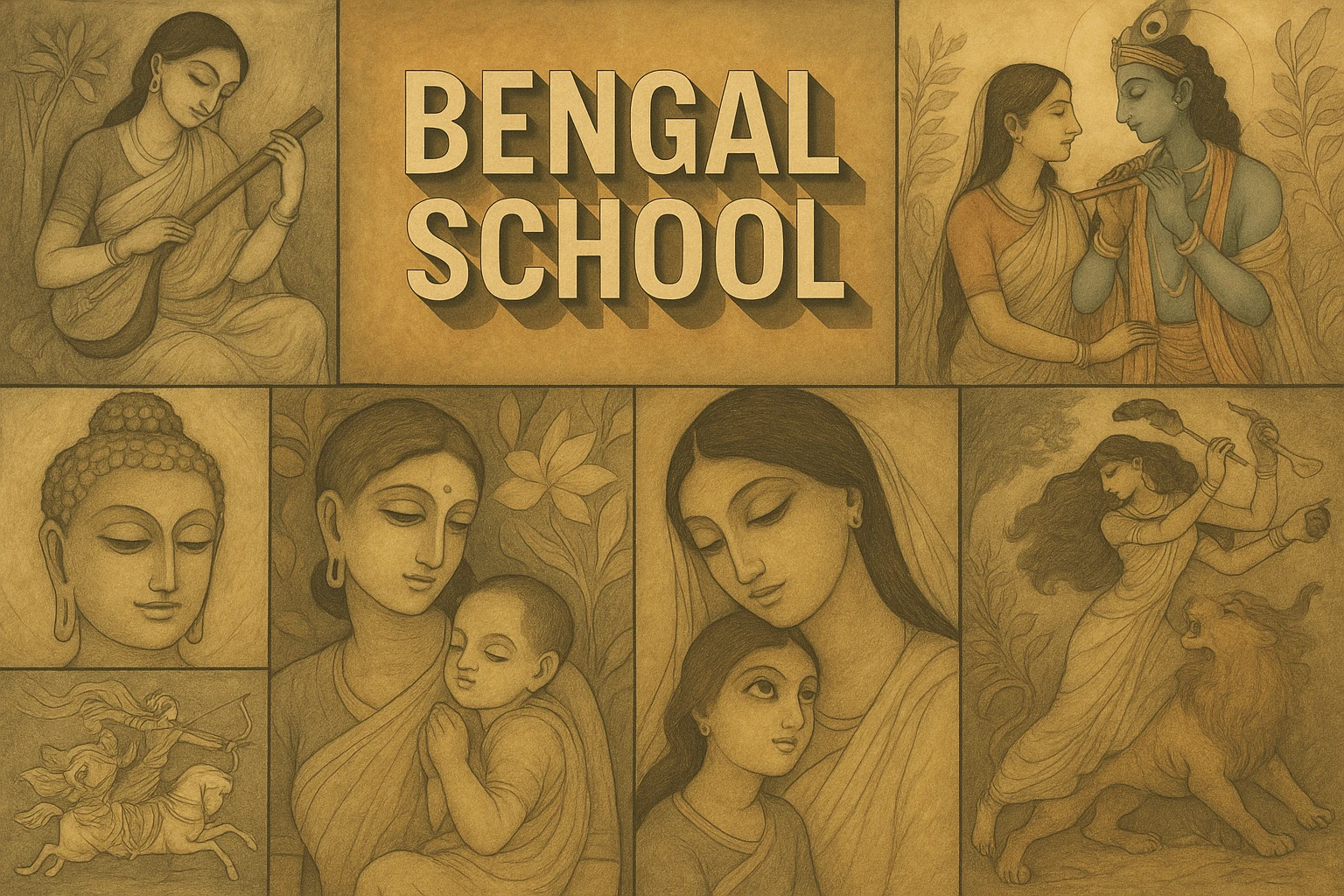
Bengal School
Bengal School paintings are visions cast in sepia and gold. They blend harmony with grace, capturing mythic dreams and serene realities, employing fine, sinuous lines and a palette that’s both earthy and ethereal.
AOI thinking about Bengal School [+_~]-/
Overview and quick facts
The Bengal School is a cultural reclamation. Emerging in early 20th-century India, it sought to revive indigenous art traditions by fusing mystical themes with nationalism, employing subtle colors and intricate lines.
Can understand it also, as:
Neo-Bengal, Swadeshi Style
Categorize it as:
Modernism, Traditionalism
.: Dreaming :.
Canvas whispers myths,
Sepia dreams gently glide,
Art in quiet grace.
:. Thought is power .:
Detailed description
Born from the fervor of Swadeshi movement, the Bengal School romanticizes Indian traditions and spirituality. It’s marked by a departure from Western realism towards an evocative idealism, whispering tales of gods, legends, and rural life. Artefacts mirror miniatures, intricate yet expansive, often rooted in mysticism, wrapped in hues that converse gently with the canvas and soul.
Archive notes — claims to verify
1. The school emerged as a reaction against Western art influences in India.
2. It was most prominent during the early 20th century.
3. Abanindranath Tagore was a leading figure.
4. It emphasized traditional Indian themes and techniques.
5. Often used watercolors and pastels.
6. Portrayed mythological and historical subjects.
7. Influenced by Mughal and Rajput paintings.
8. Focused on spiritual and nationalistic themes.
9. The movement was particularly strong in Bengal.
10. Aims to project a spiritual aura.
Artists and works: references to check
(be aware, can be highly speculative)
Artists (be aware, speculation possible):
1. Abanindranath Tagore 2. Nandalal Bose 3. Gaganendranath Tagore 4. Rabindranath Tagore 5. Jamini Roy
Artworks (be aware, speculation possible)
1. “Bharat Mata” by Abanindranath Tagore 2. “Sati” by Nandalal Bose 3. “Buddha” by Gaganendranath Tagore 4. “Krishna’s Flute” by Jamini Roy
Epoch
Early 1900s
Creative tools and further exploration
Search results are starting points for exploration, not evidence for the historical claims or attributions in this legacy entry.
- Practical AI tools and critical guidance
- Build a repeatable image workflow
- Search Wikipedia for this subject
- Search Lexica for visual interpretations
- Browse the Art Style Database
Creative studies to try
Explore these collected prompts as creative interpretations. They are starting points for image-making, not reproductions of historical artworks or evidence about a tradition.
Visual cues: regional composition, inherited craft, place-specific rhythm
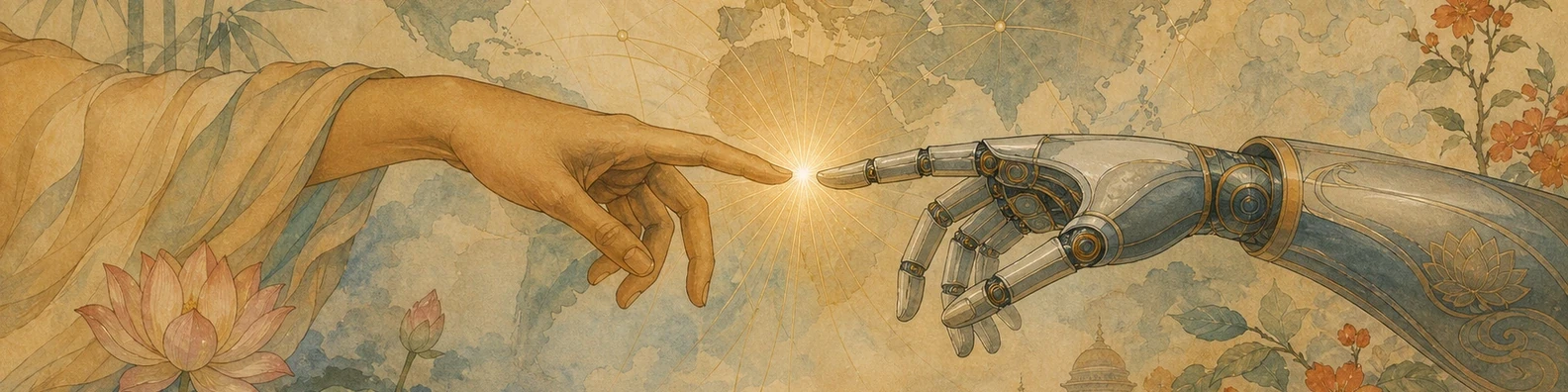
Study 1 — Bengal School
Ultra-wide panoramic banner, a human hand and a sleek robotic hand reaching toward each other, fingertips almost touching, a bright luminous spark of intelligence between them, a subtle world map behind them with global data network lines, symbolizing human-AI collaboration and digital transformation, rendered in Bengal School style, with refined composition, distinctive materials, elegant lighting, high-detail artistic finish, high quality, high detail, balanced composition, no text, no logo, no watermark, exact aspect ratio 1584:396
Prompt source: 1001 Art Styles. Select the text to copy, then adapt the subject and composition.