
Artist profile and digital visual-language study
Explore Beeple’s Everydays and HUMAN ONE, with sourced context, a close look at digital spectacle and varied original AOI visual studies.

A visual introduction
Five original AI-generated AOI studies explore scale, repetition, maintenance and technological afterlife. They are independent interpretations, not Beeple artworks, authorized reproductions or evidence of his production process.
Select an image for a closer look. Use the thumbnails, arrow keys or a swipe to compare examples. Zoom in to inspect details, or share the image that inspires you.
Creative toolbox · take this style further
Choose an input and a destination. Search sends your words to the chosen site; Copy & open puts them on your clipboard to paste there.
Create with AI
Turn your chosen input into an image prompt or a new creative direction.
ChatGPT
Copy your input and paste it into a ChatGPT conversation or image request.
Copy & open ChatGPT (new tab)Claude · Anthropic
Develop an image prompt or explore the style in a new Claude conversation.
Copy & open Claude · Anthropic (new tab)Midjourney
Paste your input into the Imagine bar on the Create page.
Copy & open Midjourney (new tab)Adobe Firefly
Copy your input, open Firefly, and paste it into the prompt field.
Copy & open Adobe Firefly (new tab)Leonardo.Ai
Copy your input, open Leonardo, and paste it into the generation field.
Copy & open Leonardo.Ai (new tab)Image search
Find visual references. Short, concrete keywords usually work best.
Lexica
Search AI images and prompts using your selected input.
Search with this input Lexica (new tab)Pexels
Search the photo and video library. Short keywords often work best.
Search with this input Pexels (new tab)Pixabay
Search photos, illustrations and other images.
Search with this input Pixabay (new tab)Unsplash
Search photographs using the style name or your own keywords.
Search with this input Unsplash (new tab)Wikimedia Commons
Search photographs, artworks and historical images. Check each file for its source and reuse terms.
Search with this input Wikimedia Commons (new tab)Art & research
Explore artists, collections and the ideas behind a style.
Wikipedia
Search for background reading. A style may not have its own article.
Search with this input Wikipedia (new tab)WikiArt
Copy your input into WikiArt’s search to explore artists and artworks.
Copy & open WikiArt (new tab)Europeana
Paste your keywords into the search to explore European museum, library and archive collections.
Copy & open Europeana (new tab)Inspiration
Discover portfolios and visual ideas from creative communities.
Instagram hashtags
Search a hashtag made from your input: spaces and punctuation are removed. Instagram may require sign-in.
Search with this input Instagram hashtags (new tab)ArtStation
Paste your input into artwork search for concept art, environments, characters and visual development.
Copy & open ArtStation (new tab)Behance
Paste your input into project search for illustration, design and visual storytelling.
Copy & open Behance (new tab)A closer look
Familiar objects become strange through shifts of scale, setting and repetition. Convincing materials and cinematic light make impossible situations feel tangible; a small figure or ordinary detail supplies a reference point.
An artist and a practice, rather than a preset
Beeple is the professional name of Mike Winkelmann. His own biography describes a practice spanning short films, VJ loops, daily images and immersive media. Reducing that range to a neon palette or a giant science-fiction object misses the role of repetition, experimentation and circulation in his work. This entry concerns an artist-related visual language, not a historical movement called Beeple. [1]
A useful way into the images is to ask how an ordinary thing becomes a spectacle. Scale can turn a familiar object into a monument; a changed setting can make routine behavior look absurd. A recognizable surface, tiny figure or convincing shadow can hold an otherwise impossible scene together. These are looking questions for this article, not a formula that explains every work.
Everydays: the image and the accumulation
Beeple dates the beginning of Everydays to May 1, 2007. He describes making each picture from start to finish in a day, with the aim of improving different skills. The project matters as a sustained practice as well as a collection of individual images. A daily constraint can encourage experiments, but a long sequence also exposes repetition and unevenness for viewers to judge. [2]
Everydays: The First 5000 Days brings the first 5,000 images into one composite. Christie’s sold the NFT-associated work on March 11, 2021 for US$69,346,250 including the buyer’s premium. That documented sale is part of its public history; the price is not a measure of the quality of every component image, nor a founding date for digital art. [3]
The composite invites two different distances of attention. From far away, many pictures become a dense surface; close inspection returns the viewer to particular scenes and changes across time. For a student, the productive lesson is to compare decisions across a sequence: what changed in the composition, what became more precise and what remained a habit? This is an editorial reading of the project’s cumulative form.
HUMAN ONE: a digital image with a physical presence
M+ identifies HUMAN ONE (2021) as a four-channel kinetic video sculpture with a polished aluminum and mahogany support and a dynamic NFT. Its astronaut-like traveler walks through changing virtual landscapes displayed on four LED screens in a rotating structure. The museum describes the artist’s ability to update that environment remotely. [4]
The premise of a first human born in the metaverse belongs to the work’s fiction. The sculpture’s physical enclosure, movement and changing imagery make it more than a still picture of a traveler. When comparing it with Everydays, consider where change occurs: across a sequence of separate daily images, or within a work whose presented world can continue to evolve.
A web reproduction can show a view of this object, but it cannot fully convey the viewer’s movement around it or its duration. Use the museum’s documentation to encounter the actual work. The images commissioned for this AOI page are separate studies and do not reproduce the sculpture.
Digital construction is not one process
In his M+ essay, curator Sunny Cheung describes Beeple’s use of created or adapted stock 3D elements, Cinema 4D rendering and Photoshop processing. He also traces the practice from earlier traditional-media images toward digital work and cultural commentary. That is a documented account of particular methods, not a claim that every Beeple image uses an identical pipeline. [5]
A constructed 3D scene gives its maker decisions about models, camera, light, materials and compositing. Text-to-image generation is a different process. The AI studies here can explore related visual questions, but they should not be cited as demonstrations of Beeple’s tools or attributed to him.
In either a concept study or a composed scene, coherence matters. The light that reveals the main object should agree with its shadows; material wear should follow the object’s construction; the scale reference should be readable. An abundance of detail cannot rescue a confused relationship between the central forms.
Read the contradiction before the spectacle
Begin with one relationship: a domestic object made monumental, a fragile organism housed in a machine, or an ordinary routine displaced into an unfamiliar landscape. State what is surprising about that relationship before adding secondary elements. If the image needs a paragraph to explain which object matters, its visual hierarchy may be doing too little.
Use scale as an argument. A small worker beside a huge object can make infrastructure, dependency or vulnerability visible. Yet the same device can become a generic emblem of importance if the scene gives the person no meaningful relation to the object. Change the task, viewpoint or scale when the familiar tiny-figure formula stops contributing.
Spectacle and satire need separate judgment. Polished lighting can make a scene seductive without making its comment precise. Ask what the exaggeration targets, which details support that reading and whether an alternative interpretation remains plausible. Do not assign a political intention to a particular Beeple image without evidence from the work and its context.
The strongest study need not be the largest or darkest. A restrained scene can make maintenance, absence or care more visible than another mountain-sized machine. This is the reason for varying the new AOI gallery’s scale and tone.
Five original studies, five points of entry
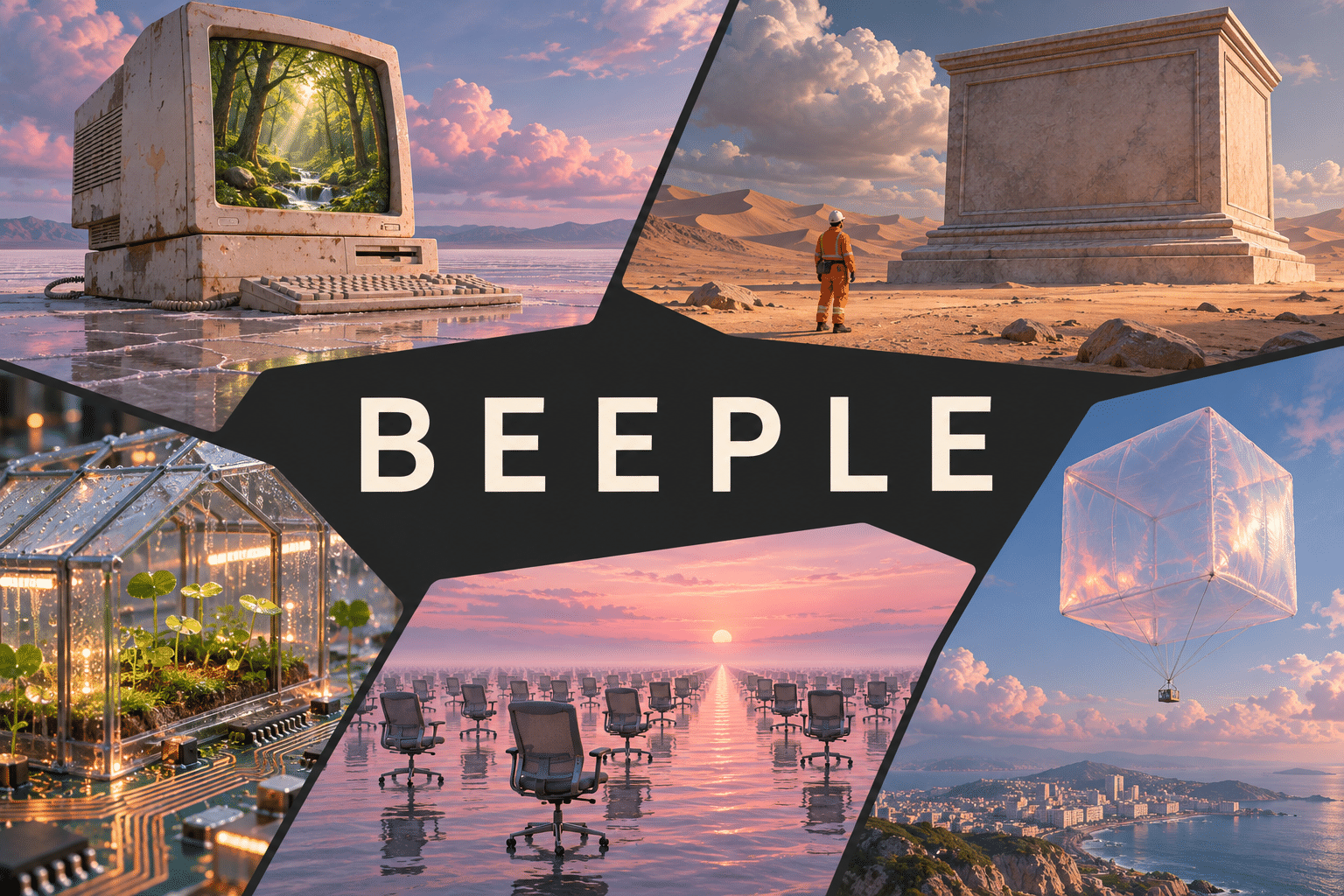
An Afterlife for the Machine, the banner, places a living woodland inside the screen of an obsolete computer on a salt flat. The tiny workers and service gantry establish the contradiction between an everyday object and a structure that now needs collective care. Its warm sky and cool distance leave the central form room to read.
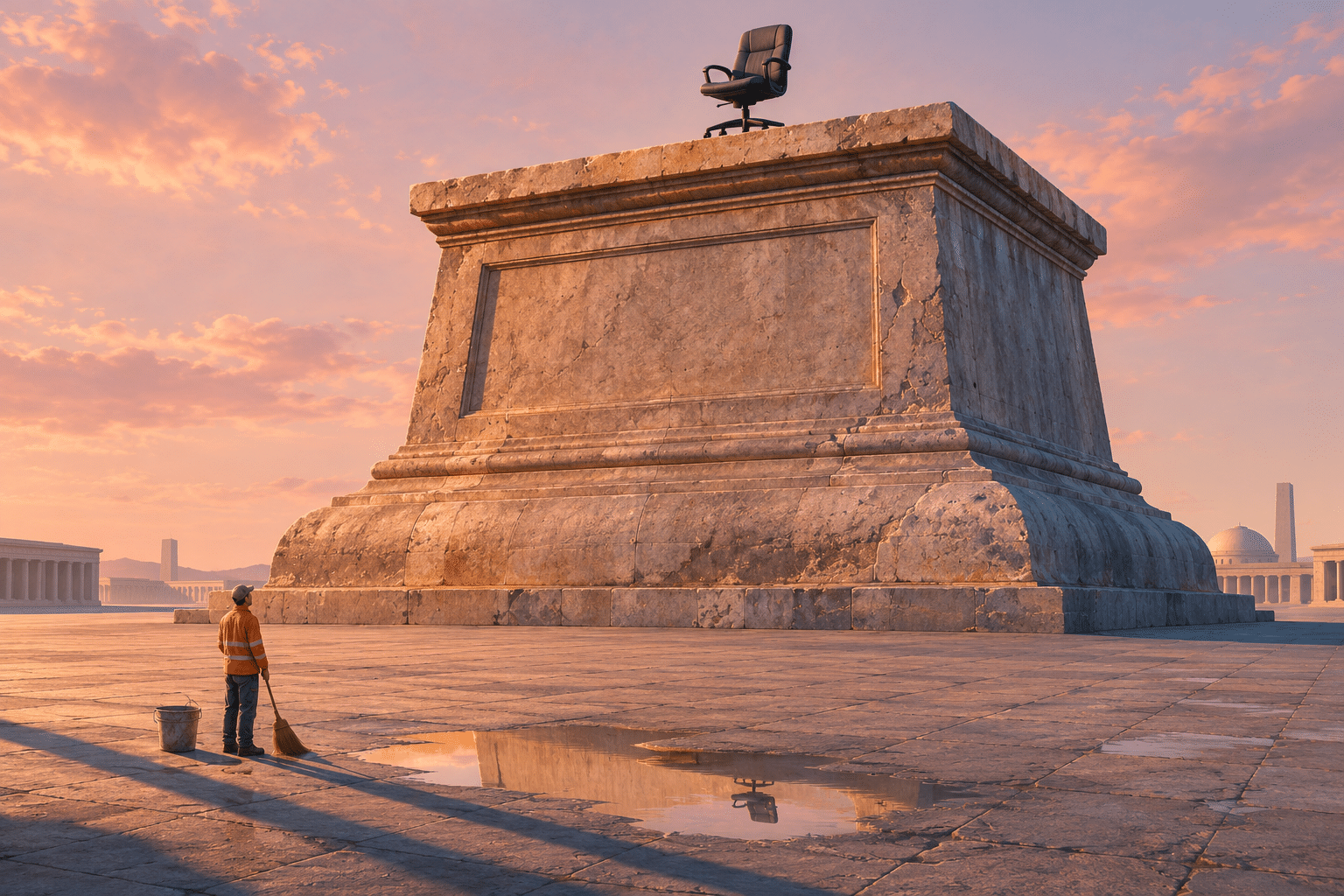
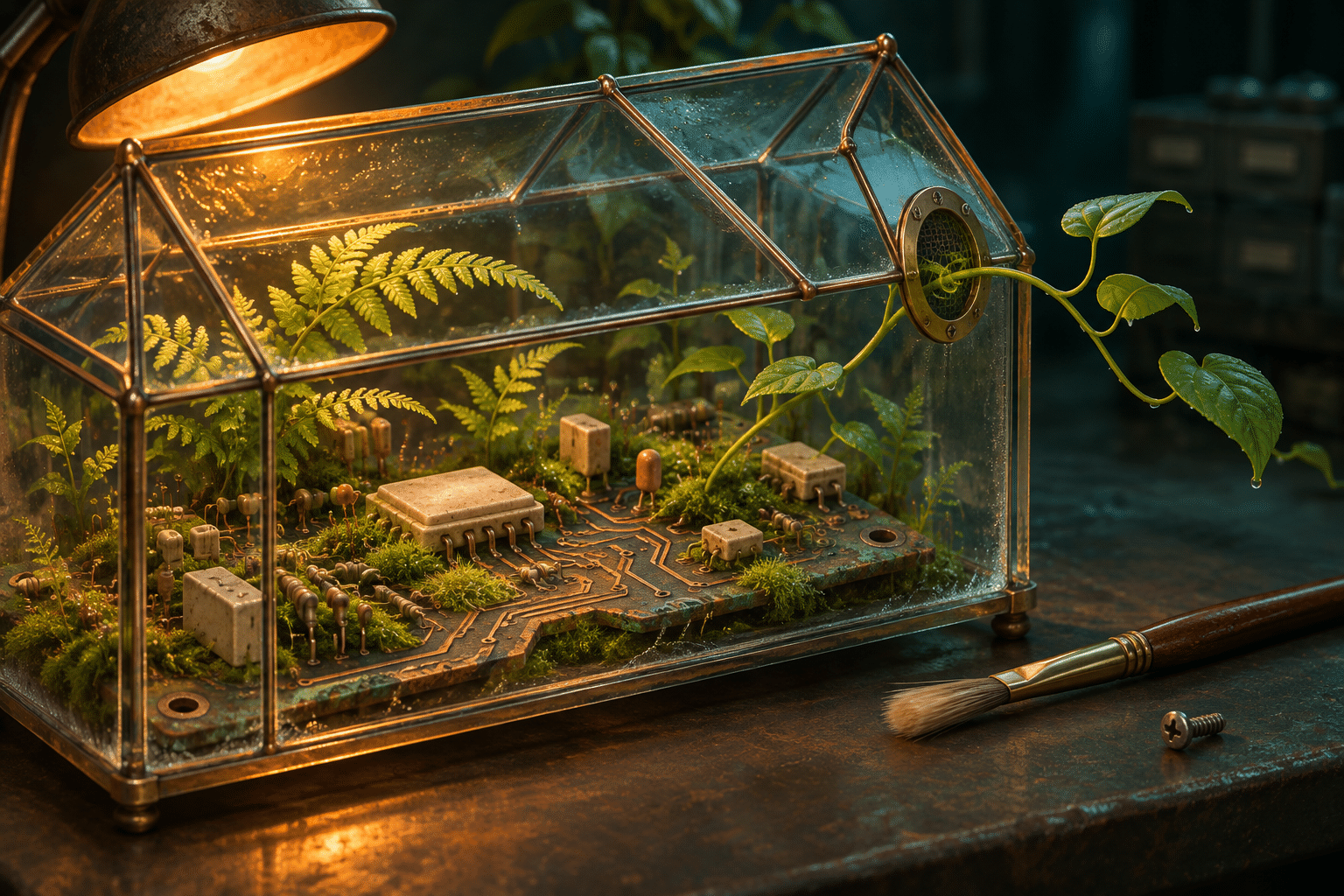
The Chair and Its Monument enlarges the support rather than the ordinary chair above it. A worker sweeping at the base introduces a second scale of attention. A Small System of Care reverses the monumental approach: glass, copper, moss and a maintenance brush make a modest workbench scene the whole subject.
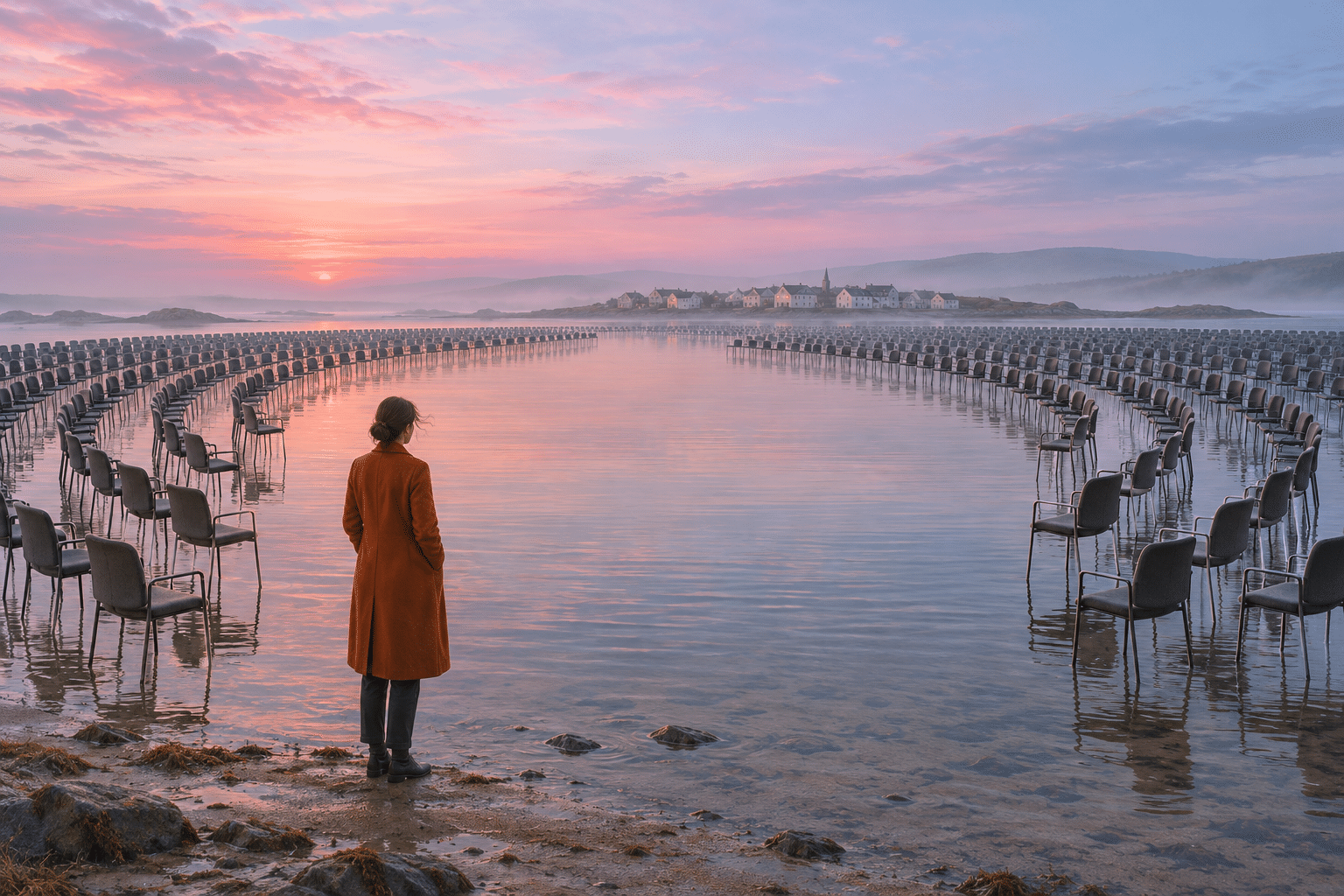
The Meeting That Did Not Begin repeats empty chairs across shallow water, leaving an open central interval. Its effect depends on absence and spacing, not on a complicated invented machine. The centered BEEPLE collage connects these new scenes with an additional translucent balloon study, showing different ways an impossible relationship can organize an image.
All five are original AI-generated AOI interpretations. They are neither artworks by Beeple nor documentary photographs. For further study, move between the artist’s own Everydays archive, the auction record for the composite and M+’s sculpture documentation; each answers a different question about the practice.
A small poetic detour
Original words from the AOI studio.
Poetry
The screen goes dark; the roots go on.
A little green outlasts the glow.
Below the monument at dawn
someone is sweeping, soft and slow.
We built a place for all our chairs
and left the water room to shine.
An empty seat still asks who cares;
a small repair can change the sign.
The prompt workshop
Original creative exercises. These prompts create new illustrations, not documentary evidence.
One impossible change of scale
Create an original digital-surrealist scene of an obsolete unbranded computer grown to monumental scale on a salt flat. A woodland glows inside its screen and two small maintenance workers stand on a coherent gantry below. Use precise materials, restrained dawn light and one clear contradiction. No copied artwork, logos or text.
A small system of care
Create an intimate original 3D-render-like still life: ferns grow among copper traces inside a glass greenhouse on a workshop bench. Include a fine brush and one screw for scale. Distinguish glass, metal and leaves through coherent amber task light and quiet teal shadows. No brands, lettering or spectacular giant objects.
Repetition with an absence
Compose an original surreal coastal scene with curving rows of empty chairs standing in shallow water. Leave an open central interval and one observer on shore. Use subtle reflections, coherent chair structures and restrained pink-blue dawn light. Let spacing suggest collective routine and absence; no copied characters or text.
People & works to explore
References discussed in this article. Consult the sources below for context.
Artists and practitioners
Mike Winkelmann, known professionally as Beeple
Paintings and other works
Everydays: The First 5000 Days (2021) — composite of the first 5,000 daily images
HUMAN ONE (2021) — evolving four-channel kinetic video sculpture
A smile from the studio
Jokes
The render needed a monument. The maintenance budget requested a chair.
Sources and further exploration
[1] Beeple — official biography; identity and range of practice
[2] Beeple — Everydays; start date and stated daily-learning purpose
[3] Christie’s — The First 5000 Days sale overview; composition and 2021 result including premium
[4] M+ — HUMAN ONE exhibition; materials, movement and ongoing updates
[5] Sunny Cheung, M+ — An Infinite Journey in the Virtual Realm; process and critical context