
Historical association of landscape painters
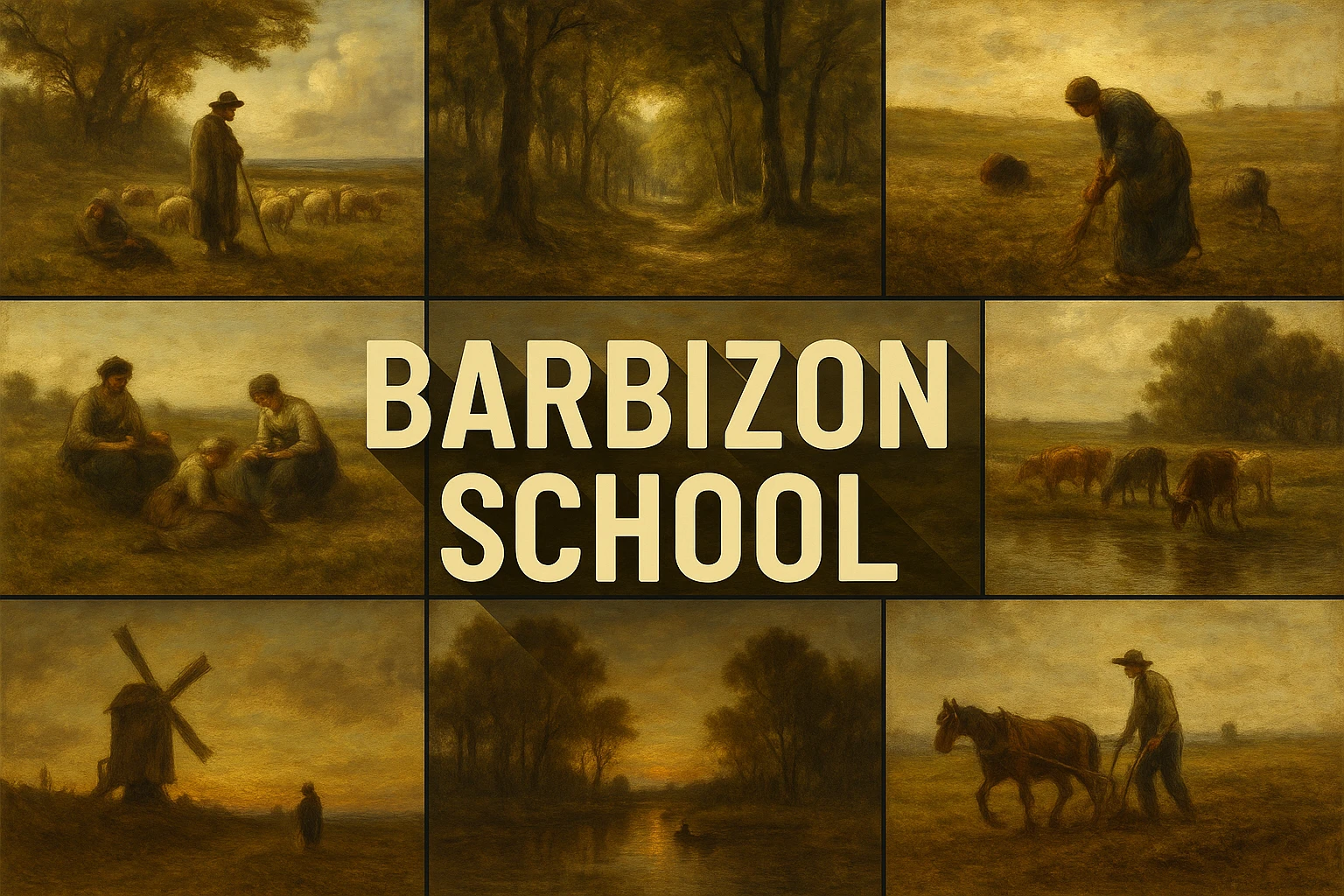
The Barbizon School names a group of nineteenth-century painters associated with landscape and the area around the Forest of Fontainebleau. It was not a school with one compulsory technique or identical artistic aims.
A visual introduction
Select an image for a closer look. Use the thumbnails, arrow keys or a swipe to compare examples. Zoom in to inspect details, or share the image that inspires you.
Creative toolbox · take this style further
Choose an input and a destination. Search sends your words to the chosen site; Copy & open puts them on your clipboard to paste there.
Create with AI
Turn your chosen input into an image prompt or a new creative direction.
ChatGPT
Copy your input and paste it into a ChatGPT conversation or image request.
Copy & open ChatGPT (new tab)Claude · Anthropic
Develop an image prompt or explore the style in a new Claude conversation.
Copy & open Claude · Anthropic (new tab)Midjourney
Paste your input into the Imagine bar on the Create page.
Copy & open Midjourney (new tab)Adobe Firefly
Copy your input, open Firefly, and paste it into the prompt field.
Copy & open Adobe Firefly (new tab)Leonardo.Ai
Copy your input, open Leonardo, and paste it into the generation field.
Copy & open Leonardo.Ai (new tab)Image search
Find visual references. Short, concrete keywords usually work best.
Lexica
Search AI images and prompts using your selected input.
Search with this input Lexica (new tab)Pexels
Search the photo and video library. Short keywords often work best.
Search with this input Pexels (new tab)Pixabay
Search photos, illustrations and other images.
Search with this input Pixabay (new tab)Unsplash
Search photographs using the style name or your own keywords.
Search with this input Unsplash (new tab)Wikimedia Commons
Search photographs, artworks and historical images. Check each file for its source and reuse terms.
Search with this input Wikimedia Commons (new tab)Art & research
Explore artists, collections and the ideas behind a style.
Wikipedia
Search for background reading. A style may not have its own article.
Search with this input Wikipedia (new tab)WikiArt
Copy your input into WikiArt’s search to explore artists and artworks.
Copy & open WikiArt (new tab)Europeana
Paste your keywords into the search to explore European museum, library and archive collections.
Copy & open Europeana (new tab)Inspiration
Discover portfolios and visual ideas from creative communities.
Instagram hashtags
Search a hashtag made from your input: spaces and punctuation are removed. Instagram may require sign-in.
Search with this input Instagram hashtags (new tab)ArtStation
Paste your input into artwork search for concept art, environments, characters and visual development.
Copy & open ArtStation (new tab)Behance
Paste your input into project search for illustration, design and visual storytelling.
Copy & open Behance (new tab)A closer look
Trees, paths, fields and changing light can become substantial subjects; broad masses and observed relationships matter as much as picturesque detail.
Landscape deserves sustained attention
The Met's account describes artists gathering around Barbizon and treating landscape as a subject in its own right. The label brings together painters with distinct practices, including Théodore Rousseau, Jean-François Millet and Charles-François Daubigny. It should not erase those differences.
The Städel's overview also distinguishes outdoor studies from paintings developed in the studio. Working from nature did not require every finished canvas to be completed entirely outdoors. Observation, memory, selection and revision could contribute to the final image.
Choose a particular piece of ground
A useful study begins with a specific arrangement: a tree group at a field edge, a wet track beneath foliage or the meeting of cultivated land and woods. Identify the largest shapes before cataloguing leaves and branches.
Ask what gives the place weight. A dark canopy may press against a pale opening; a path may connect foreground texture to distant light. These relationships can sustain attention without requiring a spectacular landmark or a dramatic narrative.
Make weather visible through its effects
Instead of naming an atmosphere, show what it does. Damp ground reflects differently from dry earth; distant forms may soften; a break in cloud can isolate one plane. Keep these effects consistent across the scene.
Limit the initial color study so that value relationships remain clear. Add smaller color differences after the composition works at a distance. An abundance of green tones is less useful than a convincing distinction between lit foliage, shaded mass and open air.
Observation is not a single style filter
Do not turn the subject into a recipe of brown trees and nostalgia. Compare different painters and individual works. A field can be a place of labor as well as a pleasing arrangement of forms, and a landscape's human presence need not be a decorative accessory.
For a contemporary interpretation, record what you actually observe and identify what you change. A generated image can explore the compositional principles, but it should not be presented as a recovered Barbizon painting or as evidence of a real location's historical appearance.
A small poetic detour
Original words from the AOI studio.
Poetry
Sunlit fields of gold— / A breeze carries rustic tales, / Whispering through trees.
The prompt workshop
Original creative exercises. These prompts create new illustrations, not documentary evidence.
Edge of the forest
Original landscape study of a field meeting dense woodland, strong masses, a narrow pale opening and observed earth colors, no imitation signature.
After rain
Original painterly study of a muddy forest track after rain, consistent damp reflections, restrained detail and a clear route into the composition.
A working landscape
Original rural scene with a distant worker and broad cultivated ground, the human presence integrated into scale and rhythm, no picturesque costume emphasis.
Sources and further exploration
The Met — Barbizon painters and landscape as a subject
Städel Museum — the group and the relation between field study and studio