
Cultural context · modern and contemporary art from Bahrain
Bahraini art encompasses different artists, media and histories connected with Bahrain. It is not a single movement with a compulsory palette. This guide introduces several documented practices, explains how place and material can matter, and offers original visual exercises without pretending that one generated picture represents an entire country.
A visual introduction
Original AI-generated visual exercises. Historical works and artists are identified separately in the text and sources.
Select the collage for a closer look; press Escape to return to the guide.
Creative toolbox · take this style further
Choose an input and a destination. Search sends your words to the chosen site; Copy & open puts them on your clipboard to paste there.
More tools
Additional destinations selected for this article.
ChatGPT
Copy your input and paste it into a ChatGPT conversation or image request.
Copy & open ChatGPT (new tab)Claude · Anthropic
Develop an image prompt or explore the style in a new Claude conversation.
Copy & open Claude · Anthropic (new tab)Midjourney
Paste your input into the Imagine bar on the Create page.
Copy & open Midjourney (new tab)Adobe Firefly
Copy your input, open Firefly, and paste it into the prompt field.
Copy & open Adobe Firefly (new tab)Leonardo.Ai
Copy your input, open Leonardo, and paste it into the generation field.
Copy & open Leonardo.Ai (new tab)Lexica
Search AI images and prompts using your selected input.
Search with this input Lexica (new tab)Pexels
Search the photo and video library. Short keywords often work best.
Search with this input Pexels (new tab)Pixabay
Search photos, illustrations and other images.
Search with this input Pixabay (new tab)Unsplash
Search photographs using the style name or your own keywords.
Search with this input Unsplash (new tab)Wikipedia
Search for background reading. A style may not have its own article.
Search with this input Wikipedia (new tab)WikiArt
Copy your input into WikiArt’s search to explore artists and artworks.
Copy & open WikiArt (new tab)Instagram hashtags
Search a hashtag made from your input: spaces and punctuation are removed. Instagram may require sign-in.
Search with this input Instagram hashtags (new tab)A closer look
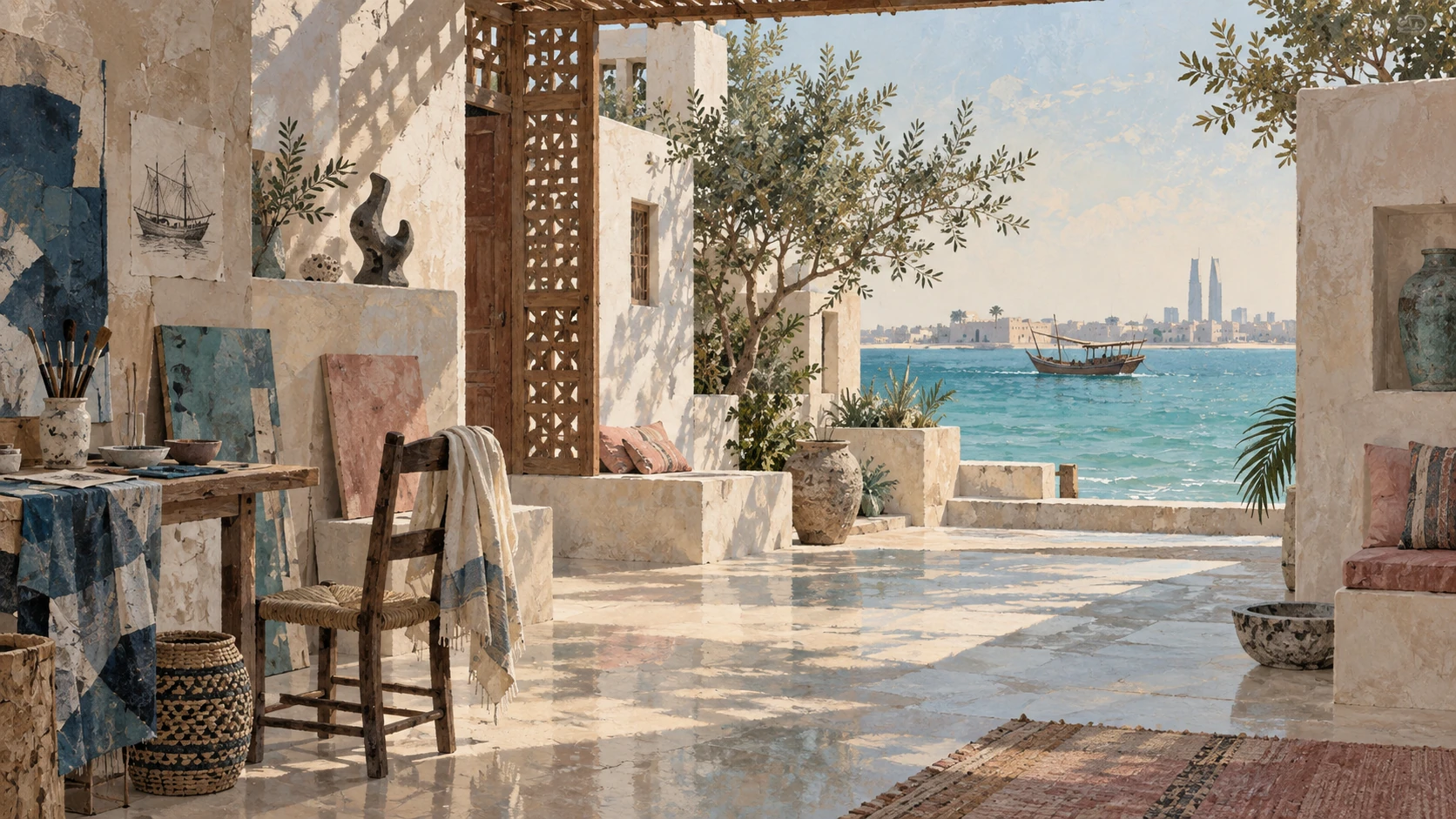
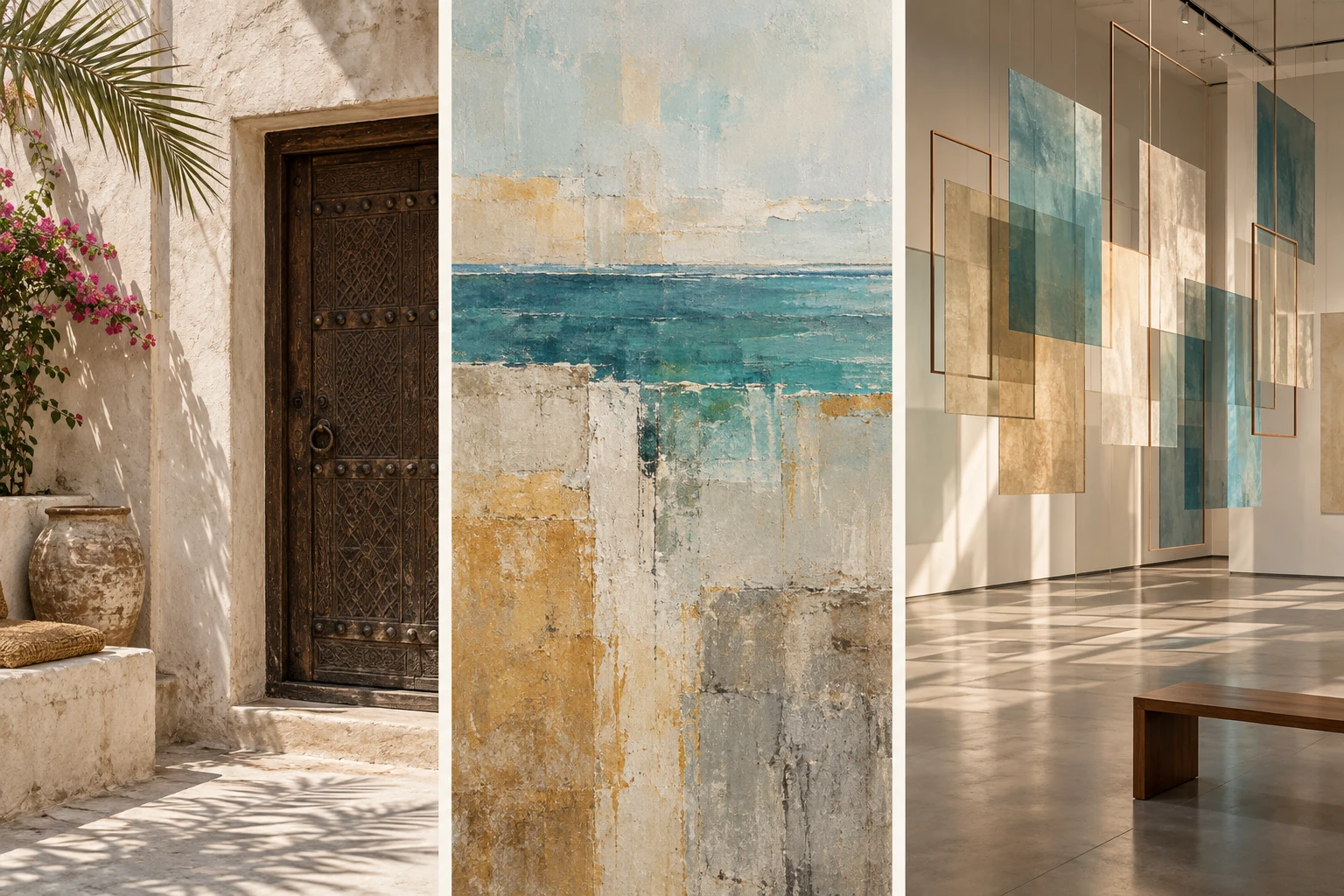
In our imagined courtyard banner, pale walls frame blue water while a chair and worktable establish a lived space. The accompanying collage changes the problem three times: describing a doorway, translating a coast into abstract layers, and arranging suspended surfaces in a gallery. These are AI-generated teaching illustrations, not photographs of actual sites or reproductions of Bahraini artworks.
Start with the artist, not a national colour chart
A nationality identifies a relationship to a place; it does not prescribe how someone must paint. The useful first question is therefore not “What does Bahraini look like?” but “Which artist, work, material and moment are we discussing?” Painting, abstraction and spatial installation can require very different kinds of attention. A database label should open those distinctions rather than flatten them.
The Bahrain Authority for Culture and Antiquities documented a 2013 exhibition of modern Bahraini art that included Rashid Al Khalifa, Abdulrahim Sharif, Balqees Fakhro, Khalil Al Hashimi and Ahmed Baqer. Even this selected group is a better starting point than an unsupported list of decorative characteristics. It supplies names to investigate, not a universal recipe. [1]
This revised entry replaces the earlier claim that Bahraini art is inherently bright, busy or chaotic. Those adjectives might describe a particular picture after close looking. Applied to a whole country, they tell us much more about the description than the art. A passport is not a brush preset.
Place is a context, not an obligation
Bahrain’s maritime history offers one substantial context. UNESCO’s Pearling site connects buildings in Muharraq with oyster beds and a surviving seashore setting. Its account ties the pearl economy to architecture, craftsmanship and social life. That relationship is richer than simply putting a pearl into every composition. [2]
For looking or making, ask what a place does to the image. A narrow threshold can compress a view; a shaded recess can make a wall feel thick; reflected water can interrupt a rigid façade. These are visual questions that can be explored through observation. They do not establish the nationality of a picture by themselves.
Nor must a Bahraini artist continually illustrate heritage. A work can address the body, a formal experiment, memory or the organisation of space without supplying a recognisable landmark. The absence of a boat or a historic doorway is not the absence of cultural meaning. Leave room for artists to choose their own subjects.
Three documented routes into the art
Rashid Al Khalifa’s own account traces a development from landscape and figuration toward geometric abstraction, convex surfaces and sculptural installations. Materials and changing light become active parts of the work. His website identifies Spectrum IV, 2021, as enamel on aluminium; it also documents Penumbra: Textured Shadow, Coloured Light at London’s Saatchi Gallery in 2018. These references invite attention to viewing position and physical surface, not simply a colour scheme. [3]
Abdulrahim Sharif offers a different route. BACA’s record of the 2022 Sharif & Sharif exhibition describes his River of Sin paintings as combining figuration and abstraction in aerial compositions. The eight exhibited works were made between 2012 and 2021. The same account discusses Hisham Sharif’s changing approach across figures, seascapes and landscapes. Shared context does not mean identical practice, even within a family. [4]
Balqees Fakhro provides another point of comparison: BACA’s 2019 exhibition notice identifies her with abstract painting. Begin with the works and exhibition documentation rather than expecting a readily decoded illustration of national identity. These examples are an introduction, not a ranked list or a complete history of Bahrain’s art. [5]
How to look beyond the subject matter
Separate what a picture depicts from how it is constructed. A courtyard might be painted through crisp architectural measurement, dissolved into patches of colour, or recalled through almost empty planes. A coast might be a location, a rhythm, a memory or a source of light. Name the evidence for your interpretation: an edge, a repeated interval, a change in density.
Then ask what the medium contributes. Enamel on metal does not behave like a wash on absorbent paper. A suspended surface casts a real shadow into the viewer’s space; a painted shadow remains an image on a support. Looking only at thumbnails can hide precisely those distinctions. Follow the artist or institution’s documentation when size, installation or material matters.
In our collage, compare the dark doorway at left with the open intervals at right. Both organise access and depth, but by different means. The middle panel keeps a horizontal coastal rhythm while discarding most identifiable objects. This is our reading of an invented teaching exercise, not a claim about three historical schools.
Build a specific, honest visual study
Choose one question before choosing an image model: perhaps the contrast between a cool recess and a sunlit wall, or the way repeated planes divide a room. Gather reliable references for the particular place or material you want to describe. If the source is a documented building, verify its details instead of treating a generated approximation as an architectural survey.
Write prompts that name the scene, medium, light and composition. “Bahraini style” alone leaves the model to fill the gaps with stereotypes. Remove decorative elements that have no reason to be present; check whether clothing, ornament and architecture have been borrowed indiscriminately from elsewhere. A convincingly painted surface does not certify cultural accuracy.
The two new illustrations are intentionally labelled as imagined AOI studies. We have retired the earlier generic ornamental portrait from this guide because it did not establish a meaningful connection to its subject. For authentic works, follow the linked artist and institutional records. Use the exercises to sharpen observation, then return to the artists whose work made the question interesting.
A small poetic detour
Original words from the AOI studio.
Poetry
A wall keeps the shade.
The sea lends a little blue.
No border for light.
The prompt workshop
Original creative exercises. These prompts create new illustrations, not documentary evidence.
Starting point: a threshold and its light
An original painterly study of an imagined Gulf courtyard: pale plaster wall, dark wooden doorway, one ordinary chair and reflected blue light. Give the doorway convincing depth and make the light direction coherent. Muted gouache surface, no invented script or decorative costume. Present as an imagined study, not a documented Bahraini site.
Original AOI exercise; a generated image is not historical or documentary evidence.
Richer composition: from place to abstraction
Translate an observed relationship between coast and weathered wall into a new abstract painting. Use three large horizontal areas, one interrupted vertical edge, thin translucent layers and a restrained contrast of sea blue with warm stone tones. Keep the surface varied without scattering meaningless symbols. No named-artist imitation.
Original AOI exercise; a generated image is not historical or documentary evidence.
Experiment: actual space, implied space
Design an imagined installation with suspended translucent planes and a simple bench. Make cast shadows and overlapping materials central. Produce a second version as a flat painting of the same arrangement; compare how depth and light change. Describe both as original speculative studies, not existing installations.
Original AOI exercise; a generated image is not historical or documentary evidence.
People & works to explore
References discussed in this article. Consult the sources below for context.
Artists and practitioners
Rashid Al Khalifa — painting, geometric abstraction and sculptural work; see source 3
Abdulrahim Sharif — River of Sin series; see source 4
Hisham Sharif — varied figurative and landscape practice; see source 4
Balqees Fakhro — abstract painting; see source 5
Paintings and other works
Rashid Al Khalifa, Spectrum IV, 2021, enamel on aluminium — source 3
Abdulrahim Sharif, River of Sin series, eight works dated 2012–2021 in the 2022 exhibition — source 4