AOI creative concept
Aural Canvas Flow is an invented AOI concept for translating musical relationships into visual ones. Repetition becomes spacing, a crescendo becomes growing density, and silence becomes unpainted ground. It is a practical compositional exercise, not a documented art movement or a claim that colours possess universal sounds.
An AOI creative concept, not an established historical movement.
A visual introduction
Open any image to look closer, then browse the examples.
Creative toolbox · take this style further
Choose an input, adjust it, then open a tool. Search links pass your text to the destination. Copy & open copies it for you to paste into the generator; you start generation there.
ChatGPT
Copy your input and paste it into a ChatGPT conversation or image request.
Copy & open ChatGPT (new tab)Claude · Anthropic
Develop an image prompt or explore the style in a new Claude conversation.
Copy & open Claude · Anthropic (new tab)Midjourney
Paste your input into the Imagine bar on the Create page.
Copy & open Midjourney (new tab)Adobe Firefly
Copy your input, open Firefly, and paste it into the prompt field.
Copy & open Adobe Firefly (new tab)Leonardo.Ai
Copy your input, open Leonardo, and paste it into the generation field.
Copy & open Leonardo.Ai (new tab)Lexica
Search AI images and prompts using your selected input.
Search with this input Lexica (new tab)Pexels
Search the photo and video library. Short keywords often work best.
Search with this input Pexels (new tab)Pixabay
Search photos, illustrations and other images.
Search with this input Pixabay (new tab)Unsplash
Search photographs using the style name or your own keywords.
Search with this input Unsplash (new tab)Wikipedia
Search for background reading. A style may not have its own article.
Search with this input Wikipedia (new tab)WikiArt
Copy your input into WikiArt’s search to explore artists and artworks.
Copy & open WikiArt (new tab)Instagram hashtags
Search a hashtag made from your input: spaces and punctuation are removed. Instagram may require sign-in.
Search with this input Instagram hashtags (new tab)A closer look
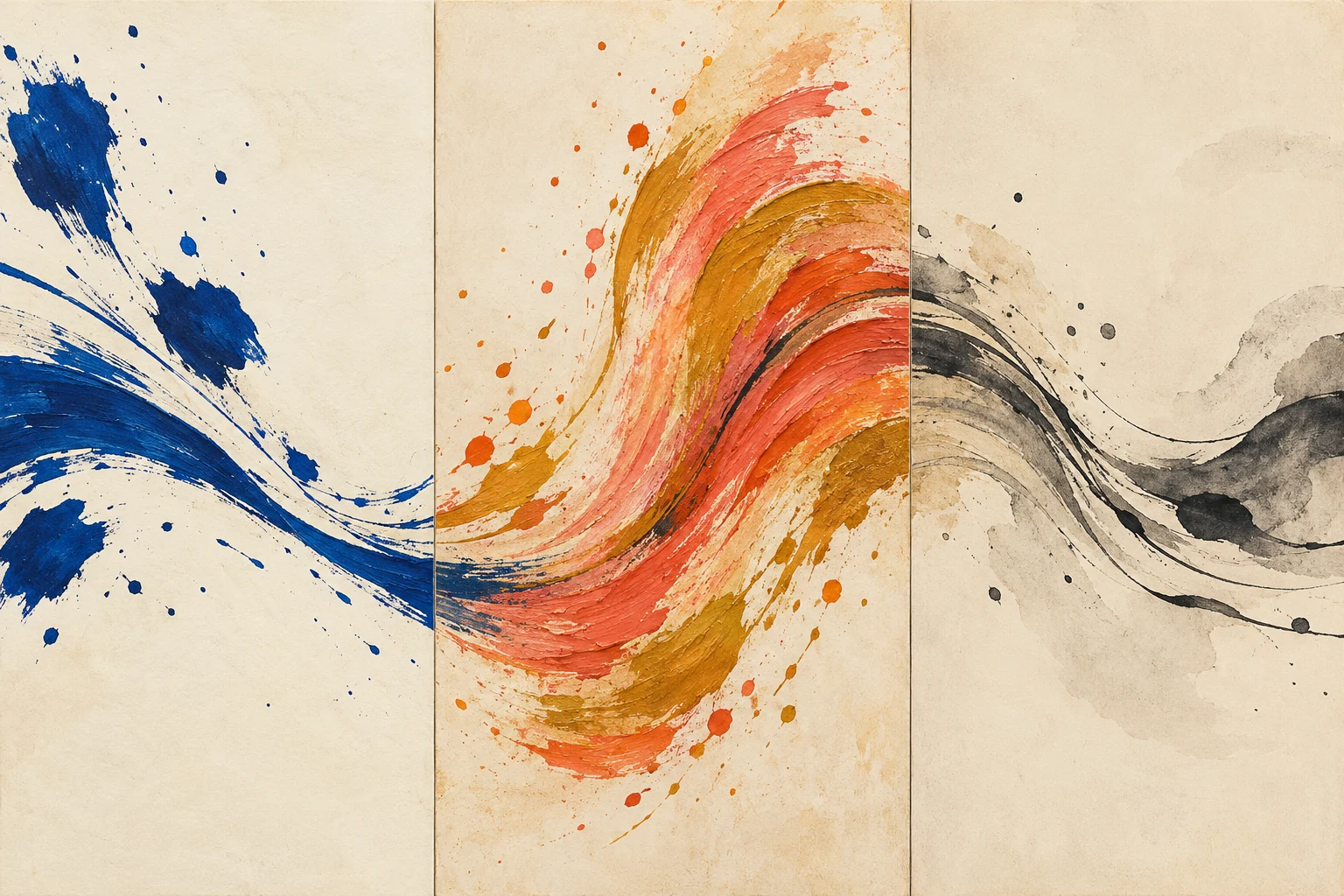
The new triptych carries a blue sweep into a thick coral-and-ochre crest, then lets it dissolve into thin charcoal ripples. Its three panels suggest an opening, a peak and a release. The generous paper-coloured gaps are as important as the energetic paint.
Listen for a relationship, not an illustration
The easy version of painting music is to add a violin and some floating notes. This concept asks for something less literal. Choose a short passage and identify one relationship you can actually hear: a repeated pulse, a sustained tone interrupted by sharp attacks, or several voices arriving at different moments. Give that relationship a visible rule. Small evenly spaced marks might carry the pulse while a broad continuous band carries the sustained tone.
There is no correct colour for a trumpet in this exercise. Your mapping is a studio decision, and another listener can reasonably choose something different. Write the rule down before you start. That small act keeps the result from becoming a collection of attractive marks that acquired a musical explanation afterwards.
Read the image as a sequence
In the illustration, the warm central crest occupies more area and has denser texture than the quieter right-hand panel. That change gives the eye a sense of emphasis. The curve continues across the boundaries, so the collage feels like a phrase rather than three unrelated samples. Read it in reverse and its emotional direction changes: the apparent ending becomes an entrance.
A static picture does not dictate a listening order, however. Viewers can jump to its strongest contrast or ignore your intended sequence. Test the composition without explaining it. Ask someone where their eye went first, where it slowed down, and what seemed to repeat. Those observations tell you more than asking whether the picture feels musical.
A useful constraint for the studio
Make three small versions using the same four marks. In the first, change only spacing. In the second, change only size. In the third, change only colour intensity. Compare which variable gives you the clearest sense of acceleration. Then combine two variables, leaving the others stable. Restraint makes the experiment readable.
For AI generation, describe the rules and the material instead of relying on the invented name. Specify how the image should move across the frame and where it should become quiet. A generated composition can suggest a score, but it is not a measured transcription unless you have supplied and checked an actual mapping from audio data. The music is a partner here, not an alibi for vagueness.
The prompt workshop
Original creative exercises. These prompts create new illustrations, not documentary evidence.
A phrase in three panels
Create an original three-panel abstraction on ivory paper. Begin with sparse blue marks, build a coral and ochre crest in the centre, and end with thin charcoal ripples. One curved route connects the panels. Preserve large quiet gaps. No lettering, musical notation or imitation artwork.