Spatial digital medium · Virtual forms in physical surroundings
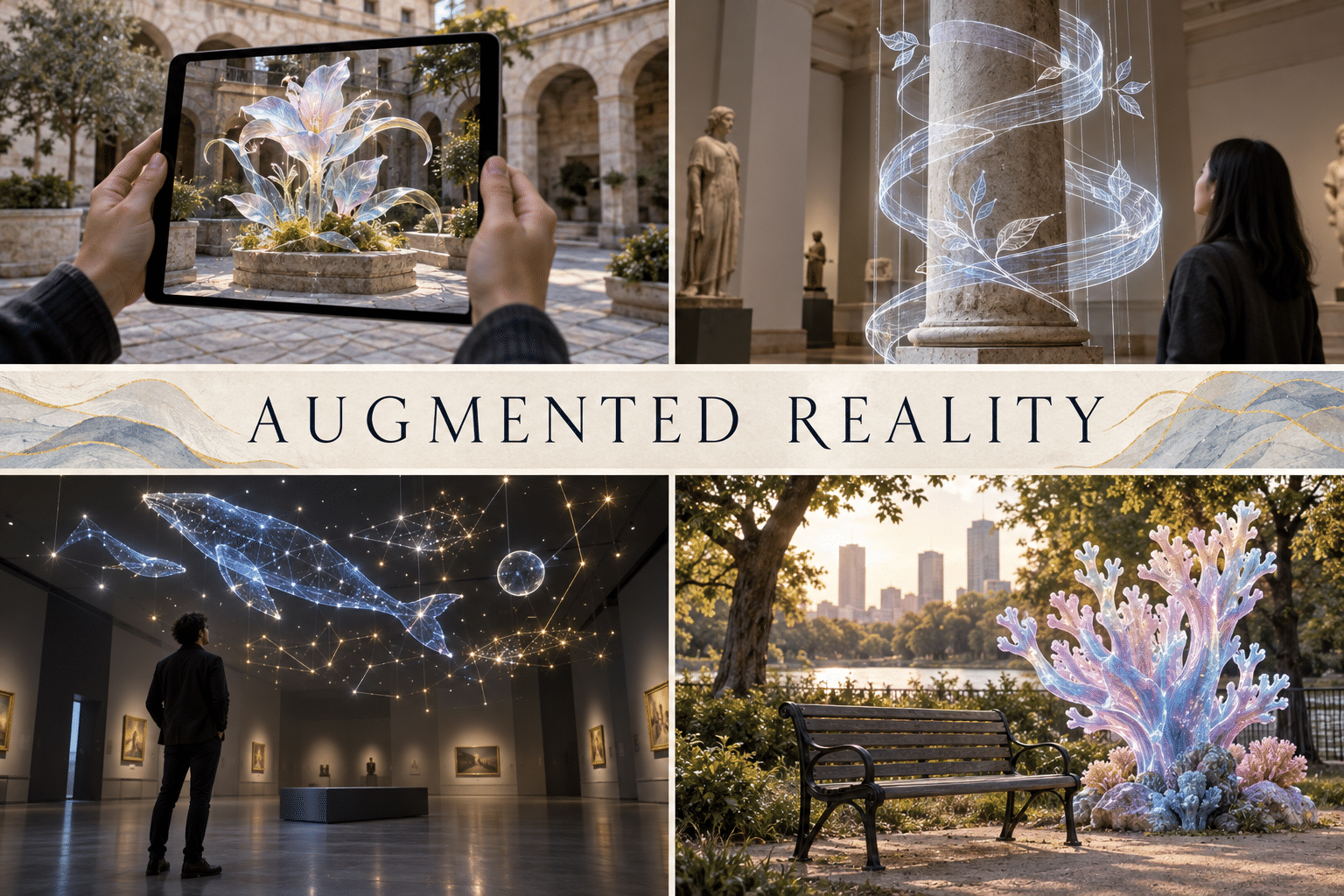
Augmented Reality art places digital forms in relation to a physical environment viewed through a device. A sculpture can appear beside a real bench, a drawing can wrap around a column, or an image can change as the viewer moves. The artistic question is how the virtual work relates to the place and to the viewer’s actions.
A visual introduction
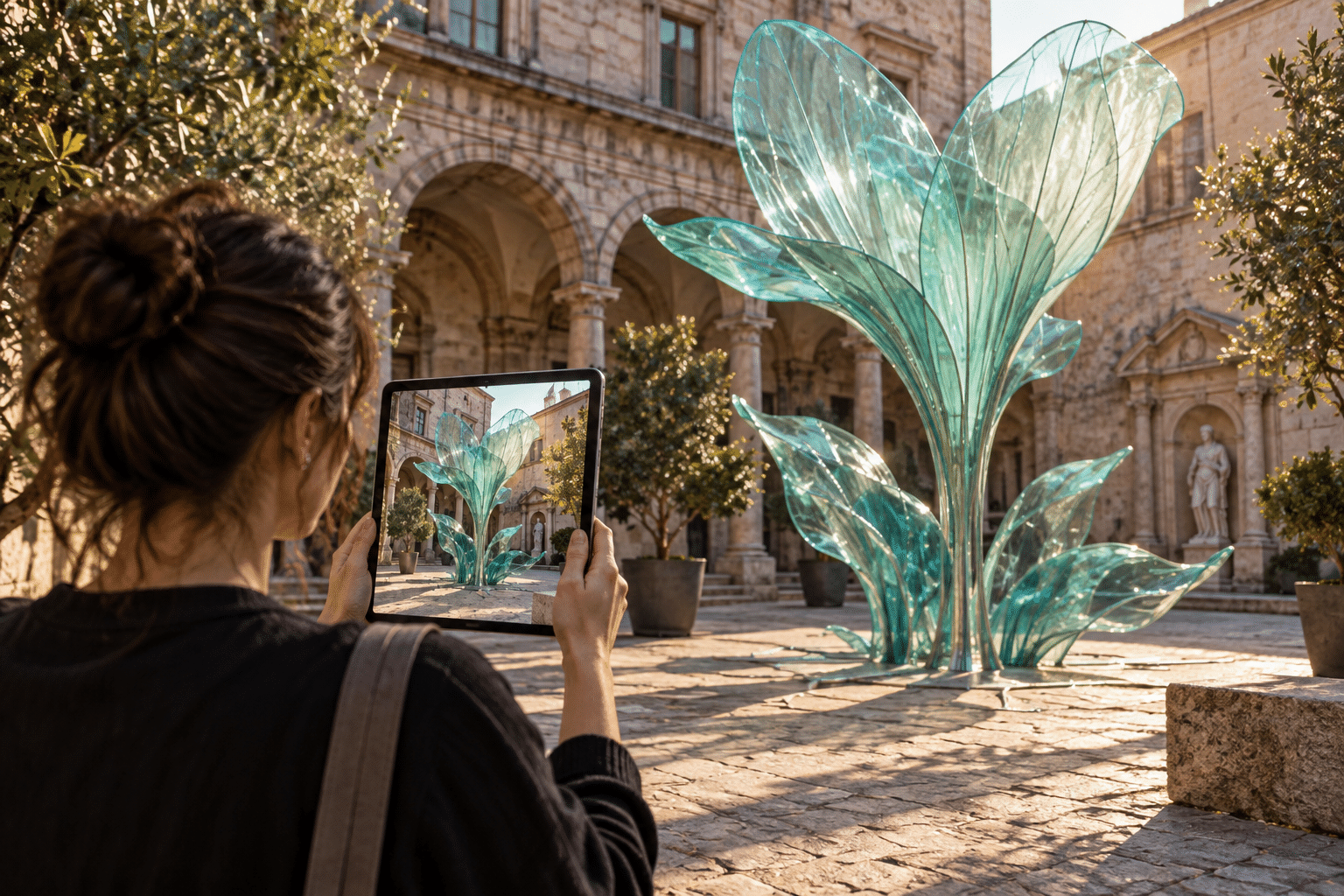
An original illustrative example and a centrally titled four-study collage. These AI-generated images explain visual possibilities; they do not document historical works or certify a physical construction.
Select an image for a closer look. Use the thumbnails, arrow keys or a swipe to compare examples. Zoom in to inspect details, or share the image that inspires you.
Creative toolbox · take this style further
Choose an input and a destination. Search sends your words to the chosen site; Copy & open puts them on your clipboard to paste there.
Create with AI
Turn your chosen input into an image prompt or a new creative direction.
ChatGPT
Copy your input and paste it into a ChatGPT conversation or image request.
Copy & open ChatGPT (new tab)Claude · Anthropic
Develop an image prompt or explore the style in a new Claude conversation.
Copy & open Claude · Anthropic (new tab)Midjourney
Paste your input into the Imagine bar on the Create page.
Copy & open Midjourney (new tab)Adobe Firefly
Copy your input, open Firefly, and paste it into the prompt field.
Copy & open Adobe Firefly (new tab)Leonardo.Ai
Copy your input, open Leonardo, and paste it into the generation field.
Copy & open Leonardo.Ai (new tab)Image search
Find visual references. Short, concrete keywords usually work best.
Lexica
Search AI images and prompts using your selected input.
Search with this input Lexica (new tab)Pexels
Search the photo and video library. Short keywords often work best.
Search with this input Pexels (new tab)Pixabay
Search photos, illustrations and other images.
Search with this input Pixabay (new tab)Unsplash
Search photographs using the style name or your own keywords.
Search with this input Unsplash (new tab)Wikimedia Commons
Search photographs, artworks and historical images. Check each file for its source and reuse terms.
Search with this input Wikimedia Commons (new tab)Art & research
Explore artists, collections and the ideas behind a style.
Wikipedia
Search for background reading. A style may not have its own article.
Search with this input Wikipedia (new tab)WikiArt
Copy your input into WikiArt’s search to explore artists and artworks.
Copy & open WikiArt (new tab)Europeana
Paste your keywords into the search to explore European museum, library and archive collections.
Copy & open Europeana (new tab)Inspiration
Discover portfolios and visual ideas from creative communities.
Instagram hashtags
Search a hashtag made from your input: spaces and punctuation are removed. Instagram may require sign-in.
Search with this input Instagram hashtags (new tab)ArtStation
Paste your input into artwork search for concept art, environments, characters and visual development.
Copy & open ArtStation (new tab)Behance
Paste your input into project search for illustration, design and visual storytelling.
Copy & open Behance (new tab)A closer look
Convincing scale, a stable spatial anchor, coherent perspective and a readable relationship between physical and virtual layers. Transparency and glowing surfaces are optional aesthetic choices, not requirements for AR.
An experience, not a fixed visual style
Smithsonian Education describes augmented reality within encounters between physical and digital worlds. This provides an institutional example of the medium’s use in cultural experiences. AR can carry many visual languages, from a quiet line drawing to a detailed three-dimensional object.
The images on this page are proposals for AR artworks, not functioning AR applications or screenshots of deployed installations. An actual experience requires tracking, rendering and interaction on a compatible device. A convincing illustration alone does not demonstrate those capabilities.
Make the relationship to place specific
Start with an actual spatial feature: a doorway, a paving pattern or a tree. Decide what the virtual element does in relation to it. A form that grows from a crack in the paving offers a different encounter from a freestanding object that could appear anywhere.
Keep scale and occlusion coherent. If a virtual ribbon passes behind a real column, the viewing system must support that relationship or the design must work around its limits. In a concept illustration, use one clear anchor and avoid filling the whole view with unrelated overlays.
Plan for the visitor, not only the screenshot
Describe where a visitor begins, what they notice first and what changes when they move. Offer a meaningful stationary view as well as an exploratory one. The work should remain understandable when seen on a small screen and should not require risky movement to reveal its main idea.
Test a minimal version before adding complexity: one object, one anchor and one purposeful interaction. Record which aspects are conceptual and which have actually been implemented. A still-image prompt should explicitly request an AR concept visualization.
A small poetic detour
Original words from the AOI studio.
Poetry
The courtyard lends a patch of stone;
A second garden finds a home.
I turn, and through the borrowed view,
The old familiar place is new.
The prompt workshop
Original creative exercises. These prompts create new illustrations, not documentary evidence.
Start here · Courtyard bloom
Original AR artwork concept visualization: a translucent turquoise botanical sculpture anchored to the paving of a real-looking stone courtyard, a visitor viewing it on a tablet, aligned perspective and warm natural light. Clearly a proposed virtual installation, no brand logos or text.
Spatial drawing · Around a column
Original augmented-reality concept: one thin luminous orange spatial line curls around a stone column in a quiet gallery, parts convincingly occluded behind the column, restrained scale and generous empty space. No interface clutter or signature.
Experimental · A bench remembers a garden
AR concept visualization of a virtual coral-like garden emerging beside a physical park bench at dusk, coherent ground contact, two distinct material worlds, understated light and an accessible stationary viewpoint. No text or documentary claim.
Your next inspiration
Discover another art style
Follow a visual thread to the next subject.
A smile from the studio
Jokes
The virtual sculpture requested a real address.
The courtyard asked whether the digital flowers needed watering or a software update.
Sources and further exploration
Smithsonian Education — When the Physical World Meets the Digital World, New Realities Emerge