A researched introduction
Artivism brings artistic practice into the work of social or political change. It can take the form of a poster, a performance, a photograph, a public intervention or a continuing collaboration. Its defining question concerns what the work does with people and institutions, rather than which colours or brushstrokes it uses.
A visual introduction
Open any image to look closer, then browse the examples.
Creative toolbox · take this style further
Choose an input, adjust it, then open a tool. Search links pass your text to the destination. Copy & open copies it for you to paste into the generator; you start generation there.
ChatGPT
Copy your input and paste it into a ChatGPT conversation or image request.
Copy & open ChatGPT (new tab)Claude · Anthropic
Develop an image prompt or explore the style in a new Claude conversation.
Copy & open Claude · Anthropic (new tab)Midjourney
Paste your input into the Imagine bar on the Create page.
Copy & open Midjourney (new tab)Adobe Firefly
Copy your input, open Firefly, and paste it into the prompt field.
Copy & open Adobe Firefly (new tab)Leonardo.Ai
Copy your input, open Leonardo, and paste it into the generation field.
Copy & open Leonardo.Ai (new tab)Lexica
Search AI images and prompts using your selected input.
Search with this input Lexica (new tab)Pexels
Search the photo and video library. Short keywords often work best.
Search with this input Pexels (new tab)Pixabay
Search photos, illustrations and other images.
Search with this input Pixabay (new tab)Unsplash
Search photographs using the style name or your own keywords.
Search with this input Unsplash (new tab)Wikipedia
Search for background reading. A style may not have its own article.
Search with this input Wikipedia (new tab)WikiArt
Copy your input into WikiArt’s search to explore artists and artworks.
Copy & open WikiArt (new tab)Instagram hashtags
Search a hashtag made from your input: spaces and punctuation are removed. Instagram may require sign-in.
Search with this input Instagram hashtags (new tab)A closer look
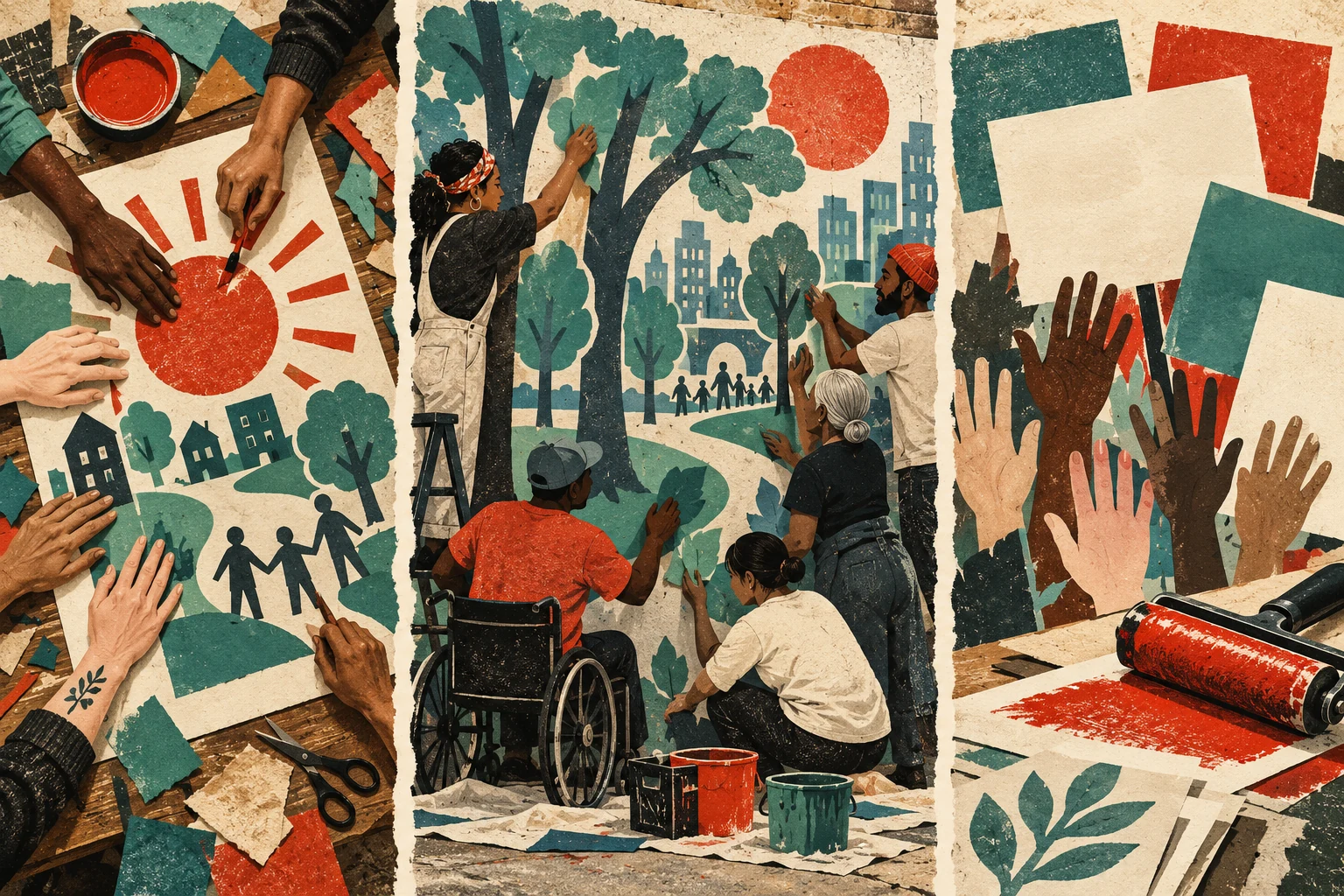
The accompanying AI-generated collage shows hands making posters, neighbours assembling a mural, and blank placards beside a printing roller. Its torn edges and limited red, teal and cream palette suggest reproducible public graphics. It illustrates collaborative making; it does not document a real campaign.
A practice, not a single look
A bold image is not necessarily activism, and a quiet one can be. The relevant context includes who made it, who participates, what situation it addresses and how it circulates. An exhibition object and a cheaply reproduced leaflet may use similar imagery while doing very different work. Treating artivism as an aesthetic preset erases those differences.
In her conversation with Claire Bishop, published by MoMA, Tania Bruguera discusses artivism through social justice and art as an agent of change. Her account is situated in the conditions of her own practice. It offers a useful corrective to the idea that attaching a political slogan to any picture automatically gives it a public effect.
Look at circulation as well as composition
MoMA’s Posters and Activism account of antiapartheid South Africa describes posters, stickers, clothing and other reproducible formats as part of collective political communication. It discusses both commercial-scale printing and collaborative hand printing. The medium mattered because the image needed to travel beyond a gallery wall.
When studying such a work, ask what remains legible across the street, what can be reproduced cheaply, and where a reader can go after seeing it. Colour contrast, size and typography serve those practical conditions. The number of online reactions is a different measure from participation, changed access or a sustained relationship with a community. Decide what success would mean before declaring it.
A current example, and a useful distinction
MoMA lists Yoko Ono’s IMAGINE PEACE installation from September 2026 into spring 2027, connecting it with her long-running use of public messages across multiple formats. This is a documented example of artistic peace activism, not evidence that all artivism should share its visual language. Consult the institution’s current listing for visit dates.
Art about a community, art made with a community and art controlled by that community are different arrangements. Credits, consent, payment and the ability to disagree can matter as much as the finished image. A beautiful campaign that extracts stories while excluding their owners has a problem that no colour adjustment can solve.
Using AI without fabricating participation
AI can help explore layouts or illustrate an idea, but a generated crowd is not evidence that a protest occurred or that a community endorsed a message. Label synthetic scenes, verify any statistics, and keep documentary photographs clearly distinguished from conceptual illustrations. Do not turn invented testimony into a persuasive design element.
For a small exercise, design an invitation to a real, ordinary community activity whose details you can verify. Give the reader one clear next action. Add the final wording in a layout tool so that names, access information and dates remain exact. Then ask an intended reader whether the invitation is understandable. Public usefulness is a more demanding brief than looking revolutionary.