
Design · living forms, flowing structure and an international movement
Art Nouveau sought a new visual language for modern life around the turn of the twentieth century. Flowing lines, stylised natural forms and relationships between structure and decoration are central to many examples. Its ambition can extend from a poster or brooch to a room in which railings, glass, furniture and handles seem to speak to one another.
Creative toolbox · take this style further
Choose an input, adjust it, then open a tool. Search links pass your text to the destination. Copy & open copies it for you to paste into the generator; you start generation there.
ChatGPT
Copy your input and paste it into a ChatGPT conversation or image request.
Copy & open ChatGPT (new tab)Claude · Anthropic
Develop an image prompt or explore the style in a new Claude conversation.
Copy & open Claude · Anthropic (new tab)Midjourney
Paste your input into the Imagine bar on the Create page.
Copy & open Midjourney (new tab)Adobe Firefly
Copy your input, open Firefly, and paste it into the prompt field.
Copy & open Adobe Firefly (new tab)Leonardo.Ai
Copy your input, open Leonardo, and paste it into the generation field.
Copy & open Leonardo.Ai (new tab)Lexica
Search AI images and prompts using your selected input.
Search with this input Lexica (new tab)Pexels
Search the photo and video library. Short keywords often work best.
Search with this input Pexels (new tab)Pixabay
Search photos, illustrations and other images.
Search with this input Pixabay (new tab)Unsplash
Search photographs using the style name or your own keywords.
Search with this input Unsplash (new tab)Wikipedia
Search for background reading. A style may not have its own article.
Search with this input Wikipedia (new tab)WikiArt
Copy your input into WikiArt’s search to explore artists and artworks.
Copy & open WikiArt (new tab)Instagram hashtags
Search a hashtag made from your input: spaces and punctuation are removed. Instagram may require sign-in.
Search with this input Instagram hashtags (new tab)A closer look
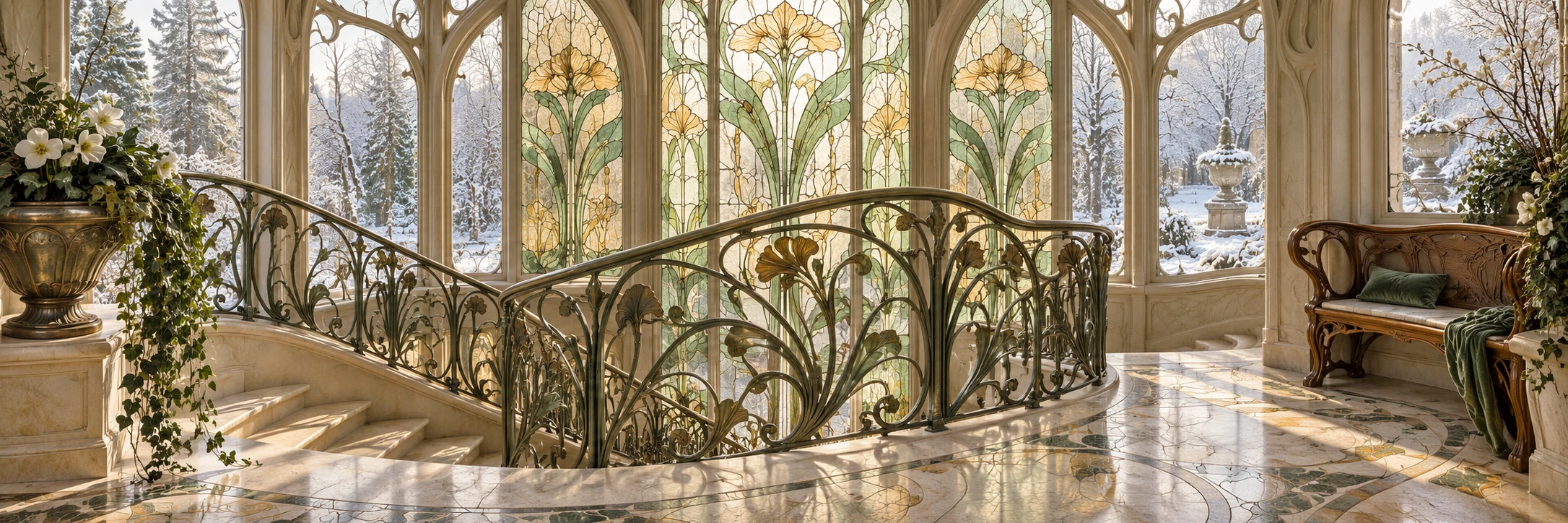
The original AI banner imagines a winter garden with botanical ironwork, coloured glass and a curved bench. It is a contemporary design fantasy rather than a photograph of a real building. The illustration explores continuity of line; it does not establish that the proposed structure could be built.
An international movement with local differences
The V&A describes Art Nouveau as an international development with distinct regional expressions. Its account connects the French name with Siegfried Bing’s Paris gallery and discusses designers including Émile Gallé, Louis Majorelle, Victor Horta and Henry van de Velde. Natural forms and flowing lines coexist with more geometric tendencies. [1]
This variety matters. Not every work is asymmetrical, not every surface carries flowers and not every colour scheme is soft or muted. A useful guide identifies the particular design’s organising idea rather than imposing the same curling border on everything made around 1900.
The term also needs a historical boundary. An image made today can explore Art Nouveau devices without becoming an authentic period object. That distinction leaves plenty of room for invention while keeping dates, materials and attribution clear.
Follow the line between object and setting
Choose one curve and see where it leads. Does a stem-like railing become a structural division in the glass? Does a chair back repeat the rhythm of a doorway? Such connections can make ornament feel integral rather than attached after the functional object has been designed.
The V&A discusses Horta’s buildings as integrated works in which elements from banisters to handles participate in the decorative scheme. This provides a specific historical example of coordination across scales. It does not imply that every Art Nouveau object belongs to a perfectly unified interior. [1]
In our banner, the ironwork provides the main movement and the glass offers a slower echo. The bench should feel related without copying every curve. Repetition is strongest when it develops an idea rather than multiplying an identical flourish.
Nature is a starting point, not a tracing assignment
Look at how a plant grows, bends or branches before drawing a decorative leaf. A useful abstraction may retain the rhythm of growth while changing the proportions dramatically. The resulting line can organise a frame, divide a surface or connect several objects.
Negative space is crucial. An elegant curve can produce a cramped, awkward pocket beside it. Examine the empty shapes between stems and supports, especially where several lines meet. If those spaces read clearly, the ornament is more likely to remain intelligible at a small scale.
Keep Art Nouveau distinct from Art Deco while allowing comparison. Both can stylise nature and use geometry. The difference is not settled by counting curved and straight lines; examine the object’s date, context and treatment of the relationship between ornament and form.
Design one family of related elements
For an exercise, invent a window, a chair back and a small border using one branching rule. Change the scale and material while preserving the rule’s character. Start with silhouettes so that elaborate surface texture cannot conceal a weak structure.
When using AI, specify the relationships you want across the ensemble. Inspect joints, supports and the transition between glass and frame. A beautiful generated railing may divide into unsupported fragments, and a convincing chair may have decorative legs that never meet its seat.
Treat the result as a concept until its construction is resolved. A successful study should retain a sense of growth even after the floral details are simplified. Let the line organise the experience, rather than asking flowers to rescue an unrelated collection of objects.
A small poetic detour
Original words from the AOI studio.
Poetry
A stem becomes a stair;
the window learns its curve.
The prompt workshop
Original creative exercises. These prompts create new illustrations, not documentary evidence.
Connect line and object
Original Art Nouveau-inspired window and bench concept sharing a branching line rhythm, pale green and amber glass, clear negative spaces, no copied historic building or lettering.
Original AOI exercise; a generated image is not historical or documentary evidence.
Develop an interior
An imagined winter garden with sinuous iron balustrade, botanical stained glass and a curving wooden bench, coordinated motifs across scales, luminous daylight, a design fantasy rather than a buildable plan.
Original AOI exercise; a generated image is not historical or documentary evidence.
Simplify the growth
Create a window, chair back and border from one invented branching rule. Compare a richly ornamented version with a simplified silhouette and check that their family resemblance survives.
Original AOI exercise; a generated image is not historical or documentary evidence.
People & works to explore
References discussed in this article. Consult the sources below for context.
Artists and practitioners
Victor Horta
Henry van de Velde
Émile Gallé
Louis Majorelle
Paintings and other works
Victor Horta, Hôtel Tassel — discussed in the V&A overview
Louis Majorelle, cabinet, about 1900 — V&A