
Painting · gesture, matter and postwar abstraction
Art Informel names a varied field of postwar abstraction in which gesture, staining and the behaviour of materials can take priority over a predetermined geometric scheme. The surface becomes a place where actions remain visible. Informal does not mean careless: an apparently spontaneous painting may depend on difficult choices about density, interruption and restraint.
Creative toolbox · take this style further
Choose an input, adjust it, then open a tool. Search links pass your text to the destination. Copy & open copies it for you to paste into the generator; you start generation there.
ChatGPT
Copy your input and paste it into a ChatGPT conversation or image request.
Copy & open ChatGPT (new tab)Claude · Anthropic
Develop an image prompt or explore the style in a new Claude conversation.
Copy & open Claude · Anthropic (new tab)Midjourney
Paste your input into the Imagine bar on the Create page.
Copy & open Midjourney (new tab)Adobe Firefly
Copy your input, open Firefly, and paste it into the prompt field.
Copy & open Adobe Firefly (new tab)Leonardo.Ai
Copy your input, open Leonardo, and paste it into the generation field.
Copy & open Leonardo.Ai (new tab)Lexica
Search AI images and prompts using your selected input.
Search with this input Lexica (new tab)Pexels
Search the photo and video library. Short keywords often work best.
Search with this input Pexels (new tab)Pixabay
Search photos, illustrations and other images.
Search with this input Pixabay (new tab)Unsplash
Search photographs using the style name or your own keywords.
Search with this input Unsplash (new tab)Wikipedia
Search for background reading. A style may not have its own article.
Search with this input Wikipedia (new tab)WikiArt
Copy your input into WikiArt’s search to explore artists and artworks.
Copy & open WikiArt (new tab)Instagram hashtags
Search a hashtag made from your input: spaces and punctuation are removed. Instagram may require sign-in.
Search with this input Instagram hashtags (new tab)A closer look
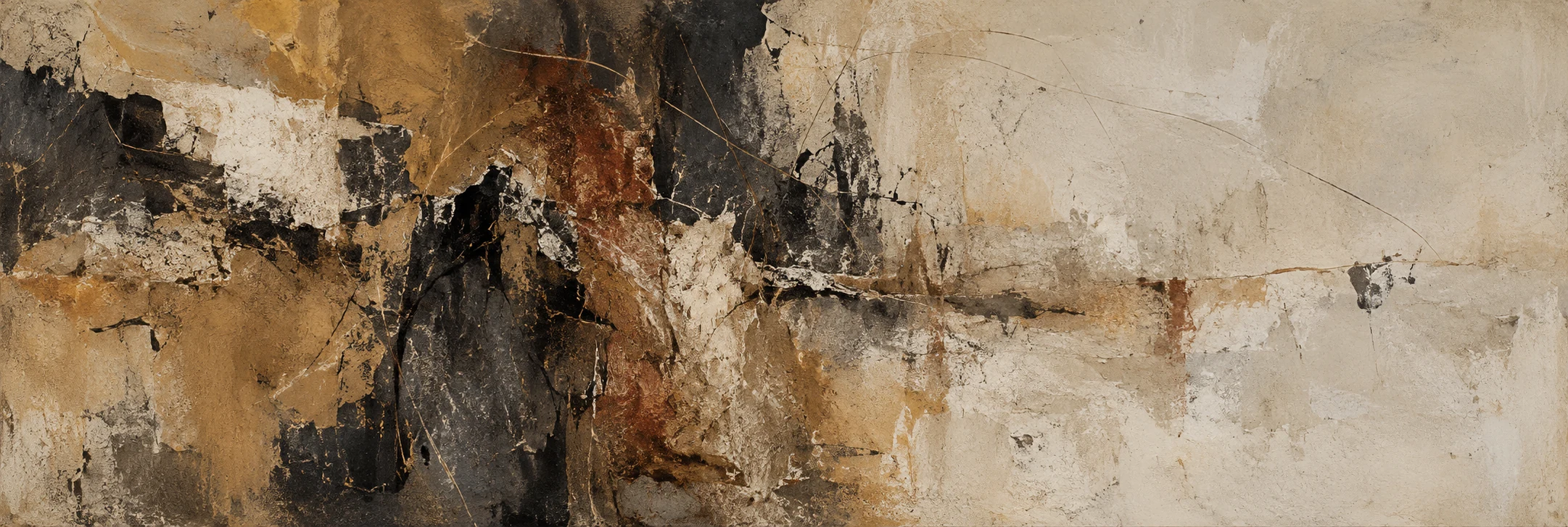
Our AI-generated banner imagines an abstract surface of ochre, charcoal and chalk-like passages, with scratches and quieter intervals. These textures are depicted in a digital image. They are not evidence of an actual layered painting or of the physical process that the image suggests.
A broad context rather than one recipe
The Guggenheim connects Art Informel with critic Michel Tapié’s 1952 project Un Art Autre and a range of artists whose approaches differed considerably. The category is best understood as a field of experimentation, not a single brushstroke that identifies every member. [1]
Guggenheim Bilbao’s discussion of Antoni Tàpies places his work within postwar informal abstraction and explains the importance of unconventional materials. Its account of Great Painting, 1958, describes a rough surface associated with the appearance of a marked wall. This offers one specific material practice within the larger field. [2]
Tachisme is a related term often discussed through stains and spots. Abstract Expressionism provides another important comparison, but shared gesture does not make the histories identical. When possible, move from the umbrella label to a named work, its date and its actual materials.
What happened on this surface?
Look for evidence of different actions: a stain spreading, a mark dragged through wet material, a scrape exposing what lies beneath. Then consider their order. A line crossing a patch may feel later than that patch; a covered mark can suggest revision or resistance.
This is a method of looking, not permission to invent the artist’s exact movements. A photograph may obscure the sequence, and a digital reproduction cannot reveal every material fact. Use the museum record to distinguish what is documented from what the surface leads you to imagine.
In the banner, the concentrated darker region and the lighter open passage create unequal pressures. That imbalance gives the eye somewhere to begin and somewhere to rest. If every part carried the same density of incident, the surface would become a texture sample rather than a developing encounter.
Structure can emerge without a grid
A painting can organise itself through repeated gestures, changes of scale or the distribution of heavy and light passages. None requires a visible geometric framework. The absence of a recognisable object also does not remove the need for relationships between marks.
Try describing a passage with verbs before naming a mood: gathering, thinning, cutting, covering, dissolving. These observations are more precise than declaring that all rough abstraction expresses anger. A vigorous mark might feel playful in one context and obstructive in another.
Material appearance deserves equal attention. A dry edge, glossy pool and granular patch imply different behaviours. In an actual work those differences may be physical; in an AI image they are simulated. The distinction changes what can reasonably be claimed about the viewer’s encounter.
Make a study that knows when to stop
Choose a small support, a limited palette and two contrasting actions. For example, spread one broad passage and interrupt it with a few narrow marks. Pause between stages. Photograph or sketch each state so that you can compare what the additions improve and what they merely fill.
For AI-assisted work, describe an organising tension rather than requesting maximum texture. Ask for concentrated matter against an open area, or a few incised traces against broad stains. Reject results in which every square centimetre has identical artificial distress.
Finally, examine the quietest area. Does it support the more active marks, or has it become an accidental gap? An effective study allows incident and restraint to depend on each other. The surface should invite sustained looking, not simply advertise that something energetic happened.
A small poetic detour
Original words from the AOI studio.
Poetry
Under the scrape, another decision;
beside the stain, enough silence.
The prompt workshop
Original creative exercises. These prompts create new illustrations, not documentary evidence.
Give texture a structure
Original nonfigurative painting study with concentrated ochre and charcoal matter beside a quieter pale area, a few incised traces, varied density, no copied artwork or writing.
Original AOI exercise; a generated image is not historical or documentary evidence.
Describe the actions
An invented Art Informel-informed surface suggesting broad stains, dragged paint and selective scraping, warm earth pigments and chalk white, deliberate open intervals, AI depiction rather than a physical painting.
Original AOI exercise; a generated image is not historical or documentary evidence.
Compare restraint
Generate two abstract studies with the same palette: one densely worked throughout, one with a large quiet passage. Compare the route of attention and retain only marks that establish a relationship.
Original AOI exercise; a generated image is not historical or documentary evidence.
People & works to explore
References discussed in this article. Consult the sources below for context.
Artists and practitioners
Antoni Tàpies
Wols
Jean Fautrier
Jean Dubuffet
Paintings and other works
Antoni Tàpies, Great Painting (Gran Pintura), 1958
Sources and further exploration
Creative studies to try
Explore these collected prompts as creative interpretations. They are starting points for image-making, not reproductions of historical artworks or evidence about a tradition.
Visual cues: gesture, splatter, pressure, emotional mark-making; Unplanned gesture and richly worked matter
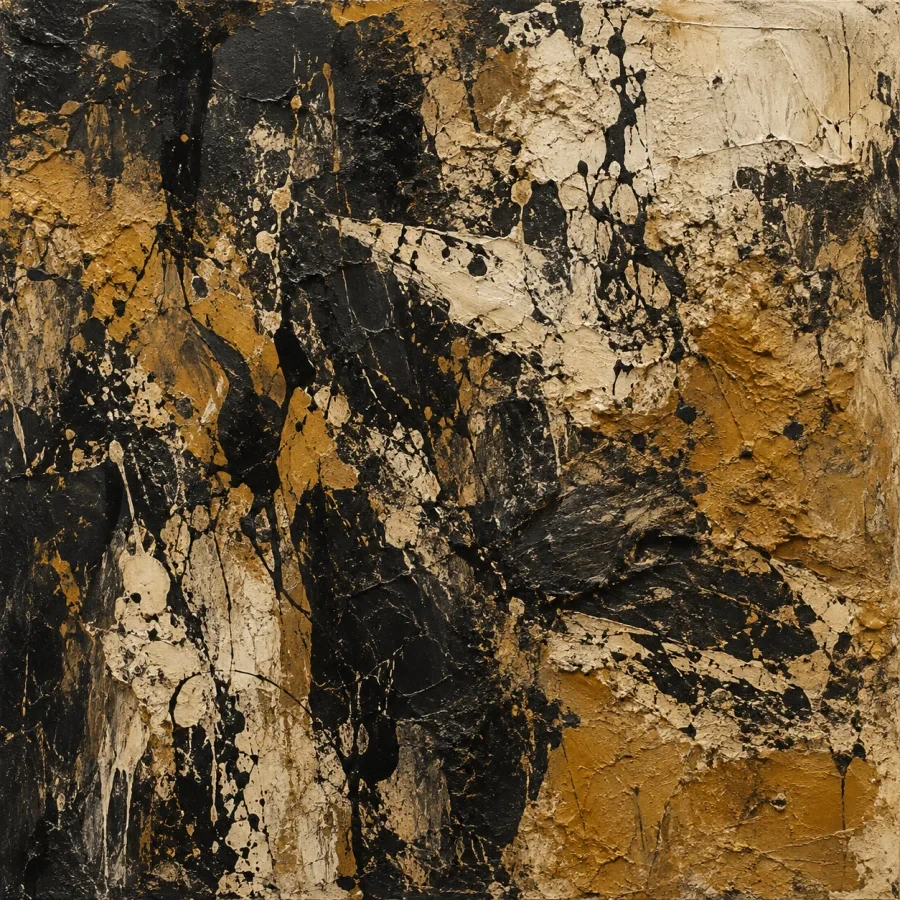
Study 1 — Art Informel
Ultra-wide panoramic banner, a human hand and a sleek robotic hand reaching toward each other, fingertips almost touching, a bright luminous spark of intelligence between them, a subtle world map behind them with global data network lines, symbolizing human-AI collaboration and digital transformation, rendered in Art Informel style, with refined composition, distinctive materials, elegant lighting, high-detail artistic finish, high quality, high detail, balanced composition, no text, no logo, no watermark, exact aspect ratio 1584:396
Prompt source: 1001 Art Styles. Select the text to copy, then adapt the subject and composition.
Study 2 — Art Informel
Apply the following visual approach to my subject or project, preserving its core content and purpose. Dissolve forms into spontaneous marks, dense pigment, irregular texture, and shifting material fields with no rigid geometric framework. Treat this as a contemporary interpretation, not a historical artifact. Adapt the composition to my subject. Do not add text unless my project calls for it.
Prompt source: Emergent Mind Style Atlas. Select the text to copy, then adapt the subject and composition.