
A fictional visual premise · self-portrait and catastrophe
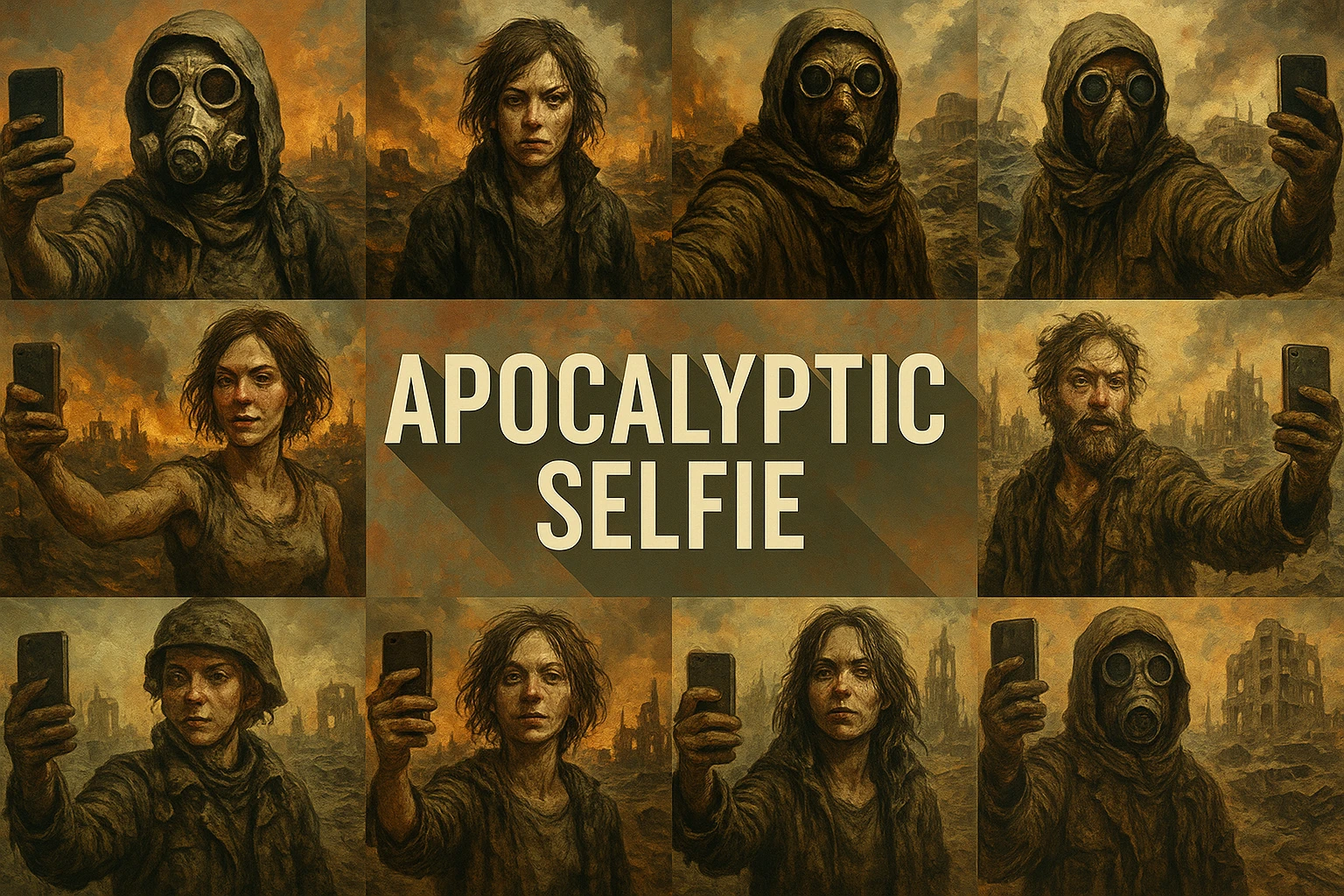
Apocalyptic Selfie places the intimate conventions of a self-portrait against an imagined disaster. AOI treats it as a visual storytelling premise, not a documented historical movement with an established founder.
An A⊕I –[-.+] creαt¡ve c⊕ncept, n⊕t αn estαbl¡she∂ h¡st⊕r¡cαl m⊕vement.
A visual introduction
Select an image for a closer look. Use the thumbnails, arrow keys or a swipe to compare examples. Zoom in to inspect details, or share the image that inspires you.
Creative toolbox · take this style further
Choose an input and a destination. Search sends your words to the chosen site; Copy & open puts them on your clipboard to paste there.
Create with AI
Turn your chosen input into an image prompt or a new creative direction.
ChatGPT
Copy your input and paste it into a ChatGPT conversation or image request.
Copy & open ChatGPT (new tab)Claude · Anthropic
Develop an image prompt or explore the style in a new Claude conversation.
Copy & open Claude · Anthropic (new tab)Midjourney
Paste your input into the Imagine bar on the Create page.
Copy & open Midjourney (new tab)Adobe Firefly
Copy your input, open Firefly, and paste it into the prompt field.
Copy & open Adobe Firefly (new tab)Leonardo.Ai
Copy your input, open Leonardo, and paste it into the generation field.
Copy & open Leonardo.Ai (new tab)Image search
Find visual references. Short, concrete keywords usually work best.
Lexica
Search AI images and prompts using your selected input.
Search with this input Lexica (new tab)Pexels
Search the photo and video library. Short keywords often work best.
Search with this input Pexels (new tab)Pixabay
Search photos, illustrations and other images.
Search with this input Pixabay (new tab)Unsplash
Search photographs using the style name or your own keywords.
Search with this input Unsplash (new tab)Wikimedia Commons
Search photographs, artworks and historical images. Check each file for its source and reuse terms.
Search with this input Wikimedia Commons (new tab)Art & research
Explore artists, collections and the ideas behind a style.
Wikipedia
Search for background reading. A style may not have its own article.
Search with this input Wikipedia (new tab)WikiArt
Copy your input into WikiArt’s search to explore artists and artworks.
Copy & open WikiArt (new tab)Europeana
Paste your keywords into the search to explore European museum, library and archive collections.
Copy & open Europeana (new tab)Inspiration
Discover portfolios and visual ideas from creative communities.
Instagram hashtags
Search a hashtag made from your input: spaces and punctuation are removed. Instagram may require sign-in.
Search with this input Instagram hashtags (new tab)ArtStation
Paste your input into artwork search for concept art, environments, characters and visual development.
Copy & open ArtStation (new tab)Behance
Paste your input into project search for illustration, design and visual storytelling.
Copy & open Behance (new tab)A closer look
A close foreground face, an arm or reflected device, and a readable environmental event compete for attention; perspective and lighting must connect both scales.
The contrast is the subject
A selfie makes the photographer’s presence part of the picture. An imagined apocalypse puts that self-presentation under pressure: what does the person notice, and what remains outside their attention? The premise becomes interesting when the relationship is specific. A cheerful pose, a distracted glance or a practical attempt to record evidence tells a different story against the same background.
This is AOI’s working interpretation of a descriptive label. It has no verified founding date or unified historical membership. The examples should be understood as fictional image-making exercises, not evidence of an actual event.
Keep the camera physically intelligible
Decide whether the image comes from a front-facing phone, a reflection or another person photographing the act. Each option produces different evidence about the camera’s position. A visible device, extended arm and viewpoint should agree rather than imply several incompatible cameras.
Give the foreground and background a common light source. If the horizon is bright, consider how it affects the face, hair and nearby surfaces. A dramatic background pasted behind an unrelated portrait weakens the scene even when each part looks convincing separately.
Show consequences at more than one scale
Choose one large environmental change and one small consequence close to the subject: an interrupted journey and a dust-covered sleeve, or rising water and an abandoned bag. Avoid filling the distance with every disaster symbol at once. Specific evidence gives the viewer something to connect.
The person’s expression need not explain the entire scene. An uncertain gesture can leave room for interpretation, while exaggerated panic may overwhelm the quieter tension between self-image and surroundings.
Test what the frame leaves out
Make a tight portrait crop and a wider version of the same fictional moment. Compare how much the environmental information changes the meaning of the pose. Let the wider view reveal a relationship, not simply more spectacle.
Use invented people and places, and label the work as staged or generated fiction. Do not present a convincing disaster image as current reportage. The retained AOI illustration is a creative interpretation of this premise.
The prompt workshop
Original creative exercises. These prompts create new illustrations, not documentary evidence.
Quiet interruption
A fictional adult taking a self-portrait at an empty station while distant lights go out, restrained expression, consistent phone-camera viewpoint, believable shared lighting; clearly fictional scene.
Two scales
An invented adult reflected in a shop window, a dusty sleeve in the foreground and an abandoned futuristic street beyond, one coherent reflection and readable camera position.
Change the crop
Create a fictional self-portrait scene in which a wide crop reveals a flooded empty street while a tight crop shows only a calm face; maintain the same pose and light in both.