
Historical painting · walls, rooms and pictorial space
Roman wall painting can imitate costly materials, open imaginary vistas or frame delicate scenes on a flat field. The surviving evidence invites a study of the whole room, not only isolated decorative fragments.
A visual introduction
Select an image for a closer look. Use the thumbnails, arrow keys or a swipe to compare examples. Zoom in to inspect details, or share the image that inspires you.
Creative toolbox · take this style further
Choose an input and a destination. Search sends your words to the chosen site; Copy & open puts them on your clipboard to paste there.
Create with AI
Turn your chosen input into an image prompt or a new creative direction.
ChatGPT
Copy your input and paste it into a ChatGPT conversation or image request.
Copy & open ChatGPT (new tab)Claude · Anthropic
Develop an image prompt or explore the style in a new Claude conversation.
Copy & open Claude · Anthropic (new tab)Midjourney
Paste your input into the Imagine bar on the Create page.
Copy & open Midjourney (new tab)Adobe Firefly
Copy your input, open Firefly, and paste it into the prompt field.
Copy & open Adobe Firefly (new tab)Leonardo.Ai
Copy your input, open Leonardo, and paste it into the generation field.
Copy & open Leonardo.Ai (new tab)Image search
Find visual references. Short, concrete keywords usually work best.
Lexica
Search AI images and prompts using your selected input.
Search with this input Lexica (new tab)Pexels
Search the photo and video library. Short keywords often work best.
Search with this input Pexels (new tab)Pixabay
Search photos, illustrations and other images.
Search with this input Pixabay (new tab)Unsplash
Search photographs using the style name or your own keywords.
Search with this input Unsplash (new tab)Wikimedia Commons
Search photographs, artworks and historical images. Check each file for its source and reuse terms.
Search with this input Wikimedia Commons (new tab)Art & research
Explore artists, collections and the ideas behind a style.
Wikipedia
Search for background reading. A style may not have its own article.
Search with this input Wikipedia (new tab)WikiArt
Copy your input into WikiArt’s search to explore artists and artworks.
Copy & open WikiArt (new tab)Europeana
Paste your keywords into the search to explore European museum, library and archive collections.
Copy & open Europeana (new tab)Inspiration
Discover portfolios and visual ideas from creative communities.
Instagram hashtags
Search a hashtag made from your input: spaces and punctuation are removed. Instagram may require sign-in.
Search with this input Instagram hashtags (new tab)ArtStation
Paste your input into artwork search for concept art, environments, characters and visual development.
Copy & open ArtStation (new tab)Behance
Paste your input into project search for illustration, design and visual storytelling.
Copy & open Behance (new tab)A closer look
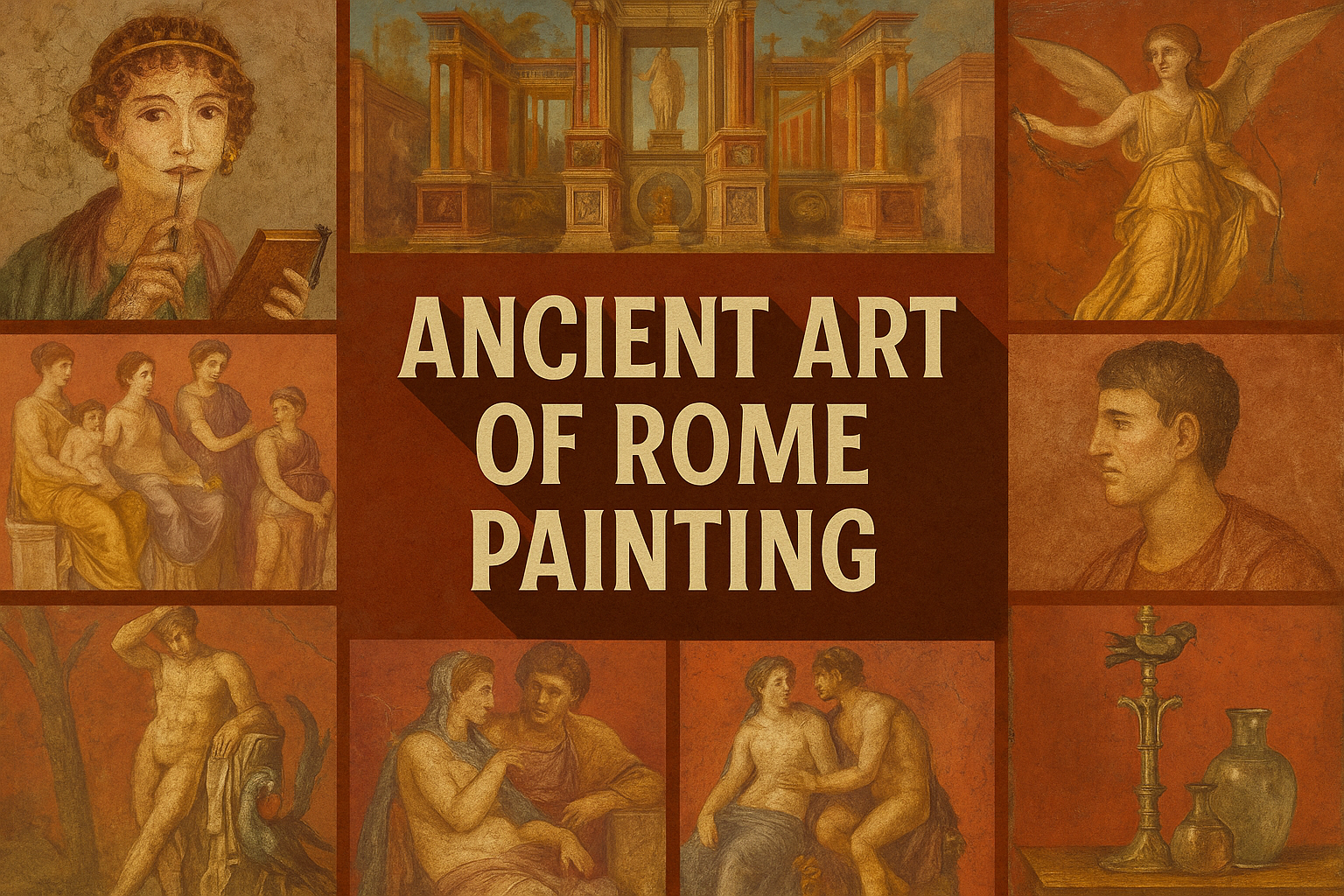
Compare simulated masonry, architectural depth, slender ornamental divisions and framed scenes; use the relationship between wall and illusion as the main design decision.
A surviving wall is part of a larger room
Much familiar evidence for Roman painting comes from wall decoration. A panel’s scale, height and relationship to neighboring walls affect how it is seen. The modern display of a fragment can make a decorative passage look like an independent easel painting, so consult the record of its original setting where available.
Preservation is uneven. Surviving colors, missing areas and later reconstructions should not be treated as a complete picture of ancient appearance. A digital restoration needs to distinguish documented portions from proposed additions.
Four styles are a useful framework, not a rigid timetable
The Met’s study of Pompeian frescoes explains August Mau’s influential four-style classification and notes the qualifications introduced by later research. Broadly, First Style decoration simulates costly masonry; Second Style imagery develops architectural illusion; Third Style emphasizes delicate ornament and framed imagery on flatter fields; Fourth Style recombines devices in more elaborate arrangements.
These are analytical categories. They are not rules requiring every room to belong neatly to one stage, and they do not exhaust Roman painting across all places and periods.
Decide whether the wall opens or holds
Open Yale’s discussion of Third and Fourth Style painting contrasts the illusion of deep space with the emphatic flatness and slender ornament of other schemes. For a design exercise, make two versions of a room wall. In one, painted architecture suggests a view beyond it. In the other, a broad color field supports a small central scene.
Keep the room’s actual doors, corners and viewing position in mind. Imaginary architecture becomes more persuasive when its relationship to those real features is deliberate. Conversely, a flat scheme can gain strength by clearly accepting the wall as a surface.
Build hierarchy before adding aged texture
Choose a lower zone, a principal field and an upper division, then test their proportions with simple color blocks. Place the main image where it can be read within that hierarchy. Fine ornament should reinforce the organization rather than compete equally in every region.
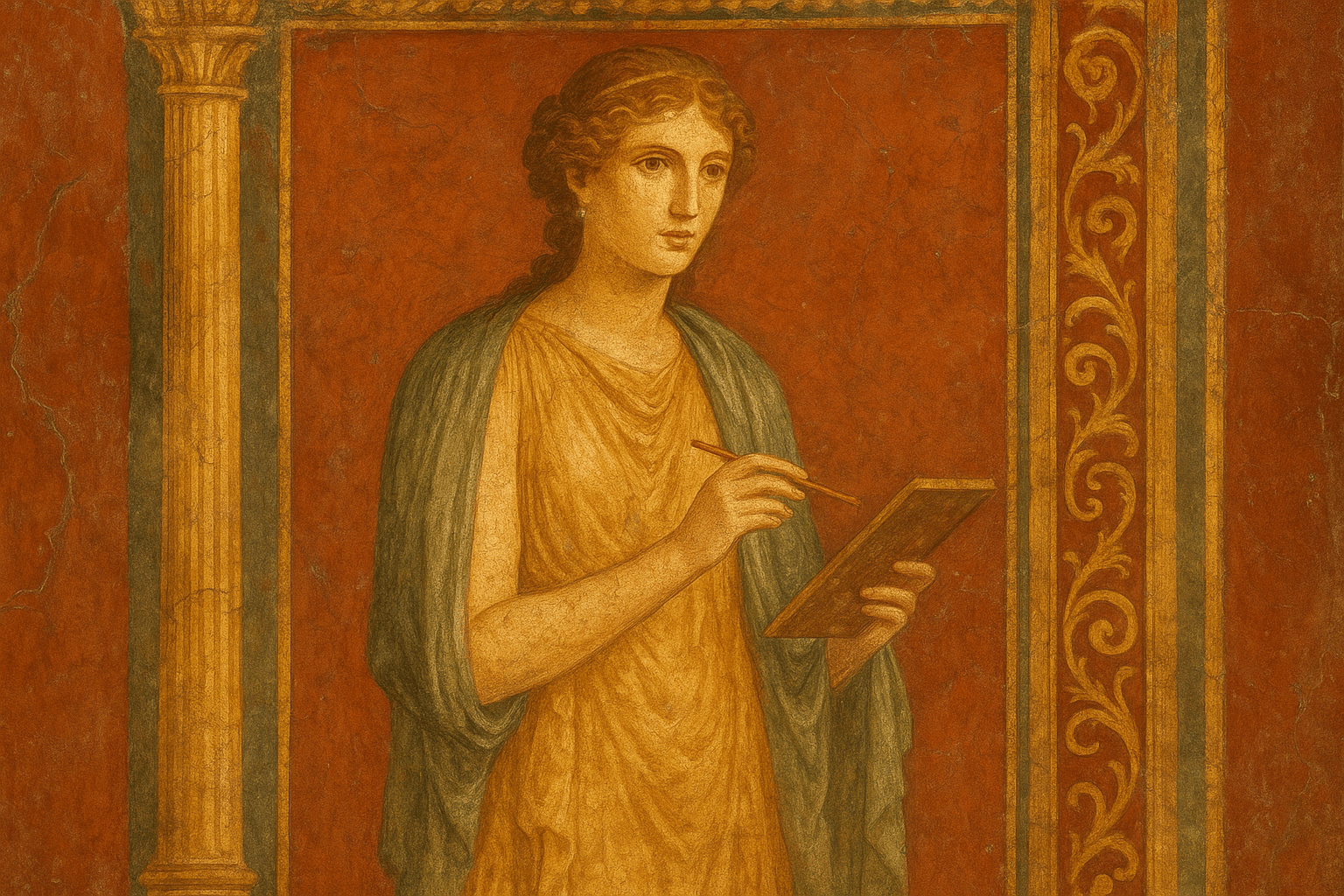
For an original digital study, avoid using cracks and faded pigment as the only signs of historical reference. The composition should work before artificial aging is applied. Label invented rooms and restored fragments as interpretations; the AOI illustrations are not excavation photographs or newly documented Roman murals.
The prompt workshop
Original creative exercises. These prompts create new illustrations, not documentary evidence.
Open the wall
Design an invented Roman-inspired interior mural with coherent architectural vistas, clear room corners and restrained colors; a contemporary proposal, not an archaeological reconstruction.
Hold the surface
Create a contrasting mural proposal with a broad dark red field, delicate vertical divisions and one small central invented landscape, emphasizing the wall’s flatness.
Compare the room
Show two studies of the same simple room, one using painted architectural depth and the other flat ornamental fields; identical viewpoint and furniture, no fake historical labels.
Sources and further exploration
The Met: Pompeian Frescoes, classification and later qualifications