
Historical overview · ancient Greek art
Ancient Greek art encompasses changing practices across pottery, sculpture, metalwork and architecture. Read objects through their date, place, material and use rather than reducing them to white marble and idealized bodies.
A visual introduction
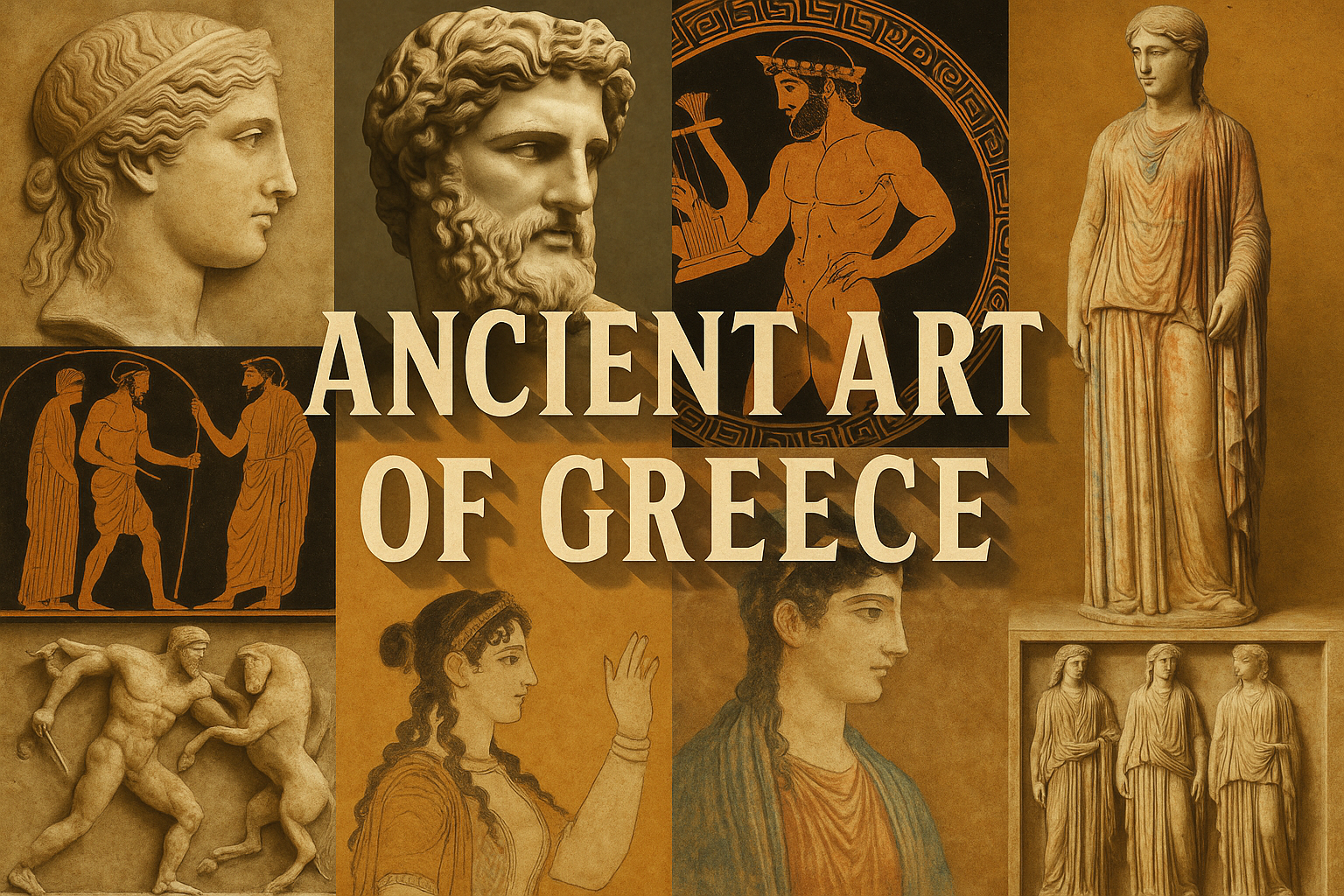
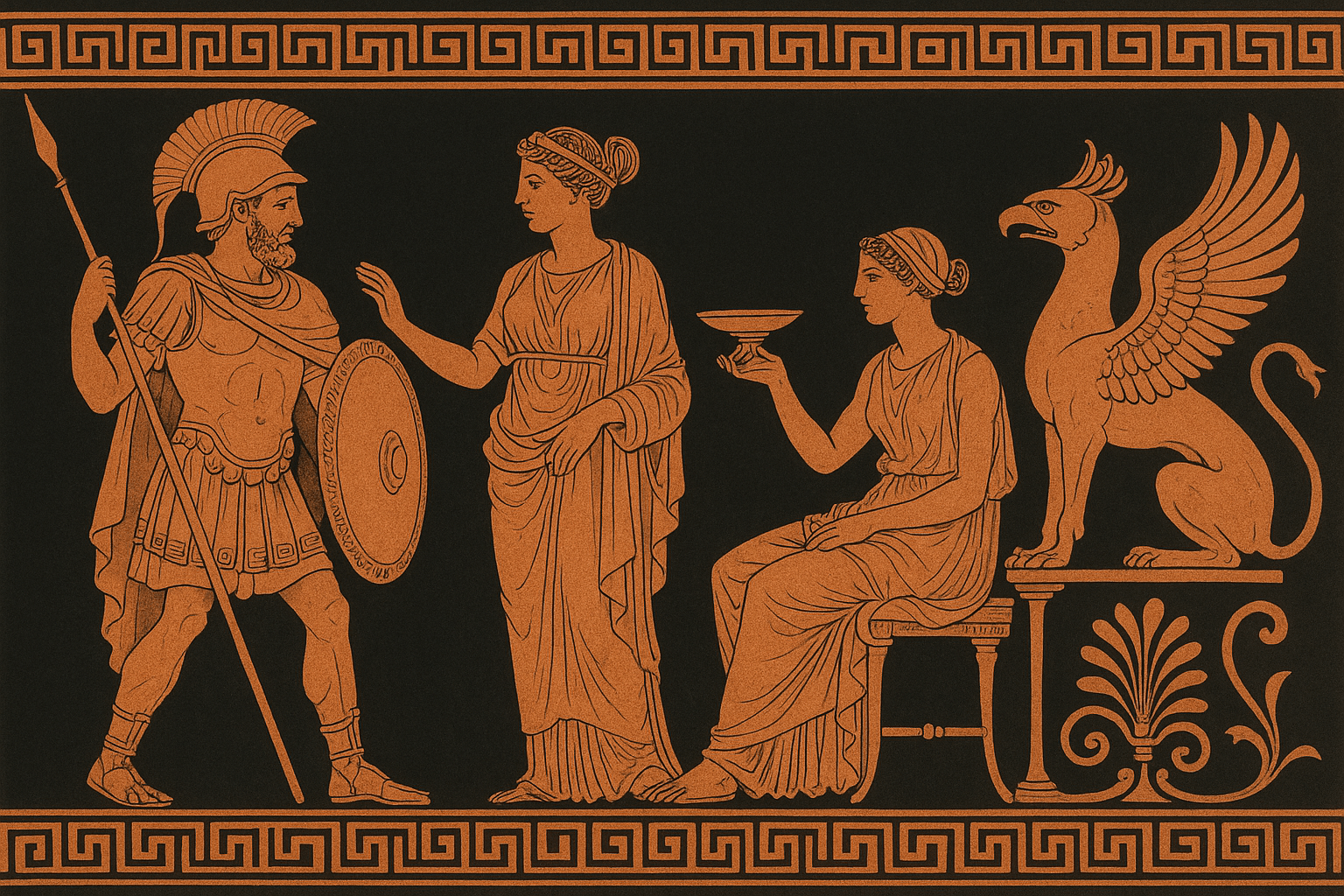
Select an image for a closer look. Use the thumbnails, arrow keys or a swipe to compare examples. Zoom in to inspect details, or share the image that inspires you.
Creative toolbox · take this style further
Choose an input and a destination. Search sends your words to the chosen site; Copy & open puts them on your clipboard to paste there.
Create with AI
Turn your chosen input into an image prompt or a new creative direction.
ChatGPT
Copy your input and paste it into a ChatGPT conversation or image request.
Copy & open ChatGPT (new tab)Claude · Anthropic
Develop an image prompt or explore the style in a new Claude conversation.
Copy & open Claude · Anthropic (new tab)Midjourney
Paste your input into the Imagine bar on the Create page.
Copy & open Midjourney (new tab)Adobe Firefly
Copy your input, open Firefly, and paste it into the prompt field.
Copy & open Adobe Firefly (new tab)Leonardo.Ai
Copy your input, open Leonardo, and paste it into the generation field.
Copy & open Leonardo.Ai (new tab)Image search
Find visual references. Short, concrete keywords usually work best.
Lexica
Search AI images and prompts using your selected input.
Search with this input Lexica (new tab)Pexels
Search the photo and video library. Short keywords often work best.
Search with this input Pexels (new tab)Pixabay
Search photos, illustrations and other images.
Search with this input Pixabay (new tab)Unsplash
Search photographs using the style name or your own keywords.
Search with this input Unsplash (new tab)Wikimedia Commons
Search photographs, artworks and historical images. Check each file for its source and reuse terms.
Search with this input Wikimedia Commons (new tab)Art & research
Explore artists, collections and the ideas behind a style.
Wikipedia
Search for background reading. A style may not have its own article.
Search with this input Wikipedia (new tab)WikiArt
Copy your input into WikiArt’s search to explore artists and artworks.
Copy & open WikiArt (new tab)Europeana
Paste your keywords into the search to explore European museum, library and archive collections.
Copy & open Europeana (new tab)Inspiration
Discover portfolios and visual ideas from creative communities.
Instagram hashtags
Search a hashtag made from your input: spaces and punctuation are removed. Instagram may require sign-in.
Search with this input Instagram hashtags (new tab)ArtStation
Paste your input into artwork search for concept art, environments, characters and visual development.
Copy & open ArtStation (new tab)Behance
Paste your input into project search for illustration, design and visual storytelling.
Copy & open Behance (new tab)A closer look
Compare patterned vessels, sculpted bodies and architectural settings; identify the material, scale and viewing conditions before borrowing a visual device.
Begin with a period and an object
Ancient Greek art is a broad historical field. Geometric, Archaic, Classical and Hellenistic are useful period labels, but they do not describe one continuous march toward a single perfect style. Workshops, patrons, regions, materials and functions complicate any simple progression.
The Met’s account of Geometric art discusses monumental pottery, small bronze figures and objects used in funerary or sanctuary settings. Repeated bands and schematic figures belong to carefully organized objects with particular uses. They should not be dismissed as unfinished steps toward later naturalism.
Material and function change the composition
A painted vessel asks the viewer to read an image around a curved body. A freestanding figure can be approached from several directions. Sculpture attached to a building responds to a specific architectural position and viewing distance. These differences shape what artists emphasize and what viewers can see.
For a comparative study, choose one documented vessel and one documented sculpture. Record where the main action sits, how empty space separates forms, and how scale affects detail. Compare those observable decisions before interpreting a gesture or identifying a mythological subject.
White marble is an incomplete historical picture
The Cambridge Museum of Classical Archaeology explains the evidence for color on Greek sculpture and the uncertainty involved in reconstructing its appearance. Its painted Peplos Kore cast is an interpretation based on evidence available when it was made, not an exact recovery of every original hue.
This distinction matters for digital images. A convincing colored reconstruction is still a proposal unless its details are grounded in documented analysis. Label invented color schemes and restored missing parts clearly.
Translate a relationship rather than a stereotype
Design a new vessel-shaped composition with one principal scene and two subordinate pattern bands. Let the curvature and handles affect the arrangement. Alternatively, study how a standing figure distributes weight without copying a particular surviving statue.
Keep the exercise contemporary and identify its chosen reference. Avoid assembling columns, armor and decorative motifs from unrelated periods and presenting the result as a precise ancient setting. The retained AOI illustrations are creative interpretations; collection records provide the evidence for historical objects.
The prompt workshop
Original creative exercises. These prompts create new illustrations, not documentary evidence.
Read a curved surface
Create an original vessel-shaped design study with a clear central gathering, two geometric border bands and compositions adjusted around the handles; contemporary interpretation, no invented museum label.
Observe weight
Draw an original standing adult figure with a clear weight-bearing leg and balanced counter-movement, simple lighting and three different viewpoints; anatomical study, not a replica of an ancient statue.
Compare color hypotheses
Make two explicitly hypothetical color studies of the same invented classical-inspired sculptural form, with a neutral third view; keep the geometry identical and label reconstructions separately in the final layout.