
Painting · facets, shallow space and sustained looking
Analytical Cubism reorganises recognisable things into interlocking planes and partial clues. A bottle, instrument or figure may seem to dissolve, yet fragments continue to suggest its structure. The challenge is not to decorate a subject with triangles. It is to make the act of examining that subject visible within a single, deliberately unsettled image.
Creative toolbox · take this style further
Choose an input, adjust it, then open a tool. Search links pass your text to the destination. Copy & open copies it for you to paste into the generator; you start generation there.
ChatGPT
Copy your input and paste it into a ChatGPT conversation or image request.
Copy & open ChatGPT (new tab)Claude · Anthropic
Develop an image prompt or explore the style in a new Claude conversation.
Copy & open Claude · Anthropic (new tab)Midjourney
Paste your input into the Imagine bar on the Create page.
Copy & open Midjourney (new tab)Adobe Firefly
Copy your input, open Firefly, and paste it into the prompt field.
Copy & open Adobe Firefly (new tab)Leonardo.Ai
Copy your input, open Leonardo, and paste it into the generation field.
Copy & open Leonardo.Ai (new tab)Lexica
Search AI images and prompts using your selected input.
Search with this input Lexica (new tab)Pexels
Search the photo and video library. Short keywords often work best.
Search with this input Pexels (new tab)Pixabay
Search photos, illustrations and other images.
Search with this input Pixabay (new tab)Unsplash
Search photographs using the style name or your own keywords.
Search with this input Unsplash (new tab)Wikipedia
Search for background reading. A style may not have its own article.
Search with this input Wikipedia (new tab)WikiArt
Copy your input into WikiArt’s search to explore artists and artworks.
Copy & open WikiArt (new tab)Instagram hashtags
Search a hashtag made from your input: spaces and punctuation are removed. Instagram may require sign-in.
Search with this input Instagram hashtags (new tab)A closer look
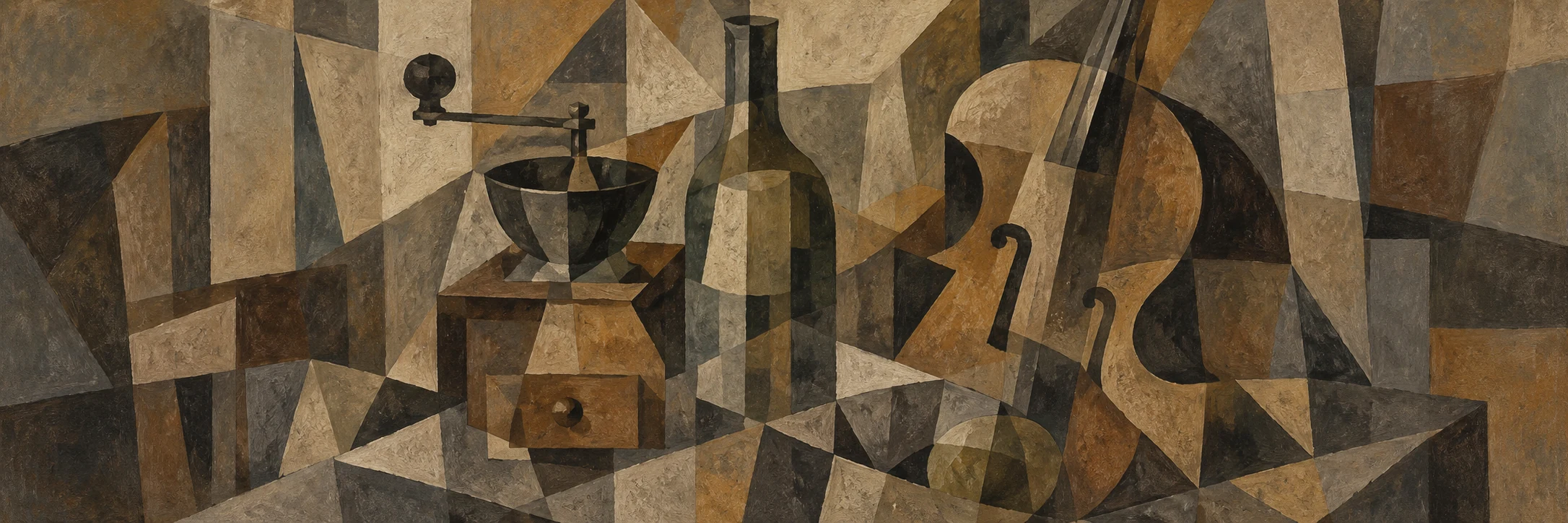
The original AI banner offers an invented still life of a grinder, bottle and string instrument. Muted planes share edges across objects and background. It is a contemporary formal exercise, not a recovered Cubist work or a demonstration that a model understands three-dimensional structure.
What the analytical phase describes
The Met identifies an Analytic phase around 1910–12 in which Picasso and Braque used overlapping planes and a restricted range of browns, greys and blacks. The term describes a particularly concentrated moment in Cubism; its boundaries should not be treated as a switch that every painting obeyed on the same day. [1]
Rather than preserving a stable outline around each object, these pictures make contours provisional. A small curve might suggest a glass rim; a diagonal may serve an object and the space beside it. Recognition arrives in pieces, and the viewer participates in assembling a reading.
That uncertainty is purposeful. It differs from an accidental tangle in which no relationship can be followed. A strong study balances enough evidence to invite recognition with enough disruption to keep the viewer examining how the image has been built.
Facets need relationships, not just quantity
Start with a familiar object and identify its important changes of direction. A shoulder, neck, opening and base give a bottle an intelligible structure. Decide which clues to retain, then let surrounding planes echo or interrupt them. The object should create pressure on the composition even when its outline disappears.
A narrow palette helps neighbouring shapes interact without every fragment announcing itself through a different colour. Value shifts can suggest a turn of surface, but they need not resolve into conventional illumination. Watch how dark accents gather attention and how quiet passages allow the eye to move.
In the banner, the intended comparison is between recognisable object clues and planes that continue into the setting. Do not judge it simply by how broken it looks. Ask where your reading begins, where it becomes uncertain and which mark lets you recover the subject.
Analytical is not the whole of Cubism
Synthetic Cubism is associated with a subsequent emphasis on constructed signs, broader shapes and collage. The Met’s account discusses the introduction of pasted materials in 1912. These distinctions help explain changing artistic problems; they should not become a claim that every work fits an airtight visual checklist. [1]
A brightly coloured polygon portrait can be attractive without being a useful example of Analytical Cubism. Digital low-poly graphics, shattered-glass effects and decorative geometric mosaics use different organising ideas. Name the actual effect when it explains the image more accurately.
Similarly, describing several viewpoints is only a starting explanation. A picture is not a mechanical record of walking around an object. Its planes, marks and intervals are decisions made on a flat surface. Look at that surface as carefully as you look for the thing it suggests.
A practical exercise in partial recognition
Arrange two simple objects and draw them conventionally first. Then make a second study that keeps only five useful clues. Connect the remaining space with a small family of angles, and limit the darkest marks. Compare whether the composition still offers a route through the objects.
For generated imagery, describe the relation between figure and ground, the restrained palette and the retained clues. Avoid relying on the word cubist alone. Reject results that merely overlay a complete realistic subject with an unrelated mesh of lines; the structure should change with the fragmentation.
Finally, return to the unfragmented drawing. What did the analytical exercise make you notice about the object that you previously ignored? If the answer is only that triangles are fashionable, simplify and look again. The reward is a more demanding form of attention.
A small poetic detour
Original words from the AOI studio.
Poetry
A rim survives the broken room;
the bottle returns one edge at a time.
The prompt workshop
Original creative exercises. These prompts create new illustrations, not documentary evidence.
Keep a few clues
Original Analytical Cubism-inspired still life of a bottle and coffee grinder, interlocking shallow planes, partial contours, restrained ochre-grey palette, object and background sharing edges, no text.
Original AOI exercise; a generated image is not historical or documentary evidence.
Develop the structure
An invented still life with a string instrument, bottle and grinder analysed into related facets; small curved clues retain recognition, overlapping planes compress depth, selective dark accents and quiet intervals, visible oil-paint texture, no reproduction.
Original AOI exercise; a generated image is not historical or documentary evidence.
Compare recognition
Create two analytical still-life studies with the same objects and limited palette. Retain many object clues in the first and only five in the second; preserve a coherent rhythm of planes rather than applying a random polygon filter.
Original AOI exercise; a generated image is not historical or documentary evidence.
People & works to explore
References discussed in this article. Consult the sources below for context.
Artists and practitioners
Georges Braque
Pablo Picasso
Paintings and other works
Analytic Cubist paintings by Braque and Picasso, especially around 1910–12