
Art history · expressive figuration, with a focus on Boston
American figurative expressionism describes practices that retain recognizable bodies and subjects while transforming them through expressive colour, drawing and paint. The figure can become a vehicle for social criticism, spiritual inquiry, memory or intimate observation. Boston Expressionism offers a particularly well-documented route into the subject, but it should not stand in for every expressive figurative practice in the United States.
Creative toolbox · take this style further
Choose an input and a destination. Search sends your words to the chosen site; Copy & open puts them on your clipboard to paste there.
Create with AI
Turn your chosen input into an image prompt or a new creative direction.
ChatGPT
Copy your input and paste it into a ChatGPT conversation or image request.
Copy & open ChatGPT (new tab)Claude · Anthropic
Develop an image prompt or explore the style in a new Claude conversation.
Copy & open Claude · Anthropic (new tab)Midjourney
Paste your input into the Imagine bar on the Create page.
Copy & open Midjourney (new tab)Adobe Firefly
Copy your input, open Firefly, and paste it into the prompt field.
Copy & open Adobe Firefly (new tab)Leonardo.Ai
Copy your input, open Leonardo, and paste it into the generation field.
Copy & open Leonardo.Ai (new tab)Image search
Find visual references. Short, concrete keywords usually work best.
Lexica
Search AI images and prompts using your selected input.
Search with this input Lexica (new tab)Pexels
Search the photo and video library. Short keywords often work best.
Search with this input Pexels (new tab)Pixabay
Search photos, illustrations and other images.
Search with this input Pixabay (new tab)Unsplash
Search photographs using the style name or your own keywords.
Search with this input Unsplash (new tab)Wikimedia Commons
Search photographs, artworks and historical images. Check each file for its source and reuse terms.
Search with this input Wikimedia Commons (new tab)Art & research
Explore artists, collections and the ideas behind a style.
Wikipedia
Search for background reading. A style may not have its own article.
Search with this input Wikipedia (new tab)WikiArt
Copy your input into WikiArt’s search to explore artists and artworks.
Copy & open WikiArt (new tab)Europeana
Paste your keywords into the search to explore European museum, library and archive collections.
Copy & open Europeana (new tab)Inspiration
Discover portfolios and visual ideas from creative communities.
Instagram hashtags
Search a hashtag made from your input: spaces and punctuation are removed. Instagram may require sign-in.
Search with this input Instagram hashtags (new tab)ArtStation
Paste your input into artwork search for concept art, environments, characters and visual development.
Copy & open ArtStation (new tab)Behance
Paste your input into project search for illustration, design and visual storytelling.
Copy & open Behance (new tab)A closer look
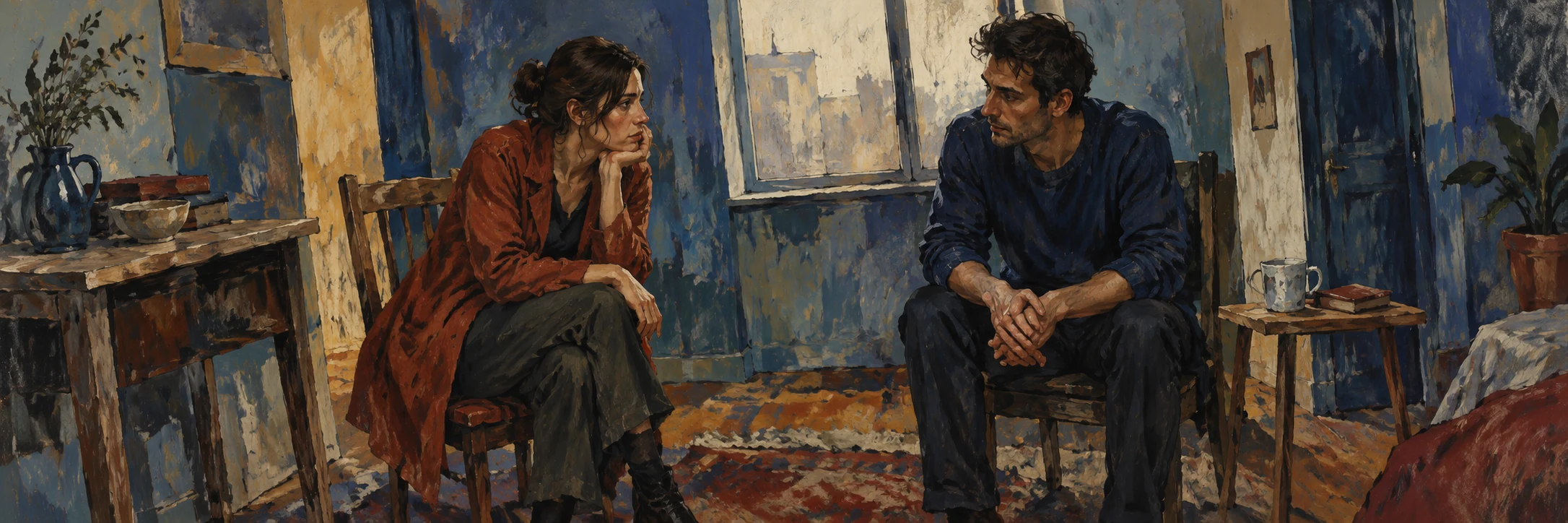
The original banner stages two fictional adults in a compressed room. Tilted architectural planes, uneven contours and warm-cool colour tensions make the space emotionally charged without depicting a violent event. Their relationship remains open to interpretation. This is a contemporary AI study, not a reconstruction of a historical painting or a portrait of identified people.
Keep the figure; change its terms
Figurative does not mean photographically exact. A recognizable body may be stretched, compressed, partially dissolved or outlined with unusual insistence. What matters is that its presence remains active in the image: distortion changes how we encounter a person or scene.
Expressionist does not simply mean colourful. A muted drawing can be intensely expressive through its pressure, scale and intervals. Conversely, a brightly painted figure may remain conventional in its handling of space and gesture.
The term is also not a synonym for Abstract Expressionism. Individual artists and works can cross those categories, but a list of famous abstract painters does not explain the particular histories of expressive figuration. Begin with a documented work and ask what its figure is doing.
Boston supplies a concrete historical context
Danforth Art Museum describes Boston Expressionism as a significant strand in its collection, connecting its emergence in the late 1930s through the 1950s with European Expressionism and Symbolism. Its account emphasizes figurative work and personal, religious and mystical concerns, and notes Karl Zerbe’s teaching connections at the School of the Museum of Fine Arts. [1]
The collection also gives the subject names beyond a generic list of modern masters, including Barbara Swan, Hyman Bloom and Karl Zerbe. These artists need not share one palette or one attitude for their work to enter a useful historical conversation. [1]
Treat Boston as a specific context of artists, institutions and exchanges. It helps replace the idea that expressive American painting followed one inevitable route toward the disappearance of the figure. It does not create a complete map of national practice.
Different purposes produce different figures
The Museum of Fine Arts, Boston, presents Hyman Bloom’s commitment to figurative painting alongside his investigations of the body, mortality and spiritual significance. Its account describes rich colour and thick paint as part of a practice that can unsettle ordinary expectations of beauty. Those subjects should be approached in their particular context, not reduced to a mood of generalized anguish. [2]
Jack Levine offers a different emphasis. The Smithsonian’s biographical account identifies The Feast of Pure Reason (1937) as a satire of Boston political power. Here a figure can carry social observation and criticism, rather than serve only as an image of inward feeling. [3]
Compare the questions these examples invite. What is the body made to reveal? Who is being observed, and from what position? A distorted face or compressed room can do different work depending on the subject and the artist’s choices.
Read the space between people
Begin with posture and distance before naming an emotion. Does a body face another body, turn away or meet the viewer? Are the figures given room to move, or pressed against the picture surface? These are observable relationships; a definitive story about their feelings may be your interpretation.
In our banner, the tilted room and unequal intervals contribute to tension. The figures do not need exaggerated facial expressions to make the encounter feel unresolved. Colour and architecture participate in the relationship.
Notice what remains stable when a contour breaks. A shoulder, a chair or the direction of a gaze can anchor the scene. Purposeful distortion usually becomes more legible when the viewer has some structure against which to read it.
An original study without a borrowed identity
Draw or generate two fictional adults sharing an ordinary room. Keep the activity simple. Make one version with ample space and another with compressed distances, holding the main poses constant. Compare how much of the emotional effect comes from the room itself.
For AI work, inspect hands, body continuity, furniture connections and unintended caricature. Distortion should support a chosen relationship rather than conceal accidental anatomy. Do not attach a real person’s biography or a medical interpretation to an invented face.
A figure can remain recognizable without becoming fully explainable. Let the image carry an encounter, and leave viewers room to test their own reading against what is actually there.
Distortion should affect a relationship
Choose what is being intensified: the distance between two people, the weight of a seated body or the pressure of a room around a figure. Then alter proportion, colour or edge handling in support of that relationship. Stretching every form equally can erase the very contrast that makes the distortion meaningful.
Keep the pose intelligible enough for the viewer to understand the action. Expressive anatomy is a deliberate transformation of structure, not a reason to overlook an accidental extra limb or an impossible joint in a generated study.
Compare two emotional readings of one arrangement
Use the same figures and furnishings in two versions. Give one ample surrounding space and the other a compressed field with sharper colour contrasts. Describe the observable changes before naming an emotion. This exercise makes interpretation accountable to the image and leaves room for different viewers to respond differently to the same formal evidence.
A small poetic detour
Original words from the AOI studio.
Poetry
Two chairs keep their distance.
The wall leans into the conversation.
Neither face explains the room.
The prompt workshop
Original creative exercises. These prompts create new illustrations, not documentary evidence.
Start with an encounter
Paint two fictional clothed adults seated in a modest room, recognizable bodies, uneven expressive contours, restrained ochre and deep-blue palette. Suggest an unresolved encounter through distance and posture, without caricature.
Original AOI exercise; a generated image is not historical or documentary evidence.
Let the room participate
Compress the same room with slightly tilted planes and varied paint density. Preserve coherent bodies and furniture while using architecture and colour to create tension. Do not imitate an existing painting.
Original AOI exercise; a generated image is not historical or documentary evidence.
Compare the interval
Repeat the scene with more space between the figures and calmer architectural angles. Keep poses and palette similar. Compare how the interval changes your reading of the relationship.
Original AOI exercise; a generated image is not historical or documentary evidence.
People & works to explore
References discussed in this article. Consult the sources below for context.
Artists and practitioners
Hyman Bloom — figurative and spiritual inquiry
Jack Levine — social satire
Karl Zerbe — Boston Expressionist practice and teaching
Barbara Swan — represented in Danforth’s Boston Expressionism collection
Paintings and other works
The Feast of Pure Reason (Jack Levine, 1937)
Archaic Figure (Karl Zerbe), Danforth collection