
Painting approach · forceful gesture, tension and revision
Aggressive expressive oil painting describes a way of handling paint, not a separate historical school. Forceful strokes, compressed space, abrupt colour changes and interrupted contours can make an image feel urgent. Yet urgency is an effect to construct, not proof that the artist was angry or that the painting was completed in a single emotional burst.
Creative toolbox · take this style further
Choose an input and a destination. Search sends your words to the chosen site; Copy & open puts them on your clipboard to paste there.
Create with AI
Turn your chosen input into an image prompt or a new creative direction.
ChatGPT
Copy your input and paste it into a ChatGPT conversation or image request.
Copy & open ChatGPT (new tab)Claude · Anthropic
Develop an image prompt or explore the style in a new Claude conversation.
Copy & open Claude · Anthropic (new tab)Midjourney
Paste your input into the Imagine bar on the Create page.
Copy & open Midjourney (new tab)Adobe Firefly
Copy your input, open Firefly, and paste it into the prompt field.
Copy & open Adobe Firefly (new tab)Leonardo.Ai
Copy your input, open Leonardo, and paste it into the generation field.
Copy & open Leonardo.Ai (new tab)Image search
Find visual references. Short, concrete keywords usually work best.
Lexica
Search AI images and prompts using your selected input.
Search with this input Lexica (new tab)Pexels
Search the photo and video library. Short keywords often work best.
Search with this input Pexels (new tab)Pixabay
Search photos, illustrations and other images.
Search with this input Pixabay (new tab)Unsplash
Search photographs using the style name or your own keywords.
Search with this input Unsplash (new tab)Wikimedia Commons
Search photographs, artworks and historical images. Check each file for its source and reuse terms.
Search with this input Wikimedia Commons (new tab)Art & research
Explore artists, collections and the ideas behind a style.
Wikipedia
Search for background reading. A style may not have its own article.
Search with this input Wikipedia (new tab)WikiArt
Copy your input into WikiArt’s search to explore artists and artworks.
Copy & open WikiArt (new tab)Europeana
Paste your keywords into the search to explore European museum, library and archive collections.
Copy & open Europeana (new tab)Inspiration
Discover portfolios and visual ideas from creative communities.
Instagram hashtags
Search a hashtag made from your input: spaces and punctuation are removed. Instagram may require sign-in.
Search with this input Instagram hashtags (new tab)ArtStation
Paste your input into artwork search for concept art, environments, characters and visual development.
Copy & open ArtStation (new tab)Behance
Paste your input into project search for illustration, design and visual storytelling.
Copy & open Behance (new tab)A closer look
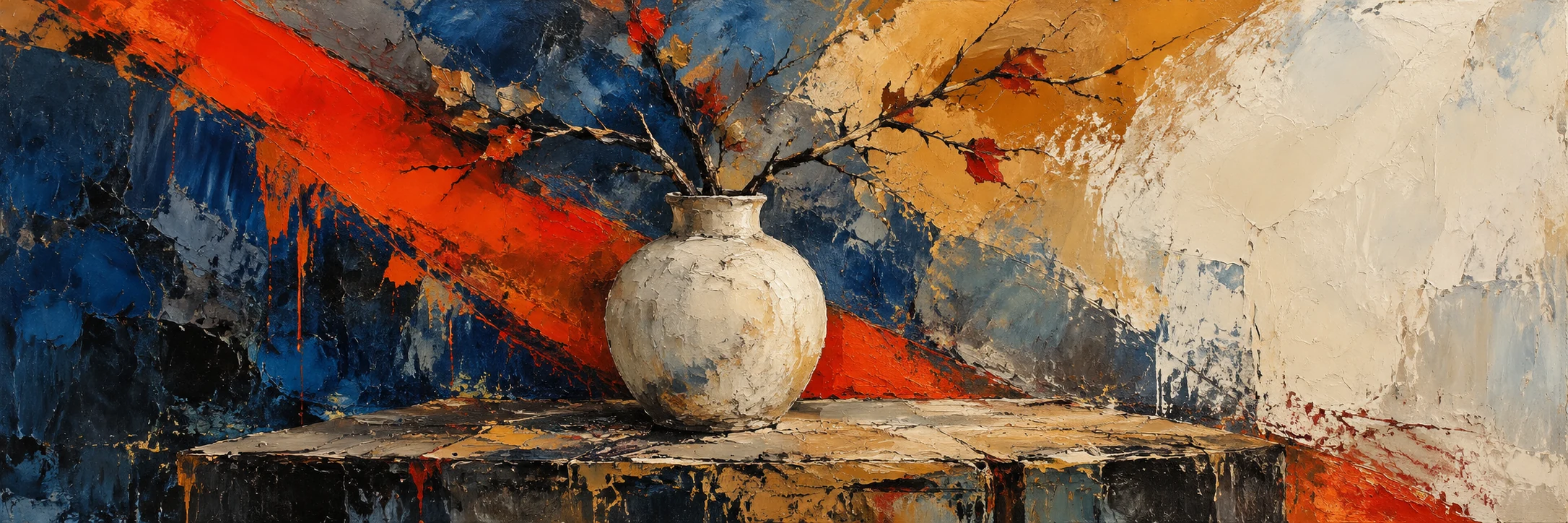
Our banner turns an ordinary vessel and branching form into a field of opposing forces. Dark blue passages resist vermilion and ochre strokes; scraped and thick-looking areas interrupt one another. A quieter interval keeps the energetic surface readable. The image simulates paint handling digitally and is not a physical oil painting.
Intensity is not a biography
A viewer can describe a mark as abrupt, heavy or agitated without knowing the maker’s emotional state. Keep that distinction intact. Reading every distorted shape as evidence of personal suffering reduces a complex artistic decision to a diagnosis the image cannot establish.
This descriptive category can draw questions from expressionist and gestural painting, but those histories are not interchangeable. A work may use vigorous marks while remaining a carefully observed still life; another may flatten and distort a figure to challenge an inherited convention.
Nor does “aggressive” require a violent subject. A vase, an empty chair or a line of trees can support a forceful composition. The pressure lies in relationships between marks, colours and shapes, not in the severity of the depicted event.
A spontaneous appearance may take sustained work
MoMA dates Willem de Kooning’s Woman I to 1950–1952 and identifies its medium as oil and metallic paint on canvas. Its account describes preliminary studies, repeated repainting and the scraping down of sections. The apparently immediate surface emerged through extended revision. [1]
The museum also records controversy around the painting’s representation of a woman. Its force should therefore be considered alongside its subject and reception, rather than celebrated as neutral brushwork detached from what it depicts. A historical example offers questions to investigate, not a formula to copy. [1]
Vincent van Gogh’s Wheatfield with Crows (1890) supplies a different case. The Van Gogh Museum rejects the familiar claim that it was his final painting. That correction is useful whenever dramatic colour and movement tempt us into repeating an irresistible story as fact. [2]
Build pressure through contrast
Begin with a limited set of directional forces. A broad horizontal can resist a rising diagonal; a stable dark mass can interrupt short bright strokes. If every mark moves at the same speed and receives equal emphasis, intensity becomes a uniform texture.
Vary the edges. A sharp break can attract attention, while a partly lost contour lets one shape merge with another. In an expressive still life, the vessel should remain sufficiently coherent for its disruption to register. Without some underlying structure, the viewer has little against which to feel the pressure.
Colour can work similarly. Reserve the strongest saturation for selected areas and give it quieter neighbours. Black is not compulsory, and a pale painting can be forceful. The practical question is which contrast carries the argument.
Surface, revision and the digital imitation of both
Impasto means raised, thickly applied paint. A screen image can suggest its ridges and shadows but cannot supply that material relief. In a physical painting, surface changes with viewpoint and illumination; in a generated illustration, those effects are represented inside a flat image.
Plan a revision pass rather than demanding maximum energy everywhere. Simplify one area, strengthen one directional stroke and remove a competing accent. Photograph stages if you want to compare decisions. Revision can preserve vitality while giving it a clearer structure.
For AI work, describe the subject, dominant directions, palette and variation of paint handling. Inspect whether the supposed strokes respond to forms or merely coat the image with a repeated texture. Label the result as a digital interpretation rather than a handmade oil original.
An exercise in restraint
Make two studies of the same plain object. In the first, allow forceful marks across the whole surface. In the second, concentrate them around one structural conflict and leave a substantial quiet passage.
Compare where your attention returns. The stronger image may be the one that appears to do less. Expressive force needs resistance; a painting cannot shout meaningfully if every centimetre shouts at once.
Give different marks different responsibilities
Choose a small vocabulary of marks before beginning: one broad stroke for weight, one narrow stroke for interruption and one scraped or wiped passage for revision. Assign each a role in the composition. A forceful image becomes more articulate when its marks disagree in useful ways rather than all shouting at the same volume.
Keep a structural landmark intact, such as a shoulder line, a table edge or the outline of a central vessel. That stable element helps the viewer read surrounding distortions as intentional pressure. Without it, energetic handling may become an unresolved field.
Stop before texture becomes the subject by accident
Photograph or save an intermediate state with fewer marks. Compare it to the later version at thumbnail size. If the action was clearer before, restore the larger relationship and keep only the surface changes that intensify it. A convincing expressive painting can contain very quiet passages; those intervals give abrupt marks their force.
A small poetic detour
Original words from the AOI studio.
Poetry
One stroke leans forward.
The quiet patch refuses to move.
Between them, a painting.
The prompt workshop
Original creative exercises. These prompts create new illustrations, not documentary evidence.
Start with opposing forces
Create an original expressive still life of a plain vessel and a branching form. A stable dark-blue mass opposes diagonal vermilion strokes. Ochre accents, varied edges and one quiet area; no copied artwork.
Original AOI exercise; a generated image is not historical or documentary evidence.
Develop the surface
Interpret the same still life with visibly varied thick and thin paint effects, scraped passages and broken contours. Keep the vessel readable. This is an AI-generated interpretation of oil-paint handling, not a physical painting.
Original AOI exercise; a generated image is not historical or documentary evidence.
Revise for strength
Reduce the busy marks in half the composition while retaining one forceful diagonal. Compare the focal point and sense of pressure with the first study.
Original AOI exercise; a generated image is not historical or documentary evidence.
People & works to explore
References discussed in this article. Consult the sources below for context.
Artists and practitioners
Willem de Kooning — revision and varied paint handling
Vincent van Gogh — a distinct historical example, not a member of an invented school
Paintings and other works
Woman I (1950–1952)
Wheatfield with Crows (1890)