
AOI creative concept · Flowing-line abstraction
Aeonic Line Flow is an imaginary AOI art concept built from continuous, curving lines. Repeated strokes gather into currents, contours and spirals, suggesting time through rhythm rather than depicting a historical period. Use it as a visual brief for drawing and AI image experiments, not as the name of an established movement.
An AOI creative concept, not an established historical movement.
A visual introduction
Open any image to look closer, then browse the examples.

Creative toolbox · take this style further
Choose an input, adjust it, then open a tool. Search links pass your text to the destination. Copy & open copies it for you to paste into the generator; you start generation there.
ChatGPT
Copy your input and paste it into a ChatGPT conversation or image request.
Copy & open ChatGPT (new tab)Claude · Anthropic
Develop an image prompt or explore the style in a new Claude conversation.
Copy & open Claude · Anthropic (new tab)Midjourney
Paste your input into the Imagine bar on the Create page.
Copy & open Midjourney (new tab)Adobe Firefly
Copy your input, open Firefly, and paste it into the prompt field.
Copy & open Adobe Firefly (new tab)Leonardo.Ai
Copy your input, open Leonardo, and paste it into the generation field.
Copy & open Leonardo.Ai (new tab)Lexica
Search AI images and prompts using your selected input.
Search with this input Lexica (new tab)Pexels
Search the photo and video library. Short keywords often work best.
Search with this input Pexels (new tab)Pixabay
Search photos, illustrations and other images.
Search with this input Pixabay (new tab)Unsplash
Search photographs using the style name or your own keywords.
Search with this input Unsplash (new tab)Wikipedia
Search for background reading. A style may not have its own article.
Search with this input Wikipedia (new tab)WikiArt
Copy your input into WikiArt’s search to explore artists and artworks.
Copy & open WikiArt (new tab)Instagram hashtags
Search a hashtag made from your input: spaces and punctuation are removed. Instagram may require sign-in.
Search with this input Instagram hashtags (new tab)A closer look
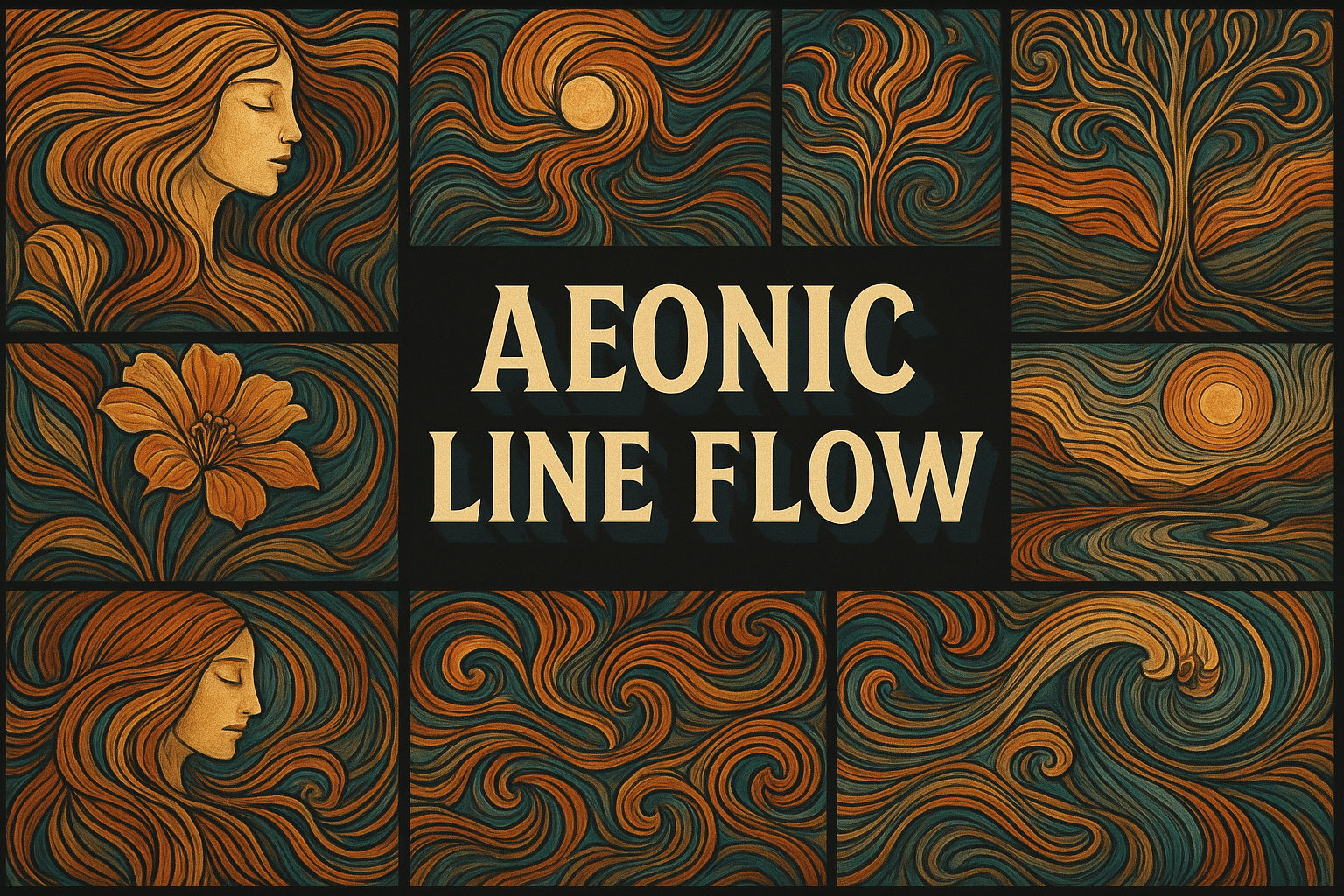
The archive collage uses ochre and orange lines against dark green and black. A face, a flower, a branching tree and curling waves share the same ribbon-like marks. The separate abstract example replaces these recognisable forms with fine blue, green and orange strands. In both, the eye follows a bend, slows where lines crowd together and moves again when the spacing opens.
What the name means here
The name proposes an image of long duration: a line that seems to have travelled before it enters the frame and might continue after it leaves. This is a studio interpretation, not an origin story. Aeonic Line Flow has no verified founding date, school, manifesto or representative artists in the evidence reviewed for this entry. Earlier versions listed speculative names and artwork titles; those unsupported attributions have been removed.
The useful part of the idea is its constraint. Instead of putting a decorative swirl around an otherwise conventional picture, build the picture through the behaviour of its lines. A cheek can emerge from a bend; a flower can open through widening intervals; a wave can gather weight as parallel strokes compress. The line should explain the form. It should not merely decorate it.
Read the collage before borrowing its vocabulary
Look at the upper-left portrait. Its closed eye and gently inclined face create stillness, while the hair continues outward in repeated curves. The movement belongs to the surrounding marks rather than to a dramatic pose. Elsewhere, the same warm lines make a flower and a branching structure. That repetition ties unlike subjects together without requiring them to tell one literal story.
The dark gaps do essential work. They separate adjacent strokes, preserve the silhouette and give the bright curves room to turn. If every gap were filled, the image would become a flat mass of orange. Conversely, if every line had the same width and spacing, the rhythm would become mechanical. A convincing version needs both continuity and interruption: long passages that carry the eye, tighter knots that slow it, and quieter areas that let the composition breathe.
The second archive image shows a different possibility. Thousands of fine strands bend around broad invisible forms. Cool blue edges surround warmer orange passages, producing an impression of currents without a river, face or tree. This is a useful comparison: the concept can organise a recognisable subject or remain entirely abstract. Neither version needs invented ancient symbols to justify its appearance.
Useful comparisons, without an invented lineage
Brush writing offers a way to think about line as a record of movement. The Metropolitan Museum of Art’s Brush and Ink exhibition describes following the gesture preserved in an inked line. Its Chinese Painting and Calligraphy Up Close exhibition emphasises close observation of ink tone, saturation and brushwork. These are useful viewing habits for the present exercise; they are not evidence that Aeonic Line Flow belongs to those traditions.
Calligraphy also involves particular writing systems, histories and practices. An image of decorative curls is not automatically calligraphy, and marks resembling a script should not be presented as meaningful text unless they have been checked. Describe the formal quality you want—tapered strokes, changes in pressure, dry edges, generous intervals—rather than asking for a vague mixture of ancient cultures.
Make the flow earn its place
Start with one dominant direction across the image. Sketch its route before adding detail. Introduce a secondary current only where it changes the balance: a loop around a face, a counter-curve near a tree trunk, or a small eddy at the edge of a broad sweep. Keep enough empty ground that the main route remains legible at thumbnail size.
Choose a limited palette and assign colours a job. A warmer line can mark a turning point; a cooler field can push surrounding strands back. Texture should reinforce the chosen medium. Ink might pool and taper, engraved marks might stay sharper, and digital filaments might retain a controlled glow. Mixing every effect at once usually obscures the structure that made the idea interesting.
For AI image generation, specify the subject, route, line spacing, palette and negative space. The invented style name alone may have little consistent meaning to a model. Judge the result by visible relationships: can you follow a line through the composition, do intersections remain readable, and does the subject still hold together without the attractive colour? Keep the version that answers those questions, rather than the one with the most ornamental adjectives.
Pocket-sized facts
Status: fictional AOI creative concept; no established historical movement is claimed.
Working vocabulary: continuous curves, contour, repetition, density, taper and negative space.
Archive examples: a warm, figurative collage and a cool, abstract field of fine strands.
Historical comparisons below concern ways of looking at line, not the provenance of this invented label.
Technique notes
Hand exercise: draw five parallel curves around a single empty oval. Change their spacing without allowing them to cross. Observe when the oval begins to feel like a solid form.
Revision exercise: view the image in grayscale and at thumbnail size. If its main current disappears, simplify the line network before adding more texture.
Comparison exercise: keep the route and composition fixed while changing only the palette. This isolates the contribution of colour from the contribution of line.
A small poetic detour
Original words from the AOI studio.
Poetry
A line leaves the page.
The space beside it keeps
the shape of its passing.
The prompt workshop
Original creative exercises. These prompts create new illustrations, not documentary evidence.
A portrait carried by its contours
Create an original stylised portrait in the fictional AOI concept Aeonic Line Flow. A calm profile faces right; long tapered ochre lines describe the cheek and continue into flowing hair. Dark forest-green ground, three main bands of movement, clear negative space around the face, restrained paper texture. Keep the eye and mouth simple. No lettering, signature or imitation of an existing artwork.
Review the silhouette first. The hair should extend the facial rhythm rather than overwhelm it.
A current without a river
Create an original abstract composition made from fine parallel blue and teal strands on a nearly black background. A broad S-shaped current crosses the frame; one narrow band turns amber near the centre. Vary spacing to suggest pressure and release. Maintain visible dark intervals and avoid tangled intersections. No text, diagram labels or symbols.
Use one warm accent. Too many bright bands will compete with the principal route.
The same rhythm, another subject
Design a tree whose trunk, branches and surrounding air are described by continuous ribbon-like curves. Use muted terracotta, ochre and deep green, a flat decorative composition, and large areas of quiet ground. The branches should remain readable as branches at small scale. Original fictional style exercise; no artist signature or pseudo-calligraphic writing.
Compare with the portrait: what remains recognisably shared when the subject changes?
A smile from the studio
Jokes
I asked the line where it was going. It said the composition had not approved a destination.