
Broad art term · form, colour and relationships beyond literal depiction
Abstractionism is a broad label for approaches that give shape, colour, line, rhythm or material a degree of independence from literal description. The more usual umbrella term is abstract art. It includes many different histories and intentions, from simplifying an observed subject to organising a work without a recognisable subject at all. It is not one movement with a universal recipe.
A visual introduction
Open any image to look closer, then browse the examples.
Creative toolbox · take this style further
Choose an input, adjust it, then open a tool. Search links pass your text to the destination. Copy & open copies it for you to paste into the generator; you start generation there.
ChatGPT
Copy your input and paste it into a ChatGPT conversation or image request.
Copy & open ChatGPT (new tab)Claude · Anthropic
Develop an image prompt or explore the style in a new Claude conversation.
Copy & open Claude · Anthropic (new tab)Midjourney
Paste your input into the Imagine bar on the Create page.
Copy & open Midjourney (new tab)Adobe Firefly
Copy your input, open Firefly, and paste it into the prompt field.
Copy & open Adobe Firefly (new tab)Leonardo.Ai
Copy your input, open Leonardo, and paste it into the generation field.
Copy & open Leonardo.Ai (new tab)Lexica
Search AI images and prompts using your selected input.
Search with this input Lexica (new tab)Pexels
Search the photo and video library. Short keywords often work best.
Search with this input Pexels (new tab)Pixabay
Search photos, illustrations and other images.
Search with this input Pixabay (new tab)Unsplash
Search photographs using the style name or your own keywords.
Search with this input Unsplash (new tab)Wikipedia
Search for background reading. A style may not have its own article.
Search with this input Wikipedia (new tab)WikiArt
Copy your input into WikiArt’s search to explore artists and artworks.
Copy & open WikiArt (new tab)Instagram hashtags
Search a hashtag made from your input: spaces and punctuation are removed. Instagram may require sign-in.
Search with this input Instagram hashtags (new tab)A closer look
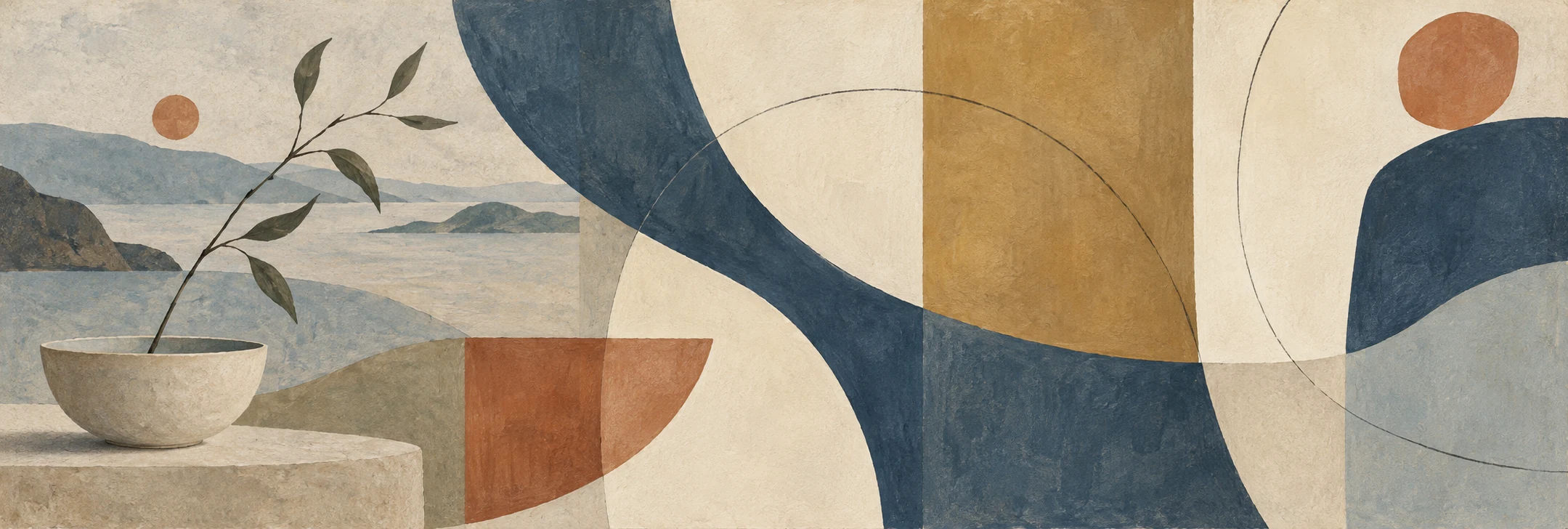
The new banner develops a visual passage from a recognisable vessel and landscape suggestion toward increasingly independent colour shapes. Shared curves and intervals connect the sections. It is an original teaching illustration, not a diagram of art history or a reproduction of a recognised painter’s work.
Abstraction is a range of decisions
A drawing can simplify a tree while remaining recognisably a tree. Another work may offer no stable object to identify. Both can involve abstraction, but in different degrees and with different aims. Ask what has been retained, altered or set aside rather than treating recognition as an all-or-nothing test.
The word “nonobjective” is useful when a work does not set out to represent an external object, although artists and historians do not always use these terms identically. A careful description explains the particular work before relying on a category. “There is no recognisable figure” is an observation; “therefore it means nothing” is an unsupported conclusion.
Nor does abstraction mean the artist abandoned every relationship with the world. Music, architecture, landscape, movement and lived experience can inform a work without appearing as illustrated subjects. The connection may be structural, emotional or conceptual rather than a resemblance.
Two documented works, two kinds of rhythm
MoMA’s account of Piet Mondrian’s Broadway Boogie Woogie (1942–43) connects its segmented grid with the artist’s enthusiasm for New York and boogie-woogie music. The painting’s small blocks and intervals create a rhythm without depicting a street scene. It is a specific example of how an abstract arrangement can remain connected to an experienced world. [1]
The Guggenheim’s teaching guide presents Vasily Kandinsky’s Composition 8 (1923) through circles, lines, geometric forms and their relationships. Compared with Mondrian’s constrained grid, it offers a useful opportunity to examine differences in direction, scale and balance. These two works should not be reduced to the same formula merely because both are abstract. [2]
Look at the museum images before reading further interpretation. Track one line, find the largest quiet area and compare the smallest colour accent with the dominant shape. This sequence gives your response something visible to stand on.
Describe what the work actually does
Begin with scale and placement. A small dark form near an edge behaves differently from the same form in the centre. It may create tension, imply continuation beyond the frame or pull attention away from a larger area. There is no universal rule that the largest object must be the most important.
Then examine edges. Hard boundaries can make shapes feel cut or measured; broken boundaries can suggest touch, weathering or movement. Neither is inherently more expressive. The question is how the edge relates to the rest of the picture.
Colour also acts through relationships. A muted patch can become active beside a neutral field; several brilliant colours can cancel one another’s emphasis. Instead of writing that a painting “uses vibrant colours to evoke emotion,” name the contrast and explain what it makes your eye do.
Avoid the shortcut history
A broad field cannot be explained well by attaching a few famous names to a story about one inventor and one date. Different practices, locations and networks require their own accounts. This entry offers a way into looking; its named examples are not an exhaustive genealogy.
Abstract Expressionism, geometric abstraction and Abstract Illusionism identify more specific contexts or approaches. Use those terms when they clarify the work being discussed. Calling every nonliteral image “Abstract Expressionism” turns a historical label into a synonym for colourful paint.
Our banner demonstrates a possible exercise rather than a necessary progression. The recognisable vessel does not become more advanced or valuable as it becomes less recognisable. Each stage offers a different visual problem.
Make three versions and compare them
Choose a bowl, branch or view through a window. In the first study, preserve its outline but simplify the interior. In the second, retain only three large shapes. In the third, rearrange those shapes according to rhythm rather than resemblance. Keep the palette consistent so that you can judge the structural changes.
With an image model, specify these decisions instead of requesting “abstract art” alone. Review the result at thumbnail size and full size. Identify one relationship worth keeping and one that feels arbitrary. Abstraction becomes more useful when it is a practice of attention rather than permission to stop looking.
A small poetic detour
Original words from the AOI studio.
Poetry
The bowl gives up its name.
A curve remains,
keeping company with blue.
The prompt workshop
Original creative exercises. These prompts create new illustrations, not documentary evidence.
Start from observation
Create an original still-life study of a bowl and a branch using only five large flat shapes and a restrained blue, ochre and ivory palette. Preserve the important intervals; no lettering.
Original AOI exercise; a generated image is not historical or documentary evidence.
Let the shapes act
Rearrange the same five shapes into a nonliteral composition. Balance one large quiet field with smaller active forms; vary edges and scale intentionally. Do not imitate a named artwork.
Original AOI exercise; a generated image is not historical or documentary evidence.
Compare the decisions
Produce three studies of the same subject: simplified observation, reduced geometry, and independent colour rhythm. Keep palette and aspect ratio constant. Describe what each version retains and changes.
Original AOI exercise; a generated image is not historical or documentary evidence.
People & works to explore
References discussed in this article. Consult the sources below for context.
Artists and practitioners
Piet Mondrian — a documented geometric example
Vasily Kandinsky — a contrasting approach to geometric relationships
Paintings and other works
Piet Mondrian, Broadway Boogie Woogie (1942–43)
Vasily Kandinsky, Composition 8 (1923)