
Paper construction technique
3D papercut combines cutting with folding, bending, layering or assembly to make paper occupy space. Its expressive power comes from the relationship between a thin sheet, the volume it becomes and the openings it leaves behind.

A visual introduction
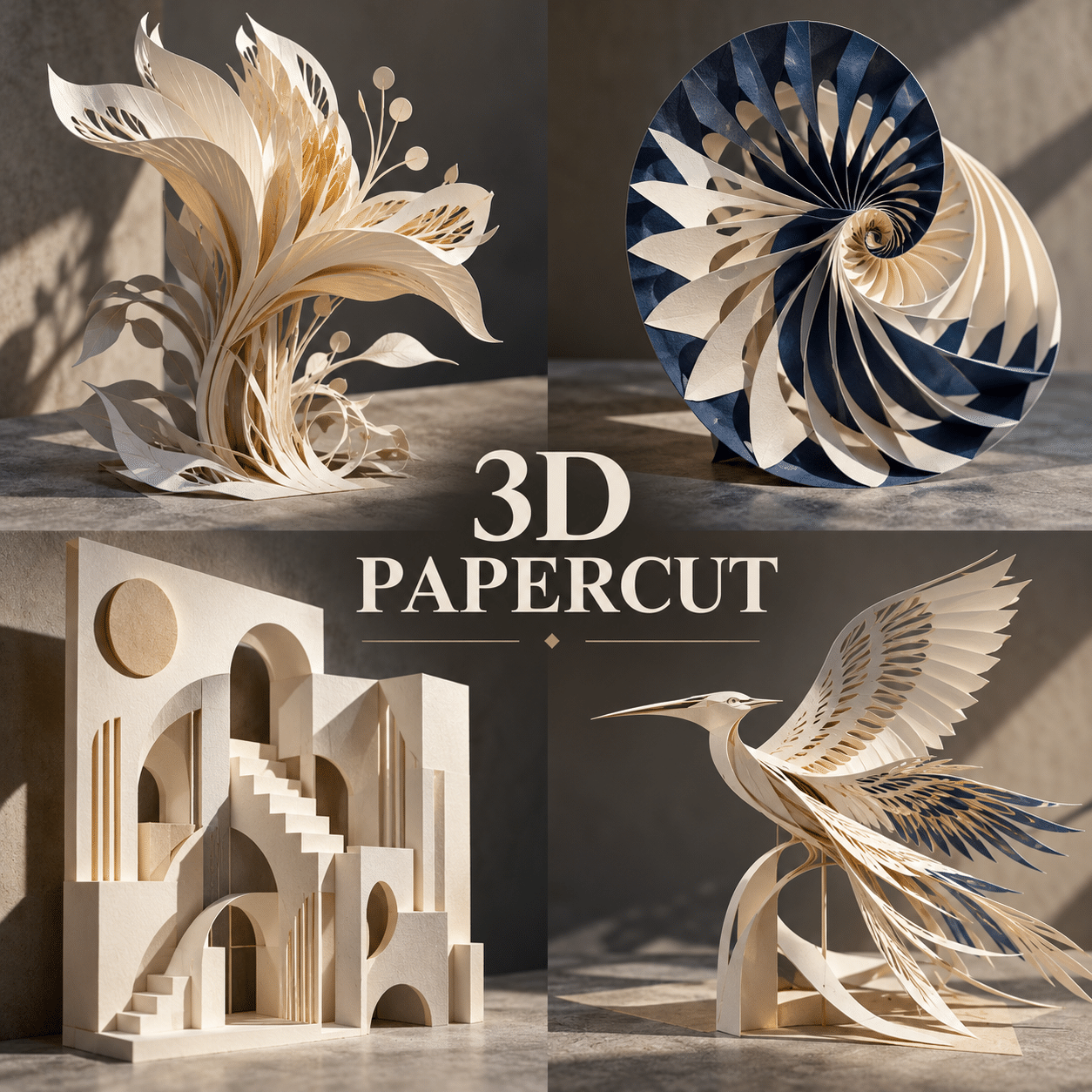
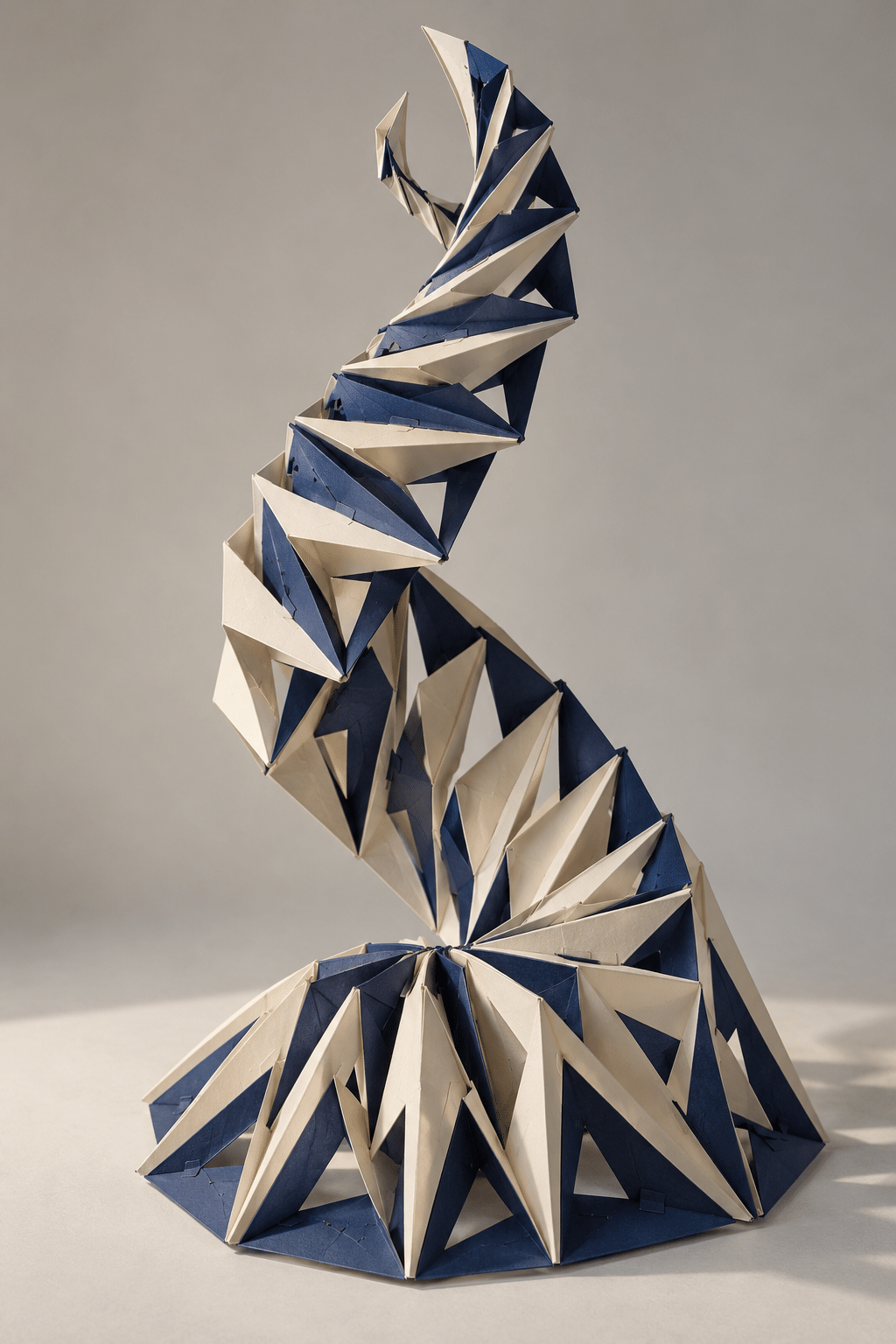
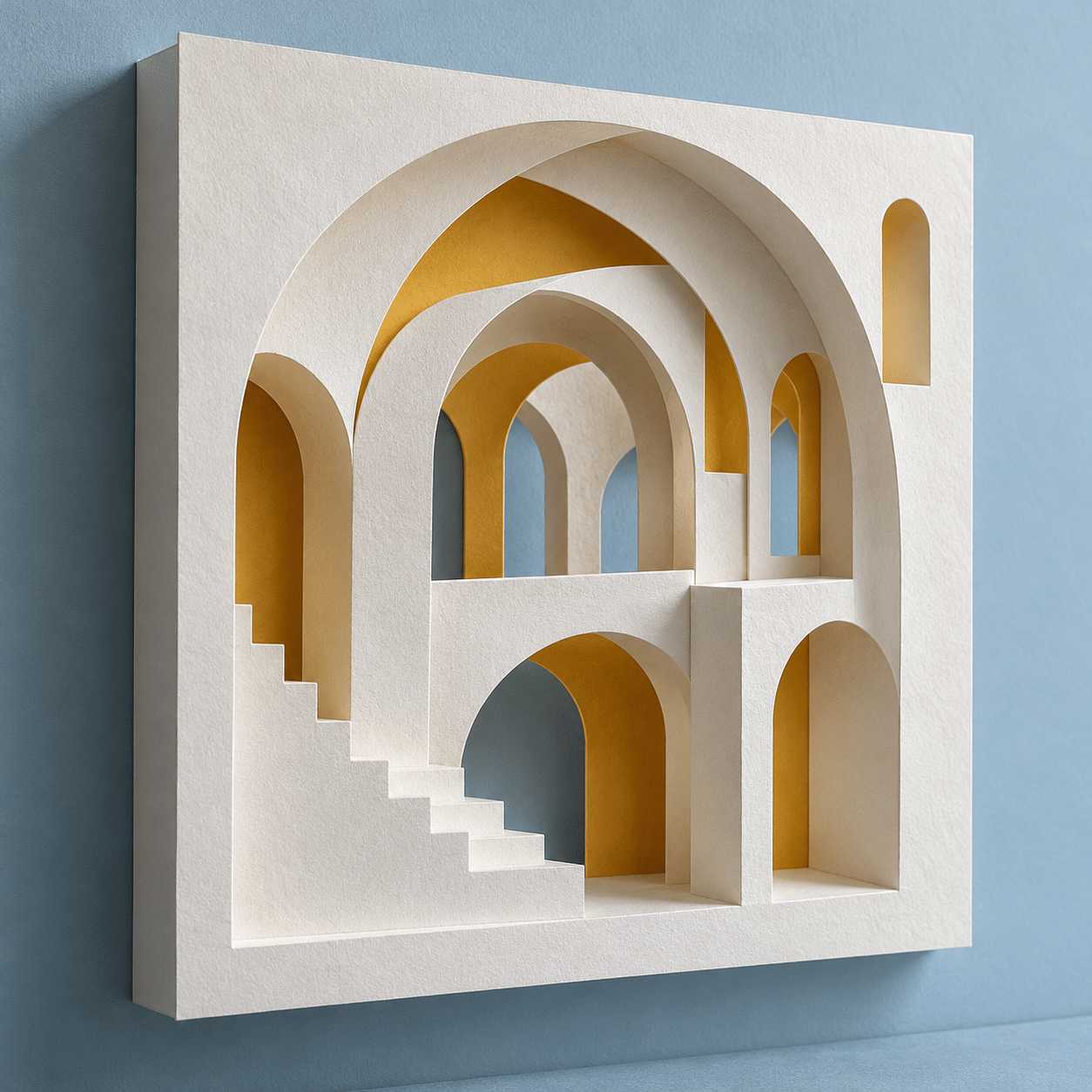
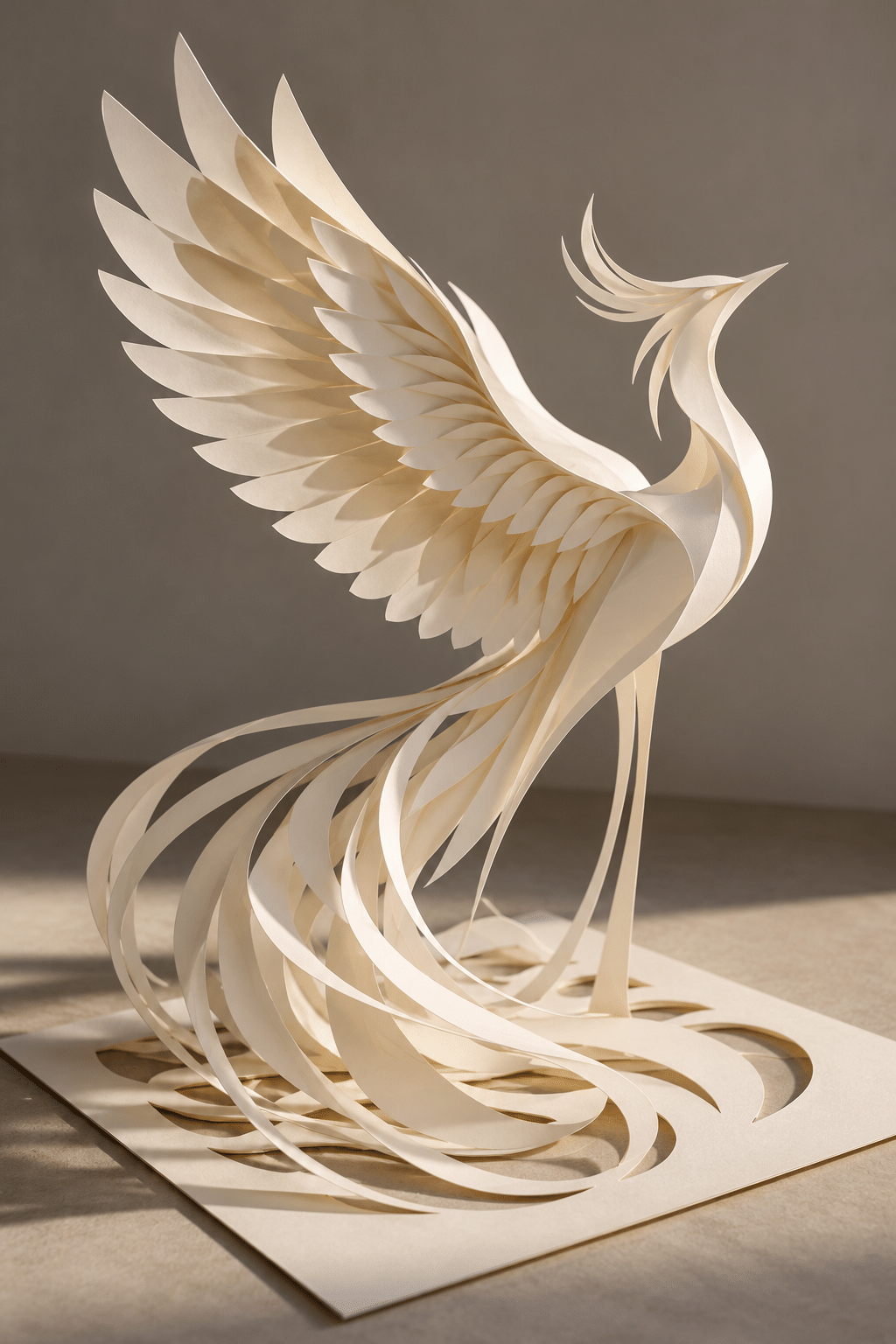
Original AI-generated interpretations of paper construction. These images are visual studies, not photographs of handmade objects or tested cutting templates.
Select an image for a closer look. Use the thumbnails, arrow keys or a swipe to compare examples. Zoom in to inspect details, or share the image that inspires you.
Creative toolbox · take this style further
Choose an input and a destination. Search sends your words to the chosen site; Copy & open puts them on your clipboard to paste there.
Create with AI
Turn your chosen input into an image prompt or a new creative direction.
ChatGPT
Copy your input and paste it into a ChatGPT conversation or image request.
Copy & open ChatGPT (new tab)Claude · Anthropic
Develop an image prompt or explore the style in a new Claude conversation.
Copy & open Claude · Anthropic (new tab)Midjourney
Paste your input into the Imagine bar on the Create page.
Copy & open Midjourney (new tab)Adobe Firefly
Copy your input, open Firefly, and paste it into the prompt field.
Copy & open Adobe Firefly (new tab)Leonardo.Ai
Copy your input, open Leonardo, and paste it into the generation field.
Copy & open Leonardo.Ai (new tab)Image search
Find visual references. Short, concrete keywords usually work best.
Lexica
Search AI images and prompts using your selected input.
Search with this input Lexica (new tab)Pexels
Search the photo and video library. Short keywords often work best.
Search with this input Pexels (new tab)Pixabay
Search photos, illustrations and other images.
Search with this input Pixabay (new tab)Unsplash
Search photographs using the style name or your own keywords.
Search with this input Unsplash (new tab)Wikimedia Commons
Search photographs, artworks and historical images. Check each file for its source and reuse terms.
Search with this input Wikimedia Commons (new tab)Art & research
Explore artists, collections and the ideas behind a style.
Wikipedia
Search for background reading. A style may not have its own article.
Search with this input Wikipedia (new tab)WikiArt
Copy your input into WikiArt’s search to explore artists and artworks.
Copy & open WikiArt (new tab)Europeana
Paste your keywords into the search to explore European museum, library and archive collections.
Copy & open Europeana (new tab)Inspiration
Discover portfolios and visual ideas from creative communities.
Instagram hashtags
Search a hashtag made from your input: spaces and punctuation are removed. Instagram may require sign-in.
Search with this input Instagram hashtags (new tab)ArtStation
Paste your input into artwork search for concept art, environments, characters and visual development.
Copy & open ArtStation (new tab)Behance
Paste your input into project search for illustration, design and visual storytelling.
Copy & open Behance (new tab)A closer look
Thin edges, folded planes, curled strips, visible cutouts and cast shadows reveal a structure made from paper rather than a solid object merely textured to resemble it.
The sheet and the space it creates
A cut can release a flap, separate a silhouette or open a route through a surface. A fold then changes the direction of a plane; a curve turns a strip into a volume; an assembly joins several pieces into a larger structure. The resulting work may be abstract, architectural, botanical or figurative. The category describes a family of processes rather than one visual formula.
Peter Callesen’s own archive offers a clear contemporary reference. His A4 papercuts include works made from paper and glue, and the accompanying artist-site essay discusses relationships between raised forms and the negative spaces left in the sheet. This is one artist’s particular approach, not a requirement that all 3D papercut use one sheet or reproduce his subjects.
Decide whether the negative space matters
When a form rises from its original sheet, the remaining opening can become part of the composition. It may echo the object, reveal its origin or create a second image. Plan the positive form and the void together. An elegant sculpture above a visually confused base may lose the relationship that made the transformation interesting.
A work assembled from separate pieces has different possibilities. It can repeat a module, build a shell or join contrasting colors. There is no need to pretend it came from a single sheet. Clear construction logic is more valuable than an unsupported claim of technical virtuosity. Let joints, folds or repeated tabs contribute to the rhythm when appropriate.
Volume needs structure
Begin with a broad shape that can support itself. Curves, folded ribs and triangulated planes can stiffen a thin material, while long unsupported strips can sag. The exact behavior depends on paper, grain, moisture and scale. A physical model is the practical way to test those relationships; an image alone cannot certify them.
Think about the center of gravity and the connection to the base. A tall flower, tower or abstract spiral should have a plausible path through which its weight reaches support. For an exploratory artwork, a visible prop may be preferable to hiding an impossible connection. Structural decisions can become part of the subject rather than an afterthought.
Light describes the material
White paper offers a wide range of tones through orientation and shadow. A plane facing the light may nearly merge with the background while a turned edge becomes a dark accent. Use a background that preserves important silhouettes without overwhelming delicate details. Soft side light often reveals both thickness and curvature.
Colored paper can emphasise separate modules or the transition from outer surface to interior. Keep the palette related to the structure. A contrasting underside can reveal a fold; a gradual sequence can describe rotation. Random color changes may conceal the very construction the viewer needs to understand.
A sculpture, a relief or a layered scene?
Freestanding work invites several viewpoints. A relief remains attached to a backing and projects outward. A papercut diorama usually arranges a scene through parallel layers and a preferred viewing direction. These formats overlap, but selecting one clarifies where to spend effort. A sculpture needs a considered back and side, whereas a staged diorama may deliberately conceal them.
Photographing or rendering the work adds another choice. A frontal image can describe the outline; an oblique view can reveal depth and the cut base. Include enough surrounding space for the shadow to register. Avoid an extreme perspective that makes a modest paper form appear monumental unless that change of scale is the intended subject.
Use generated studies as proposals
The illustrations on this page are AI-generated interpretations of cut-paper construction. They can help explore silhouette, light and spatial rhythm. They are not records of completed objects, and they do not demonstrate that a single sheet could produce every visible part. That distinction is particularly important when a design appears technically intricate.
To develop a study, reduce it to a few connected planes and test them with inexpensive paper. Revise one feature at a time: the width of a support, the angle of a fold or the size of an opening. A less intricate structure with clear material behavior can be more persuasive than an elaborate rendering whose parts cannot connect.
A small poetic detour
Original words from the AOI studio.
Poetry
The Sheet Stands Up
A fold remembers where it lay,
a cut admits the air.
The little wall has left a door
inside the page it used to share.
Its shadow travels farther still:
a second shape the light will fill.
The prompt workshop
Original creative exercises. These prompts create new illustrations, not documentary evidence.
A form rises
Create an original white-paper sculpture of a small abstract botanical form rising from a visibly cut sheet. Thin edges, plausible folded supports, meaningful negative space in the base and soft side lighting; no text.
A spatial rhythm
Create an original freestanding papercut sculpture made of repeated cream and indigo folded modules, an open spiral with clear joints and a stable base, photographed at an oblique angle with a soft cast shadow.
Inside and outside
Create an original cut-paper architectural relief with nested arches and a contrasting warm underside visible through folds. Emphasise sheet thickness, voids and connected supports; no stone-like slabs, no lettering.
A smile from the studio
Jokes
The sculpture began as a flat plan. It became three-dimensional when the paper raised an objection.