
Artist study · Narrative illustration
A guide to Norman Rockwell’s narrative illustration: a precisely chosen moment, expressive faces and hands, and ordinary objects that reveal a larger story. The new gallery offers independent AI-generated studies, not paintings by Rockwell.
A visual introduction
Open any image to look closer, then browse the examples.
Creative toolbox · take this style further
Choose an input, adjust it, then open a tool. Search links pass your text to the destination. Copy & open copies it for you to paste into the generator; you start generation there.
ChatGPT
Copy your input and paste it into a ChatGPT conversation or image request.
Copy & open ChatGPT (new tab)Claude · Anthropic
Develop an image prompt or explore the style in a new Claude conversation.
Copy & open Claude · Anthropic (new tab)Midjourney
Paste your input into the Imagine bar on the Create page.
Copy & open Midjourney (new tab)Adobe Firefly
Copy your input, open Firefly, and paste it into the prompt field.
Copy & open Adobe Firefly (new tab)Leonardo.Ai
Copy your input, open Leonardo, and paste it into the generation field.
Copy & open Leonardo.Ai (new tab)Lexica
Search AI images and prompts using your selected input.
Search with this input Lexica (new tab)Pexels
Search the photo and video library. Short keywords often work best.
Search with this input Pexels (new tab)Pixabay
Search photos, illustrations and other images.
Search with this input Pixabay (new tab)Unsplash
Search photographs using the style name or your own keywords.
Search with this input Unsplash (new tab)Wikipedia
Search for background reading. A style may not have its own article.
Search with this input Wikipedia (new tab)WikiArt
Copy your input into WikiArt’s search to explore artists and artworks.
Copy & open WikiArt (new tab)Instagram hashtags
Search a hashtag made from your input: spaces and punctuation are removed. Instagram may require sign-in.
Search with this input Instagram hashtags (new tab)A closer look
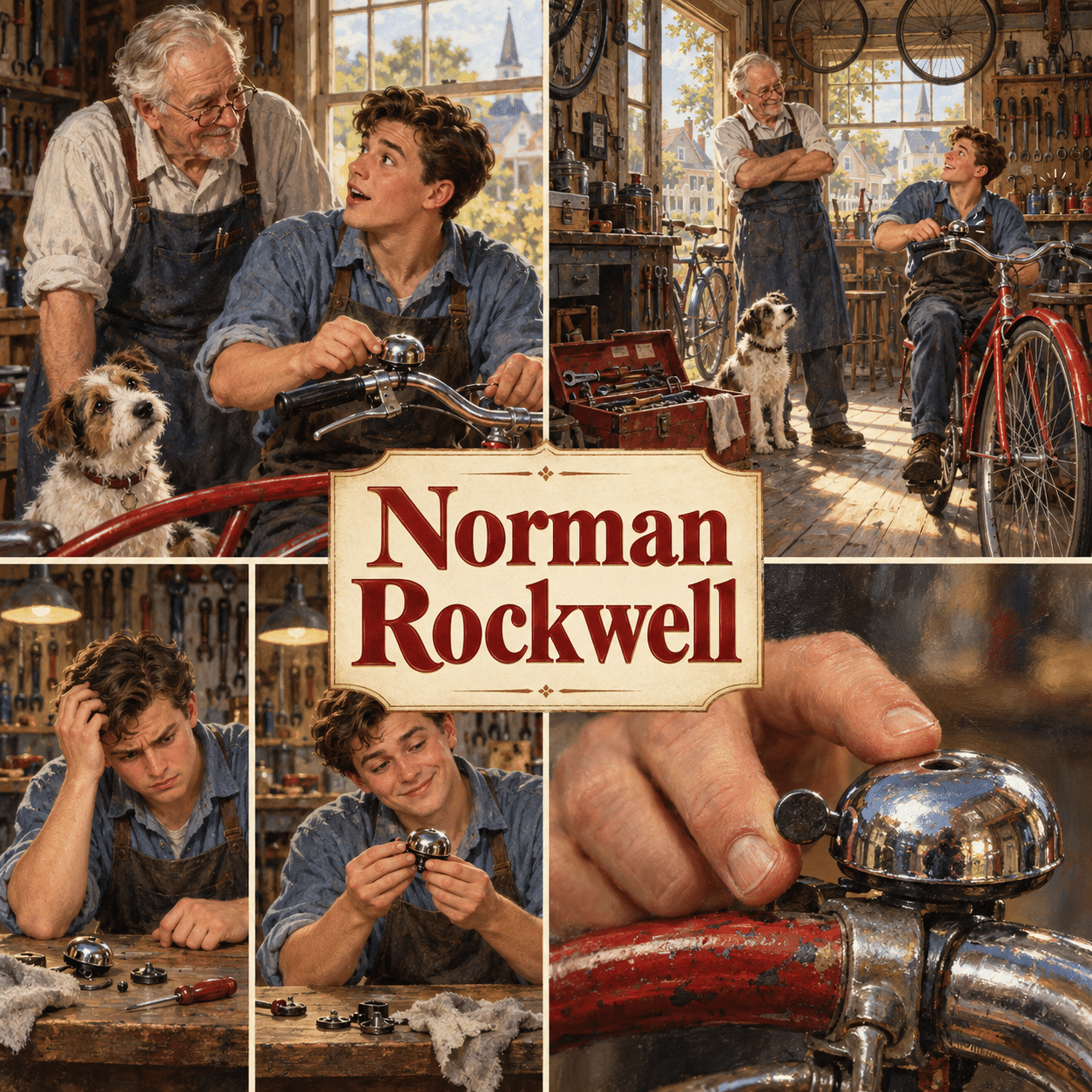
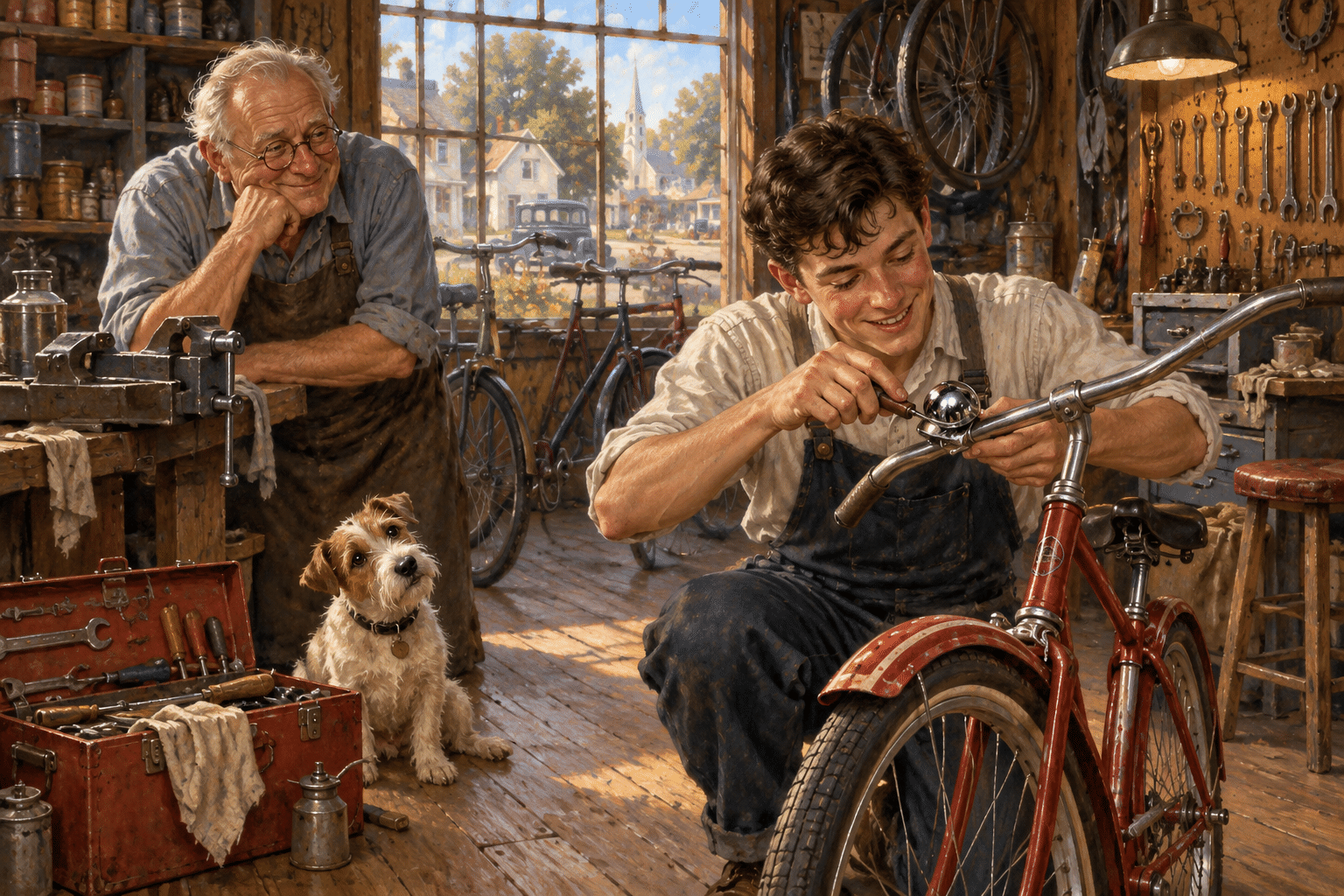
An original narrative oil illustration inspired by Norman Rockwell: inside a modest neighborhood bicycle repair shop, an elderly mechanic with rolled-up sleeves and round spectacles watches with amused pride as an earnest young adult apprentice triumphantly fits a bicycle bell, while a curious small terrier tilts its head beside a neatly arranged toolbox; natural expressive faces, believable hands, warm window light, worn timber floor, a restrained red bicycle accent and carefully observed everyday details.
Understand the subject
Norman Rockwell is an artist, not the name of a separate art movement. The National Museum of American Illustration emphasizes his ability to choose the moment that makes a story readable in one picture. A glance, a prop, and the distance between two people can imply what has just happened and what might happen next. This guide uses that narrative principle as a starting point for original image-making, while keeping the artist’s own work separate from newly generated interpretations.
Build its visual language
Begin with an action specific enough to describe in one sentence. An apprentice testing a repaired bicycle bell gives the hands, tools, and onlookers a purpose. Decide who knows what: the apprentice may be proud, the mechanic amused, and the dog surprised. Their reactions should differ. Let the eye travel from the key object to a face and then to a secondary response. Background objects should deepen the story instead of filling every available space with antique decoration.
Compose a convincing scene
Careful observation matters more than an all-over sepia tone. Separate materials through paint: the soft sleeve, polished bell, scuffed wooden floor, and coarse apron should feel different. Use light to clarify the central gesture, and keep the most expressive hands and faces readable. A limited warm palette can hold the scene together, but a small contrasting accent often does more work than an entire room of bright colors. Humor can emerge through timing and an affectionate mismatch of expectations.
Context and original interpretation
Rockwell’s subjects should not be reduced to reassuring nostalgia. The Norman Rockwell Museum identifies The Problem We All Live With as a 1964 illustration for Look addressing school desegregation. That context matters when discussing the breadth of his work. The playful workshop scene on this page is a new compositional exercise, not a summary of his career or a substitute for viewing documented originals. The poem and jokes are new AOI additions, not quotations or statements attributed to the artist.
Technique notes
Warm, carefully observed mid-century American narrative oil illustration in the style of Norman Rockwell, convincing anatomy and individual expressions, subtle visible paint handling, a clear human story rather than a generic nostalgic filter; original composition, no existing painting copied.
Establish the large composition before adding small detail.
Keep scale, light direction and the chosen visual technique consistent throughout the image.
A small poetic detour
Original words from the AOI studio.
Poetry
A little bell, a lifted brow,
a patient hand that shows us how.
The smallest triumph fills the room;
a story flowers beside the broom.
The prompt workshop
Original creative exercises. These prompts create new illustrations, not documentary evidence.
Start with one scene
Norman Rockwell: a bicycle mechanic and an adult apprentice exchanging a surprised look over a newly repaired bell. Warm, carefully observed mid-century American narrative oil illustration in the style of Norman Rockwell, convincing anatomy and individual expressions, subtle visible paint handling, a clear human story rather than a generic nostalgic filter; original composition, no existing painting copied. Deliberate composition, clear focal point, no labels, logo, watermark or interface.
Build a richer world
Norman Rockwell: a neighborhood repair shop with three distinct reactions to one tiny mechanical success, believable hands and carefully chosen props. Warm, carefully observed mid-century American narrative oil illustration in the style of Norman Rockwell, convincing anatomy and individual expressions, subtle visible paint handling, a clear human story rather than a generic nostalgic filter; original composition, no existing painting copied. Deliberate composition, clear focal point, no labels, logo, watermark or interface.
Try a variation
Norman Rockwell: a quiet narrative diptych showing the same adult apprentice before and after solving a small problem, with expressions carrying the change. Warm, carefully observed mid-century American narrative oil illustration in the style of Norman Rockwell, convincing anatomy and individual expressions, subtle visible paint handling, a clear human story rather than a generic nostalgic filter; original composition, no existing painting copied. Deliberate composition, clear focal point, no labels, logo, watermark or interface.
Your next inspiration
Discover another art style
Follow a visual thread to the next subject.
A smile from the studio
Jokes
The bicycle mechanic asked for a character reference. The portrait supplied three excellent expressions.
The painting tried to tell a short story. The dog insisted on a subplot.
I added one meaningful prop. By lunchtime it had hired a supporting cast.